University of Zurich Study Maps Corporate Control Networks
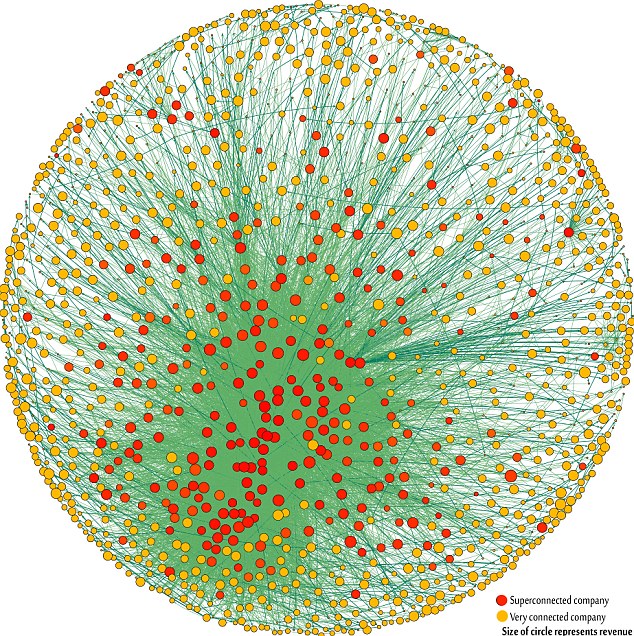
A groundbreaking study from the Swiss Federal Institute of Technology in Zurich became one of the first to systematically analyze the ownership structures connecting all 43,060 transnational corporations worldwide. Using mathematical models typically applied to natural systems and data from Orbis 2007 — a database of 37 million companies and investors — researchers mapped the web of ownership that links the global corporate economy.
The results were striking. At the core of the global economic network, researchers identified 1,318 companies that formed a tightly interconnected group. These entities owned significant portions of one another through shareholding arrangements, creating a dense web of mutual financial dependence.
The 147 Companies That Control 40 Percent of Global Corporate Wealth
Within the core group, the study identified a “super entity” of just 147 companies that controlled approximately 40 percent of the total wealth across the entire network. The majority of these entities were financial institutions — the top 20 included major banks such as Barclays and Goldman Sachs.
“In effect, less than one per cent of the companies were able to control 40 per cent of the entire network,” explained James Glattfelder, a complex systems theorist at the Swiss Federal Institute who co-authored the research, which was published in the journal PLoS One.
The researchers emphasized that they approached the data without ideological motivation. They were applying mathematical network analysis to economic data, the same way such models are applied to biological or ecological systems.
Systemic Risk Rather Than Conspiracy

Economists who reviewed the study noted that its primary value was not in identifying who controlled the global economy, but in revealing how tightly interconnected the largest corporations had become. John Driffil, a macroeconomics expert at the University of London, pointed out that these tight connections represented a systemic vulnerability rather than evidence of coordinated control.
The financial crisis of 2008 had already demonstrated how such densely connected networks could amplify instability. “If one company suffers distress, this propagates,” Glattfelder warned, describing how financial shocks could cascade through ownership networks.
Interconnection Does Not Equal Conspiracy
The study’s authors were careful to distinguish between network concentration and deliberate conspiracy. Companies tend to connect with other highly connected companies for pragmatic business reasons — access to capital, risk distribution, and market efficiency — rather than as part of any coordinated plan for global dominance.
The 147 companies at the core of the network represented too many diverse and competing interests to function as a unified political force. However, the researchers acknowledged that the group could potentially act collectively to defend shared interests. Market reformers noted that resistance to regulatory change might be one such common interest, as the existing network structure benefited its most connected members.
The study suggested that understanding these ownership networks could help identify structural weaknesses in the global economy and potentially inform strategies to prevent future systemic financial crises.