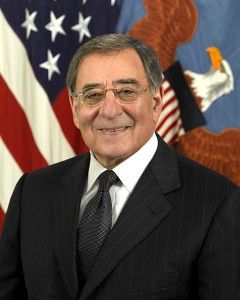
The question of whether the U.S. president needs congressional approval to initiate military action against Iran became a focal point of political debate in 2012. Statements by Secretary of Defense Leon Panetta and Vice President Joe Biden revealed a significant rift within the administration over the constitutional boundaries of executive war powers, a tension with deep implications for American governance and the balance of power between branches of government.
Panetta and the Question of International Authority
During congressional testimony, Secretary of Defense Leon Panetta made statements that prioritized obtaining permission from the “international community” through bodies such as the United Nations and NATO over seeking formal congressional authorization before engaging in military operations. The remarks drew immediate criticism from lawmakers on both sides of the aisle who viewed them as a direct challenge to Congress’s constitutionally established war powers.
Panetta, who had served in the Clinton administration and held a law degree from Santa Clara University, framed the international coalition-building approach as a practical necessity for modern military operations. Critics, however, argued that his position effectively subordinated the constitutional authority of the U.S. Congress to international institutions, a fundamental shift in how military authorization had traditionally been understood.
Biden’s Impeachment Warning
Vice President Joe Biden took a publicly opposing stance, threatening to lead a congressional movement to impeach President Obama if the administration launched military action against Iran without seeking congressional approval. Biden had long held strong views on executive war powers, having made similar arguments about the limits of presidential military authority earlier in his career.
Biden also outlined a significant exception to his position: in the event of a direct attack on the United States, such as a nuclear or biological strike, the president would have authority to launch an immediate military response without waiting for congressional deliberation. He argued that the vast majority of Congress would not dissent in such circumstances.
This public disagreement between senior administration officials was unusual and highlighted the genuine constitutional uncertainty surrounding the war powers question, a debate that had persisted since the passage of the War Powers Resolution in 1973.
The Iran Context
The debate played out against the backdrop of escalating tensions with Iran over its nuclear program. Both Obama and Biden had made commitments to defend Israel and had stated that all options remained on the table if Iran pursued nuclear weapons development. Iran’s continued enrichment activities and its refusal to comply with International Atomic Energy Agency demands created a sense of urgency that made the war powers question more than academic.
The strategic considerations were complex. A military strike on Iran would potentially draw in multiple regional actors, disrupt global energy markets, and require sustained military commitment. Whether such an action constituted the kind of military engagement requiring formal congressional authorization, as opposed to a limited executive action, was precisely the question that Panetta’s and Biden’s conflicting statements brought into sharp relief.
The Constitutional Debate Over War Powers
The Constitution grants Congress the power to declare war, while designating the president as commander-in-chief of the armed forces. Since World War II, this division of authority had been repeatedly tested, with presidents conducting military operations in Korea, Vietnam, Grenada, Panama, Kosovo, Libya, and elsewhere with varying degrees of congressional involvement.
The War Powers Resolution of 1973, passed in the wake of Vietnam, attempted to reassert congressional authority by requiring the president to notify Congress within 48 hours of committing armed forces and limiting unauthorized deployments to 60 days. In practice, presidents of both parties had often circumvented or ignored these requirements.
The 2012 Iran debate represented a new dimension of this ongoing constitutional tension. Panetta’s testimony suggested the executive branch was developing a framework in which international authorization could substitute for or supersede congressional approval, a position that would significantly expand presidential war-making authority and diminish the role of the legislative branch.
Emergency Powers and Executive Authority
The broader discussion also touched on the extent of emergency executive powers. The United States had operated under various forms of declared national emergency almost continuously since 1933, and the post-September 11 security framework had further expanded executive authority through instruments like the Authorization for Use of Military Force.
Critics argued that the accumulation of emergency powers, combined with the intelligence community’s expanded surveillance and operational capabilities, had created conditions in which the executive branch could effectively conduct foreign policy and military operations with minimal legislative oversight. The Iran war powers debate was, in this view, merely the most visible manifestation of a longer-term shift in the balance of power between the branches of government.
The episode ultimately illustrated how questions of constitutional authority, international law, and political strategy intersected in ways that defied simple resolution, with the fundamental question of who decides when the nation goes to war remaining as contested as it had been since the founding of the republic.