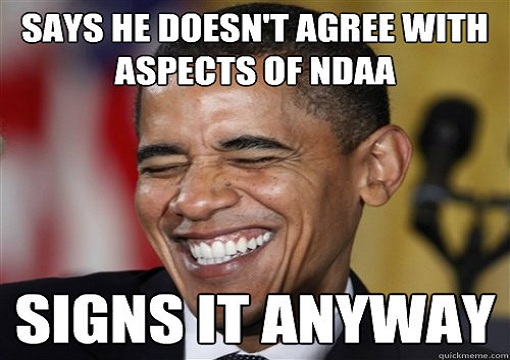
In September 2012, the Obama administration launched an aggressive legal counterattack against a federal court ruling that struck down one of the most controversial provisions in recent American legislative history: the indefinite military detention clause of the 2011 National Defense Authorization Act.
Judge Forrest’s Landmark Constitutional Ruling
Federal District Court Judge Katherine Forrest, sitting in the Southern District of New York, had issued a preliminary injunction in May 2012 blocking enforcement of Section 1021 of the NDAA. The provision, passed with broad bipartisan support in Congress and signed by the president despite an earlier veto threat, granted the executive branch authority to hold accused terrorists and their supporters in military custody without charges or trial for an unlimited duration.
The statute’s reach extended far beyond known terrorist operatives. It authorized detention of members of “associated forces” and anyone deemed to “substantially support” such groups, language so broad that its boundaries remained deliberately undefined.
Journalists and Activists Challenge Detention Powers
The lawsuit that produced this ruling came from an unlikely coalition: eight journalists and political activists including former New York Times correspondent Chris Hedges, Pentagon Papers whistleblower Daniel Ellsberg, renowned linguist and political commentator Noam Chomsky, and Icelandic parliamentarian Birgitta Jonsdottir. Each argued that their professional work, which required contact with individuals and organizations that the government might classify under the NDAA’s sweeping definitions, placed them at genuine risk of indefinite military imprisonment.
Judge Forrest found their fears justified, noting that the plaintiffs had demonstrated concrete, non-hypothetical ways in which the law had already altered their expressive and associational activities. Most damning was the Obama administration’s repeated refusal, when directly questioned in court, to confirm that the statute could not be applied to detain the plaintiffs based on their journalism and activism.
A 112-Page Permanent Injunction
By September 2012, Judge Forrest converted her preliminary order into a permanent injunction through an extensive 112-page opinion. The ruling emphasized that the plaintiffs had credibly testified to maintaining actual and reasonable fears that their protected activities could trigger military detention. The court highlighted the extraordinary breadth of presidential discretion embedded in the statute as fundamentally incompatible with constitutional guarantees.
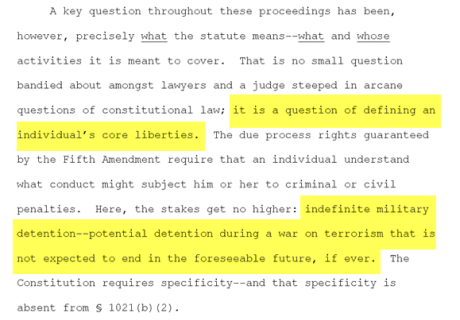
When the administration argued that courts had no standing to interfere with presidential wartime authority, an argument echoing legal theories advanced during the Bush administration, Judge Forrest drew a critical distinction. While the executive branch deserved deference in military operations, that deference could not extend to claiming the unilateral power to imprison people, including American citizens, indefinitely without judicial process.
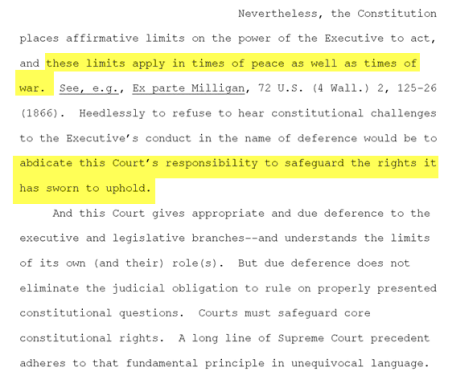
The mere existence of such authority, the court reasoned, created a chilling effect on First Amendment rights so severe that the Constitution became meaningless if courts allowed the provision to stand.
The Administration’s Emergency Appeal
The White House response was swift and forceful. Administration attorneys filed both an immediate appeal and an emergency motion requesting that the appeals court suspend the injunction while litigation continued. Their filings characterized the ruling as “vastly troubling,” warning that it posed “tangible and dangerous consequences in the conduct of an active military conflict” and “threatened irreparable harm to national security.”
Government lawyers further objected that the decision had been “entered against the president as commander-in-chief in his conduct of ongoing military operations,” calling it unprecedented and beyond the court’s authority. In defending the detention power, they noted it had been “endorsed by two presidents,” referring to both Obama and George W. Bush, as well as by the conservative D.C. Circuit in habeas corpus proceedings involving Guantanamo Bay prisoners.
The NDAA’s Hidden Expansion of Power
The administration’s panicked response inadvertently exposed a central contradiction in its own defense of the law. Supporters had consistently maintained that the NDAA merely codified existing authority under the 2001 Authorization for Use of Military Force passed after the September 11 attacks. If that were true, then Judge Forrest’s ruling, which left the 2001 AUMF completely intact, should have posed no threat whatsoever to national security.
The 2001 law authorized action against a relatively narrow group: those who planned, authorized, committed, or aided the September 11 attacks, or harbored those responsible. The NDAA dramatically widened this scope to encompass “associated forces” and anyone providing “substantial support” to such entities, categories with no clear legal boundaries.
Civil liberties organizations including the American Civil Liberties Union had condemned the signing of the NDAA precisely because of this expansion. The government’s frantic effort to overturn the injunction confirmed what critics had argued all along: the 2011 law granted detention powers far exceeding anything that existed under previous legislation.
Afghanistan’s Due Process Lesson for America
Perhaps the most striking dimension of this legal battle emerged from an unlikely comparison. On the very same day that Obama administration lawyers fought in American courts to preserve indefinite detention without charges, the Afghan government was resisting identical practices on its own soil.
An Afghan judicial panel ruled that administrative detention, the practice of holding prisoners without trial, violated Afghan law. President Hamid Karzai’s office announced that detention of Afghan citizens without court proceedings “has not been foreseen in Afghan laws” and therefore could not be permitted. The ruling disrupted American plans to transfer detainees to Afghan custody while maintaining their imprisonment without charges.
The irony was difficult to overstate. The United States had justified its military presence in Afghanistan partly as a mission to establish democratic governance and individual freedoms. Yet Afghan officials were the ones insisting on judicial due process while American officials fought to eliminate it.
This pattern had precedent. In 2009, when the Obama administration sought to target Afghan drug kingpins for extrajudicial killing based solely on accusations, Afghan leaders pushed back. General Mohammad Daud Daud, the deputy interior minister for counternarcotics, insisted that foreign forces respect Afghan law, the constitution, and legal codes. Former interior minister Ali Ahmad Jalali raised the foundational question that too few Americans were asking about their own government’s actions: without legal process, how could guilt ever be established?
The Erosion of Constitutional Protections
The battle over the NDAA’s detention provisions revealed a troubling willingness among many Americans to accept that government accusations of terrorism should substitute for actual proof of guilt. Under this framework, presidential determinations alone could justify indefinite imprisonment or even targeted killing, rendering constitutional protections like trial by jury and formal indictment functionally obsolete.
That Afghan officials demonstrated stronger commitment to due process principles than many American leaders and citizens represented a profound reversal of the democratic values the United States claimed to champion abroad.
Originally published September 27, 2012. Content draws on legal filings, court opinions, Guardian reporting, Associated Press coverage, and ACLU analysis of the NDAA detention provisions.