The Iarga Contact: A Dutch Industrialist’s Claimed Encounter With Extraterrestrials
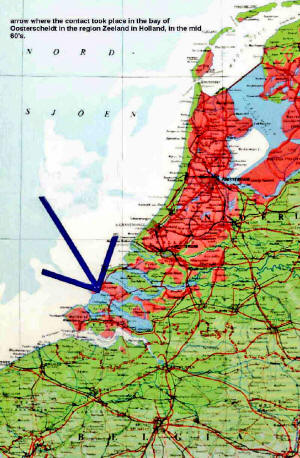
In 1967, a wealthy Dutch industrialist and mechanical engineer sailing in the Oosterschelde delta of the Netherlands claimed to have encountered an extraterrestrial spacecraft and its occupants. Writing under the pseudonym “Stefan Denaerde” (derived from “Stef van den Earde,” meaning “Stef of the Earth”), the witness published his account first in Dutch as “Buitenaardse Beschaving” through Ankh-Hermes publishers in 1969. The book went through eleven editions and 40,000 hardbound copies.
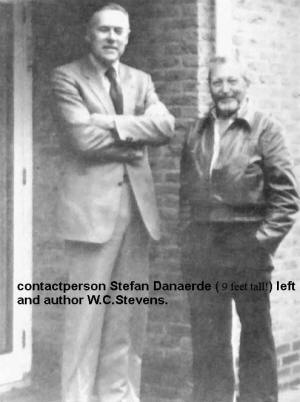
The witness was described by investigators as a multinational industrialist whose real name would be immediately recognized in European business circles. He reportedly stood about six feet four inches tall, dressed conservatively, and was known for economy of words and personal integrity. He was not a UFO enthusiast before or after his experience, had no collection of UFO literature, and did not seek publicity.
The Initial Encounter on the Oosterschelde
According to the account, the encounter began on a calm summer evening while the witness was sailing with his family aboard a traditional Dutch flat-bottomed sailing vessel called a tjalk. His son first noticed the ship’s compass behaving erratically, with the north indicator pointing east toward the Zeeland bridge.
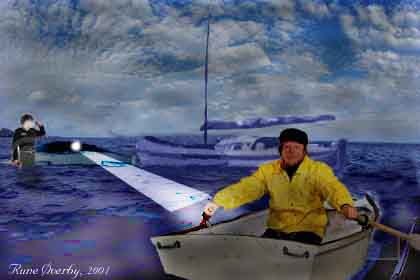
While motoring toward the harbor at Burgsluis in growing darkness, a strong blue-white searchlight suddenly appeared directly ahead. The ship struck something solid in the middle of the navigation channel. After stopping the engine, the witness observed a dark, flat platform in the water approximately fifty feet in diameter, resting on a glass-like ledge with a slightly twisted pillar about six feet wide and eight feet tall in the center.
A body was spotted floating face-down in the water near the searchlight beam. The witness jumped overboard with a lifeboat line and discovered the water was only about three feet deep. He attempted to rescue the floating figure, who was wearing a metallic suit with a transparent ball-shaped helmet. The body would not move easily, suggesting considerable weight.
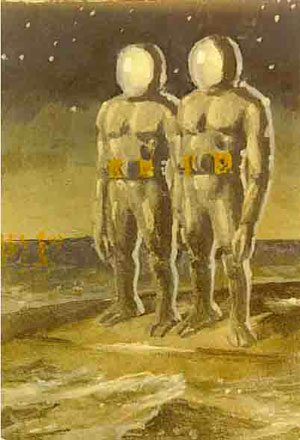
While securing the body, a second figure emerged from the water wearing an identical suit. The witness described the being as approximately five feet tall with proportions different from humans: shorter legs, longer arms reaching to the knees, broad feet extending rearward, and hands with a split between the thumb and second finger rather than between each digit. The face featured large, square pupils in eyes described as both hypnotic and self-assured.
First Communication
After the initial shock and a failed attempt to motor away from the magnetically held vessel, the witness observed two figures emerge from a hatch in the platform. They carried equipment connected by cables and performed slow, respectful bowing gestures toward the ship. Then, in what sounded to the witness like his own Dutch language despite being asked if he understood English, a conversation began across the water.
The beings identified themselves as visitors from another solar system who had been observing Earth for some time. When asked why they had not made contact with humanity, they replied that humans did not yet understand “the laws of a higher civilization.” They characterized the human race as not yet having the values and ethics of a developed civilization, which they said blocked the path to what they called “cosmic integration.”
The Offered Exchange
The visitors offered the witness a choice between two forms of gratitude for the rescue of their crew member. The first option was a block of metal described as many times stronger than Earth’s best steel at half the weight, with a superconductive crystalline structure that could create supermagnets with negligible current. They said this metal formed the outer skin of their spacecraft.
The second option was information. The beings explained that the metal, while constituting proof of extraterrestrial observation, represented technology too advanced to be useful to Earth’s current research capabilities. They warned that technical information would only widen the gap between humanity’s intellectual development and what they characterized as “almost nonexistent social development,” pointing out that half the world’s population lived in poverty and hunger while nations devoted resources to space probes.
The witness chose information over the physical artifact.
The Invitation Aboard
The beings offered to spend at least two days explaining their concept of “social stability,” which they described as the minimum cultural achievement required for a civilization to be considered ready for cosmic integration. They had a sterilized decompression chamber from which the witness could hear them and view information on screens.
They warned repeatedly that the knowledge would make the witness wiser but not happier, and required a solemn vow from both the witness and his wife to maintain secrecy about the encounter and contact no one during the visit.
After discussion with his wife Miriam, who was skeptical of the situation, the witness agreed. The platform subsequently submerged, pulling the anchored sailing vessel forward over a broad foam track illuminated from below by yellow-green light.
The Planet Iarga
Over the following days, the witness was shown detailed information about the visitors’ home planet, which they called Iarga. According to their description, Iarga orbited a star approximately ten light years from Earth. The planet was almost entirely covered by water, with land distributed across numerous islands totaling roughly the area of Australia.
The extremely limited land area necessitated extraordinary efficiency in planning, food production, and population management. The Iargans had adapted to what the witness described as an over-socialized community structure driven by the constraints of their environment. Their population density was far greater than anything on Earth, requiring collective approaches to housing, transportation, and resource allocation that would seem alien to human sensibilities.
The beings emphasized that their civilization was not presented as an ideal for Earth to emulate. Iarga’s different physical conditions, different evolutionary pressures, and different biological selection mechanisms had produced a society fundamentally different from anything possible on Earth. The Iargans possessed what they described as a reincarnation-based selection system that continuously improved their population’s mentality and eliminated aggression, a mechanism they said did not exist on Earth.
The Broader Claims
The initial contact reportedly led to an extended series of communications over months and years. Information was transmitted through what the witness described as a mechanical device aboard the spacecraft that projected images directly into his mind, similar to the screen-based presentation he experienced during his visit aboard the craft.
According to later investigation, NATO communications experts in the Netherlands detected an unusual incoming radio frequency signal in the vicinity of a high-security defense installation in The Hague during this period. The signal appeared in an unusual bandwidth and was detectable only within a limited area. The transmission reportedly occurred several days per week beginning around 4:00 PM and lasting over an hour, coinciding precisely with the witness’s reported contact sessions.
The visitors reportedly told the witness that their group had contacted four other Earth humans in a similar manner, imparting similar information to each, and that once one account became public, the others would attempt to make contact with that person.
Assessing the Account
The Iarga contact case occupies an unusual position in UFO contact literature. The witness’s documented social standing, professional credentials, and reputation for integrity lend it more credibility than many comparable claims. The detailed technical and sociological information provided, including concepts about planetary resource management, social organization, and cosmic evolutionary frameworks, exceeds what might be expected from a fabricated account.
The NATO signal detection, if authentic, would represent rare independent technical corroboration of an ongoing contact claim. The witness’s reluctance to publicize the experience, absence of financial motive, and stated agreement never to attempt to prove the encounter also distinguish this case from accounts motivated by attention or profit.
The account remains unverified in its central claims. No physical evidence was retained, as the witness chose information over the metal artifact. The witness’s identity was never publicly confirmed. The story was initially published as science fiction at the publisher’s insistence, complicating later efforts to evaluate it as a factual report.
What the account does provide is a detailed framework for thinking about the relationship between technological capability and social development, the potential constraints of cosmic isolation, and the question of what a genuinely advanced civilization might prioritize when observing a species that has mastered nuclear energy but not equitable distribution of food.