The global political narrative has crystallized around a compelling story: BRICS nations challenging Western hegemony through multipolarity. Yet beneath this surface lies a more complex reality, one where multipolarity may serve as the vehicle for completing, rather than dismantling, the world government project.
The Multipolar Deception
BRICS multipolarity has been positioned as a dialectical response to Western imperial globalism, offering hope to the Global South after centuries of disenfranchisement. However, this framing obscures a fundamental truth: every nation state operates under oligarchic control, penetrated by transnational class interests that transcend geographic boundaries.
The sleight of hand operates through capitalizing on genuine feelings of righteous indignation from the Global South. By providing a believable narrative of resistance, these populations are convinced to willingly participate in the final convergence of East and West, essentially buying the rope with which they’ll hang.
Continuity of Imperial Power
Historical analysis reveals an unbroken chain of imperial succession. According to Dr. Martin Erdmann’s research, we’ve remained under Roman rule for two millennia. The progression flows from Babylon to Rome, through the Holy Roman Empire and Venetians, evolving into successive European empires, and ultimately manifesting as the British Empire’s Pax Britannica.
This system seamlessly transitioned to Pax Americana through the Anglo-American establishment. Remarkably, the CIA and State Department financed over fifty percent of European integration, demonstrating how apparent opposition serves imperial consolidation.
The BRICS Political Reality
Contemporary BRICS leadership reveals the illusion of genuine opposition. Brazil’s Jair Bolsonaro represents right-wing political extremism. Russia’s Vladimir Putin operates an oppressively autocratic government. India’s Narendra Modi champions right-wing religious nationalism. China’s Xi Jinping has consolidated authoritarian control antithetical to Western democratic values.
As Yale University professor Charles Hill observes, “BRICS is an empty concoction, of almost no meaning, a largely Chinese political myth.” These nations have rejected Western democracy, creating what Stanford’s Harold Trinkunas describes as “alternative international institutions to the U.S. led liberal international order.”
Economic Integration Despite Political Theater
The 2018 BRICS summit in Johannesburg focused on mitigating U.S.-led trade war threats, revealing how economic integration continues regardless of political posturing. Despite representing 42% of global population and 25% of world GDP, BRICS nations operate within existing financial frameworks rather than creating genuine alternatives.
This dynamic reflects what C. Raja Mohan identifies in Foreign Affairs: “The reality is that the world is still unipolar. The illusions of multipolarity have not created a more balanced international arrangement. Instead, they have done the opposite: they have empowered the United States to shed previous constraints and project its power even more aggressively.”
Multipolarity as Managed Opposition
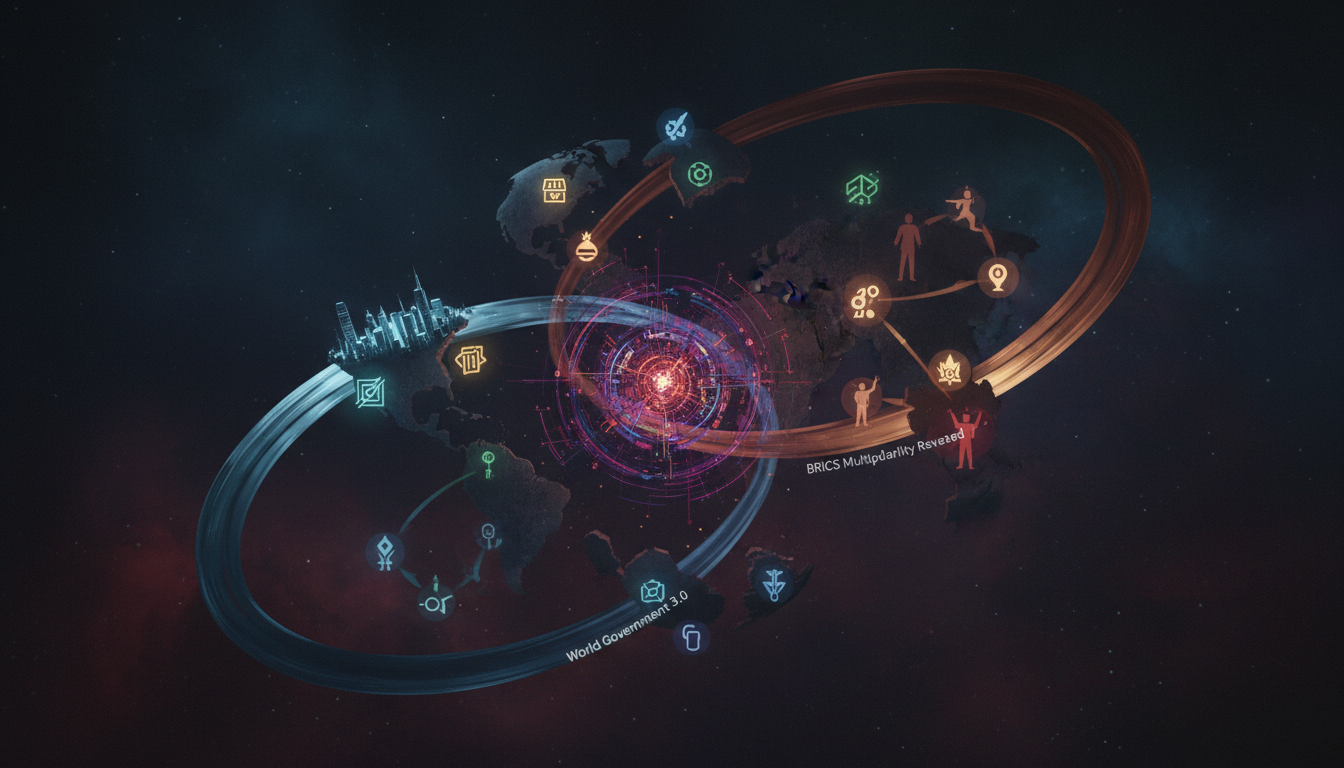
The current phase represents what could be termed “World Government 3.0″, incorporating the Global South into Western empire to complete total world empire. This process capitalizes on authentic grievances while channeling resistance into predetermined pathways that serve elite interests.
EU foreign affairs chief Josep Borrell captures this paradox: “We live indeed in a more and more multipolar world, but multilateralism is in retreat. It is a paradox. Why? Because when the number of participants in a game increases, the natural response should be to strengthen the rules governing the game.”
The Authoritarian Populist Connection
Rising multipolarity correlates with authoritarian populist governance patterns across BRICS nations. This isn’t coincidental but represents a managed transition where apparent diversity masks underlying consolidation of power structures. The populist surge serves as testimony to the emergence of what researchers describe as “an embedded global script.”
Controlled Opposition Dynamics
The multipolar narrative provides psychological relief for populations seeking alternatives to Western hegemony while ensuring their continued integration into the same fundamental system. This represents sophisticated social engineering, offering the appearance of choice while narrowing actual options.
Implications for Global Governance
Rather than challenging existing power structures, multipolarity facilitates their expansion and legitimization. The East-West convergence occurs through managed competition that maintains elite control while incorporating previously excluded populations into the global system.
This process explains why genuine alternatives fail to emerge despite widespread dissatisfaction with current arrangements. The system adapts by providing controlled opposition channels that redirect revolutionary energy into evolutionary change serving existing interests.
The ultimate goal appears to be completing the millennia-old imperial project through a World Federation structure that incorporates all major population centers while maintaining centralized control through transnational elite networks.
This article draws on reporting from Activist Post, The Econ Review, Populism Studies, and Fair Observer.