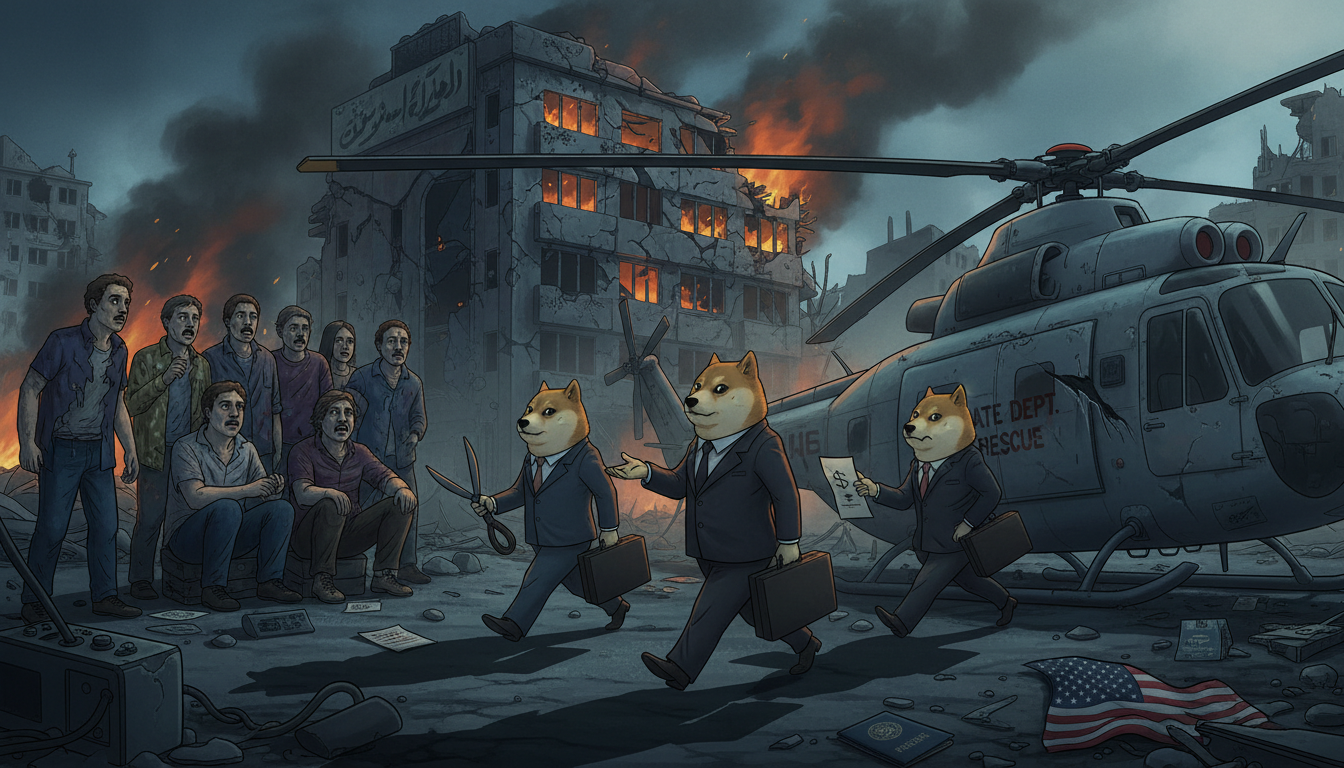
When conflict erupted between the United States, Israel, and Iran, it exposed a critical vulnerability in America’s ability to protect its citizens abroad. Nearly 250 experienced State Department foreign service officers have revealed that the Trump administration’s mass firing of diplomatic personnel has left the U.S. government unable to effectively rescue Americans trapped in expanding war zones across the Middle East.
The crisis stems directly from Elon Musk’s Department of Government Efficiency (DOGE) purge, which eliminated over 1,300 State Department personnel in July 2025. Among those terminated were the entire rapid-response consular officer team—specialists trained specifically for evacuating Americans from dangerous situations.
The Human Cost of Government Efficiency
The fired foreign service officers, all holding Top Secret clearances and still being paid under federal reduction-in-force procedures, contacted lawmakers with a stark warning: “The Department is actively preventing experienced, cleared, available officers from helping American citizens in crisis.”
Their letter, shared exclusively with The Intercept, detailed how “the expertise required to manage the current crisis has been systematically removed.” The Bureau of Consular Affairs—whose primary mission is protecting American lives overseas—lost 102 personnel, gutting the very department responsible for citizen services during emergencies.
The timing could not have been worse. When the U.S.-Iran conflict began, the State Department estimated that up to 1 million Americans living in the Middle East were at risk. The department issued urgent advisories telling citizens to “depart Lebanon while commercial flight options remain available” and to flee Iraq via “overland routes” due to fears of widespread attacks against U.S. citizens.
Stranded Citizens Describe Abandonment
Americans caught in the war zone describe a State Department unprepared and unresponsive. Emaan Abbass, a beauty consultant who had lived in Dubai for over nine years, enrolled in the State Department’s STEP emergency notification program on March 2nd as Iranian counterattacks targeted the UAE. Despite the program’s promise to help embassies contact citizens during emergencies, Abbass received no direct communication from the State Department for 11 days.
When she finally received an evacuation offer on March 10th, she had already arranged her own escape to Cairo. “It took 11 days of conflict for the State Department to contact me. That’s disappointing, to say the least,” Abbass told reporters.
Matt Gentile from Rochester, New York, was trapped in the Kurdistan region of Iraq when fighting erupted. Colleen West from Utah found herself stranded in Jerusalem with her husband. These Americans and thousands of others faced airspace closures and missile strikes in regions previously considered safe for travel.
Emergency Hotlines That Don’t Work
The dysfunction extended to basic emergency services. When Americans called the emergency assistance numbers posted on State Department social media, they discovered one number didn’t work internationally, while the other led only to recorded messages offering no evacuation instructions.
Despite Secretary of State Marco Rubio’s March 3rd assurance that the department would “assist every American,” the reality on the ground told a different story. While approximately 24,000 U.S. citizens eventually returned safely, the process exposed critical gaps in the government’s crisis response capabilities.
The DOGE Experiment’s True Cost
Musk’s DOGE initiative targeted $2 trillion in federal savings, ultimately claiming $215 billion in reductions through job cuts, contract cancellations, and asset sales. More than 260,000 federal workers left government service in 2025 due to Trump administration initiatives, including reductions in force, early retirement, and hiring freezes.
However, budget analysts have struggled to verify these savings figures. Dominik Lett from the libertarian Cato Institute noted “basic mistakes on the DOGE pages tracking savings,” leading him to believe the numbers were inflated. The complexity of the cuts has made it difficult for watchdog organizations to determine what was actually saved—or lost—through the reform efforts.
Thea Price, a former program operations manager at the United States Institute of Peace, experienced the chaos firsthand. Along with 300 colleagues, she was fired, rehired, and fired again as DOGE targeted her agency. “Nobody was prepared for the complete destruction,” Price said. “And for what?”
Expertise Systematically Removed
The fired State Department officers emphasized that their elimination wasn’t random cost-cutting but the systematic removal of institutional knowledge. Many of the terminated personnel had experience specifically in Middle East operations, crisis management, evacuation procedures, and what the department calls “active conflict/ordered departure environments.”
These officers, still available and willing to serve, possess exactly the skills needed during the Iran crisis. Their letter to Congress described how “the crisis now unfolding in the Middle East is, in part, a foreseeable consequence of this and other short-sighted decisions taken by this administration to undermine the federal bureaucracy by eliminating expertise and politicizing our apolitical workforce.”
The situation became even more dire after President Trump issued genocidal threats against Iran, suggesting he was willing to wipe out the country’s “whole civilization.” Even with a fragile ceasefire now in place, the State Department continues advising Americans to reconsider travel across the Middle East due to ongoing security risks.
Questions Without Answers
As Americans who lived through the evacuation crisis ask what the government cuts actually accomplished, the answers remain elusive. Musk himself later admitted that DOGE was only “somewhat successful” and that he wouldn’t undertake such an effort again.
The Government Accountability Office and other watchdog organizations have been unable to pinpoint concrete savings from the DOGE operation. What is clear is the human cost: experienced diplomats fired, Americans abandoned in war zones, and critical government capabilities dismantled in the name of efficiency.
The Iran crisis may have ended with most Americans safely home, but it exposed a troubling reality about the current administration’s priorities. When ideology-driven cuts eliminate the expertise needed to protect American lives, the true cost of government efficiency becomes measured not in dollars saved, but in citizens abandoned.
This article draws on reporting from The Intercept, PBS NewsHour, and USA Today.