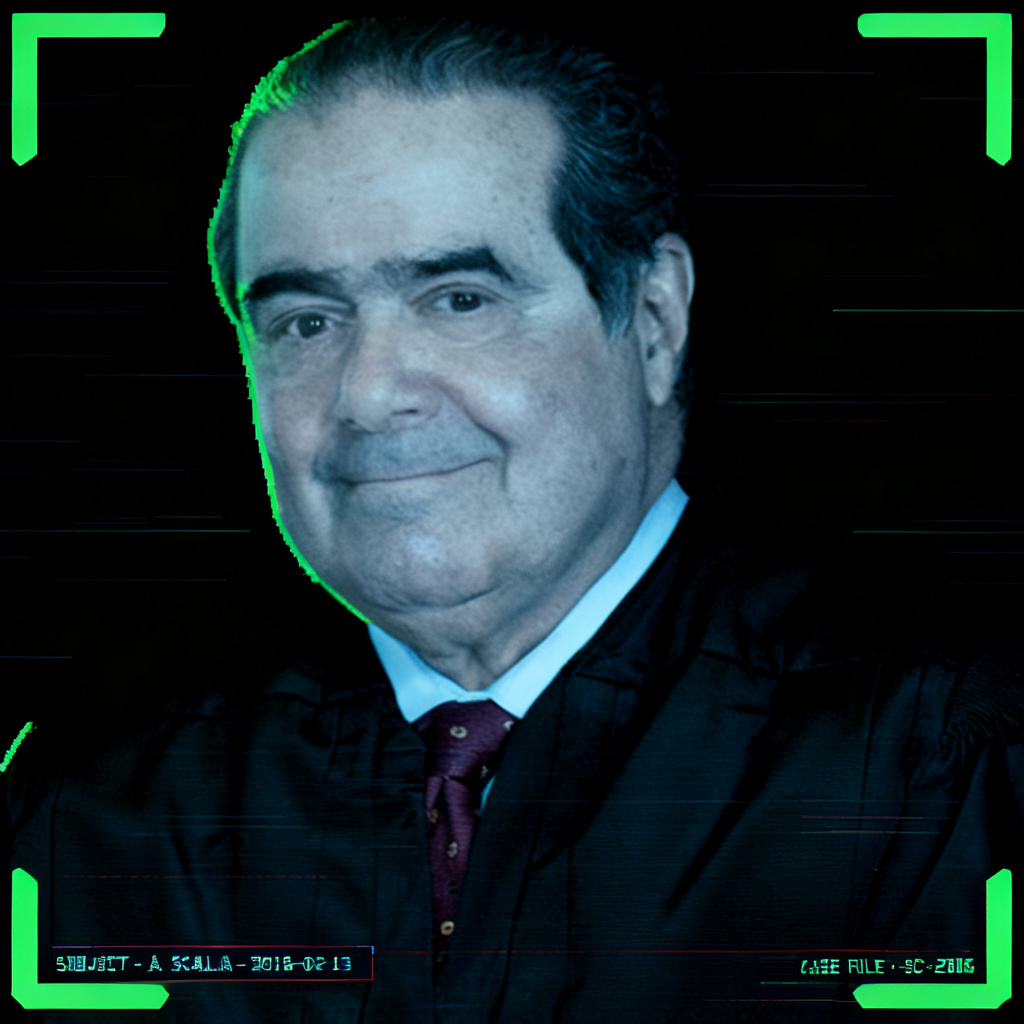
A Presidio County official sixty miles from the scene pronounced a sitting Supreme Court Justice dead by telephone, without ever examining the body. By 4 a.m. the next day, the body was embalmed. What changed in his absence — and what was foreclosed forever — is the question this Case File asks.
On the morning of February 13, 2016, a Presidio County official sixty miles from the scene pronounced a sitting Supreme Court Justice dead by telephone, without ever examining the body. By 4 a.m. the next day, the body was embalmed at a funeral home in El Paso. No autopsy was ordered. The thirty-five other guests at the ranch where Antonin Scalia spent his final night were never publicly named. United States Marshals deputies in the Western District of Texas — the federal district that covers the ranch — never knew he was in their jurisdiction.
Each of those facts has a plausible explanation taken alone. Together, they did one thing: they made independent forensic verification of how the most consequential originalist Justice in two generations actually died impossible.
This Case File does not claim Scalia was killed. That question cannot be answered with the available evidence and never will be. This Case File asks a sharper question: when standard forensic procedure is bypassed and a Justice with a specific record of bench resistance dies at a specific moment, who benefits, and how durably?
Antonin Scalia died at Cibolo Creek Ranch in Presidio County, Texas, on the night of February 12-13, 2016. The host was retired Major John B. Poindexter, founder of J.B. Poindexter & Co. and a member of the International Order of St. Hubertus. Scalia's traveling companion was C. Allen Foster, a Washington litigator and the U.S. Chancellor of the same Order. Scalia himself was not an Order member; he had no documented affiliation with it.
What deviated from standard procedure on the death itself is documented in mainstream reporting (Washington Post, New York Times, Texas Tribune, NPR, AP) and in a 2018 Fix the Court FOIA release of U.S. Marshals records:
The "pillow over his head" line that ran in the San Antonio Express-News on February 14 was clarified by Poindexter five days later: the pillow was "against the headboard," and the bedding was still creased from morning service, indicating no struggle. The clarification is itself reportable. It was not retracted; it was elaborated under press pressure.
The Antonin Scalia who appears in patriot-circuit shorthand as a uniform anti-establishment Justice is not the Antonin Scalia of the U.S. Reports. Boumediene, Citizens United, and Whole Woman's Health have to be read on their own terms.
The Antonin Scalia who did stand in the way of specific entrenched interests was a different and narrower figure. His bench presence was a structural impediment to surveillance, prosecutorial shortcuts, and the administrative state.
That is a record of structural resistance to the surveillance state, the prosecutorial shortcut, and the unaccountable administrative apparatus. It is not a record that any particular financial or corporate interest had reason to fear. It is a record that the deep institutional architecture of post-9/11 American power had every reason to fear.
A 2016 SSRN study by Stephen Bruce ("Any Good Hunting?") and a 2018 Fix the Court compilation found that Scalia took approximately 258 subsidized trips during his SCOTUS tenure — more than any other Justice in that period — including at least eighty-five undisclosed hunting and fishing trips on private aircraft and at private estates. Scalia and his colleagues used the "personal hospitality" exemption to the Ethics in Government Act of 1978 as a routing mechanism around the federal judicial financial disclosure rules. He reportedly tutored Justice Thomas in the same disclosure-avoidance scheme.
The canonical pre-Cibolo example is the 2004 Cheney duck hunt. Vice President Dick Cheney flew Scalia on Air Force Two to a private hunting estate in Louisiana three weeks after the Court agreed to hear Cheney v. United States District Court for the District of Columbia — the case challenging Cheney's refusal to disclose Energy Task Force records. Scalia refused to recuse and authored a 21-page memorandum defending the trip. He voted with the Court's 7-2 majority returning the case to the D.C. Circuit on terms favorable to the Vice President.
The Cibolo Creek arrangement followed the same template: a private hunting estate, full board comped at room rates between $700 and $1,000 per night, and a host with documented Supreme Court business. Mic Industries, a subsidiary of Poindexter's holding company, had been the defendant in Hinga v. Mic Industries, an age-discrimination case. The Supreme Court denied certiorari on the case the term before the February 2016 trip. Whether the cert denial constitutes a "favorable result" is contested in the reporting; the proximity is documented.
The hospitality pattern matters here because it is the structural feature that placed Scalia inside private elite-fraternal environments without USMS protection, without disclosure, and without an independent inquest infrastructure on call.
The Senate refused to consider Merrick Garland for 293 days — the longest blockade in the history of the Court, and the first SCOTUS nomination since 1866 to receive no Senate action. The seat was held open across an election. Three Trump appointments followed — Gorsuch (2017), Kavanaugh (2018), Barrett (2020) — producing a 6-3 majority.
What that majority delivered:
Scalia, alive, would have been in the Dobbs majority. He would not have been in the Janus or Trump v. Hawaii majorities by the same margin, and the OT2015 docket — Friedrichs against the unions, U.S. v. Texas on DAPA, Whole Woman's Health on Texas abortion clinic regulations — was decided by 4-4 splits and remand because his vote was missing.
The Federalist Society pipeline that Scalia co-founded as a Chicago law professor in 1982 became the staffing mechanism for the post-Scalia replacement court. Forty-three of Trump's fifty-one appellate nominees were Society members. Leonard Leo's network collected over $250 million between 2014 and 2017. The post-2016 vacancy was the operational hinge that converted the Society's three-decade infrastructure investment into durable judicial supremacy.
This is not the first time a judge in the way of an entrenched financial-legal arrangement has died at the moment his obstruction was operational, with standard forensic verification foreclosed.
In 1968, a Minnesota Justice of the Peace named Martin V. Mahoney ruled in First National Bank of Montgomery v. Daly that bank-created credit is not lawful consideration for a mortgage and voided the foreclosure. He died August 22, 1969, before the case could be appealed on its merits. Cause of death is not stated in the docket. The case was eventually dismissed by stipulation, never reversed. Read the Credit River Case File →
The systemic effect of both deaths is identical: the line of legal reasoning each judge represented was removed from the institutional process before that reasoning could ripen into binding authority. Independent forensic verification was foreclosed in both cases.
The Decrypted Matrix does not assert a chain of intent in either death. The wiki carries the same posture for Mahoney that it carries for Scalia: secondary "poisoning" or "suspicious circumstances" lore is not endorsed without primary-source corroboration.
The honest claim — narrower and stronger than the conspiratorial frame — is this:
In both cases, independent forensic verification was foreclosed, and the institutional consequences of the death advanced specific interests that the judge's bench presence had been blocking.
That claim is sourced to primary documents and mainstream reporting. It does not require speculation. It also does not let anyone off the hook.
The Matrix doesn't need to kill its obstacles. It only needs to be there, ready, when an obstacle stops moving.
Filed · Judicial Death Pattern Series · Companion to Credit River