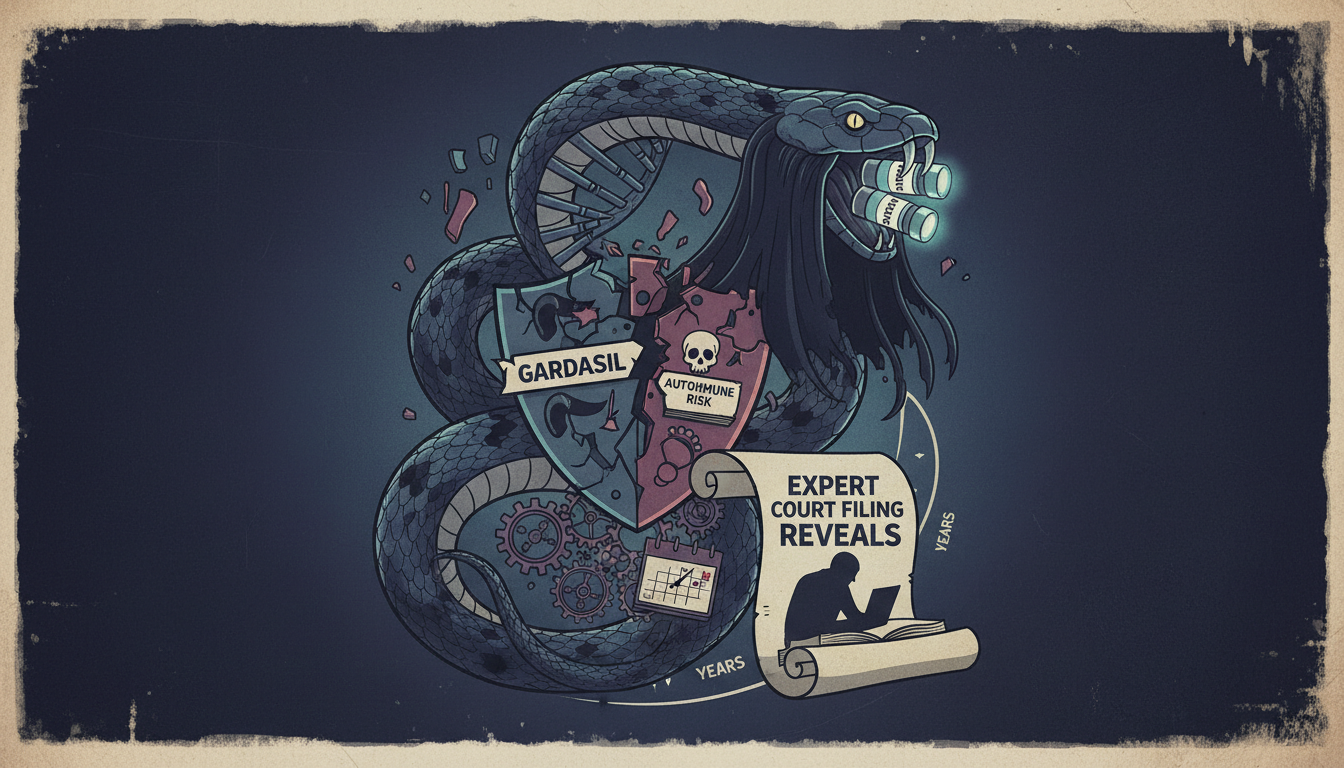
A pharmaceutical regulatory expert with decades of experience, including service as a U.S. Food and Drug Administration consultant, has declared in a public court filing that Merck possessed sufficient evidence to warn the public about a potential link between its Gardasil HPV vaccine and autoimmune disorders, including postural orthostatic tachycardia syndrome (POTS), years before it chose to act. The declaration, filed amid a wave of Gardasil injury lawsuits, has drawn renewed scrutiny to how one of the world’s most widely administered vaccines reached hundreds of millions of people with what critics argue was an incomplete safety profile.
The Expert at the Center of the Filing
The declaration comes from Stephen Amato, Ph.D., a professor and department chair of Graduate Regulatory Affairs and Life Science at Northeastern University. Amato has worked as a consultant to the FDA and holds decades of experience in pharmaceutical regulation. His findings were submitted as part of litigation that has since culminated in Merck moving to settle more than 200 lawsuits for a reported sum exceeding $50 million, according to court updates from the Lawsuit Information Center.
In his court declaration, Amato concluded that Merck should have added stronger warnings about possible autoimmune-related adverse events, including POTS, to the Gardasil label. He further noted that Merck had listed POTS symptoms on the label as individual adverse events, dizziness, fatigue, fainting, rather than identifying the condition itself by name. According to Amato, a warning, as opposed to a simple adverse event listing, carries a higher level of precaution and would more effectively alert physicians and patients to a possible causal relationship between the vaccine and the condition.
What the Evidence Showed, and When
Gardasil first received FDA approval in 2006. Since then, the vaccine’s label has been updated multiple times. Over the years, Merck added reports of dizziness, fatigue, fainting, and eventually noted postmarketing reports of autoimmune diseases, motor neuron disease, and transverse myelitis, among other conditions, according to reporting by the Activist Post drawing on the Children’s Health Defense.
Amato’s filing argues that the accumulation of evidence, drawn from animal studies, Merck’s own clinical trials, case reports submitted to the company, and peer-reviewed scientific literature, collectively indicated that Gardasil could trigger autoimmune disorders and POTS in certain individuals. His position is that this body of evidence was sufficient to justify a formal warning well before one was ever issued.
The allegation is not that Merck was unaware of these signals, but that the company made a deliberate regulatory choice not to elevate its labeling language to the warning level, leaving prescribing physicians and patients without the higher-tier alert that Amato contends the data warranted.
The Litigation Landscape
The Gardasil lawsuits have taken shape as a sprawling, procedurally complex body of litigation. As of April 2026, the JPML’s pending MDL report listed 129 active cases in the Gardasil Products Liability Litigation, with 258 total historical actions, according to the Lawsuit Information Center. The relatively modest case count, by mass tort standards, reflects the significant procedural hurdles facing plaintiffs, including Vaccine Court exhaustion requirements, timeliness disputes, and federal preemption arguments.
In March 2026, the U.S. Supreme Court declined to hear Needham v. Merck, leaving in place a Fourth Circuit ruling against Gardasil plaintiffs on Vaccine Act timeliness and procedural issues. The practical consequence, as noted by the Lawsuit Information Center, is that many plaintiffs who missed the Vaccine Court filing deadline will have no viable legal path forward, regardless of the severity of their injuries.
The first major California state court case positioned as a jury trial, Robi, was dropped in June 2026 without a public explanation of whether it was tied to a settlement. Merck had already disclosed a tentative agreement to resolve that case before it reached trial. Observers noted that Merck’s willingness to settle before a jury could evaluate the Gardasil safety evidence was a significant strategic decision for a company whose vaccine remains a major commercial product.
Settlement Without Admission
Merck disclosed in its February 2026 annual report that it had entered into a proposed agreement to resolve the Gardasil litigation, contingent on enough claimants agreeing to participate. By June 2026, the company was reportedly moving to finalize a settlement worth more than $50 million covering more than 200 cases. Merck has continued to deny liability throughout this process.
The settlement structure, resolving cases before a single jury could publicly evaluate the safety evidence, is a pattern familiar to observers of pharmaceutical mass tort litigation. As the Lawsuit Information Center noted in its coverage, the settlement confirms that these claims carried enough evidentiary weight and litigation risk to bring one of the world’s largest pharmaceutical companies to the negotiating table, even as no court has adjudicated the underlying scientific questions.
What the Label Says, and What It Doesn’t
The current Gardasil 9 official patient materials, as listed on the manufacturer’s own website, identify the most common side effects as pain, swelling, redness, and other injection-site reactions, along with headache, fever, nausea, dizziness, tiredness, diarrhea, abdominal pain, and sore throat. The label notes that fainting can occur and advises patients to remain seated or lying down for 15 minutes post-injection.
Notably absent from that publicly facing patient information is any reference to POTS as a recognized condition of concern, or to the broader category of autoimmune disorders that Amato’s filing contends should have been formally flagged. Whether that absence represents a reasonable regulatory judgment or a deliberate understatement of known risk is precisely the question that the settled lawsuits will now leave unanswered in any public forum.
The Broader Context
Gardasil and its successor Gardasil 9 have been administered to tens of millions of individuals since 2006. The vaccine was approved to address human papillomavirus, certain strains of which are associated with cervical cancer and other HPV-related cancers. At its peak, Gardasil was one of Merck’s most commercially significant products globally, as noted in Bloomberg reporting cited by the Activist Post.
Lawsuits allege that Merck not only failed to adequately warn about autoimmune risks, but that the company misrepresented the vaccine’s efficacy and concealed safety risks during the approval process, allegations Merck disputes. The lawsuits span injuries including POTS, autoimmune disorders, and premature ovarian failure, according to legal filings cited by the Robert King Law Firm and the Lawsuit Information Center.
Questions That Remain Unanswered
The settlements, while providing some measure of resolution for individual plaintiffs, foreclose the public evidentiary proceedings that might have produced a clearer record on the central scientific questions. Did Merck’s clinical trial data, animal studies, and postmarketing case reports, taken together, reach the threshold that should have triggered a formal POTS or autoimmune warning on the Gardasil label? What did internal communications show about when company officials became aware of these signals?
Those questions, the ones that Amato’s declaration was designed to put before a jury, remain, for now, without a definitive public answer. What the record does show is that a regulatory expert with FDA credentials concluded, under penalty of perjury in a federal court filing, that Merck had the evidence and the regulatory obligation to warn more explicitly than it did, and that the company chose a different path.
For the families whose cases were resolved quietly, and for the broader public that received the vaccine without that warning, the significance of that conclusion is not diminished by the absence of a verdict.
This article draws on reporting from Activist Post / Children’s Health Defense, Lawsuit Information Center, and Robert King Law Firm.