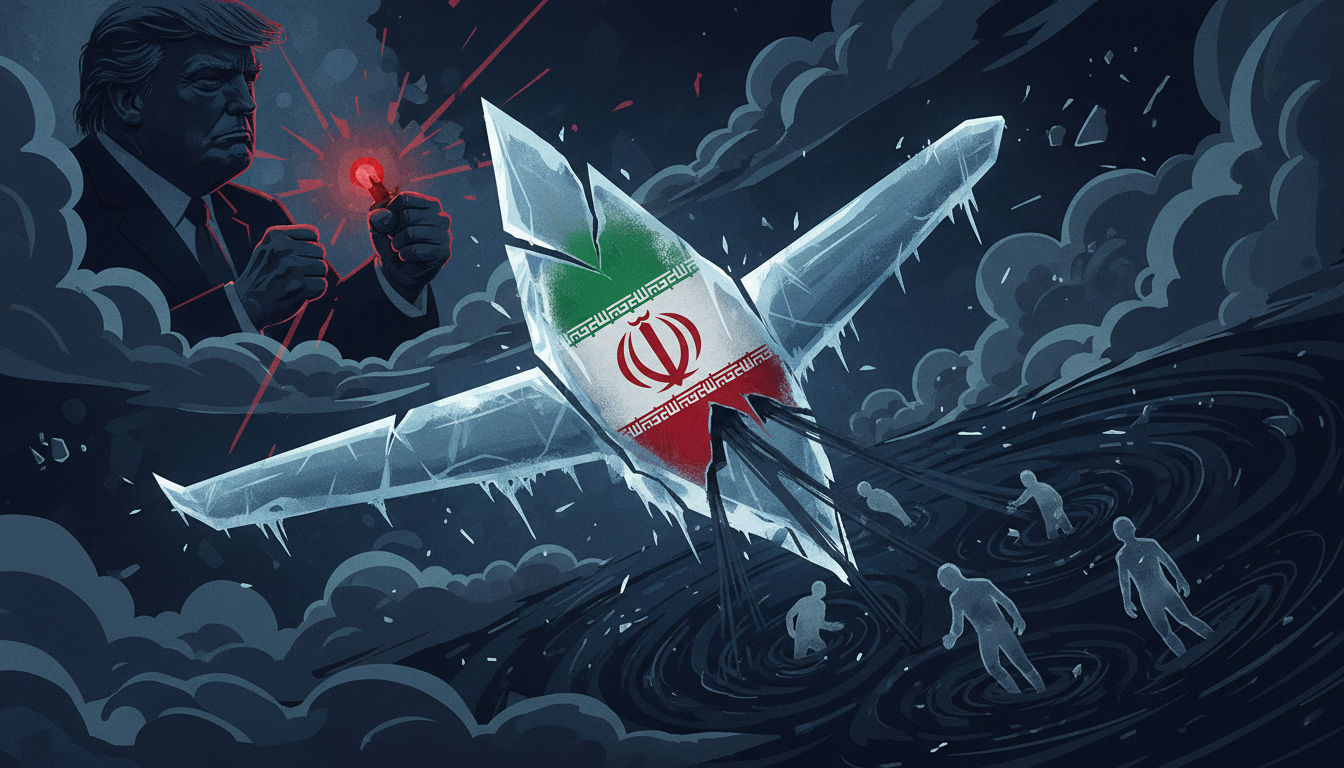
Internal emails obtained through a Freedom of Information Act request reveal that Immigration and Customs Enforcement officials worked directly with Iranian government officials to arrange deportation flights carrying more than 100 Iranian nationals to Tehran, even as the Trump administration simultaneously laid the groundwork for a military conflict against Iran. The documents, released to the National Iranian American Council and provided exclusively to The Intercept, paint the clearest picture yet of a covert coordination effort that reversed decades of U.S. immigration policy toward Iranians.
Inside the Email Trail: Pressure From the Top
Hundreds of internal ICE emails spanning from May to November of last year document the planning and execution of three charter deportation flights to Iran, the first of which landed in Tehran on September 29, 2025. The correspondence shows officials operating under orders from then-Acting Director Todd Lyons, alongside senior figures including head of removal operations Marcos Charles, then-deputy director Madison Sheahan, and Joshua Coster, identified in the emails as the Enforcement and Removal Operations attaché at ICE’s U.S. Embassy branch office in Tel Aviv.
Coster appears to have served as the primary liaison with the Qatari government, managing back-and-forths over landing permits, passenger manifests, and the logistics of transferring deportees to Qatar Airways charter flights for the final leg to Tehran. The involvement of the Tel Aviv office, according to Jamal Abdi, president of the National Iranian American Council, “reveals how integral the ICE office in Tel Aviv has been to this transnational network of ICE officers removing people from America.”
The emails show not only coordination through Qatari intermediaries but, in some instances, direct communication between ICE officials and Iranian government officials. Among the most striking disclosures: immigration officials appear to have complied with an Iranian government request to repatriate three specific individuals living in the United States.
A Reversal of Decades of Policy
For decades, U.S. immigration authorities allowed Iranians with final removal orders to remain in the country, citing credible fears of persecution under a regime that American officials have long accused of murdering its own citizens. The sudden about-face under the Trump administration represented a dramatic and deliberate policy shift.
Data obtained by the National Iranian American Council showed Iranians were already under increased targeting by ICE before the flights were arranged. “It seemed clear that Iranians were under the microscope all of a sudden,” Abdi told The Intercept. “And we now know that it was actually in the middle of the [Twelve-Day] war where the White House was directing ICE to start removing Iranians.”
The flights carried more than 100 people to Tehran, including political activists and ethnic and religious minorities with documented reasons to fear persecution upon return. At least one man transported on the flights later told the New York Times that he attempted suicide prior to boarding and was physically forced onto the plane by ICE agents.
Confidential Asylum Data Allegedly Shared With Tehran
A separate lawsuit filed in U.S. District Court in Washington, D.C., in July 2026 by the Iranian American Legal Defense Fund and the Public Citizen Litigation Group adds another layer to this picture. The complaint alleges that starting in March 2025, the U.S. State Department arranged monthly meetings with Iranian officials, conducted through the Pakistani embassy as an intermediary, in which U.S. officials shared detailed, sensitive information about detained Iranian immigrants the government hoped to deport.
The information allegedly shared included details from asylum applications filed by individuals who claimed persecution for converting to Christianity, for their sexuality, or for participating in the Women, Life, Freedom protests against the Iranian government in 2022. Federal regulations passed in the late 1990s explicitly prohibit the government from sharing information that could reveal that a deportee had applied for asylum, protections Congress enacted precisely because such disclosures can place lives in danger.
“Congress made these confidentiality protections mandatory precisely because lives depend on them, and no agency and no administration, of either party, may set them aside,” said Ali Rahnama, interim executive director of the Iranian American Legal Defense Fund. The Department of Homeland Security denied sharing asylum application records with the Iranian government.
The War Intervenes, But Plans Continued
Following U.S. and Israeli strikes on Iran beginning February 28, 2026, deportation logistics became complicated by airspace closures. Court filings in Texas show the Trump administration had convinced a federal judge to delay releasing an Iranian national, Esmael Rajabi, from ICE custody on the basis that deportation was imminent, only to later inform the court that his removal “remains under review in Tehran” due to “recent airspace closure.”
In a separate California case, the Trump administration had a deportation charter flight scheduled for late March 2026, which was ultimately cancelled because, as the government acknowledged in court filings, “removal flights to Iran have temporarily ceased” amid the conflict. The administration nonetheless pledged in a public statement to “continue to use all lawful options to deport illegal aliens.”
Federal judges across multiple jurisdictions were left to weigh whether Iranians held in ICE detention faced a realistic prospect of deportation in the near term, and if not, whether they were constitutionally entitled to release or at minimum a bond hearing. In at least one case, the administration conceded a detainee should be released because there was “no significant likelihood of removal in the reasonably foreseeable future.”
Scale of ICE Air Operations Under the Second Trump Administration
The Iran deportation flights took place against the backdrop of a historically expanded ICE Air operation. According to Human Rights First’s ICE Flight Monitor, from January 20, 2025 to January 20, 2026, the Trump administration conducted 2,253 deportation flights to 79 countries, a 46 percent increase in flights and a 76 percent increase in destinations compared to the final year of the Biden administration. The flights reached 25 countries that had never previously received ICE removal flights.
Domestic transfer flights between detention centers surged to 9,066 during the same period, a 132 percent increase over the prior year. Human Rights First’s ICE Flight Monitor also noted that ICE continued what it described as “layover-transfer” removal flights to both Iran and Russia during this period, countries with which the United States maintains strained or openly hostile diplomatic relations.
“The scale and brutality of ICE’s operations, whisking members of our communities off the streets and flying them to be staged for deportation without due process, is unconscionable,” said Savi Arvey, Director of Research and Analysis for Refugee Protection at Human Rights First. “Behind every data point, every flight, is a person, someone separated from family in the United States, transferred across the country in shackles, or deported to a place where they may face danger.”
An Apparent Case of Mistaken Identity
The internal emails also document at least one deeply troubling operational error: an apparent mix-up in which ICE officials accidentally placed the wrong person on a deportation flight bound for Iran. The details of that case remain partially redacted in the released documents, but its existence underscores the chaotic and high-pressure conditions under which officials were executing these transfers.
What the Documents Reveal
Taken together, the FOIA-released emails and subsequent litigation present a documented record of the U.S. government coordinating with a foreign adversarial government to remove people, some of whom had credible asylum claims, to a country the United States was simultaneously planning to bomb. The use of Qatari intermediaries, the Tel Aviv embassy office as an operational node, and the apparent compliance with Iranian requests for specific individuals raise questions that congressional oversight committees and federal courts are only beginning to examine.
Roughly 600 Iranians were placed in immigration detention last year, according to public records obtained by the National Iranian American Council. The full human toll of these flights, for those delivered to Tehran in the months before and during an active war, remains difficult to assess.
This article draws on reporting from The Intercept, Politico, PBS NewsHour / Associated Press, and Human Rights First.