The CARET Program: An Alleged Insider’s Account of Reverse-Engineered Extraterrestrial Technology
In June 2007, an anonymous individual using the pseudonym “Isaac” released a detailed account of his alleged participation in a classified 1980s program called CARET (Commercial Applications Research for Extraterrestrial Technology). The testimony, accompanied by photographs and photocopied documents, described a facility in Palo Alto, California where civilian engineers and scientists were tasked with reverse-engineering extraterrestrial artifacts for commercial applications. The release was prompted by a wave of UFO sightings in California that Isaac claimed were related to the technology he had worked with decades earlier.
Background of the Whistleblower
Isaac described himself as an electrical engineer with a background in computer science who had worked for the Department of Defense before being recruited into the CARET program in 1984. His DoD tenure and technical credentials qualified him for the program, and his experience earned him an internal management position that would later facilitate his removal of classified documents from the facility.
He stated that approximately 30 other civilians with similar DoD backgrounds were recruited alongside him, supplemented by engineers from major technology companies including IBM and Xerox PARC. The program was deliberately modeled on the working culture of Silicon Valley technology firms, with the military providing the artifacts and security while allowing civilian staff to establish their own workflows, documentation standards, and management structures.
The Palo Alto CARET Laboratory
The facility, designated PACL (Palo Alto CARET Laboratory), was hidden in an office complex designed to look like an ordinary technology company. From the street, visitors would see only a gated parking lot and a one-story building bearing a fictitious company name and logo. Behind the entrance, however, were heavy armed security and five underground floors housing laboratories, over 200 staff members including computer scientists, electrical engineers, mechanical engineers, physicists, and mathematicians.
Security was extensive. Staff underwent thorough searches entering and leaving the building, armed guards were present in virtually every room including the laboratories, and biweekly inspections by military brass ensured compliance. The program operated under strict compartmentalization, with staff rarely hearing terms like “alien” or “UFO.” Different extraterrestrial sources were referred to simply as different “sources,” and discussion of philosophical or ethical implications of the work was actively discouraged.
The Technology: Holographic Computational Substrate
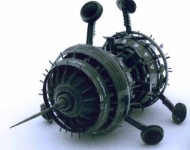
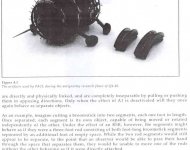
While antigravity research was a major component of the program, Isaac’s primary area of interest was a technology that defied conventional engineering categories. The extraterrestrial hardware did not contain discrete components like CPUs, data buses, or memory modules. Instead, the interior material appeared to be a single, uniform substance that functioned as what Isaac described as a “holographic computational substrate.”
Each particle within the material could function independently but was designed to operate in massive clusters. The system was holographic in the sense that any subdivided section contained a scaled-down but complete representation of the entire system. Computational power scaled nonlinearly: four elements working together were more than four times as powerful as one. The shape of substrate sections directly affected their functionality, serving as physical “shortcuts” to achieve computational outcomes that would otherwise require greater complexity.
The Self-Executing Language
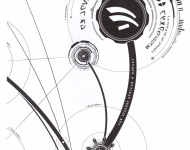
The most remarkable aspect of the technology, according to Isaac, was a system of symbols and geometric forms that functioned as what he called a “self-executing language.” Unlike human computing, which requires hardware to interpret and execute software instructions, this system operated differently. The symbols and diagrams, when inscribed on appropriate materials in the presence of a specific type of field, would immediately begin performing their intended functions without any separate processing hardware.
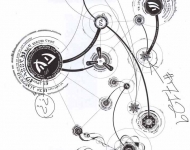
Isaac described these diagrams as “functional blueprints” in which the form of each element was itself operational. Every component was dependent on and related to every other component, making independent modification of any single element impossible. A given symbol could represent anything from a single binary flag in one context to the equivalent of an entire genome database in another. The symbols did not merely represent data; they contained it.
Working with these diagrams proved extraordinarily difficult. Teams of ten or more researchers found that as each new element was added, complexity grew exponentially. The CARET team developed computer-based systems to manage the combinatorial relationships, but even supercomputers of the era quickly reached their processing limits. The extraterrestrial originators, by contrast, could reportedly design these diagrams as quickly as a human programmer could write simple code.
The Cloaking Disruption Theory
Isaac’s testimony was prompted by a 2007 wave of UFO sightings in California, particularly in the Saratoga and South Bay areas near Mountain View, home to Moffett Field and NASA Ames Research Center. He proposed that the crafts were not newly arrived but had been present for decades, equipped with invisibility technology that could be controlled both onboard and remotely.
He suggested that experimental testing of a device capable of disrupting cloaking technology, likely conducted at or near Moffett Field, had inadvertently rendered normally invisible craft temporarily visible. He cited the Big Basin sightings specifically, where witnesses reported crafts appearing and disappearing in momentary flickers consistent with intermittent disruption rather than deliberate decloaking.
Isaac claimed personal familiarity with such disruption devices, stating that previous accidental activations had caused similar incidents. He characterized most reported UFO crashes as the result of human experimentation with powerful alien technology at inopportune moments rather than mechanical failures on the part of the craft themselves.
The Document Collection
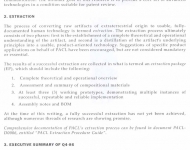
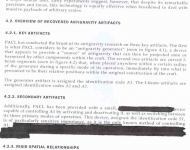
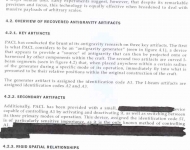
During the final months of his three-year tenure at PACL, Isaac took advantage of his management-level access to systematically photocopy and remove documents from the facility. He described concealing papers under his shirt during movements through unmonitored hallways, eventually accumulating hundreds of photocopies, original documents, and photographs.
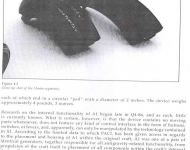
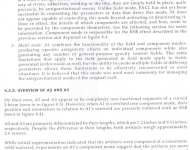
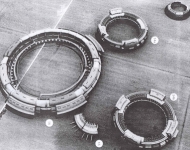
The materials he released included inventory review pages showing components similar to those visible in the 2007 sighting photographs, pages from quarterly research reports, original photographs from those reports, and pages from a “Linguistic Analysis Primer” depicting the complex symbol diagrams visible on the undersides of photographed craft.
Departure and Perspective
Isaac left the CARET program in 1987, citing burnout from the cognitive demands of working with the symbol system and frustration with military restrictions on information access. Approximately a quarter of PACL staff departed during the same period for similar reasons. He maintained contact with former colleagues and heard through informal channels that PACL closed within a few years of his departure, though similar facilities reportedly continued operating in Sunnyvale and Mountain View.
He emphasized several points in his conclusion. He stated that during his entire tenure working with well-connected insiders, he never encountered information about invasions, abductions, or hostile extraterrestrial intentions. He described his view of the extraterrestrial situation as positive, noting that any civilization capable of the technology he had witnessed would have no difficulty eliminating humanity if that were their goal. The fact that they had not done so suggested benign or indifferent intent.
Evaluating the CARET Claims
The Isaac/CARET testimony generated intense debate in the UFO research community. The technical sophistication of the account, the specificity of the descriptions of holographic computational substrates and self-executing symbolic languages, and the apparently genuine internal documents were cited by supporters as evidence of authenticity. The anonymous nature of the source, the inability to verify the existence of PACL or the CARET program through public records, and the convenient timing relative to the California sightings were cited by skeptics.
The concept of a self-executing symbolic language represents one of the more intellectually provocative claims in the UFO disclosure literature, touching on fundamental questions about the relationship between information, physical reality, and computation that remain at the frontier of theoretical physics and computer science.