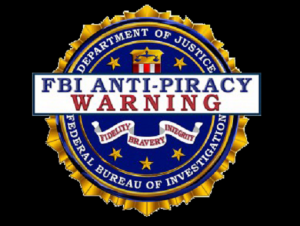
The FBI Anti-Piracy Warning Seal: A Brief History of Intimidation Theater
The FBI’s anti-piracy warning seal has been a fixture of purchased media for years. Under a special pilot program, the bureau allowed major industry groups including the RIAA, MPAA, BSA, ESA, and SIIA, representing record labels, movie studios, video game publishers, and software companies, to display the FBI seal on their products. The message to consumers was unmistakable: you just bought this product, and the federal government wants you to know you might be a felon.
The program represented one of the most visible examples of federal law enforcement acting as an enforcement arm for private industry interests, using the weight of a government badge to threaten customers on behalf of corporations.
Expanding the Warning to Every Copyright Holder in America
The FBI announced plans to dramatically expand the program through new rules that would allow any copyright holder, not just members of major industry associations, to place the anti-piracy seal on their products. The practical effect would be the proliferation of federal law enforcement imagery across virtually every piece of copyrighted content in existence.
The FBI’s own documentation stated that the agency believed the seal and its accompanying warnings conveyed important messages and constituted a significant component of its intellectual property crime deterrence efforts. The agency argued that allowing broader access to the seal would enhance those efforts and increase public awareness of copyright law prohibitions. Whether ordinary consumers responded to FBI warnings with compliance or contempt was apparently not part of the calculus.
Blurring the Line Between Civil Infringement and Federal Crime
The fundamental problem with the FBI’s anti-piracy campaign was its deliberate conflation of civil and criminal copyright infringement. Nearly all copyright infringement committed by ordinary individuals falls under civil law, meaning it is a matter for private lawsuits between parties, not federal criminal prosecution. Most consumers do not understand the distinction between these two legal categories, and the FBI’s seal did nothing to clarify it.
Instead, the visual message of a federal law enforcement badge accompanying a criminal warning strongly implied that sharing music with a friend or making a personal backup copy could trigger an FBI investigation. This was, by any honest assessment, a fear-based campaign designed to intimidate consumers rather than educate them.
The legal threshold for criminal copyright infringement requires that the action be willful, meaning the person must knowingly be breaking the law. Placing additional warnings before people who are already aware they are infringing adds nothing to the deterrence equation. Those who do not know they are infringing are committing civil violations at most, not the federal crimes the seal implies.
Zero Evidence of Effectiveness Despite Continuous Expansion
Perhaps the most damning aspect of the program was the complete absence of data supporting its effectiveness. The FBI acknowledged that measuring the impact of the anti-piracy seal on actual piracy rates was difficult. Despite this admission, the agency proceeded to expand the program rather than question its value.
The MPAA had displayed the warning before theatrical films for years without any measurable reduction in unauthorized copying. When the FBI and Immigration and Customs Enforcement jointly decided to extend and double the duration of DVD warnings, the result was identical: no change in infringement rates, but significant annoyance for paying customers who had to sit through longer interruptions before watching content they legitimately purchased.
The irony was inescapable. The only people consistently exposed to anti-piracy warnings were the customers who had actually paid for the content. Individuals accessing unauthorized copies encountered no such warnings at all, making the program effectively a punishment for legitimate purchases.
Fair Use Under Threat from Overzealous Seal Deployment
Multiple public comments submitted during the rulemaking process warned that broader deployment of the FBI seal would create a chilling effect on fair use, the legal doctrine that permits limited use of copyrighted material for purposes such as criticism, commentary, education, and parody. The concern was that copyright holders would weaponize the FBI seal to discourage uses of their work that were entirely legal under existing law.
The FBI’s response acknowledged that fair use does not constitute infringement and stated that its warning language did not suggest otherwise. The agency’s proposed remedy was to address the issue on its public website. This solution assumed that every consumer who encountered the intimidating FBI seal on a product would then navigate to the FBI’s website and locate a clarifying footnote about fair use exceptions, an assumption that bordered on absurd.
The Irony of the FBI Protecting Its Own Logo While Distributing It Freely
The expansion of the anti-piracy program stood in stark contrast to the FBI’s historically aggressive protection of its own logo. The same agency that wanted every copyright holder in America to display its seal had previously sent legal threats to Wikipedia for displaying the FBI logo on an informational page about the bureau. The Wikipedia Foundation’s general counsel responded by pointing out that the FBI’s demands had no legal basis, creating one of the more memorable exchanges in the history of intellectual property disputes.
The contradiction was fundamental: the FBI simultaneously demanded control over who could display its standard logo while actively encouraging the widest possible distribution of its anti-piracy variant. The underlying logic appeared to be that the FBI logo should be reserved for purposes that served the bureau’s institutional interests, whether those purposes were legally coherent or not.
When Copyright Enforcement Alienates the Paying Customer
The ultimate failure of the anti-piracy seal program was strategic rather than legal. Every legitimate customer who purchased a DVD, software package, or video game was greeted with an implicit accusation of criminal intent, complete with federal law enforcement branding. Meanwhile, anyone who obtained the same content through unauthorized channels experienced no such inconvenience.
The business case for treating paying customers as suspects remained impossible to articulate. No data demonstrated that the warnings reduced piracy. Substantial evidence suggested they annoyed the very consumers who were supporting the industry through legitimate purchases. And the expansion of the program to every copyright holder in the country guaranteed that the FBI’s anti-piracy seal would soon become as ubiquitous and meaningless as a terms-of-service agreement that nobody reads.