Undercover Investigation Reveals Security Failures at London 2012
In the lead-up to the 2012 London Olympics, investigative journalist Lee Hazledean went undercover as a security guard trainee with G4S, the private firm contracted to handle event security. What he reported raised serious concerns about the safety of the Games and the competence of the security apparatus surrounding them.
Hazledean, an experienced filmmaker and TV journalist who had previously covered British Army infiltration of the IRA and related false flag operations, documented a pattern of failures throughout the security training process.
Screening Equipment and Training Deficiencies
During training exercises, Hazledean was asked to pose as a would-be attacker and reported that he successfully smuggled knives, simulated firearms, and improvised explosive device components through security screening on every attempt.
The problems extended across the security operation:
X-ray machine operators received only two days of training and routinely missed obvious prohibited items including weapons and ammunition. Bag searchers and physical screening personnel failed to detect dangerous objects during exercises. Trainees demonstrated an inability to properly use Hand Held Metal Detectors (HHMD).
Most concerning, the Rapiscan walk-through metal detectors were reportedly not sensitive enough to detect large knives, ammunition, or other metallic threats. Hazledean was told the detectors would be configured to trigger an alarm only after every 50th person passed through, a measure designed to reduce queue times rather than maximize security.
Facility Security and Personnel Issues
The training facility itself presented security risks. It was designed as an accurate mock-up of the actual Olympic venue security layout. Multiple trainees were observed photographing the facility with mobile phones. While some were caught by trainers, most went unnoticed. Claims that mobile phone jammers were installed in the facility proved false — trainers privately admitted to Hazledean that no jammers existed and the claim was merely a verbal deterrent.
Personnel quality was also a concern. Reports described drug deals taking place in training classrooms, trainees who could not communicate in basic English, and individuals without completed Security Industry Authority (SIA) licenses being promoted to team leader positions over experienced ex-military and former police personnel. Uniforms were also reported missing or stolen from the facility.
Military Deployment and Evacuation Plans
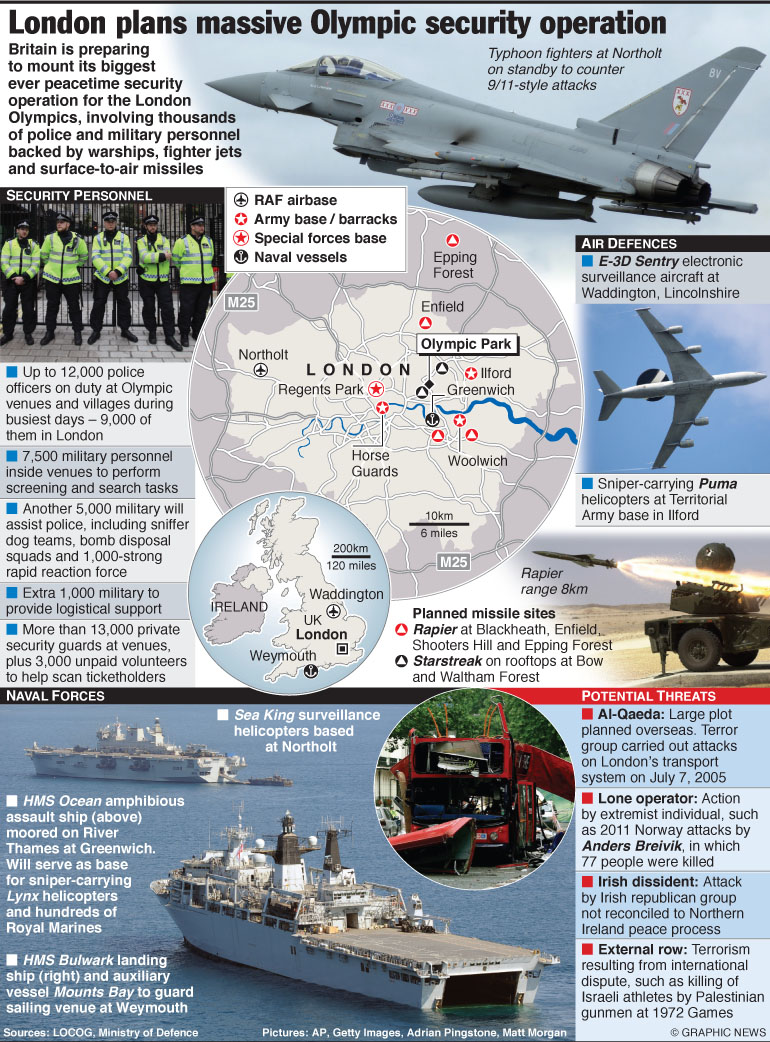
Beyond the civilian security operation, plans existed for a substantial military presence. Approximately 100,000 troops were reportedly being deployed through Woolwich barracks, comprising regular British forces along with American and European military personnel stationed at various barracks across London.
G4S personnel were briefed on plans for a potential evacuation of London, though no specific reason for such a contingency was provided. Trainees were told only that it would be a “defining moment in the history of London.”
Additionally, trainees were shown footage of drone operations in Afghanistan and informed that drones would patrol London’s airspace during the Olympics for surveillance purposes, with the capability for armed response if deemed necessary.
Separately, media reports confirmed that surface-to-air missile systems were deployed on residential rooftops in East London, and anti-aircraft launchers were placed on Blackheath, both of which drew public scrutiny over the scale of the military response to a sporting event.
Media Blackout Allegations
Hazledean also reported that a media blackout appeared to be in effect regarding negative Olympic security coverage. He claimed that major news outlets would not run critical stories about Olympic security unless they were first broken by a newspaper or foreign news agency, suggesting coordinated suppression of unfavorable information about the Games.