A History of Blame and Deflection
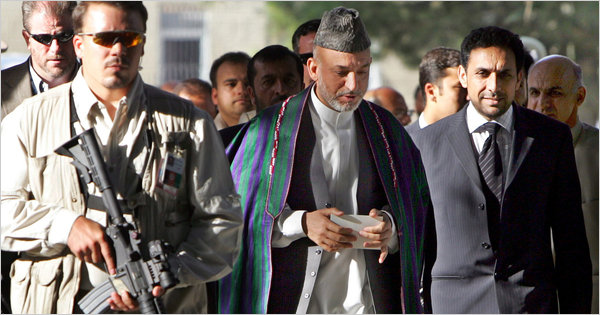
In September 2012, Afghan President Hamid Karzai told CBS’s “60 Minutes” that corruption in his government had reached a level “not ever before seen in Afghanistan.” He claimed that under the Soviet occupation during the 1980s, governance was “not even 5 percent as corrupt,” arguing that the Soviets never funneled contracts to the relatives and associates of powerful officials the way American programs had.
Karzai’s complaints were easy to dismiss on their face. He had repeatedly blamed the United States and its allies for Afghanistan’s corruption problems, and his criticism of contracts going to relatives of influential Afghans rang hollow given that many beneficiaries included members of his own family and cabinet. Yet the documentary record suggested his claims were not entirely without foundation.
American Analysts Acknowledged the Problem
In September 2010, national security analyst Anthony H. Cordesman — a former Reagan-era Pentagon official — published a report through the Center for Strategic and International Studies titled “How America Corrupted Afghanistan.” In it, he argued that Americans in government, media, and academia needed to take a hard look at U.S. contributions to Afghan corruption, stating that Washington bore at least as much blame as the Afghans themselves.
Cordesman, who had spent considerable time in Afghanistan, was particularly critical of the military contracting process. He wrote that the bulk of money spent inside the country flowed through poorly supervised military contracts and aid projects that prioritized speed and spending metrics over actual results. This system, he observed, channeled enormous sums to a narrow group of Afghan power brokers who established corrupt companies that frequently failed to deliver — and in many cases paid off insurgents to allow operations to continue.
His recommendation was straightforward: tightly control outside money flows, limit distribution to honest and capable Afghans at every level of government, and create transparency mechanisms allowing citizens to see how funds were actually used.
The Fuel Contracting Scandal
An interim report sent to Defense Secretary Leon Panetta and senior Pentagon officers in late 2012 illustrated how these problems persisted. The report examined the planned transfer of petroleum, oil, and lubricant procurement to the Afghan National Army — a program estimated at $343 million in U.S. taxpayer funds plus $123 million from international donors.
The Special Inspector General for Afghanistan Reconstruction (SIGAR) found the program would be “vulnerable to theft and waste” after transition because the coalition lacked a valid method for estimating Afghan army fuel needs and maintained no reliable records of past fuel purchases, deliveries, or consumption.
A Pattern of Theft and Missing Records
Evidence of fuel-related corruption was already extensive. In the months preceding the report, an Army sergeant pleaded guilty to approving fraudulent documents that enabled truckers to steal $1.5 million in fuel from a forward operating base in 2010. A former Army sergeant admitted to soliciting $400,000 in a similar scheme involving $1.4 million in stolen fuel. Two additional servicemen pleaded guilty to a plot involving the theft of jet fuel in exchange for $6,000 payments to fill 3,000-gallon trucks owned by an Afghan contractor.
SIGAR reported 20 active criminal investigations into fuel theft, diversion, bribery, and bid-rigging on contracts exceeding $100 million combined. Perhaps most alarming, coalition financial records covering $475 million in fuel purchases from October 2006 to February 2011 had been shredded in violation of Department of Defense and Army policies.
Auditors were denied access to half the records requested for the March 2011 to March 2012 period. Even after partial reconciliation efforts, the military command could not account for how much fuel had actually been delivered and consumed. In one documented case, approximately one million gallons of fuel disappeared over four months without triggering any system alerts. The command was even providing fuel for vehicles that had already been destroyed.
Shared Responsibility for Systemic Failure
The SIGAR findings painted a clear picture: the U.S.-NATO command lacked accurate or supportable information about how much taxpayer money was needed for Afghan army fuel, where and how fuel was being used, or how much had been lost or stolen. While corrective actions were underway to improve controls over purchases, deliveries, and payments, the inspector general maintained that comprehensive tracking and accountability remained inadequate.
Afghanistan had a long history of corruption, but American involvement had consistently created new, lucrative targets for misuse — and the record showed that enough Americans were willing participants in the schemes to make the problem bilateral rather than one-sided.