Historical Photograph of Catholic Bishops During the Nazi Era
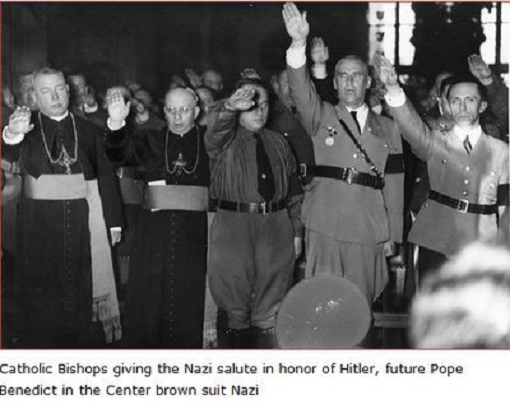
A widely circulated historical photograph depicts a group of Catholic bishops performing what appears to be the Nazi salute. The image has been cited in discussions about the Catholic Church’s relationship with the Third Reich and the complicity of religious institutions during the Nazi period.
Joseph Ratzinger and the Hitler Youth
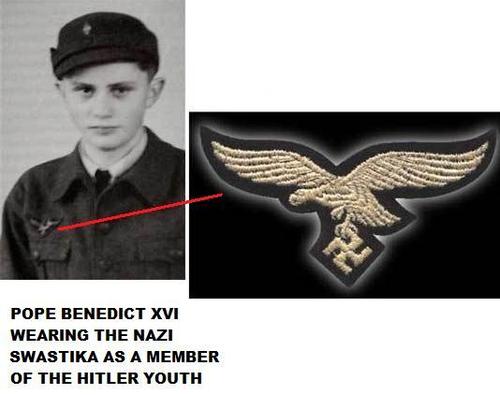
Joseph Ratzinger, who later became Pope Benedict XVI, was enrolled in the Hitler Youth as a teenager in Nazi Germany. This fact has been publicly acknowledged and is part of the historical record. Ratzinger was born in 1927 in Marktl am Inn, Bavaria, and membership in the Hitler Youth became mandatory for boys in Germany in 1939.
According to biographical accounts, Ratzinger’s family was not sympathetic to the Nazi regime. His father, a police officer, was reportedly critical of the Nazis, and the family’s Catholic faith put them at odds with elements of Nazi ideology. However, the compulsory nature of Hitler Youth enrollment meant that virtually all German boys of that era participated.
The Catholic Church and the Third Reich
The relationship between the Catholic Church and Nazi Germany remains one of the most examined and debated subjects in modern religious history. The 1933 Reichskonkordat — a treaty between the Vatican and the Nazi government — guaranteed certain rights for the Catholic Church in Germany in exchange for the Church’s withdrawal from political activity.
Critics have argued that the concordat lent legitimacy to the Nazi regime at a critical moment in its consolidation of power. Defenders of the Church’s position contend that the agreement was a pragmatic attempt to protect Catholic institutions and believers under an increasingly authoritarian government.
During the war, individual Catholic clergy responded in vastly different ways. Some actively collaborated with or were complicit in Nazi policies. Others engaged in resistance, sheltered persecuted individuals, or spoke out against atrocities. The full spectrum of these responses continues to be studied by historians.
Pope Pius XII and the Silence Debate
The most contentious aspect of the Church’s wartime conduct centers on Pope Pius XII, who led the Vatican from 1939 to 1958. His critics — most notably playwright Rolf Hochhuth in The Deputy (1963) — accused him of failing to publicly condemn the Holocaust despite having knowledge of the mass killings.
Supporters of Pius XII point to behind-the-scenes diplomatic efforts and claim that Catholic institutions under his direction sheltered hundreds of thousands of Jews and other persecuted people. The Vatican has gradually opened wartime archives to researchers, and the historical assessment continues to evolve.
The Broader Question of Institutional Accountability
Photographs like the one showing bishops performing the Nazi salute serve as stark visual reminders of the compromises that institutions — religious and otherwise — made during one of history’s darkest periods. They raise enduring questions about the responsibilities of powerful organizations when confronted with authoritarian governments.
The election of Joseph Ratzinger as Pope Benedict XVI in 2005 renewed public interest in these questions. While his childhood membership in the Hitler Youth was compulsory and does not indicate personal ideological alignment with Nazism, it underscored the impossibility of fully separating individual biographies from the historical contexts that shaped them.
The historical record demonstrates that the Catholic Church’s relationship with fascist governments in the twentieth century was complex, varied by country and individual, and remains a subject of legitimate scholarly inquiry and debate.