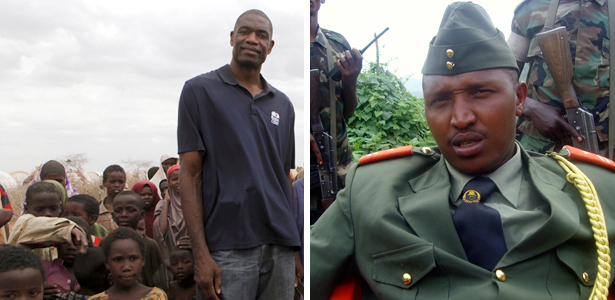
From NBA Courts to African Gold Fields
When a retired basketball legend and a Texas energy mogul tried their hand at purchasing gold in East Africa, they stumbled into one of the most dangerous mineral trafficking networks on the continent. Their costly misadventure exposes how Congo’s illicit gold trade ensnares even the most high-profile outsiders.
Dikembe Mutombo spent 18 seasons in the NBA, earning eight All-Star selections and recording the second-highest number of blocked shots in league history. Standing seven feet tall, the Congolese-born center was one of the most intimidating defensive forces of his era, averaging double-digit rebounds and points through his first eleven campaigns. His signature move after swatting away a shot was a wagging finger aimed at whatever unfortunate opponent had dared challenge him at the rim.
A Humanitarian’s Parallel Career
Away from the hardwood, Mutombo carved out a reputation as one of professional basketball’s most dedicated philanthropists. He completed dual degrees in linguistics and diplomacy at Georgetown University during an era when many prospects bypassed higher education entirely. While a bitter 1998 labor stoppage soured public opinion of professional athletes, Mutombo channeled his energy toward the crisis engulfing his homeland. Through his personal foundation, he financed and built a medical facility serving an impoverished district of Kinshasa. His charitable partnerships included collaborations with the Clinton Global Initiative and the Gates Foundation.
Caryl Stern, who led the U.S. Fund for UNICEF, described Mutombo’s devotion to the Democratic Republic of Congo as the driving force behind his philanthropic efforts, noting that he consistently worked behind the scenes rather than seeking media attention.
The $30 Million Gold Proposition
However, as a December 2011 United Nations Group of Experts report revealed, Mutombo’s business instincts lagged far behind his humanitarian impulses. He had partnered with Kase Lawal, CEO of Houston-based energy firm CAMAC and a presidential appointee to the Federal Trade Commission’s trade policy advisory committee. Together, the pair attempted to acquire what they believed was $30 million worth of gold from dealers operating in Kenya. The precious metal turned out to be largely counterfeit and controlled by one of Central Africa’s most feared military commanders, who ultimately pocketed millions from the duo’s reckless venture.
Their ordeal illustrates the treacherous nature of eastern Congo’s mineral economy, where opportunistic traders exploit conflict-tainted resources and perpetuate the region’s decades-long suffering. Even individuals with impeccable public credentials found themselves funneling cash directly to a warlord widely regarded as among the most ruthless figures in the Great Lakes region.
A Hotel Room Pitch That Started It All
On December 2, 2010, Mutombo convened a small gathering in a New York City hotel. He outlined a deal promising returns as high as $20 million within weeks. His primary audience included Lawal and Carlos St. Mary, a former West Point football player who traded West African diamonds professionally. Mutombo proposed they pool $10 million to purchase 4.5 tons of gold from Kenyan-based sellers. If they could transport the haul overseas and resell it on global markets, the potential windfall would triple their investment.
The retired athlete framed the proposition purely as a financial opportunity through his firm, Mutombo International Group, a modest company primarily invested in Atlanta-area retail properties.
Red Flags Ignored From the Start
The scale of the proposed transaction should have triggered immediate alarm. St. Mary, whose diamond-buying career took him regularly to Liberia and Sierra Leone, recalled that in his line of work, people rushed to sell quantities as small as ten grams. The notion of 4,000 kilograms sitting available for purchase strained all credibility.
Yet the promise of enormous profit kept everyone at the table. According to a presentation Mutombo delivered, relatives of his wife named David and Stephane Kapuadi had brought the opportunity forward. The slideshow stated the gold was securely stored in Nairobi and the sellers were actively seeking a buyer. Both relatives had supposedly verified the gold’s authenticity and assured immediate delivery.
Reading the presentation in hindsight, the gaps are conspicuous. Mutombo identified no actual owner of the gold. He referenced unnamed “partners” with unspecified roles and unclear motivations. Neither Mutombo’s foundation nor Lawal’s company agreed to provide detailed comment when journalists later sought clarification.
St. Mary acknowledged he failed to probe further during that initial meeting. As a longtime acquaintance of both principals, he felt reluctant to press uncomfortable questions. He later admitted that the combined reputations of everyone involved created a false sense of security.
$5 Million Vanishes in Nairobi
Lawal committed to funding the entire $10 million transaction, with Mutombo and St. Mary receiving profit shares for overseeing the exchange. St. Mary flew to Nairobi on a private jet, where David Kapuadi introduced him to the so-called partners: Eddy Michel Malonga, listed as the gold’s owner on a Kenyan export document, and a man who identified himself only as “Benoit.” United Nations investigators later identified Malonga as a member of a Kenya-based counterfeit gold operation spanning Central Africa, while “Benoit” was likely Yusuf Omar, another counterfeit gold trafficker.
Initially, the gold appeared genuine. Malonga escorted St. Mary to a refinery and showed purified samples. But the sellers then insisted the transaction could not close in Nairobi. Most of the gold, they admitted, was not even in Kenya. They demanded a $5 million deposit and offered Lawal two options: collect the gold later in Kampala, Uganda, or retrieve it immediately in Goma, the besieged capital of North Kivu province in eastern Congo.
A Struggling Company’s Desperate Gamble
With $5 million already committed and nothing received in return, Lawal pressed forward. His company’s financial position helps explain the urgency. CAMAC’s stock had plummeted from over $5 per share in April to roughly $2 by mid-December 2010. Despite controlling more than $400 million in assets, the company held just $22 million in liquid reserves and had posted nearly $188 million in losses for the fiscal year. The projected $20 million windfall from the gold deal represented a potential lifeline.
Lawal maintained an office in Kinshasa and assumed a transaction in the DRC would proceed smoothly, expecting the exchange to wrap up in a single afternoon.
Walking Into a Warlord’s Territory
Fred Robarts, one of the authors of the UN experts report, noted that the abrupt change of location combined with the large cash transfers in Nairobi should have signaled a scam. The Kenyan-based counterfeiting ring employed sophisticated methods to deceive buyers, including networks of individuals posing as customs officials and the ability to produce convincing-looking documentation.
Before departing New York, St. Mary had received Congolese export forms from Dikembe Mutombo’s nephew, Reagan Mutombo, and from David Kapuadi. These documents authorized the transfer of 73 grams of gold to Kenya, ostensibly proving the metal had legally crossed an international border. However, the gold’s stated origin was the conflict-ravaged Goma region. DRC President Joseph Kabila had imposed a domestic ban on mineral exports from the eastern provinces in September 2010, targeting the so-called conflict minerals that fund militia violence. The sellers may have circumvented this embargo by claiming a re-importation from Kenya. Alternatively, the paperwork may have been entirely fabricated.
On February 4, 2011, Lawal dispatched St. Mary to Goma aboard a leased Gulfstream with several CAMAC employees and nearly $5 million in cash. The moment the plane touched down, armed personnel boarded, confiscated passports, and delivered a chilling message.
According to St. Mary, soldiers told the group that “the general” wanted to see them. When they asked which general, the answer came back: Bosco Ntaganda, a notorious warlord later indicted by the International Criminal Court for war crimes. Ntaganda wanted to speak with them immediately.
A Chilling Exchange With a War Criminal
During the encounter, St. Mary challenged everyone in the room, demanding a single reason to place any trust in them. Ntaganda’s reply was blunt and menacing: the fact that they had not been killed that morning should suffice.
The entire episode stands as a stark warning about the perils of pursuing quick profits in conflict zones without adequate due diligence. Two prominent Americans, one a celebrated athlete and philanthropist, the other a presidential appointee running a publicly traded energy company, walked directly into the grip of an internationally wanted war criminal because the lure of easy money overwhelmed every warning sign along the way.
This article is based on reporting originally published by The Atlantic in March 2012, drawing on a December 2011 UN Group of Experts report and interviews with Carlos St. Mary and other sources.