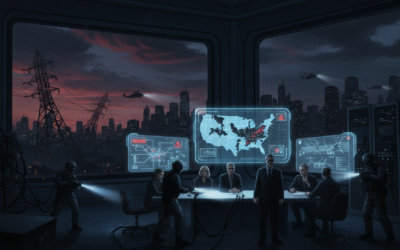
An Anonymous DHS Source Breaks Silence on Domestic Preparations
In late December 2012, an anonymous high-level official within the Department of Homeland Security — identified only by the codename “Rosebud” — broke a prolonged silence to share alarming claims about what was allegedly being planned behind closed doors in Washington. The interview, conducted by investigative journalist Doug Hagmann of the Northeast Intelligence Network, painted a picture of a government apparatus quietly positioning itself for widespread civil unrest, economic turmoil, and the systematic erosion of constitutional liberties.
The source had gone dark for months prior to the interview, citing intensified efforts within federal agencies to identify and prosecute internal leakers. According to Rosebud, surveillance of DHS employees by their own agency had reached unprecedented levels, forcing those with inside knowledge to adopt extreme measures of operational security.
Claims of a Planned Dollar Collapse and Economic Crisis
At the heart of Rosebud’s allegations was the assertion that the collapse of the U.S. dollar was not a matter of if, but when — and that it had been engineered over the course of decades. According to the source, this financial implosion was central to DHS preparations, suggesting the agency had been established not to shield Americans from external threats, but to manage domestic upheaval when the economy finally buckled.
Rosebud claimed that the fiscal cliff standoff of late 2012 was deliberately left unresolved as part of a broader strategy. The insider described hearing firsthand discussions at the highest levels of DHS involving senior White House adviser Valerie Jarrett and then-DHS Secretary Janet Napolitano, with Jarrett allegedly serving as the primary architect of these domestic contingency plans.
The source warned that the triggering event could be a derivatives market meltdown or an oil embargo, potentially arriving as early as spring 2013. While acknowledging that patriots within the system were working to delay or prevent such outcomes, Rosebud insisted the preparations were already well underway regardless of the precise timeline.
Prepositioning of Federal Assets and FEMA Facilities
Perhaps the most unsettling claims involved the physical infrastructure allegedly being prepared across the country. According to Rosebud, DHS was quietly establishing storage depots, armories, and detainment facilities in strategic locations near major urban centers. Commercial and business properties were reportedly being purchased or leased at a rapid pace for these purposes, all done with a deliberately low profile.
The source stated that some of these facilities, commonly referred to as FEMA camps, had been repurposed through executive orders for potential civilian detainment — a function that even FEMA personnel were allegedly unaware of. Rosebud described a scenario in which authorities would allow initial chaos to unfold, waiting for ordinary citizens to demand military intervention before implementing full-scale control measures.
Gun Confiscation Plans and the Targeting of the Second Amendment
Rosebud was emphatic that sweeping gun control measures were an integral component of the broader strategy. The insider claimed that plans formulated in the 1990s were being revived and accelerated in the wake of the Sandy Hook tragedy, which the source described as emotionally exploited for political leverage.
According to the whistleblower, the intended scope went far beyond assault weapon bans. The plan reportedly included criminalization of nearly all firearm possession, beginning with voluntary registration, followed by an amnesty period, and culminating in door-to-door confiscation. Semi-automatic weapons, shotguns with pistol grips or multi-round capacity, and high-capacity magazines over five rounds were all said to be targeted.
Ammunition manufacturers would face new restrictions, and the Affordable Care Act was described as a data collection tool that would link medical records — including questions about gun ownership asked during doctor visits — with federal databases to identify and flag armed citizens.
TSA Expansion and the Militarization of Local Police
The interview revealed claims of deepening coordination between DHS, the TSA, and municipal police departments. Federal funds were allegedly being distributed to local law enforcement at an accelerating pace, with strings attached that effectively transformed police units into paramilitary forces equipped with armored vehicles and military-grade equipment.
Rosebud singled out the TSA as a critical instrument in future domestic operations. The source described active planning between Napolitano and TSA Administrator John Pistole to deploy TSA agents alongside local police for operations tied to both economic crisis response and firearms confiscation. Under this framework, the TSA would assume authority over domestic travel — particularly once fuel became rationed or unavailable.
Surveillance, Dissent Lists, and Silencing Critics
The DHS insider confirmed the existence of classified lists maintained by federal agencies identifying political dissidents and vocal critics of government policy. While declining to specify color-coding systems that had circulated in alternative media, Rosebud stated unequivocally that such lists were real, had existed for years across multiple administrations, and had become far more organized under the current apparatus.
According to the source, the NSA’s comprehensive communications surveillance served a dual purpose: counterterrorism and the identification of individuals deemed threats to the established power structure. Those on the lists faced a range of potential consequences — from being approached with offers to cease their opposition, to forced re-education programs, to outcomes disguised as natural deaths or suicides.
Rosebud drew a parallel to the aftermath of the 1995 Oklahoma City bombing, when the Clinton administration partially blamed talk radio for fostering extremism. The source predicted that in a full-blown crisis, any media figure or blogger who spoke against the government would be accused of inciting violence, with their speech effectively criminalized under emergency measures.
Manufactured Division and the Path to Martial Law
Throughout the interview, Rosebud emphasized that the deep ideological division in America was not accidental but cultivated. The source compared the national rift to conditions preceding the Civil War and warned that the combination of economic collapse, food shortages, and civil unrest would create conditions under which citizens would voluntarily surrender their freedoms in exchange for the promise of order.
The insider described seeing internal documents including a borderless map of North America dated 2015, alongside a separate map dividing the United States into economic zones with Denver marked prominently. While acknowledging these claims would sound conspiratorial, Rosebud maintained they were drawn from materials observed firsthand within DHS facilities.
The source also referenced Bill Ayers and Bernardine Dohrn, suggesting their revolutionary ideology had been reborn within the current political framework. Rosebud urged examination of White House visitor logs as evidence of ongoing ideological influence at the highest levels of government.
Resistance and the Question of Loyalty
When asked about potential resistance from within law enforcement ranks, Rosebud acknowledged that some officers and agents — including those affiliated with groups like Oath Keepers — would refuse to comply with unconstitutional orders. However, the source warned that such resisters would be both outnumbered and outgunned, particularly once outside forces were brought in to manage domestic unrest.
The insider’s final warning was characteristically urgent: watch events beginning with the January 2013 inauguration, pay attention to precious metals markets for signals of impending economic disruption, and understand that the machinery of control was already in motion — adaptable in its timing but unwavering in its objectives.
Assessing the Claims in Historical Context
The Rosebud interview, originally published in late December 2012, represents one of the more detailed alleged insider accounts from this period of heightened anxiety about government overreach. While many of the specific predictions — particularly regarding imminent dollar collapse and mass gun confiscation — did not materialize on the timeline described, the interview reflected genuine concerns about expanding government surveillance, the militarization of domestic law enforcement, and the erosion of civil liberties that would become major topics of public debate in subsequent years, particularly following the Edward Snowden revelations of June 2013.
The claims should be evaluated critically, recognizing that anonymous sources operating without verifiable credentials present inherent credibility challenges. Nevertheless, the themes raised — government surveillance of citizens, emergency preparedness that doubles as population control infrastructure, and the political exploitation of crises — remain relevant subjects of inquiry and public discourse.