For years, a nondescript warehouse on Chicago’s west side operated as something civil liberties attorneys would come to describe as the domestic equivalent of a CIA black site. Known as Homan Square, the facility housed special police units that, according to multiple lawyers and at least one detainee who spoke publicly, systematically denied Americans their basic constitutional protections.
Inside Homan Square: What Attorneys and Detainees Reported
Based on interviews conducted by The Guardian with local defense lawyers and individuals held at the facility, the practices allegedly carried out at Homan Square included:
- Detaining individuals without entering them into official booking databases, making them effectively invisible to the legal system
- Physical violence during interrogations, resulting in documented head injuries
- Prolonged shackling of detainees, sometimes lasting the better part of a full day
- Systematically refusing attorneys access to what police called a “secure facility”
- Holding people — including minors as young as fifteen — without legal counsel for twelve to twenty-four hours
- At least one death: a man found unresponsive in a Homan Square interrogation room, later pronounced dead
Unlike standard police precincts, Homan Square apparently maintained no publicly searchable booking records for those brought inside. Family members and lawyers described an agonizing process of calling station after station, searching databases, and hitting dead ends — only to eventually discover their loved one or client had been inside the warehouse all along.
The Case of Brian Jacob Church and the NATO Three
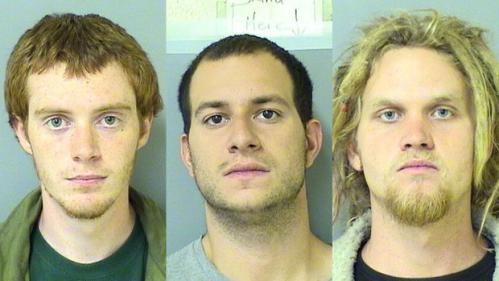
Brian Church, Jared Chase, and Brent Vincent Betterly, known as the NATO Three
One of the most detailed accounts of Homan Square came from Brian Jacob Church, a protester arrested alongside eleven others on May 16, 2012, after police infiltrated a demonstration against the NATO summit in Chicago. Church described being handcuffed to a bench inside a windowless cinder-block cell for approximately seventeen hours. Throughout that time, officers intermittently questioned him without ever reading him his Miranda rights.
Church had written a National Lawyers Guild phone number on his arm before the protest as a precaution. Once inside Homan Square, he specifically asked to contact his attorneys and was refused. As he later recounted, the experience felt like being forcibly disappeared — removed from any system that would allow the outside world to locate him.
His legal team spent twelve hours in what attorney Sarah Gelsomino described as “active searching” before they could determine where Church was being held. No booking record existed. Only after attorneys made what Gelsomino called a “major stink” — leveraging contacts in the offices of both the corporation counsel and Mayor Rahm Emanuel — did they learn about the Homan Square facility at all.
When an attorney was finally permitted to visit, the meeting took place through a floor-to-ceiling chain-link cage. It took several additional hours before Church and his two co-defendants were transported to a nearby police station for formal booking and charging. Church ultimately served two and a half years in prison after being acquitted of terrorism charges but convicted on lesser counts of possessing an incendiary device and misdemeanor “mob action.”
A Pattern of Concealment Across Multiple Cases
Church’s experience was far from isolated. Between 2009 and 2013, at least three attorneys reported being personally turned away from Homan Square when attempting to see clients. Two additional lawyers described the facility as a location where police actively concealed information about detainees’ whereabouts.
Chicago attorney Julia Bartmes characterized it as common knowledge among defense lawyers who regularly visited police stations: when a client could not be found in any system, they were most likely at Homan Square. In one case she handled in September 2013, a fifteen-year-old boy was held at the facility for twelve or thirteen hours in connection with a shooting investigation before being released without charges — but only after Bartmes physically traveled to the building and confronted officers.
In January 2013, according to Eliza Solowiej of Chicago’s First Defense Legal Aid, one man had his name altered in the central bookings database before being transferred to Homan Square with no record of the move. Solowiej spent six to eight hours searching for him. She only located the man after he was taken to a hospital with head injuries he attributed to an interrogation inside the facility.
A Death Inside the Facility
On February 2, 2013, a 44-year-old man named John Hubbard was brought to Homan Square. He never left alive. According to the Chicago Tribune, Hubbard was discovered unresponsive inside an interrogation room. The Cook County medical examiner subsequently determined the cause of death to be heroin intoxication, but the circumstances surrounding his detention and death raised troubling questions that were never fully resolved.
Constitutional Rights and Chicago’s History of Police Abuse
Civil rights attorney Flint Taylor, best known for pursuing cases against the notoriously abusive Area 2 police commander Jon Burge, placed Homan Square within a decades-long continuum of Chicago police misconduct. Taylor recalled how, beginning in the early 1970s, his clients described being shuffled between police stations before ending up at facilities where coerced confessions were extracted through torture and other forms of abuse.
Retired Washington, D.C. homicide detective James Trainum, who studies interrogation practices for the Innocence Project and the Constitution Project, said he was unaware of any comparable facility in the United States where police held individuals incommunicado for extended periods before booking. The concept, he said, was deeply alarming.
Chicago’s own police directives explicitly prohibited the practices described at Homan Square. One policy titled “Processing Persons Under Department Control” stated that interrogation must not delay the booking process and that arrestees must be permitted a reasonable number of phone calls to attorneys promptly after arriving at any place of custody. Another directive mandated that supervisors allow attorney visitation. Despite a tightening of these rules in 2012 — reportedly prompted by quiet complaints from lawyers about Homan Square specifically — the abuses continued.
Military Equipment and the Blurring of Domestic and Foreign Operations
Church recalled seeing oversized military-style vehicles inside the Homan Square compound that resembled the Mine-Resistant Ambush Protected vehicles used by US forces in the Middle East. Cook County had received approximately 1,700 pieces of surplus military equipment through a Pentagon program that transferred battlefield gear to local law enforcement agencies, including at least one Humvee.
Criminologist Tracy Siska of the Chicago Justice Project argued that Homan Square, along with the unrelated revelation that a retired Chicago detective had previously served as an interrogator at Guantanamo Bay, illustrated a dangerous convergence between foreign military operations and domestic policing. The interrogation techniques, the equipment, and the institutional secrecy — all had migrated from overseas battlefields into American cities.
Andrea Lyon, a former Chicago public defender and dean of Valparaiso University Law School, drew a direct parallel to CIA operations abroad. When she practiced in Chicago during the 1980s and 1990s, she said, police used the term “shadow site” to describe exactly the kind of off-the-books detention that Homan Square had institutionalized on a larger scale.
The Chicago Police Department’s Response
The Chicago Police Department initially declined to answer questions about the facility. After The Guardian published its investigation, the department issued a statement insisting that all laws, rules, and guidelines were followed at what it termed a “sensitive” location housing undercover units. The statement claimed that attorneys were permitted to visit detained clients and that booking records were always maintained — assertions directly contradicted by the testimony of multiple lawyers and at least one former detainee.
The department did not address how long after an arrest those records were generated or whether they were accessible to the public in real time. A spokesperson declined to respond to detailed follow-up questions.
This article is based on investigative reporting originally published by The Guardian in February 2015, including interviews with attorneys, detainees, former law enforcement officials, and legal scholars. All factual claims reflect the public record as documented at the time of the original investigation.