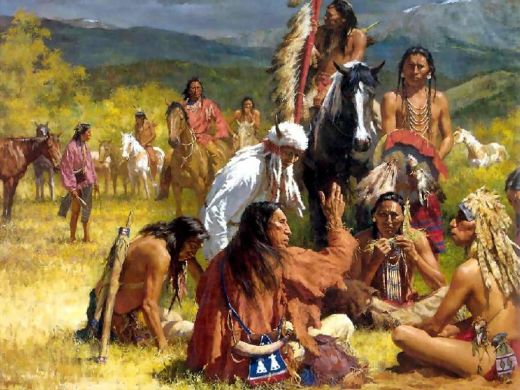
Long before modern technology made daily life convenient, indigenous peoples across North America developed sophisticated methods for thriving in the wilderness. These techniques, refined over thousands of years, encompassed everything from silent movement through dense forest to crafting effective tools from raw materials. Many of these skills remain highly relevant for anyone interested in self-reliance, outdoor preparedness, or simply developing a deeper connection with the natural world.
The Value of Community in Survival
Indigenous survival traditions emphasize that no individual can thrive in isolation for long. Tribal communities distributed specialized knowledge across their members, with different individuals mastering different skills such as tracking, tool making, plant identification, and shelter construction.
This principle translates directly to modern preparedness thinking. Finding others with complementary skills and a shared commitment to self-reliance creates resilience that no individual can achieve alone. A functioning community provides access to diverse resources, distributed labor for essential tasks, and the psychological benefit of mutual support during difficult circumstances.
Learning directly from experienced practitioners remains the most effective way to internalize survival skills. Martial arts, wilderness courses, and hands-on mentorship programs all provide experiential learning that reading alone cannot replicate.
The Survival Knife as a Foundation Tool
Across virtually every indigenous culture, the blade represented the foundational technology upon which all other survival capabilities rested. Understanding how to select, use, and even fabricate a knife remains one of the most critical wilderness skills.
A well-chosen survival knife needs to perform a wide range of tasks:
- Chopping and cutting wood for shelter and fire
- Carving wood into tools, utensils, and weapon components
- Stripping bark for cordage and lashing
- Processing game after a hunt
- Cutting cordage and natural fiber
- Fashioning fishing implements
- Striking fire steel to create sparks
- Shaving and scoring wood for fine work
- Self-defense when necessary
Experienced practitioners generally recommend a blade no longer than five inches. Longer blades become unwieldy for detailed carving work and can be dangerous in close-quarters tasks. A straight edge is preferable to serration, since the strongest cutting zone near the handle needs to be smooth for effective chopping and carving. The blade should taper to a sharp point, enabling its use as a spear tip when lashed to a long stick for hunting.
Learning to fabricate a knife from bar stock is a valuable skill in itself. For under a hundred dollars in materials, the knowledge of shaping and heat-treating metal ensures the ability to replace a lost or broken blade, a capability that indigenous metalworking cultures considered essential.
The Fox Walk: Moving Without Detection
One of the most refined techniques developed by indigenous peoples was a method of silent movement through the forest known as the Fox Walk. This approach allowed hunters and scouts to pass through dense woodland without alerting wildlife or leaving obvious trail signs. The technique was so effective that the U.S. Navy SEALs later adopted it for covert movement behind enemy lines.
The Fox Walk follows specific principles:
- It is most effective barefoot or in soft-soled footwear such as moccasins, allowing the foot to feel the ground surface and avoid noise-producing debris like dry sticks and leaves.
- Each step begins with the heel making contact first. This requires deliberate balance, as the walker may need to shift foot placement mid-step to avoid objects that would produce sound.
- The outside edge of the foot rolls down next, followed by the ball of the foot, distributing weight gradually and minimizing both noise and visible footprint depth.
- When traveling in a group, each person places their feet in the tracks of the person ahead, a battle-tested method of concealing group size from trackers.
- The pace is deliberately slow and steady, conserving energy while maintaining near-total silence.
Wide-Angle Vision: Seeing Like a Hunter
Complementing the Fox Walk is a visual technique known as Wide-Angle Vision, which shifts perception from focused detail to broad awareness. Rather than fixating on objects directly ahead, this method engages peripheral vision to detect movement, inconsistencies in pattern, and environmental cues across a much wider field.
To practice Wide-Angle Vision:
- Extend both hands directly in front of you at eye level.
- Slowly separate them outward until your arms are fully extended to each side.
- Wiggle your fingers. If you can detect the movement of both hands simultaneously, you have activated your peripheral awareness.
- Maintain this expanded field of vision while moving through the environment.
Wide-Angle Vision serves multiple functions. It dramatically improves the ability to spot game, detect approaching threats, and identify useful resources in the surrounding landscape. It also enhances sound perception, as the relaxed visual state appears to allow the brain to process auditory information more effectively.
Combining Techniques for Wilderness Effectiveness
When practiced together, the Fox Walk and Wide-Angle Vision create a remarkably efficient mode of wilderness travel. The slow, deliberate pace conserves energy. The expanded awareness identifies resources and threats at greater distances. The silent movement avoids alerting wildlife, improving hunting success.
Practitioners often describe the combined effect as something approaching a heightened state of awareness, a deep attunement to the surrounding environment that experienced indigenous hunters reportedly maintained throughout their daily activities. The perception extends beyond what focused, hurried movement through the landscape could ever achieve.
These techniques represent just a fraction of the wilderness knowledge developed by indigenous peoples over millennia. As interest in self-reliance and outdoor skills continues to grow, the methods of those who lived closest to the land offer some of the most time-tested and effective approaches available.