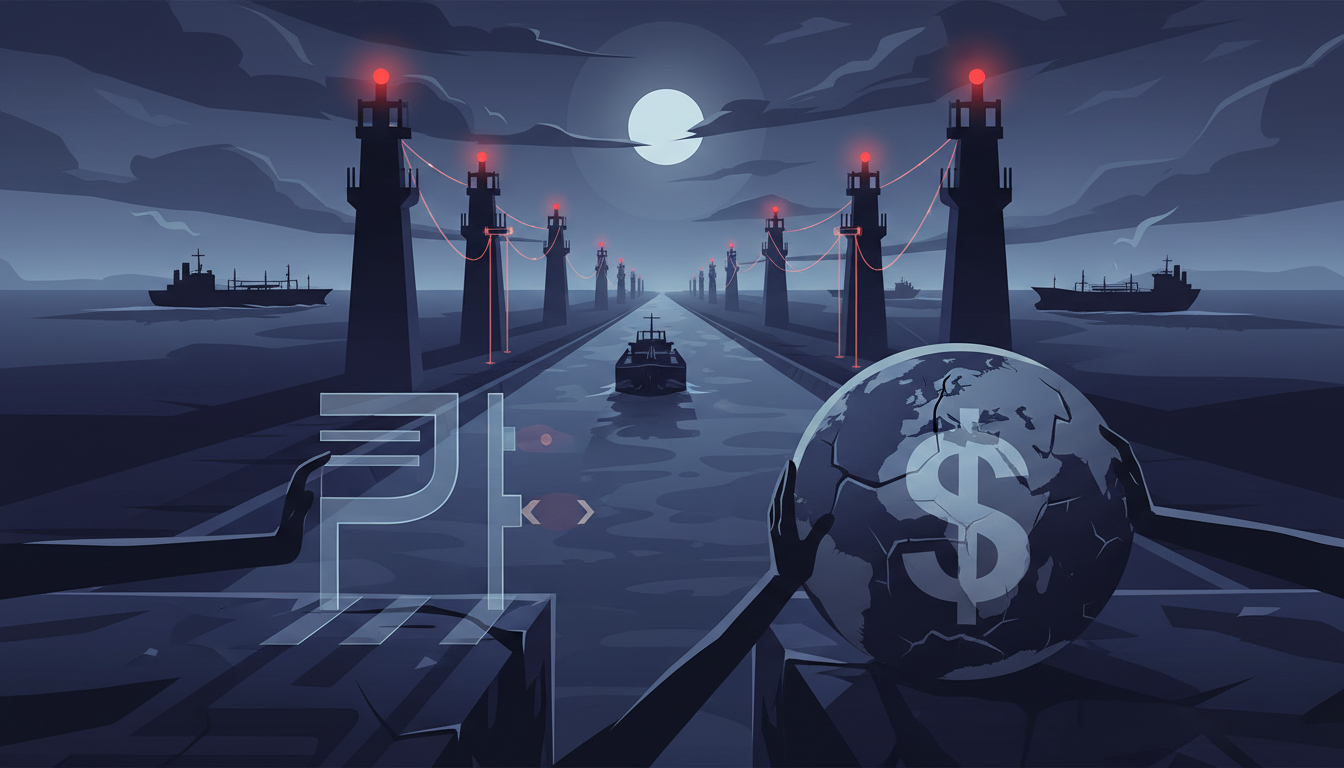
Iran has transformed the Strait of Hormuz from a free-passage waterway into what amounts to a controlled toll gate, fundamentally challenging the petrodollar system that has anchored U.S. global economic dominance for half a century. Through this strategic chokepoint flows roughly 20% of the world’s oil and a fifth of global liquefied natural gas trade—making Iran’s new approach a direct assault on the financial architecture underpinning American power.
According to Reuters and Lloyd’s List reporting, Iranian officials are actively implementing a system requiring ships to pay transit fees, with some vessels reportedly making payments in Chinese yuan. This represents more than a simple navigation fee—it constitutes a fundamental restructuring of how energy flows through one of the world’s most critical maritime passages.
The Mechanics of Iran’s New System
Lloyd’s List maritime intelligence reports that Tehran has established what industry sources describe as a “toll booth” system, requiring vessels to follow Iranian-coordinated routes and protocols. Some ships have already paid fees—reportedly in yuan—though many operators are seeking diplomatic intervention to avoid direct engagement with what the U.S. designates as a Foreign Terrorist Organization.
The Iranian approach goes beyond simple transit control. According to multiple industry sources cited by Lloyd’s List, operators now face legal and sanctions risks even for indirect engagement with Iran’s Revolutionary Guard Corps (IRGC), which maintains control over the strait. Sanctions experts warn that paying IRGC-linked tolls could trigger U.S., UK, or EU penalties, despite Iran’s assertions that “non-hostile” vessels may transit with proper coordination.
Bloomberg reports that vessels are increasingly required to follow specific Iranian protocols, marking a decisive shift from the traditional principle of free navigation that has governed this waterway since the establishment of modern maritime law.
Striking at the Petrodollar Foundation
The implications extend far beyond shipping logistics. For decades, Washington’s global influence has rested on its control over oil flows and the requirement that energy trades occur in U.S. dollars. This petrodollar system has guaranteed global demand for American currency and provided the United States with immense leverage over international commerce.
According to Frontline reporting, the dollar remains involved in roughly 89% of all global foreign exchange transactions, with oil being priced almost exclusively in dollars since the 1974 U.S.-Saudi arrangement. Every nation importing oil must accumulate dollars, feeding demand for U.S. Treasury securities and maintaining the depth of American financial markets.
Iran’s toll system directly threatens this arrangement. If oil passing through Hormuz begins shifting toward yuan-denominated transactions, it could accelerate erosion of a key pillar of American economic influence. The precedent is significant—previous leaders who attempted to move oil trade away from the dollar, including Iraq’s Saddam Hussein and Libya’s Muammar Gaddafi, faced severe consequences.
Economic Cascade Effects
The immediate market response has been severe. Oil prices have surged to $120 per barrel, with analysts warning of further increases if disruptions continue. But the effects extend throughout the global economy, as energy costs are embedded in virtually every sector from transportation and manufacturing to agriculture.
Rising energy costs drive up production expenses for fertilizers, transportation, and supply chain maintenance, creating a cascade effect that ultimately impacts consumers through increased food prices. Economic analysts warn that households across Western economies could face grocery cost increases of up to 20% as these pressures compound.
Economist Richard Wolff has characterized the current situation as part of a broader historical shift away from U.S. dominance, describing it as “the decline of an empire” and pointing to Washington’s diminishing ability to dictate global economic outcomes.
Geopolitical Realignment
The crisis is accelerating alignment among major powers seeking alternatives to U.S.-led financial systems. China and Russia have deepened economic and strategic ties with Iran, forming part of a broader bloc that strengthens BRICS nations and signals movement toward a multipolar world with more distributed economic power.
For countries in the Global South, this represents an opportunity to reduce dollar dependence and gain greater control over their economic policies. However, others face exposure, particularly the Gulf Arab states whose economies have been built around the petrodollar compact.
Reuters reports that Gulf nations are reconsidering the fundamental bargain underlying their relationship with Washington—U.S. protection in exchange for dollar-denominated oil sales and recycling of petrodollar revenues into American investments. The arrangement has required these nations to maintain an estimated $800 billion in dollar reserves and invest over $6 trillion through sovereign wealth funds in U.S.-heavy assets.
Strategic Miscalculation
Even President Trump has acknowledged the scale of Iran’s response exceeded expectations, admitting he “didn’t think they would react this strongly” while recognizing that Iran has proven “very strong” under pressure. This admission points to a significant miscalculation regarding Iran’s willingness to leverage its strategic position.
The crisis represents a direct test of whether the petrodollar system can withstand challenges from regional powers willing to use geography and energy resources as economic weapons. Iran’s transformation of Hormuz into a controlled passage demonstrates how traditional assumptions about maritime commerce and currency dominance can be disrupted by determined state actors.
As this situation develops, it will likely determine whether the half-century-old petrodollar arrangement can adapt to multipolar realities or whether alternative financial architectures will emerge to challenge American economic supremacy. The stakes extend beyond regional conflict to the fundamental structure of global finance.
This article draws on reporting from Activist Post, Lloyd’s List, Frontline, and Reuters.