The NSA’s Massive Expansion After 9/11
In a period of extraordinary growth, the National Security Agency embarked on a construction spree that reshaped the American intelligence landscape. NSA Director General Keith Alexander traveled the country inaugurating one classified facility after another — a $358 million signals intelligence building in Hawaii in January, followed by a 604,000-square-foot operations center at NSA Georgia in March. The Georgia facility was designed to accommodate roughly 4,000 intercept operators, analysts, and specialists, many employed by private defense contractors rather than the government itself. Its amenities included a 2,800-square-foot fitness center, 47 conference rooms, and 22 secure compartmented information facilities known internally as “caves.” Media cameras were prohibited within two miles of the dedication ceremony.
The expansion stretched overseas as well. Menwith Hill, the agency’s enormous satellite interception station in Yorkshire, England — bristling with 33 dome-covered antenna dishes — received tens of millions of dollars in upgrades, including a $68 million power generation facility for new supercomputers. Staffing at the base, heavily populated by Lockheed Martin and Northrop Grumman employees, was projected to grow from 1,800 to 2,500 by 2015 according to British studies.
Back at Fort Meade, the agency’s 27-hole golf course was being demolished to accommodate a $2 billion, 1.8-million-square-foot headquarters expansion incorporating a cybercommand complex and a supercomputer center estimated at nearly $1 billion.
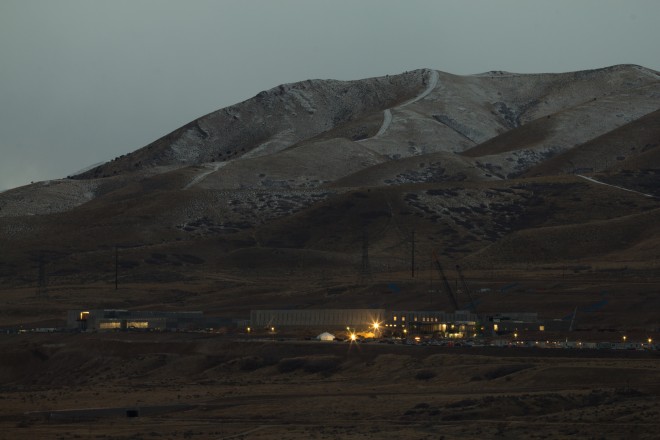
The crown jewel of this building campaign was the nearly completed Utah Data Center — a million-square-foot, $2 billion facility designed to serve as the central repository for the trillions of intercepted phone calls, emails, and digital records collected by the agency’s global monitoring apparatus.
Stellar Wind: How Secret Domestic Wiretapping Was Built
While the agency publicly maintained that Americans should trust its commitment to constitutional protections, the internal reality told a different story. The actual construction of the NSA’s domestic eavesdropping network — codenamed Stellar Wind — had never been fully described until former agency insiders began speaking publicly.
J. Kirk Wiebe, a senior analyst serving as chief of staff for the Signals Intelligence Automation Research Center (SARC), recalled the moment the program materialized before his eyes. Walking through the hallways of Operations Building 2B at Fort Meade, he encountered stacks of new Dell 1750 servers piled in their shipping boxes. When he attempted to enter the SARC Situation Room on the third floor — just below the director’s office — he was nearly ejected by a colleague named Ben Gunn, who was orchestrating the launch of the classified program.
According to Bill Binney, a former SARC co-director who had spent decades automating the NSA’s worldwide monitoring systems, Gunn was a Scottish-born naturalized American citizen and former GCHQ analyst who had risen to a senior position at the agency. The NSA refused requests to confirm or deny Gunn’s employment, citing standing policy.
A Small Contractor With a Troubled Past Gets the Keys
The servers were soon moved behind a red-sealed door indicating the highest levels of compartmented classification. But rather than staffing the operation with vetted government employees, the NSA turned to a tiny private company with a deeply problematic history: Technology Development Corporation.
TDC was founded in April 1984 by brothers Randall and Paul Jacobson and operated largely out of Randall’s home in Clarkesville, Maryland, with his wife handling the bookkeeping. The company’s listed address was a post office box across the highway from NSA headquarters, and its phone number in business directories actually rang to a line inside Binney’s former office at the agency.
The arrangement began unraveling in June 1992 when Paul Jacobson lost his security clearance. Binney described him as exhibiting erratic behavior that agency officials considered unstable. Paul subsequently sued his rival contractor Unisys, alleging their employees had sabotaged his reputation by characterizing him as strange, robotic in demeanor, poorly dressed, and emotionally unfit. Around the same period, he began legally changing his name — first to Jimmy Carter, then to Alfred Olympus von Ronsdorf.
After losing clearance, Paul remained a shareholder and retained access to company finances, allegedly making approximately $100,000 in unauthorized withdrawals according to court filings. His brother Randall had his own legal difficulties, having failed to file income tax returns for three consecutive years during the 1990s according to tax court records. Then in March 2002, while TDC was finalizing the Stellar Wind infrastructure, Randall terminated his brother for improper billing practices, triggering years of litigation over company ownership and management.
Contractors Sound the Alarm on Unconstitutional Surveillance
Despite these internal problems, TDC personnel reportedly recognized the constitutional implications of their work almost immediately. Binney recounted that company employees approached him with alarm after discovering the true scope of what they were building. They understood that the system was ingesting domestic American communications — phone numbers, email addresses, personal data, and content — sourced from secret installations embedded in major telecommunications switching centers across the country, estimated at between 10 and 20 locations.
Once TDC completed the initial setup, the NSA transferred operational control to employees from Science Applications International Corporation. TDC was reassigned to other agency projects, where both the company and Randall Jacobson remained as of the time of reporting.
Israeli-Linked Firms at the Heart of U.S. Wiretapping Infrastructure
The use of questionable contractors extended beyond building the surveillance center to the actual wiretapping of American telecommunications networks. According to a former Verizon employee with knowledge of the arrangements, the Israeli-founded company Verint — a subsidiary of Comverse Technology — installed and operated the interception equipment on Verizon’s communication lines.
At AT&T, the surveillance infrastructure relied on hardware and software from Narus, an Israeli-founded company later acquired by Boeing. Former AT&T technician Mark Klein first exposed these secret wiretapping rooms in 2004, revealing how internet traffic was being duplicated and routed to NSA-controlled equipment.
Both companies maintained deep connections to Israel’s intelligence establishment. Narus was incorporated in Israel in November 1997 by six Israeli founders, with financing from the Israeli venture capital firm Walden Israel. Co-founder Ori Cohen acknowledged publicly that his business partners had performed technology work for Israeli intelligence services. Another founder, Stanislav Khirman, had previously worked at Elta Systems — a division of Israel Aerospace Industries that specialized in building advanced electronic surveillance equipment for Israeli defense and intelligence organizations. Khirman served as Narus’s chief technology officer.
Secret Transfer of NSA Technology to Israel
Binney revealed that the situation was compounded by an unauthorized transfer of the NSA’s own proprietary surveillance software to Israel. A mid-level technical director within the Operations Directorate — described by Binney as an ardent supporter of Israel — secretly provided the agency’s advanced data mining and analytical tools to Israeli counterparts without authorization or the knowledge of the relevant oversight bodies.
Binney, who chaired the Technical Advisory Panel responsible for monitoring foreign technical relationships, said he was never informed of the transfer. After discovering what had occurred, he advocated for formalizing the arrangement so the NSA could at least obtain something in return, ultimately negotiating access to communications switching infrastructure. However, he later came to suspect that Israeli intelligence had shared the technology with private Israeli companies operating internationally, effectively creating commercial extensions of the intelligence service. The subsequent emergence of Narus and its sophisticated interception capabilities struck Binney as more than coincidental.
Verint’s Founder: A Fugitive Wanted by the FBI
The integrity concerns surrounding these contractors were hardly theoretical. Verint was co-founded by Jacob “Kobi” Alexander, a former Israeli intelligence officer who became a fugitive from American justice, facing nearly three dozen federal charges including fraud, theft, bribery, and money laundering. Two senior Comverse executives — CFO David Kreinberg and former General Counsel William F. Sorin — were also indicted, pleaded guilty, and served prison sentences while paying millions in fines.
Retired Brigadier General Hanan Gefen, a former commander of Israel’s Unit 8200 (the country’s equivalent of the NSA), publicly acknowledged the unit’s direct influence on companies dominating the American surveillance market. He specifically cited NICE, Comverse, and Check Point as enterprises shaped by Unit 8200 technology, noting that Check Point was founded by unit alumni and that Comverse’s flagship product was derived from military systems developed within the unit.
A former Unit 8200 chief estimated that veterans of the secretive signals intelligence organization had established between 30 and 40 technology companies, with five to ten achieving listings on Wall Street. He characterized this pattern as anything but coincidental, noting that many globally deployed commercial technologies originated as Israeli military systems refined by unit veterans.
The NSA’s Hollow Assurances
Confronted with questions about these contractors and their histories, the NSA declined to verify any specific claims but offered general reassurances about its commitment to investigating misconduct and adhering to constitutional requirements. The agency characterized allegations of improper monitoring of American communications as a disservice to its workforce.
These assurances sat uneasily alongside the extensive documented record of warrantless surveillance. In the only lawsuit challenging the program to survive the government’s invocation of state secrets privilege, a federal judge ruled that two American lawyers had been illegally surveilled and were entitled to compensation — a judicial finding that directly contradicted the agency’s claims of lawful operation.
As the NSA’s network of outsourced surveillance facilities continued to multiply, one question persisted that few in Congress appeared willing to raise: who was providing oversight over the organizations conducting the surveillance?
This article is based on reporting originally published by Wired. All factual claims are attributed to the sources cited.