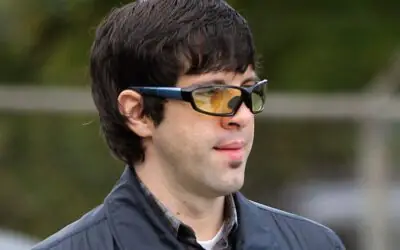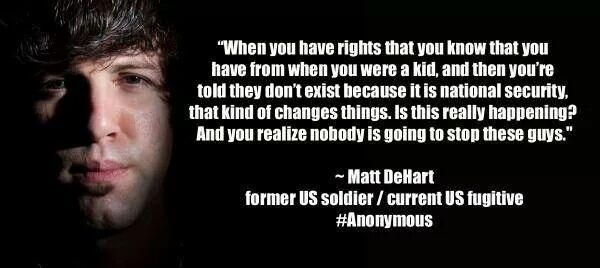
The case of Matt DeHart, a former U.S. Air National Guard Intelligence Analyst who became entangled with the hacktivist collective Anonymous, raised complex questions about government surveillance, whistleblower protections, and the treatment of citizens accused of espionage-related activities.
From Military Service to Hacktivism
DeHart grew up in a military family and followed his parents into government service, training as an Intelligence Analyst with the Air National Guard. His introduction to activism came through Project Chanology, the Anonymous-led campaign against the Church of Scientology that popularized the now-iconic Guy Fawkes mask.
His involvement deepened over time. DeHart eventually co-administered a Tor server on which files of unclear origin appeared in the fall of 2009. According to his attorney Tor Ekeland, the file in question was reportedly an FBI investigative document concerning domestic criminal activity by the CIA. Some speculated the file was en route to WikiLeaks, though this was never confirmed. The file remained unencrypted on the server for approximately two days before DeHart deleted it.
The FBI Raid and Child Pornography Charges
In 2010, federal agents raided DeHart’s residence. No malware or the mystery file were found on his equipment. The search warrant, issued by the Memphis FBI field office, stated the agents were searching for child pornography. No such material was reportedly found during the search.
However, the raid marked the beginning of DeHart’s legal troubles. Department of Justice documents later revealed that his detention was actually related to national security and espionage concerns, not the child pornography charges that were formally filed.
Detention and Allegations of Mistreatment
After visiting the Russian and Venezuelan embassies — either seeking employment opportunities or, by his alternate account, attempting to provide misinformation about drone technology — DeHart relocated to Canada. When he briefly returned to the U.S. to obtain paperwork for a Canadian student visa, he was detained at the border.
According to DeHart and his family, he was handcuffed by border guards, transported to an ICE detention center by an FBI agent, denied access to a lawyer, strapped into a chair, administered an intravenous drip, and interrogated aggressively for hours. A new criminal complaint charging solicitation of child pornography was written that same day.
Medical personnel at the hospital where he was subsequently taken determined his symptoms were consistent with drug-induced psychosis. His family has repeatedly requested transcripts of the interrogation but was told no audio or video records exist. His father, Major Paul DeHart, found this implausible given that agents had been flown in from the national security section in Washington specifically for the questioning.
A judge eventually reviewed the inconsistencies in the case, found DeHart to be a credible witness and not a flight risk, and ordered his release with electronic monitoring.
Flight to Canada and Asylum Claim
On April 2, 2013, DeHart and his family drove north to Fort Frances, Ontario, where they claimed refugee status and requested asylum under the United Nations Convention Against Torture. The family argued that DeHart had been subjected to treatment by the FBI that constituted torture under international law.
His father drew parallels to Canada’s history of providing sanctuary. During the Vietnam era, Canada welcomed tens of thousands of American war resisters and granted them immigrant status. The elder DeHart noted that requesting asylum against one’s own country after a career of military service was a gut-wrenching experience.
The Canadian government responded the following day by charging Matt with espionage against Canada. He was subsequently detained and held in Canadian custody, where he made two apparent suicide attempts, including diving headfirst onto a concrete floor from a top bunk.
Legal Limbo Between Two Countries
The case created an unusual jurisdictional situation. More than a year and a half after the family arrived in Canada, the United States had filed no extradition request — a delay his father described as raising obvious questions. The child pornography case in Tennessee was suspended pending DeHart’s potential return to the U.S.
Both Canadian and American intelligence agencies appeared to be coordinating behind the scenes. Questions posed to the DeHart family by the Canadian Security Intelligence Service and the war crimes unit of the Canada Border Services Agency focused on events in the United States unrelated to child pornography.
The family’s legal fundraiser was abruptly shut down by the hosting platform GoFundMe, allegedly for terms of service violations, though the campaign had been created and managed by a law firm. The fundraiser was quickly rebuilt on a Canadian platform.
A Family in Exile
The DeHart family expressed their intention to remain in Canada permanently, understanding that receiving protected status would mean never returning to their country of birth. Major DeHart was unable to attend his own mother’s funeral after she passed away in May 2013.
The case illustrated the precarious position of individuals caught between national security interests and civil liberties protections, and raised ongoing questions about the use of criminal charges as leverage in espionage investigations, the treatment of detainees during national security interrogations, and the limits of asylum protections when powerful allied governments are involved.