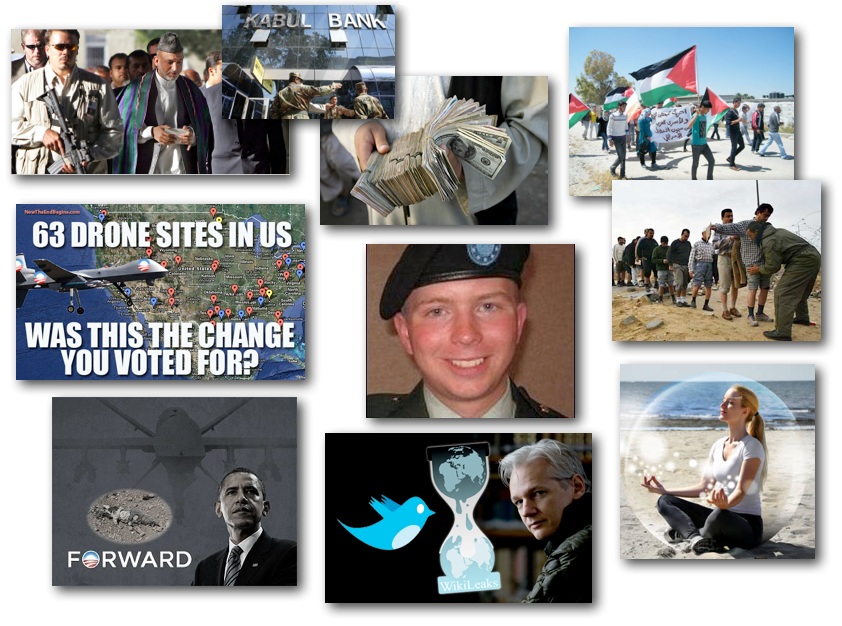
Afghan corruption, and how the U.S. facilitates it
4 More Drones! Robot Attacks Are on Deck for Obama’s Next Term
U.S. WikiLeaks Criminal Probe ‘Ongoing,’ Judge Reveals
Gaza, The World’s Largest Open-Air Prison
How to resist the federalization and militarization of your local police
Psychic Protection: Immunize Yourself Against Negative Energy
Show Transcript
Introduction: Afghan Corruption and Tonight’s Topics
Welcome to Decrypted Matrix on Revealing Talk Radio. It is Wednesday, November 7th, 2012. Thank you for giving me another opportunity to stand before you and talk into a live microphone about crazy stuff that is going on in the world. Things you will not hear anywhere else. Well, I think that you can hear it elsewhere, but in very few places. There are some great alternative shows out there. Decrypted Matrix is just one of them. Get out there, find out what works for you, find out where you’re getting the most bang for your buck.
Tonight we will talk about a few topics. We start off with a fact of the day. Did you know that the US has spent two billion dollars bombing the country of Libya for only ninety days? That is enough to provide clean water and education for half of the world’s needy children. That fact brought to you by Injustice Facts. Pop over to injusticefacts.com for your regular dose of injustice to remind you why shows like Decrypted Matrix are so important. Mind you, mainstream news is dying. The numbers have never, ever been worse. So thanks again for tuning in.
Tonight we start off with Afghan corruption and how the US facilitated it. Then for those who want more drones, we all heard about the election. Barack Obama has won another four years. Not that it really matters, because drones are coming whether you like it or not. A lot of our tax money is going toward these Hunter Killer Skynet robots that are attacking military-aged males overseas and taking out civilians with them. These robot attacks are certainly on deck for Obama’s next term. Then we will talk about WikiLeaks. The judge has revealed the WikiLeaks criminal probe which has wrapped up many people, not just Julian Assange, but many privacy advocates as well. Jacob Appelbaum, the privacy advocate, is in jeopardy now because of this criminal probe. Then I am going to tell you about the world’s largest open-air prison: Gaza, the oppressed Palestinian lands, shrinking by the day. And finally, we talk about ways to immunize yourself against negative energy.
US-Facilitated Corruption in Afghanistan
When it comes to corruption in Afghanistan, the time to look in the mirror and see what lessons can be learned from contracting has arrived. On September 30th, Afghan President Hamid Karzai, a former Unocal executive and oil guy, told CBS Sixty Minutes about the corruption wracking his government and its people. He said he had never, ever seen it before in Afghanistan. In the days when the Soviets ran the country, the government was not even five percent as corrupt. The Soviets did not give contracts to relatives and robbers. He said the Americans did. They continue to push, but we get blamed for it.
It is easy to disregard what Karzai told CBS. He is often seen as a boy to the United States and its allies. His complaints about US contracts going to relatives of influential Afghans ring hollow when you consider that includes many members of his own family as well as cabinet ministers. But according to an analysis, Karzai has a point with which others agree. It is time that Americans, this government, the media, analysts, and academics take a good hard look at causes of corruption in Afghanistan. The fact is that we are at least as much to blame for what happened as the Afghans, and we have been slow in our efforts to correct it. That was written in September 2012 by Anthony Cordesman, a national security expert and former Reagan and Pentagon official at the Center for Strategic and International Studies, in a report called “How America Corrupted Afghanistan.”
Cordesman, who has spent a good deal of time in Afghanistan, wrote that we can probably do more to fight the worst causes of Afghan corruption by changing our own actions than any amount of effort to encourage Afghan anti-corruption drives. He particularly criticized the military contracting process, saying the bulk of the money actually spent inside Afghanistan went to poorly supervised military contracts and big projects where the emphasis was on projected starts and measuring progress in terms of spending rather than results. US and foreign contractors poured money into a limited number of Afghan power brokers who set up companies that were corrupt and did not perform. In many cases, they also paid off insurgents to let them operate. He suggested that the government tightly control the influx of outside money, ensure it flowed to honest and capable Afghans in every local government, and provide the transparency to allow Afghans to see how honestly and effectively the money is used.
A 2012 report found that as the US prepares to turn over the Afghan National Army’s petroleum, oil, and lubricants program, estimated next year to involve $343 million in US taxpayer funds and another $123 million from international donors, the program after transition will be vulnerable to theft and waste because the United States and its allies do not have a valid method for estimating fuel needs. The Afghan army keeps poor records of past fuel purchases, deliveries, and consumption. It is a big hot mess.
The US military is the largest purchaser and user of petroleum fuels. Nobody uses more gas, jet fuel, and various petroleum-based fuels than the United States military. Just last month, an Army researcher pleaded guilty to approving fake documents that allowed truckers to steal $1.5 million of fuel from a forward operating base in 2010. In August, an Army sergeant pleaded guilty to sourcing $400,000 in a similar plot that involved stealing $1.4 million in fuel from another forward operating base. In June, two Army servicemen pleaded guilty to a plot to steal jet fuel. These are the low-level guys trying to mimic the ones at the higher echelons who actually get away with it.
Obama’s Drones: Four More Years
Four more years, but what does it matter? We would still have these drones buzzing around. When Barack Obama took office, drone strikes were a rare thing, with an attack every week or two. Now they are the centerpiece of a global US counterterrorism campaign. Obama institutionalized the strikes to the point where the next president inherits an efficient, bureaucratic process for delivering death by robot, practically on autopilot.
Early in the first term, then-CIA Director Leon Panetta observed that drones were “the only game in town” for attacking al-Qaeda in Pakistan. That meant that invading a country for the third time in a decade was a non-starter, and the flesh-and-blood spies needed for crucial intelligence operations were not available in sufficient numbers. So the Obama administration crafted its counterterrorism strategy around the drones.
What started as surveillance using drones turned into putting missiles on them, turning surveillance operations into legal death-squad behavior. It is all wrapped in this nice little bureaucratic apparatus led by White House aides with virtually no oversight. The CIA and Joint Special Operations Command, the elite forces that rarely operate visibly, have the lead for implementing the robot-based agenda, augmenting it with commando raids and new tools to invade and disrupt data networks. They can execute precision-based EMP attacks that can take out the power and electricity of a localized area or a specific building.
The strikes have spread from Pakistan to Yemen and Somalia. We are in three countries the United States is not even at war with. Now that Obama has been reelected, expect them to spread to Mali, another country that most Americans neither know nor understand. The northern part of the North African country has fallen into militant hands. The arrival of Army General David Rodriguez, the former deputy commander of the Afghanistan war, as leader of US forces in Africa is a signal that Obama wants someone experienced at managing protracted wars on a continent where large troop footprints are not available. Instead, Rodriguez will try to check the spread of militants in northern and eastern Africa using drones and commando forces.
The Obama administration is doing something similar with cyber weaponry, trying to make it a normal part of military operations. The Pentagon talks openly about spending billions on new tools to destroy, degrade, disrupt, deceive, corrupt, and usurp an adversary’s ability to use the cyberspace domain. Think of the Stuxnet worm that messed with Iran’s centrifuges. This is only the beginning. All this might seem aggressive for a president who liked to say on the campaign trail that the tide of war is receding. Same guy who got the Nobel Peace Prize.
As for Iran, Obama has a stronger hand with Netanyahu now that he does not have to worry about reelection, but he is still committed to preventing an Iranian nuclear weapon. Even if Obama can avert war, Iran will continue to consume a tremendous amount of the White House and Pentagon’s attention. As for the Afghanistan war, Obama is fond of saying he has plans on ending the war so we can focus on nation-building here at home. But his real policy is way more complex than that. While withdrawing troops during 2014, he plans on keeping a residual presence in the country even after the withdrawal. Among the things Obama is likely to seek is Afghanistan’s permission to keep bases as launch pads for drone strikes in Pakistan.
The WikiLeaks Grand Jury Probe
The US WikiLeaks criminal probe is still ongoing. You might remember when WikiLeaks founder Julian Assange made a statement in August to the media and supporters from a balcony of the Ecuadorean embassy in central London. We were lucky enough to report on it live. Shortly before the official announcement of asylum came out, the Metropolitan Police surrounded the building, making sure he could not leave. It was a huge media spectacle.
WikiLeaks’ now two-year-old federal grand jury probe into the secrets-spilling website is still ongoing. A federal judge in Virginia revealed Wednesday, in a brief ruling, the first official confirmation since Julian Assange was granted asylum by the Ecuadorean government in August, that the grand jury investigation is continuing.
US District Judge Liam O’Grady in Alexandria, Virginia, noted the investigation in a ruling surrounding three WikiLeaks associates who lost their bid to protect their Twitter accounts from US investigators. The three asked the court to unseal documents in their case, but the judge ruled that unsealing of documents at this time would damage an ongoing criminal investigation. The Justice Department served Twitter with a records demand in December 2010 as part of the investigation into WikiLeaks. The targets of the records demand were the official WikiLeaks Twitter account and accounts of three people connected to the group.
Among those targeted: Birgitta Jonsdottir, an Icelandic member of parliament; Dutch businessman Rop Gonggrijp; and WikiLeaks spokesperson Jacob Appelbaum, who helped prepare the release of the classified US military video “Collateral Murder” and was the site’s US representative. The court ordered Twitter to comply and hand over full contact details of the Twitter accounts, phone numbers, addresses, payment methods, credit card and banking information, IP addresses used to access the accounts, connection records, session times, and data transfer information.
The Electronic Frontier Foundation and the American Civil Liberties Union fought the Twitter order, arguing it violated the account holders’ First Amendment rights. They lost, and the judge refused to stay the order pending appeal, requiring Twitter to turn over the information. The government was also seeking billing information and credit card and bank account numbers from other internet service providers.
The only person who has been charged with any crimes connected to WikiLeaks is former Army intelligence analyst Bradley Manning, whose long-delayed trial is scheduled for February. He has been detained for almost nine hundred days now in solitary confinement, with one hour a day to leave his cell for exercise. He is not allowed to do push-ups, jumping jacks, or anything remotely physical while in his cell. He may actually still be on suicide watch, which requires that he be naked, under the explanation that he could strangle himself with his clothes. It sounds like they are trying to turn his brain to mush and get him to say whatever they want him to say. The tactics they are using, purposely delaying his trial, are designed to break him. They obviously do not have enough evidence to carry this out transparently, so they need to do it in secret.
In the United States, renowned whistleblowers go to jail. People who expose corruption go to jail. Those who participate in corruption are protected. Julian Assange is holed up in the Ecuadorean embassy. Karol Davis, a very vocal whistleblower about corruption involving child abuse within the upper echelons, and yet nobody knows about her. John Kiriakou, the former CIA whistleblower who exposed the illegal torture taking place under the US government, faces two years in prison. All the guys who actually carried out the torture, the guys who authorized the torture within the State Department, are still walking around right now.
Life Under Occupation in Gaza
Let us go outside the United States into the world’s largest open-air prison: Palestine, also known as Gaza, the Gaza Strip. What is left of Palestine is isolated and blockaded to the coast, completely surrounded by Israel. Yet Gaza is portrayed as such a threat.
Even a single day in jail is enough to give anyone a taste of what it means to be under the total control of some external force. It only takes more than a day in Gaza to appreciate what it must be like to survive in the world’s largest open-air prison, where some 1.5 million people in a roughly 140-square-mile strip of land are subject to random terror and arbitrary punishment with no purpose other than to humiliate and degrade.
Gaza has the look of a third-world country, with pockets of wealth surrounded by abject poverty. It is not, however, underdeveloped. Rather, it is de-developed, systematically so, to borrow the term from Sara Roy, the leading academic specialist on Gaza. Such cruelty is designed to ensure that hopes for a decent future will be crushed and the overwhelming global support for a diplomatic settlement granting basic human rights will be nullified. The Israeli political leadership has dramatically demonstrated this commitment, warning that they will “go crazy” if Palestine is given even limited recognition by the UN.
Israeli political leaders, including some now considered statesmen, regularly committed acts against the Arab population with total impunity. As the prominent military-political analyst Yoram Peri wrote, the role of the Israeli army, it seems, is not just to defend the state but also to crush the rights of innocent people. Gazans have been singled out for particularly cruel treatment.
Years ago, in his memoir “The Third Way,” Raja Shehadeh, a lawyer, described the hopeless task of trying to protect fundamental human rights within a legal system designed to ensure failure. He has steadfastly watched his home turn into a prison by brutal occupiers and could do nothing but endure. Since then, the situation has become much worse. The Oslo Accords, celebrated with much pomp in 1993, determined that Gaza and the West Bank are a single territorial entity. But by that time, the US had initiated programs to separate Gaza and the West Bank so as to block a diplomatic settlement.
The oppression of Gazans became still more severe in January 2006, when they committed what was considered a major crime: they voted the wrong way in the first free elections in the Arab world and elected Hamas. Nobody else would step up to protect the Palestinian people. Hamas was labeled a terrorist organization because they are opposed to US and Israeli interests, but they continually tried to bring resources and medical supplies to the people.
Remember the flotilla, trying to bring aid to the blockaded territory, when Israeli helicopters dropped commandos onto the deck and people died on board? All they were trying to do was bring aid. Keep Gaza in your hearts. There are human beings being oppressed, and it is allowed and covered up by the US State Department.
Resisting the Militarization of Local Police
Let us talk about how to resist the federalization and militarization of your local police. Fusion centers are supposedly intelligence-sharing hubs, but nine months ago a Senate subcommittee investigation blasted them. The testimony concluded that fusion centers are a colossal waste of money, mired in bureaucracy, and a threat to liberty. The Senate subcommittee report observed that the intelligence mission for which hundreds and hundreds of billions of dollars have been spent is being more effectively executed by the FBI’s Joint Terrorism Task Force operations.
Homeland Security’s testimony was more of the same, with a bad twist. As the threat grows more local, the prospects that a local partner will generate the first lead on a new threat will grow. The federal government’s need to train and staff local agencies such as major-city police departments will grow as well. Translation into plain English: the federal government is doubling down on its quest to transform local police departments into domestic intelligence agencies. That is a terrible idea, and it is up to us to stop it.
Why should you want to resist this? Put simply, we need police departments to respond to local issues, not serve as foot soldiers for federal spy agencies. Terrorism is an issue, but ninety-nine percent of the time in the United States, you are as likely to be killed by your furniture as you are by a terrorist. That fact has not stopped Homeland Security from showering your local police with money and technology.
Here are steps you can take. First, find out what is going on at your local police department. Check their website for postings about federal grants, equipment, or information-sharing programs. File public records requests to learn how any federal monies have been spent over the past few years. You can file public records requests quickly and easily at MuckRock.com. Take what you find to the people. Write about it for your local paper. Most local papers are happy to accept op-eds from people who live in town. Spread the word in whatever way you can. Make it clear to local government that you are paying attention. Finally, bring this issue to your town or city government body. Your message: this is the wrong direction for our community. If we can work together to reverse the federalization and militarization of our local police departments, we will be much better off.
Psychic Protection: Immunizing Yourself Against Negative Energy
Have you ever entered an empty room or office and felt uncomfortable? Perhaps you were quite happy to get out of that room as fast as possible. Maybe you found that someplace feels bad at one time but feels okay at another. What about people? Do you know anyone who seems to have a negative energy about them, who leaves you feeling depressed or angry or fearful? Or the opposite: someone who seems to make you feel better just by being around, even without saying anything?
Are you feeling worse around certain people or in certain places? Do you find that sometimes you lose a lot of energy? Do you have problems with insomnia, poor sleep, nightmares, or low energy levels? Maybe you have been diagnosed with chronic fatigue, and there seem to be no clear causes. If the answer is yes, chances are you may be under intentional or unintentional negative psychic influence.
Can anything be done about such situations? Absolutely. Psychic protection is something one can learn. To better understand this, we need to understand negative influences. Put simply, these are usually negative thought energies. We are all spirit of some sort. Some of us are physically alive, some are not. We do not become spirit when we physically die; we already are. We are all frequency. It is just energy. You might say you cannot see spirits, and use that as proof they do not exist. Well, you cannot see radio or television waves in the room. Does that mean they are not here? Much the same with hearing. I cannot hear a dog whistle, but dogs can. It would be foolish to conclude that such a whistle makes no noise simply because I did not hear it.
Negative thought energies are created by people in our lives thinking negative thoughts. If a person is thinking these thoughts about us, they are projected in our direction. Fortunately, there is a defense against these things. Positive energy cancels out negative energy. We can arrange for positive spirits to help protect us against negative ones. The principle of using the opposite response applies. Negative thought, spell, or any other form of psychic attack can be cancelled out by directing a positive thought of the same or greater strength. When they meet, the negative thought forms dissolve. This can be achieved by such things as prayer and visualization. For example, you can imagine yourself surrounded by a protective bubble of white light, radiating that light outward to cancel the negative energies.
This article was written by John Fitzsimmons, who has been teaching for years on past lives, healing, and psychic protection. Look him up and do further research on your own.