Prison Industrial Complex Explained: Learn how Corporations are outsourcing & privatizing labor costs to the Prison Industry and how there are massive profits exploding from within this corrupted Incarceration System. Slave Labor Camps, Return of the Debtor Prisons, Products most often created by Prisoners, Recent Wallstreet investments & the Goldman Sachs connection. SERCO, UNICOR, Federal Prison Industries, Inc. and the astronomical nationwide per-capita figures that will make your head spin.
Show Transcript
Show Introduction and Tonight’s Topics
Welcome to Decrypted Matrix on Revealing Talk Radio. Your host, Max. Thank you for joining us, September 6, 2012. We have an interesting show tonight. We will talk about some news, wrap up the news with the ten most guarded places on earth, a little bit about the secretive nature of the human race and what we have actually created and guarded for years, in some cases centuries. Some of the most protected areas on the planet. Better known unknowns, if you will.
News Segment: TSA, Dream Engineering, and Quantum Teleportation
Some news items that have been moving closer and creeping ever so close. We have the TSA now that looks like they are moving from your underwear to your Starbucks. They are randomly testing beverages. This is happening now. On video, at a Columbus, Ohio airport, one passenger on a flight from Columbus was simply sitting inside a Starbucks in the lounge drinking a coffee that was just purchased, when she was approached and they demanded that random screening was to be performed. It is certainly an invasion of privacy.
Scientists can now control the dreams of rats. Could humans be next? Dream engineering over at MIT. Researchers have successfully manipulated rat dreams, and soon they could potentially manipulate where one’s mind goes at night. This is really about info placement. This is really about remote neural monitoring, which was discussed intimately by James Casbolt, a whistleblower. This technology has existed for a long time. If you’re seeing it on TV, if you’re seeing it now in the news, insiders typically say they’ve mastered it a long time ago, probably twenty-plus years ago.
Quantum teleportation over 143 kilometers, a new record. An international research team including several scientists from the University of Waterloo have achieved quantum teleportation over a record-breaking distance of 143 kilometers through free space. The experiment involved the successful teleportation of quantum information, in this case the states of light particles or photons, between the Canary Islands of La Palma and Tenerife. This is a crucial step toward quantum communications using satellite-based quantum teleportation. This isn’t teleportation of solid objects, popular through science fiction. It is the social prerequisite of quantum computing, quantum communication, and other powerful technologies under development at the Institute for Quantum Computing at Waterloo. Insiders and engineers who claim to have worked on black projects have said that teleportation was accomplished long ago.
The Ten Most Guarded Places on Earth
Number one is the Doomsday Seed Vault. The Svalbard Global Seed Vault was created as world leaders and scientists realized that science fiction scenarios could really become apocalyptic realities. Located on Spitsbergen in Norway, the seed vault holds over 250 million crop seeds. What makes the vault not only impossible to reach but also protected against disasters involving the melting of ice caps.
Number two, Fort Knox. The US Bullion Depository, commonly known as Fort Knox, is adjacent to a nearby military base and is one of the most famous highly secured locations. It currently stores thousands of tons of gold and is also presumed to hold important historical artifacts like the Magna Carta and the Declaration of Independence. What makes it super high security makes sense, but what doesn’t make sense is that they actually house tons of gold, because if you pay attention, you would know that the Federal Reserve system has loaned out far more gold at a premium than they actually store. Many insiders in the banking sector have said the very issue is simply that they are lending the gold out. God forbid anybody who has physical ownership of gold that is supposed to be stored in secure locations actually calls and asks for it. That would be a really big problem. There is also the artificial suppression of precious metals, specifically gold, that has been talked about for a long time. Fort Knox is super secure, probably still is, but the big guys know they’re guarding empty rooms because that gold has actually been leased out.
Number three, Cheyenne Mountain. Built during the Cold War, the Cheyenne Mountain Complex hosts the command center of NORAD, the North American Aerospace Defense Command. Although NORAD relocated its operations to another location, it is still one of the most secured places on earth. To get in, you need super high-level security access. The tunnels are protected by solid granite and designed to absorb shock waves. The infrastructure is reinforced so shock waves are evenly distributed.
Number four, Area 51. Even if you’re not a fan of alien conspiracy theories, it’s likely you’ve heard of Area 51. The mystery around the base is compounded by the fact that you can’t even get close. The airspace around it is strictly forbidden. Everyone knows about the famous mailbox, the closest you can get without tripping censors or passing a boundary line. Even at the mailbox you’ll probably be watched from a distance. I suspect this is the one they want you to know about. It probably was at one time a major reverse-engineering-related facility, but more than likely now that’s all done elsewhere and they want to attract the attention there.
Number five, the Secret Vault of the Mormon Church. Not really a big surprise. What is interesting about the vaults of the Mormon Church is they are so secret that few people have actually heard of them. According to representatives of the Mormon Church, the vaults hold genealogy and historical records. Special care has gone into maintaining temperature, and there are motion heat sensors able to withstand powerful earthquakes.
Number six, the Federal Reserve Bank. Given the fact that the Federal Reserve Bank of New York City contains approximately 25 percent of the world’s gold, the extreme security measures are not surprising. It sits 80 feet below street level. The perimeter is controlled by armed officers with marksmanship training.
Number seven, Air Force One. Designed to become a mobile White House for the president in case of a serious threat. What makes it highly secure is the extended range fuel tank. The equipment on board is coated with an electromagnetic pulse shield, so it can fly through any nuclear blasts. It is capable of deploying countermeasures against heat-seeking missiles. You never know which plane the president is actually on at any given time.
Number eight, Alcatraz of the Rockies. The most storied prison, home to some of the most dangerous terrorists and criminals. The cells are sparse, with only a few windows that provide a small view of the sky. Inmates are mostly kept in solitary confinement and cannot make a move without triggering a multitude of motion detectors. There are massive steel doors, various gun towers, and watch dogs trained to attack at any sign of a breach.
Number nine, the Bahnhof Underground Data Center. One of the safest facilities on earth. In order to gain access to this facility, you need a barcode which also indicates your exact location. Once you park, motion sensors activate. If something happens to the automobile when the driver is not there, the facility may even have an emergency system that locks the entire building. These and many other undisclosed security features have kept the facility incident-free for over a decade.
Number ten, Haven Co. If you’re looking for alternative production servers, try Haven Co. This company was located somewhere in the North Sea on a sea fortress. The only way you could gain access was if you were a member of the British royal family, a company investor, or an authorized member of staff. The company allegedly closed without any explanation in 2008, probably relocated and started something more secret.
Bonus number eleven, the Vatican. The Vatican would obviously be heavily guarded. If you’re interested in Vatican conspiracies and corruption, the Vatican Bank and the multitude of scandals involving bishops and cardinals, all the dirty deeds, check out the Assassin’s Creed series.
Introduction to the Prison Industrial Complex
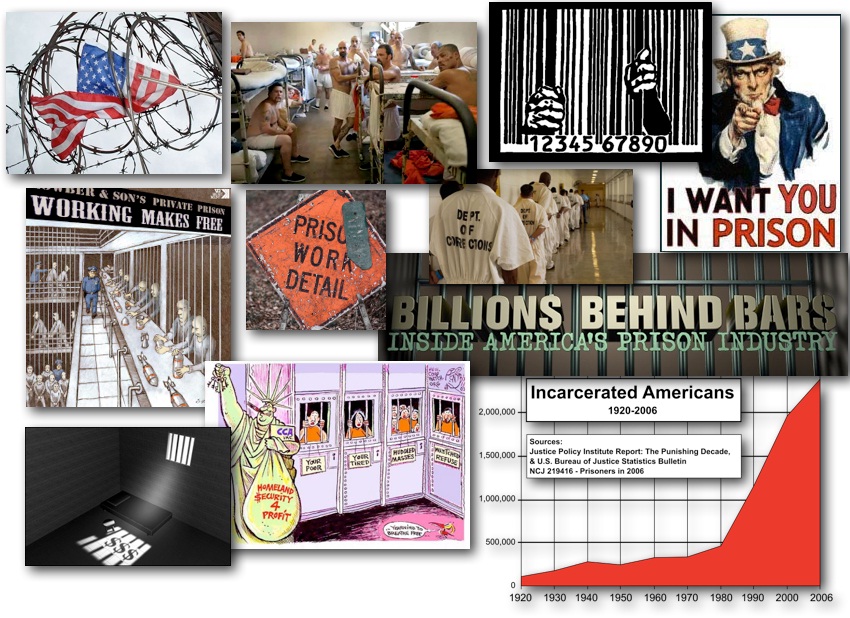
Now on to our feature presentation: Prisons for Profit. An introduction to the prison industrial complex, slave labor camps, privatization of an industry that should have no privatization involved when it comes to the rehabilitation of criminals. The USA has explosive incarceration figures. You look at the figures: we went from 500,000 incarcerated in the 1980s, and by the 1990s the total climbed drastically around the time of the drug war. The drug war really played into the expansion of the prison industrial complex. The drug war doesn’t protect society from the real drug dealers. It puts the lowest-level offenders who are really not even a danger to society into jail, now being forced to work slave labor essentially for what should be minor infractions.
It’s completely changing the nature of prison and what it means to be a prisoner. There’s no rehabilitation involved here. Instead, prisoners have been conditioned to become more dangerous criminals simply to survive. They have no choice. In prison you’ll be forced into doing things you would never even imagine you have to do just to stay alive.
A lot of people out there might know somebody, within one degree of separation, who is in prison. They might be in there, and they might be innocent, falsely accused. The flawed justice system really benefits this industry as well, because there is no drive to fix a flawed system when a flawed system is profitable. Problems are profitable, and that’s why we see the same ones over and over.
The Growth of For-Profit Prisons and Prison Labor
Where some correction officers see danger in prison overcrowding, others see opportunity. With nearly two million Americans behind bars, the majority of them non-violent offenders, it means jobs for the prison regions and windfalls for profiteers. Although a wider variety of goods have long been produced by prisoners for the US government, license plates being a classic example, more recent contracts have expanded to everything from guided missile parts to solar panels. Prison labor for the private sector, which was legally barred for years to avoid unfair competition with private companies, has changed thanks to the American Legislative Exchange Council, which created the Prison Industries Enhancement Certification Program, also known as PIE. This is what really allowed the explosive expansion of prison labor that was previously not allowed.
Three decades after the war on crime began, the United States has developed a prison industrial complex, a set of bureaucratic, political, and economic interests that encourage increased spending on imprisonment regardless of actual need. The prison industrial complex is not a conspiracy theory. It is a confluence of special interests that has given prison construction in the United States a seemingly unstoppable momentum. It’s composed of politicians, both liberal and conservative, who use the fear of crime to gain votes. Prisons have become a cornerstone of economic development. Private companies regard the roughly $35 billion spent each year on corrections by American taxpayers as a lucrative market.
Even as the rate of violent crime in the United States fell by 20 percent, the number of people in prison or jail rose by 50 percent. Steven Johnson, an attorney with the National Criminal Justice Commission, explained in 1996: if crime is going up, then we need to build more prisons. If crime is going down, it’s because we built more prisons. Either way, more prisons.
Who Fills the Prisons and Racial Disparities
The raw material of the prison industrial complex is its inmates: the poor, the homeless, the mentally ill, drug addicts, alcoholics. Not violent sociopaths. Seventy percent of prison inmates in the United States are illiterate. Perhaps 200,000 of the country’s inmates suffer from serious mental illness, a significant number not being treated. A generation ago, these people were handled primarily by the mental health system, not the criminal justice system. Sixty to 80 percent of the American inmate population has a history of substance abuse. Meanwhile, the number of drug treatment slots in American prisons has declined by more than half since 1983. Drug treatment is now available to only one in ten of the inmates who need it.
Among those arrested for violent crimes, the proportion of African American men has changed little over the past twenty years. Among those arrested for drug crimes, the proportion of African Americans has tripled, although the prevalence of illegal drug use among white men is approximately the same as that among black men. Black men are five times as likely to be arrested for drug crimes. As a result, half the inmates in some states are African American. One of every fourteen black men is now in prison or jail. One of every four black men is likely to be imprisoned at some point during his life. The number of women sentenced to prison has grown twelve-fold since 1970. Eighty thousand women are now in prison, about 70 percent of them non-violent offenders.
Mass incarceration on this scale has almost never been seen before in human history. There are more black people in the grip of the criminal justice system now, either in prison, on probation, or on parole, than there were in slavery. There are more people held in this system than were in the Gulag Archipelago under Stalin at its height.
The Business of Private Prisons: CCA and GEO Group
In an age when freedom is fast becoming the exception rather than the rule, imprisoning Americans in private prisons run by mega-corporations has turned into a cash cow for big business. At one time, the American prison system operated on the idea that dangerous criminals needed to be put under lock and key in order to protect society. Today, states seek to save money by outsourcing prisons to private corporations. The flawed yet rich American system of justice is being replaced by an even more flawed and insidious form of mass incarceration based on profit and expediency.
A growing number of American prisons are now contracted out as for-profit businesses to for-profit companies. The companies are paid by the state, and their profit depends on spending as little as possible on the prisoners and the prisons. It’s hard to imagine any greater disconnect between public good and private profit. The interest of private prisons lies not in the obvious social good of rehabilitating inmates, but in having as many inmates as possible, housed as cheaply as possible.
The growth of private detention is really something subject to scrutiny. A series in the New Orleans Times-Picayune chronicled how more than half of Louisiana’s 40,000 inmates are housed in prisons run by private companies as part of a broader financial incentive scheme. As a Huffington Post investigation pointed out, nearly half of all immigration detainees are now held in privately run detention facilities. The New York Times covered the lax oversight of privately run halfway houses in New Jersey.
Looking at corrections corporation of America specifically: 1.6 million was the number of state and federal prisoners in the United States as of December 2010, according to the Bureau of Justice Statistics. 128,195 was the number of prisoners housed in private facilities. The number of prisoners in private facilities increased by 37 percent between 2000 and 2009. CCA is the country’s largest private prison company with 91,000 beds available across twenty states and the District of Columbia. Total revenue recorded by CCA in 2011: almost $1.8 billion. CCA spent $17.4 million in lobbying expenditures in the last ten years, according to the Center for Responsive Politics. Total political contributions from 2003 to 2012 were $1.9 million according to the National Institute on Money in State Politics. Executive compensation for the CEO was $3.7 million in 2011. There were 132 recorded inmate assaults at CCA’s Crowley County Correctional Center between September 2007 and 2008.
The GEO Group is the second-largest private detention company. Total revenues were $1.6 billion in 2011. They own or operate 65 domestic correctional facilities with 67,000 beds. GEO Group spent $2.5 million in lobbying expenditures and $2.9 million in total political contributions from 2003 to 2012. Executive compensation for GEO’s CEO was $5.7 million in 2011. A $6.5 million wrongful death lawsuit was awarded against the company for an inmate killed by cellmates at a GEO Group-run Oklahoma prison. A $1.1 million fine was levied against the company by the New Mexico Department of Corrections for failure to provide adequate staffing. When your total revenues are $1.6 billion dollars and you’re fined $1.1 million for inadequate staffing, that’s not even a parking ticket, ladies and gentlemen.
Prison Labor Undercutting American Workers
American businesses don’t just have trouble competing with free trade and cheap labor in third-world countries to maximize profit. They are also now fighting government-run corporations that pay prisoners pennies on the dollar to manufacture cheap goods and undercut private industry. The US government is using federal prison inmates to steal businesses away from civilians, producing comparable merchandise for pennies on the dollar. At the very heart of the scheme is Federal Prison Industries, known as UNICOR. It’s slave wages, selling products exclusively to the government and cutting into major slices of several strong markets.
Michael Mitchell, a shoulder holster manufacturer with Actual Sales and Service of Pennsylvania, had his contract work undercut by US government prison labor. He recently spoke with the American Free Press about the impact. He says: I make certain products and UNICOR makes the same chemical products. They get paid higher prices even though their labor rates range somewhere between 23 cents and $1.15 per hour. They don’t pay workers’ compensation, they don’t pay taxes, and they don’t have any of the benefits private enterprise has to pay. They get a higher price by the Department of Defense than I do.
Prisons should be about rehabilitation, not profits. The humanity in this system deserves real rehabilitation, not the prospect of serving as cheap labor for a booming prison industry. It starts with understanding what’s actually going on, then it moves to taking action, spreading the word, and making sure your friends and family are educated on how the prison system has been exploited. There are more people incarcerated in the United States than in China. The United States has 310 to 320 million people. China has over a billion. Yet the United States has more prisoners. Come on. The problem here is pointing in a very clear direction.