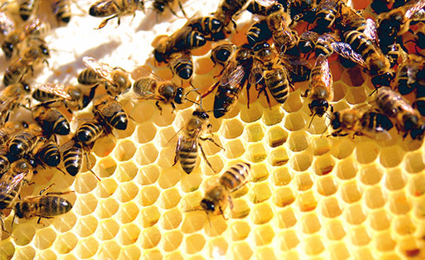
On March 15, over 1,500 beekeepers and anti-GMO protesters marched through the streets of Warsaw, depositing thousands of dead bees on the steps of the Ministry of Agriculture in protest of genetically modified foods and their pesticides which are together largely responsible for the killing off of bees, butterflies, moths and other beneficial pollinators in great numbers.
Later that day the Minister of Agriculture, Marek Sawicki, announced plans to ban MON810, which has already produced millions of hectares of pesticide resistant “superweeds” in the US.
The Polish Beekeepers Association organized the protest, joining forces with International Coalition to Protect the Polish Countryside (ICPPC) and the Coalition for a GMO Free Poland. Targeting Monsanto’s MON810 GM corn in particular, they also called for a complete ban on all genetically engineered crops as well as the pesticides found to be most damaging to the environment (and particularly to bees).
In 2008, the Polish Parliament banned GM feed, including both the planting and importing of GM crops. “Despite this progressive step,” reports Food Travels, “the European Commission has refused to accept regional bans on GMOs, keeping Polish farmers, producers, and activists on the offensive.”
Regardless, says the ICPPC, “None of the nine European Union countries that have already prohibited MON 810 did so by asking the permission of the EU.”
There was a great variety of attire as beekeepers dressed in their work bee suits and masks and ran their hive smoke guns as they marched, many wore yellow jackets with the famous Einstein quote, and many more original signs, props, and costumes. Go here for more photos.
The ICPPC is asking Polish residents to write Minister of Agriculture Marek Sawicki, demanding that he implement an immediate moratorium on GM crops, without waiting for EU approval.
Monsanto only cares about bee’s so they can figure out how to make them only pollinate Monsanto GMO crops. Whistle-blower testimony and supporting evidence will confirm that Monsanto seeks ultimate agricultural world domination through most incomprehensible and nefarious means. -Anonymous
Monsanto, the massive biotechnology company being blamed for contributing to the dwindling bee population, has bought up one of the leading bee collapse research organizations. Recently banned from Poland with one of the primary reasons being that the company’s genetically modified corn may be devastating the dying bee population, it is evident that Monsanto is under serious fire for their role in the downfall of the vital insects. It is therefore quite apparent why Monsanto bought one of the largest bee research firms on the planet.
It can be found in public company reports hosted on mainstream media that Monsanto scooped up the Beeologics firm back in September 2011. During this time the correlation between Monsanto’s GM crops and the bee decline was not explored in the mainstream, and in fact it was hardly touched upon until Polish officials addressed the serious concern amid the monumental ban. Owning a major organization that focuses heavily on the bee collapse and is recognized by the USDA for their mission statement of “restoring bee health and protecting the future of insect pollination” could be very advantageous for Monsanto.
In fact, Beelogics’ company information states that the primary goal of the firm is to study the very collapse disorder that is thought to be a result — at least in part — of Monsanto’s own creations. Their website states:
While its primary goal is to control the Colony Collapse Disorder (CCD) and Israeli Acute Paralysis Virus (IAPV) infection crises, Beeologics’ mission is to become the guardian of bee health worldwide.
What’s more, Beelogics is recognized by the USDA, the USDA-ARS, the media, and ‘leading entomologists’ worldwide. The USDA, of course, has a great relationship with Monsanto. The government agency has gone to great lengths to ensure that Monsanto’s financial gains continue to soar, going as far as to give the company special speed approval for their newest genetically engineered seed varieties. It turns out that Monsanto was not getting quick enough approval for their crops, which have been linked to severe organ damage and other significant health concerns.
Steve Censky, chief executive officer of the American Soybean Association, states it quite plainly. It was a move to help Monsanto and other biotechnology giants squash competition and make profits. After all, who cares about public health?
“It is a concern from a competition standpoint,” Censky said in a telephone interview.
It appears that when Monsanto cannot answer for their environmental devastation, they buy up a company that may potentially be their ‘experts’ in denying any such link between their crops and the bee decline.

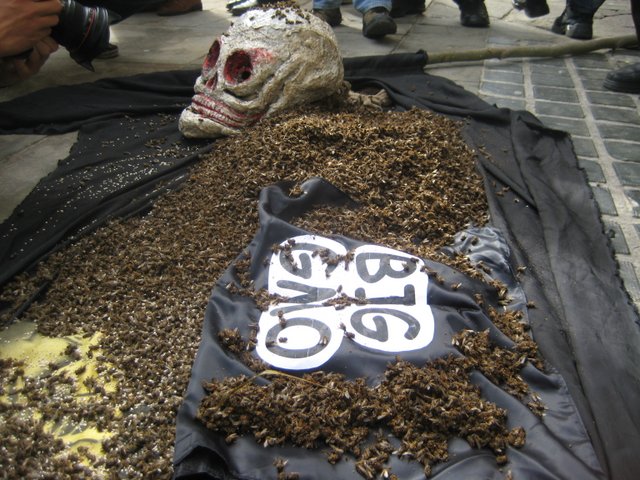
 On March 15, over 1,500 beekeepers and anti-GMO protesters marched through the streets of Warsaw, depositing thousands of dead bees on the steps of the Ministry of Agriculture in protest of genetically modified foods and their pesticides which are together largely responsible for the killing off of bees, butterflies, moths and other beneficial pollinators in great numbers.