Find Out If You Are Doing Things Which Might Be Considered Suspicious
There have been so many anti-terrorism laws passed since 9/11 that it is hard to keep up on what kinds of things might get one on a “list” of suspected bad guys.
We’ve prepared this quick checklist so you can see if you might be doing something which might get hassled.
The following actions may get an American citizen living on U.S. soil labeled as a “suspected terrorist” today:
In January 2012, two controversial pieces of legislation were making their way through the US Congress. SOPA, the Stop Online Piracy Act, and PIPA, the Protect Intellectual Property Act, were meant to crack down on the illegal sharing of digital media. The bills were drafted on request of the content industry, Hollywood studios and major record labels.
The online community rose up against the US government to speak out against SOPA, and the anti-online piracy bill was effectively killed off after the largest online protest in US history. But it was only one win in a long battle between US authorities and online users over internet regulation. SOPA and PIPA were just the latest in a long line of anti-piracy legislation US politicians have passed since the 1990s.
“One of the things we are seeing which is a by-product of the digital age is, frankly, it’s much easier to steal and to profit from the hard work of others,” says Michael O’Leary, the executive vice-president for global policy at the Motion Picture Association of America (MPAA).
The US government says it must be able to fight against piracy and cyber attacks. And that means imposing more restrictions online. But proposed legislation could seriously curb freedom of speech and privacy, threatening the internet as we know it.
Can and should the internet be controlled? Who gets that power? How far will the US government go to gain power over the web? And will this mean the end of a free and global internet?
Fault Lines looks at the fight for control of the web, life in the digital age and the threat to cyber freedom, asking if US authorities are increasingly trying to regulate user freedoms in the name of national and economic security.
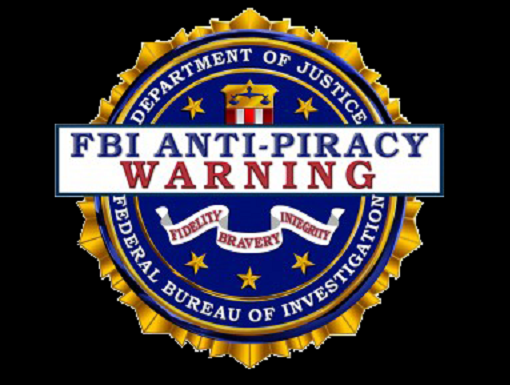
It’s the FBI’s special “anti-piracy” warning. For the past few years, under a special “pilot” program, the FBI has allowed the RIAA, MPAA, BSA, ESA and SIIA (basically, the big record labels, movie studios, video game makers and software companies) to make use of the logo to warn all of their customers that they just might be felons and the FBI might show up at any moment. It’s pure FUD. It also makes no difference. Is there seriously anyone anywhere in the world who sees this logo and suddenly changes their behavior?
However, this program is about to expand in a big, big way. The FBI is about to release new rules (pdf and embedded below) that expand the program so that any copyright holder will be allowed to slap this logo on their product. Expect to start seeing it everywhere… and to feel that much more like the content creator you’re legitimately buying from thinks you’re a crook subject to federal law enforcement action. Way to “connect” with fans, huh?
The document from the FBI discussing this repeats a few times that the FBI really feels like this program is effective and important. Could they be any more out of touch?
First, the FBI believes that the APW Seal and accompanying warnings convey important messages to the public and are a significant component of its efforts to deter and to investigate federal crimes involving the piracy of intellectual property. Allowing use by copyright holders who are not members of industry associations will enhance those efforts. Second, although broader access may make unauthorized use more likely, this concern is overshadowed by the value of increasing public awareness of these prohibitions and the FBI’s role in investigating related criminal activity.
There are all sorts of issues with this. The first is that this whole campaign is ignoring a key point: nearly all copyright infringement is a civil infraction, not a criminal one. Most ordinary users don’t understand the difference between civil and criminal infringement — and the FBI and its silly seal do nothing to explain that difference. It’s pretty clear that the purpose is to falsely imply that sharing with a friend music you legally purchased might somehow lead you to being targeted in an FBI sting operation. It’s FUD, plain and simple. Second, the idea that spreading this logo further will deter actual criminal infringement? Are they serious? Remember, one of the requirements for criminal copyright infringement is that the action is willful. That means that the person knows they’re breaking the law. So educating them on the fact that they’re breaking the law… er… shouldn’t make much of a difference.
Finally, notice that nowhere does the FBI provide any data on how effective this program has been. Because there isn’t any. The MPAA shows this logo before movies, and it’s not like there has been any less infringement. In fact, the FBI and ICE recently decided to double up and extend the warnings on DVDs , and it’s not like that made a difference either. No, instead, all it’s done is piss off tons of legitimate customers, who paid good money for the content, only to be interrupted by a giant FBI logo warning them that they may be criminals facing federal charges. The FBI even admits: “it is difficult to measure the effectiveness of the APW Seal program at preventing piracy,” but apparently that won’t stop it from expanding it. Who in their right mind thinks this is a sensible strategy?
Either way, it’s interesting to read through the comments and feedback on this program — including someone who suggested that the FBI should make sure the warning is skippable at the beginning of movies (the FBI notes that’s up to the film producers) or another one that says this seal should be mandatory on copyright-protected works (the FBI rightly points out it has no such authority). Repeatedly, when people raise issues of more widespread use of the seal (dilution, confusion, belief that works without the seal aren’t protected, etc.) the FBI insists that the supposed benefits of blanketing the universe with this logo far outweigh any downsides.
There were also concerns raised that the logo will have serious chilling effects on fair use — which is definitely a major possibility. And the FBI’s response is ridiculous.
Five comments also expressed a concern that the broader accessibility of the APW Seal may have a “chilling effect” on fair use, as some copyright holders may attempt to use the APW Seal to discourage uses of their copyrighted work that would otherwise be permissible under the fair use doctrine. The FBI fully recognizes that fair use, which is authorized under Title 17, United States Code, Section 107, does not constitute infringement, much less a federal crime. The warning language does not suggest otherwise. The FBI intends to address this matter on its public website.
Because we all know that everyone who sees the logo will go to the FBI’s website and read the fine print at the bottom of the page.
Of course, what’s really crazy in all of this is that the FBI is famous for having an itchy trigger finger when anyone uses its normal logo. Remember, this is the same FBI that, just two years ago, sent a threat letter to Wikipedia, because the Wikipedia page on the FBI shows the FBI logo (leading to an awesome reply from Wikimedia General Counsel, Mike Godwin).
Honestly, the whole thing is silly, but because of this kind of cluelessness, expect to see those pointless FBI warning logos on all sorts of content in the future, so that every time you legitimately purchase content, you’ll be reminded that the copyright holder thinks you’re a lousy stinking thief who deserves a federal investigation. I’m still trying to figure out how that could possibly be good for business, but I guess I just don’t understand copyright…
On numerous occasions here at the TLF over the past eight years, I’ve noted the profound influence that the late Ithiel de Sola Pool had on my thinking about the interaction of technology, information, and public policy. In fact, when I needed to pick a thematic title for my weekly Forbes column, it only took me a second to think of the perfect one: “Technologies of Freedom.” I borrowed that from the title of Pool’s 1983 masterpiece, Technologies of Freedom: On Free Speech in an Electronic Age. As I noted in my short Amazon.com review, Pool’s technological tour de force is simply breathtaking in its polemical power and predictive capabilities. Reading this book three decades after it was published, one comes to believe that Pool must have possessed a crystal ball or had a Nostradamus-like ability to foresee the future.
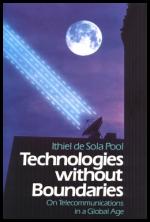
I felt that same was this week when I was re-reading some chapters from his posthumous book, Technologies without Boundaries: On Telecommunications in a Global Age–a collection of his remaining essays nicely edited and tied together by Eli Noam after Pool’s death in 1984. Re-reading it again reminded me of Pool’s remarkable predictive powers. In particular, the closing chapter on “Technology and Culture” includes some of Pool’s thoughts on the future of copyright. As you read through that passage below, please try to remember he wrote these words back in the early 1980s, long before most people had even heard of the Internet and when home personal computing was only just beginning to take off. Yet, from what he already knew about networked computers and digital methods of transmitting information, Pool was able to paint a prescient portrait of the future copyright wars that we now find ourselves in the midst of. Here’s what he had to say almost 30 years ago about how things would play out:
Can a computer infringe copyright? The printed output of recorded copyright material is likely to be a statutory violation of the Copyright Act which vests the exclusive right “to print, reporting, publish, copy and vend the…work.”
In short, the process of computer communication entails processing of texts that are partly controlled by people and partly automatic. They are happening all through the system. Some of the text is never visible but is only stored electronically; some is flashed briefly on a terminal display; some is printed out in hard copy. What started as one text varies and changes by degrees to other things. The receivers may be individuals and clearly identified, or they may be passersby with access but whose access is never recorded; the passerby may only look, as a reader browsing through a book, or he may make an automatic copy; sometimes the program will record that, sometimes it will not.
To try to apply the concept of copyright to all these stages and actors would require a most elaborate set of regulations. It has none of the simplicity of checking what copies rolled off a printing press. Good intentions about what one would like can be defined. One would like to compensate an author if a computer terminal is used as a printing press to run off numerous copies of a valuable text. One would like not to impose any control as someone works at a terminal in the role of a reader and checks back and forth through various files. The boundary, however, is impossible to draw. In the new technology of interactive computing, the reader, the writer, the bookseller, and the printer have become one. In the old technology of printing one could have a right to free press for the reader and the writer but try to enforce copyright on the printer and the bookseller. That distinction will no longer work, any more than it would ever have worked in the past on conversation.
Those whose livelihood is at stake in copyright do not like that kind of comment. They contend that creative work must be compensated. Indeed it must. Publishers may point the finger in accusation and charge that one is taking bread out of the mouths of struggling writers. But the system must be practical to work. On highly charged subjects there is an impulse to insist that those who make a negative comment must have a panacea to offer instead. If one says prisons do not cure criminals, the rejoinder is apt to be, “Do you want to let them out to kill people?” One does not necessarily want that at all, but it may still be true the prisons do not cure criminals. Likewise, one can say that in an era of infinitely varied, automated text manipulation there is no reasonable way to count copies and charge royalties on them.
That is the situation now emerging. It may be very unfair to authors. It may have a profoundly negative effect on some aspects of culture, and in any case, whether positive or negative, it may change things considerably. If it becomes more difficult for authors and artists to be paid by a royalty scheme, more of them will seek salaried bases from which to work. Some may try to get paid by personal appearances or other auxiliaries to fame. Or the highly illustrated, well-bound book may acquire a special marketing significance if the mere words of the text are hard to protect. Or one may try to sell subscriptions to a continuing service, with the customer knowing that he will be a first recipient.
These are the kinds of considerations one must think about in speculating about the consequences for culture of a world where the royalty-carrying unit copy is no longer easy to protect in many of the domains where it has been dominant. While Congress tries to hold the fort, it is clear that with photocopiers and computers, copyright is an anachronism. Like many other unenforceable laws that we keep on the statute books from the past, this one may be with us for some time to come, but with less and less effect. (pp. 257-59)
Indeed, as I wrote in one of my recent Forbes column’s (The Twilight of Copyright?”), it appears that–whether some of us like it or not–”copyright is dying… [as it] is being undermined by the unrelenting realities of the information age: digitization, instantaneous copying, borderless transactions, user-generated content, and so on.” Of course, I’m basing that assertion on the facts on the ground around me circa 2012. By contrast, Ithiel de Sola Pool already had it figured out 30 years ago. Absolutely remarkable.
Last week, Bryan McCarthy, the 32-year-old operator of ChannelSurfing.net, was arrested on charges of criminal copyright infringement. This arrest has once again raised questions about the seizure of domains operated by those that are accused, but not convicted, of copyright infringement related crimes. Critics ranging from bloggers to individual rights advocates to Senators have rightfully questioned the constitutionality of these seizures.
The most serious constitutional issues with the domain seizures arise because the Government does not provide any notice to the domain owners prior to seizing them. One moment, their normal site is up at their web address, the next moment, all that is up at their web address is a DHS/ICE seal.
Without knowing what they have been accused of or having the opportunity to defend their site, the Government has repurposed the owners’ private property.
In order to seize the domain names without notice to the owners, the Government uses a procedure that permits it to bring an action directly against a piece of property used in the commission of a crime –in this case the domain name– rather than the owner. This type of action (called an “In Rem” forfeiture) is not new. In the past, the Government has used In Rem actions for purposes such as an action against an automobile used to transport bootleg whiskey.
An In Rem action does not necessarily require the Government to wait until a court hears both sides and rules that the property has been used for illegal purposes and is subject to forfeiture. Instead, in many cases, the law is written so that all the Government has to do is to sign an affidavit that demonstrates probable cause for the forfeiture, which is signed by a magistrate judge and the Government can seize the property. (more…)




 In order to seize the domain names without notice to the owners, the Government uses a procedure that permits it to bring an action directly against a piece of property used in the commission of a crime –in this case the domain name– rather than the owner. This type of action (called an “In Rem” forfeiture) is not new. In the past, the Government has used In Rem actions for purposes such as an action against an automobile used to transport bootleg whiskey.