Newly Released Drone Records Reveal Extensive Military Flights in U.S.

Newly Released Drone Records Reveal Extensive Military Flights in U.S.

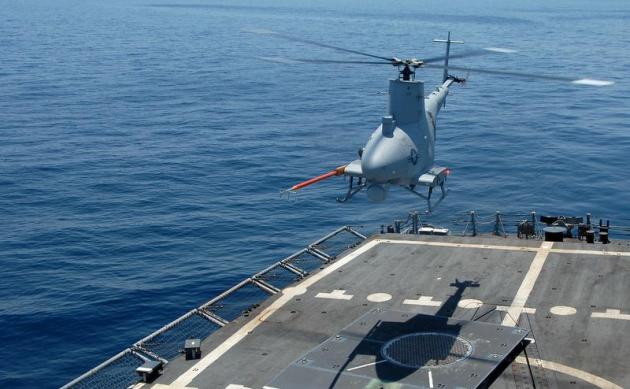
us-navy-mq-8-drone

Via: Electronic Frontier Foundation:

Today EFF posted several thousand pages of new drone license records and a new map that tracks the location of drone flights across the United States.

These records, received as a result of EFF’s Freedom of Information Act (FOIA) lawsuit against the Federal Aviation Administration (FAA), come from state and local law enforcement agencies, universities and—for the first time—three branches of the U.S. military: the Air Force, Marine Corps, and DARPA (Defense Advanced Research Projects Agency).

While the U.S. military doesn’t need an FAA license to fly drones over its own military bases (these are considered “restricted airspace”), it does need a license to fly in the national airspace (which is almost everywhere else in the US). And, as we’ve learned from these records, the Air Force and Marine Corps regularly fly both large and small drones in the national airspace all around the country. This is problematic, given a recent New York Times report that the Air Force’s drone operators sometimes practice surveillance missions by tracking civilian cars along the highway adjacent to the base.

The records show that the Air Force has been testing out a bunch of different drone types, from the smaller, hand-launched Raven, Puma and Wasp drones designed by Aerovironment in Southern California, to the much larger Predator and Reaper drones responsible for civilian and foreign military deaths abroad. The Marine Corps is also testing drones, though it chose to redact so much of the text from its records that we still don’t know much about its programs.

via Cryptogon

America’s Deadly Double Tap Drone Attacks Are ‘killing 49 people for every known terrorist in Pakistan’

America’s Deadly Double Tap Drone Attacks Are ‘killing 49 people for every known terrorist in Pakistan’

  • Study found war against violent Islamists has become increasingly deadly
  • Researchers blame common tactic now being used – the ‘double-tap’ strike
  • Drone strikes condemned for their ineffectiveness in targeting militants
Just one in 50 victims of America’s deadly drone strikes in Pakistan are terrorists – while the rest are innocent civilians, a new report claimed today.The authoritative joint study, by Stanford and New York Universities, concludes that men, women and children are being terrorised by the operations ’24 hours-a-day’.

And the authors lay much of the blame on the use of the ‘double-tap’ strike where a drone fires one missile – and then a second as rescuers try to drag victims from the rubble. One aid agency said they had a six-hour delay before going to the scene.

The tactic has cast such a shadow of fear over strike zones that people often wait for hours before daring to visit the scene of an attack. Investigators also discovered that communities living in fear of the drones were suffering severe stress and related illnesses. Many parents had taken their children out of school because they were so afraid of a missile-strike.

Today campaigners savaged the use of drones, claiming that they were destroying a way of life.

Clive Stafford Smith, director of the charity Reprieve which helped interview people for the report, said: ‘This shows that drone strikes go much further than simply killing innocent civilians. An entire region is being terrorised by the constant threat of death from the skies. ‘

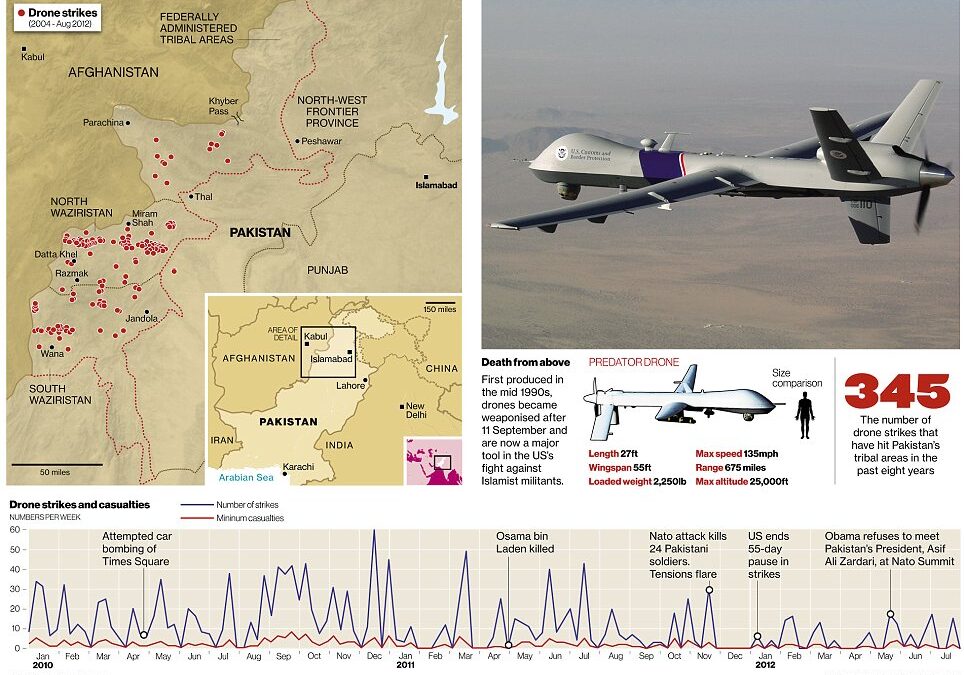
There have been at least 345 strikes in Pakistan’s tribal areas near the border with Afghanistan in the past eight years.

‘These strikes are becoming much more common,’ Mirza Shahzad Akbar, a Pakistani lawyer who represents victims of drone strikes, told The Independent.

‘In the past it used to be a one-off, every now and then. Now almost every other attack is a double tap. There is no justification for it.’

The study is the product of nine months’ research and more than 130 interviews, it is one of the most exhaustive attempts by academics to understand – and evaluate – Washington’s drone wars.

Despite assurances the attacks are ‘surgical’, researchers found barely two per cent of their victims are known militants and that the idea that the strikes make the world a safer place for the U.S. is ‘ambiguous at best’.

Researchers added that traumatic effects of the strikes go far beyond fatalities, psychologically battering a population which lives under the daily threat of annihilation from the air, and ruining the local economy.

They conclude by calling on Washington completely to reassess its drone-strike programme or risk alienating the very people they hope to win over.

They also observe that the strikes set worrying precedents for extra-judicial killings at a time when many nations are building up their unmanned weapon arsenals.

The Obama administration is unlikely to heed their demands given the zeal with which America has expanded its drone programme over the past two years.

Washington says the drone program is vital to combating militants that threaten the U.S. and who use Pakistan’s tribal regions as a safe haven.

The number of attacks have fallen since a Nato strike in 2011 killed 24 Pakistani soldiers and strained U.S.-Pakistan relations.

Pakistan wants the drone strikes stopped – or it wants to control the drones directly – something the U.S. refuses.

Reapers and Predators are now active over the skies of Somalia and Yemen as well as Pakistan and – less covertly – Afghanistan.

But campaigners like Mr Akbar hope the Stanford/New York University research may start to make an impact on the American public.

‘It’s an important piece of work,’ he told The Independent. ‘No one in the U.S. wants to listen to a Pakistani lawyer saying these strikes are wrong. But they might listen to American academics.’

Today, Pakistani intelligence officials revealed a pair of missiles fired from an unmanned American spy aircraft slammed into a militant hideout in northwestern Pakistan last night.

The two officials said missiles from the drone aircraft hit the village of Dawar Musaki in the North Waziristan region, which borders Afghanistan to the west.

Some of the dead were believed to be foreign fighters but the officials did not know how many or where they were from.

The Monday strike was the second in three days. On Saturday a U.S. drone fired two missiles at a vehicle in northwest Pakistan, killing four suspected militants.

That attack took place in the village of Mohammed Khel, also in North Waziristan.

North Waziristan is the last tribal region in which the Pakistan military has not launched an operation against militants, although the U.S. has been continually pushing for such a move.

The Pakistanis contend that their military is already overstretched fighting operations in other areas but many in the U.S. believe they are reluctant to carry out an operation because of their longstanding ties to some of the militants operating there such as the Haqqani network.

Notre Dame Law Professor Leads Lonely Campaign Against Drone Strikes

Notre Dame Law Professor Leads Lonely Campaign Against Drone Strikes

A law professor at Notre Dame leads a lonely campaign to stop the targeted killings in Pakistan and elsewhere, insisting they violate international law.

Notre Dame law professor Mary Ellen O’Connell is a leading critic of the U.S. targeted-killing program against Al Qaeda militants. (Los Angeles Times, Ken Dilanian / October 9, 2012)

SOUTH BEND, Ind. — Notre Dame law professor Mary Ellen O’Connell was in her office last month when Imran Khan, a former cricket star who could be Pakistan’s next prime minister, phoned to ask for help.

Pakistanis are furious about the CIA‘s covert campaign of drone missile strikes, Khan told her. Was she aware that the CIA often doesn’t know who it is killing?

“Yes, of all Americans, I think I have a pretty good handle on the facts,” she replied, recounting the call.

O’Connell, a fierce critic of America’s drone attacks outside a war zone, insists the targeted killings are illegal under international law.

“We wouldn’t accept or want a world in which Russia or China or Iran is claiming authority to kill alleged enemies of the state based on secret evidence of the executive branch alone,” O’Connell said. “And yet that’s the authority we’re asserting.”

O’Connell, 54, has led a lonely campaign to stop the drones since she wrote a paper branding the first CIA drone strike, in 2002, as unlawful. She rejected claims by the George W. Bush administration that the attack, which killed several Al Qaeda militants and a U.S. citizen, was a legitimate act of self-defense in the war on terrorism.

Since then, President Obama has sharply increased drone attacks, and O’Connell has jousted with government officials, debated other academics and outlined her critique in scholarly publications.

“Her views are definitely taken seriously,” said Sean Murphy, a former State Department lawyer who argues the drone strikes are permitted under the law. “She’s on the leading edge of this argument.”

She remains in a small minority of U.S. legal scholars, but her views are gaining currency as targeted killings continue.

A report issued last month by researchers at the law schools of New York University and Stanford University argued that many U.S. drone strikes appear unlawful because they don’t meet the strict legal test for killing outside a war zone — to stop an imminent threat to life when no other means is available.

In June, Christof Heyns, the United Nations special rapporteur on extrajudicial killings, told a conference in Geneva that “double tap” drone strikes, in which a second missile is fired at people coming to aid the wounded, could constitute a war crime. Pakistan claims several such attacks have occurred in its tribal areas.

O’Connell and her intellectual allies agree the United States is fighting a lawful war in Afghanistan because it gave shelter to terrorists who attacked America on Sept. 11, 2001. But they argue that killing militants in Pakistan, Yemen and Somalia is not a legitimate part of that conflict, and thus violates laws of war intended to protect noncombatants.

If the U.S. government has a case against an Al Qaeda militant in Yemen or Somalia, they argue, it must try to arrest him and give him a chance to surrender unless lives are in immediate danger.

That view strikes O’Connell’s many critics as a naive reading of international law that fails to account for modern stateless terrorists. But the U.S. government held a similar view until the Sept. 11, 2001, attacks.

U.S. officials criticized Israel for killing Palestinian militants on the West Bank in the 1990s, for example, and CIA officials believed they lacked the authority to kill Osama bin Laden even after he was indicted for the 1998 bombings of two U.S. embassies in East Africa.

National Security Council spokesman Tommy Vietor declined to comment for this article, but he noted that White House counter-terrorism advisor John Brennan publicly explained the administration’s view on targeted killings in April.

“As a matter of international law, the United States is in an armed conflict with Al Qaeda, the Taliban, and associated forces, in response to the 9/11 attacks, and we may also use force consistent with our inherent right of national self-defense,” Brennan said.

Under Obama, the United States has launched 284 drone missile strikes in Pakistan and 49 in Yemen, according to independent groups that track reported attacks. That’s up from 46 in Pakistan and one in Yemen under Bush. Strikes have also been reported in Somalia.

So-called high-value targets typically are named on a classified “kill list,” which is reviewed by lawyers from the White House, the CIA, the Pentagon and other agencies. Many others are killed in “signature strikes” that target unidentified militants based on activities deemed suspicious.

In September, Obama sought to explain who gets targeted and why.

“It has to be a threat that is serious and not speculative,” Obama told CNN. “It has to be a situation in which we can’t capture the individual before they move forward on some sort of operational plot against the United States.”

O’Connell and other critics say no evidence suggests that all those killed met Obama’s standard. Drone strikes have killed up to 3,000 people, according to the New America Foundation, a nonpartisan public policy institute in Washington.

O’Connell sees her effort as an exercise in moral suasion, similar to the public outcry that erupted after news reports detailed how the CIA had used waterboarding and other harsh interrogation techniques against several Al Qaeda detainees after Sept. 11.

A trim woman with brown hair, O’Connell isn’t a pacifist. Her husband is a former Army interrogator who served in the first Gulf War. They met while she was working for the Defense Department, teaching soldiers about international law.

O’Connell praises the Navy SEAL mission that killed Bin Laden, and supports using drones to target enemy fighters in Afghanistan. “I do think drones can be a more accurate weapon, and I’m all in favor of saving our troops’ lives,” she said.

Benjamin Wittes, a Brookings Institution fellow who supports the drone strikes, put O’Connell on the defensive in a debate two years ago by challenging her to take her position to its logical conclusion — as he put it, “that President Obama is a serial killer.”

She fumbled her response. But upon reflection, she sees some parallels to the abortion debate. One can believe, as she does strongly, that abortion is deeply immoral, without labeling women who have abortions as murderers.

“I feel the same way about targeted killing,” she said. “I understand that Americans don’t … see it, but we want the practice to end. I don’t think President Obama should go to jail for it.”

via LATimes