Snowden made video to teach reporter how to speak with him securely
It explains how to use Public Key Encryption to scramble online messages
Privacy campaigners call on ordinary people to learn how to use the method
+4
Whistleblower: The tutorial Edward Snowden made for reporters on to avoid NSA email surveillance has been made public for the first time
Ordinary people must learn to scramble their emails, privacy campaigners said today, as an encryption how-to video made by Edward Snowden was made public for the first time.
The former NSA employee who blew the whistle on the agency’s all-pervasive online surveillance made the video to teach reporters how to communicate with him in secret.
The 12-minute clip, in which Mr Snowden has used software to distort his voiceover, explains how to use free software to scramble messages using a technique called Public Key Encryption (PKE).
The video’s description on Vimeo says: ‘By following these instructions, you’ll allow any potential source in the world to send you a powerfully encrypted message that ONLY YOU can read even if the two of you have never met or exchanged contact information.’
Mr Snowden made the video last year for Glenn Greenwald in an effort to get the then-Guardian reporter to communicate securely with him online so he could send over documents he wanted to leak.
Viewers may find the video difficult to follow. Mr Greenwald himself admitted he wasn’t able to finish it. It took him seven weeks and help from experts to finally gather the expertise to get back to Snowden.
The video’s publication comes as more and more internet users are adopting encryption techniques after the alarm caused by Mr Snowden’s revelations about communications surveillance.
He leaked documents which showed the NSA and its UK counterpart GCHQ were able to spy on virtually anybody’s communications and internet usage, monitor social network activity in real time, and track and record the locations of billions of mobile devices.
There was outrage when it emerged that, contrary to promises the NSA made to Congress, these technologies were being used to track U.S. citizens without warrants and to tap the communications of leaders of allied countries.
One answer to the risks to freedom that such surveillance pose is to scramble online communications so that government agencies can no longer eavesdrop at will.
However, the encryption technologies currently available can be difficult to use and privacy activists have called on internet companies to include them in their products at the source.
Meanwhile, the campaign to end blanket surveillance continues as experts warn encryption tools are unlikely to make their way into the mainstream while internet firms continue to make their profits on the back of users’ personal information.
Scroll down for video
+4
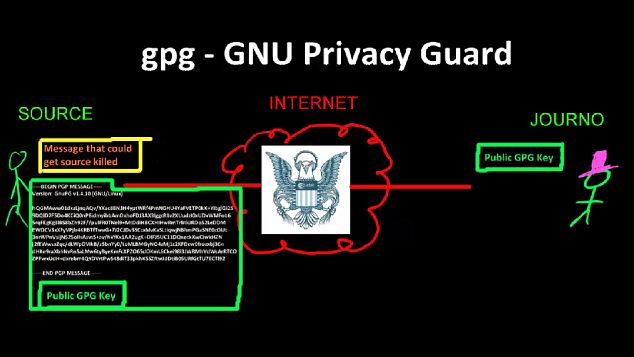
How-to guide: The video begins with a basic outline of the theory behind Public Key Encryption. It is voiced over by Mr Snowden, who has disguised his voice to avoid detection by NSA or GCHQ spies
+4
Detailed: The video then explains how to use a free program called GPG4Win to scramble messages using Public Key Encryption then send them over Tor, software that allows people to use the internet anonymously
In Mr Snowden’s video, he explains how traditional emails are sent as plain text – unencrypted by default – across the internet, allowing anyone able to intercept them to easily read their contents.
‘Any router you cross could be monitored by an intelligence agency or other adversary [such as] a random hacker. So could any end points on the way there, a mail server or a service provider such as Gmail.
‘If the journalist uses a web mail service personally or its provisioned by their company, the plain text could always be retrieved later on via a subpoena or some other mechanism, legal or illegal, instead of catching it during transit. So that’s doubly dangerous
‘The solution to that is to actually encrypt the message. Now one of the problems with encryption typically is that it requires a shared secret, a form of key or password that goes between the journalist and the source.
‘But if the source sends an encypted file across the internet to the journalist and says “Hey, here’s an encrypted file. The passwork is cheesecake,” the internet is going to know the password is cheesecake.
‘But public key encryption such as GPG allows the journalist to publish a key that anyone can have based on the design of the algorithm, and it doesn’t provide any advantage to the adversary.’
The video goes on to specifically explain how to use a free program called GPG4Win to scramble messages using Public Key Encryption then send them over Tor, a piece of software that allows people to use the internet anonymously.
It’s lessons, as well as help from experts, allowed Mr Greenwald to communicate securely with Mr Snowden to publish what has since been called the most significant leak in U.S. history. It has been made public to coincide with the release of Mr Greenwald’s book, No Place To Hide, in which he tells the story of the scoop.
Privacy campaigners told MailOnline today that all internet users should be now using encryption technology to preserve their privacy and maintain freedom of speech in the face of government spying.
Javier Ruiz, director of policy at the Open Rights Group, said: ‘Emails are like postcards and encryption is a tamper-proof envelope.
‘It’s probably obvious that journalists, MPs, doctors, lawyers or anyone transmitting confidential information online should always encrypt their emails to keep that information secure.
+4
http://youtu.be/jo0L2m6OjLA
‘But since the Snowden revelations, more and more ordinary citizens are adopting encryption software to help keep their emails private.
‘If encryption is to be used on a mass scale, it will require companies like Google, Apple and Microsoft to embed encryption in their tools.’
But TK Keanini, chief technology officer at internet security firm Lancope, said that it was unlikely that major internet companies would begin including encryption functions in their services as standard.
‘PGP and similar programs are just too complicated for the masses,’ he said. ‘Managing key pairs, understanding revocation and all that stuff is too complicated for most, and thus adoption over the past 20 years has been limited to the highly technical – the uber geeks.
‘Now, if a service like gmail.com had an option in there to perform digital signing and encryption in a way that most people could use it, that would have a huge impact; but it will never happen because Google and other ‘free’ services make their money on the fact that your data is in the clear and they can use it to market services to you.
‘People need to understand that when people offer free services, you and your information are the payment.’
‘While people can use technology to empower themselves, we must also challenge the policies of Government and intelligence agencies to end the unlawful mass surveillance of people around the world’
Mike Rispoli, a spokesman for Privacy International, echoed those sentiments, but added that there needs to be more pressure on government to stop them from snooping on the private lives of ordinary people.
‘It is critical that people use all technology at their disposal to keep their communications private and secure,’ he said.
‘We should all support the creation and widespread use of these tools. Ultimately, however, people should never have to do more or go to extra lengths to protect their rights.
‘This is why we need political, legal, as well as technological, solutions to ensure that our privacy rights are protected.
‘While people can use technology to empower themselves, we must also challenge the policies of Government and intelligence agencies to end the unlawful mass surveillance of people around the world.’
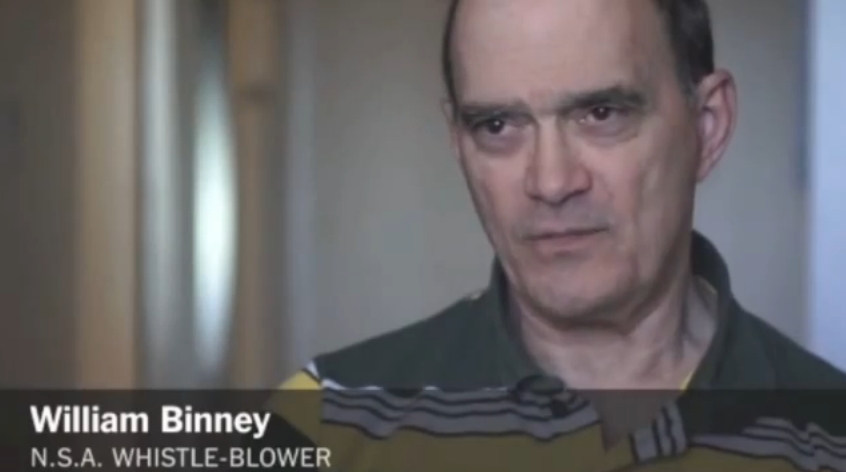
RT talks to William Binney, whistleblower and former NSA crypto-mathematician who served in the agency for decades. Virtual privacy in US, Petraeus affair and whistleblowers’ odds in fight against the authorities are among key topics of this exclusive interview
RT: In light of the Petraeus/Allen scandal while the public is so focused on the details of their family drama, one may argue that the real scandal in this whole story is the power, the reach of the surveillance state. I mean if we take General Allen – thousands of his personal e-mails have been sifted through private correspondence. It’s not like any of those men was planning an attack on America. Does the scandal prove the notion that there is no such thing as privacy in a surveillance state?
William Binney: Yes, that’s what I’ve been basically saying for quite some time, is that the FBI has access to the data collected, which is basically the emails of virtually everybody in the country. And the FBI has access to it. All the congressional members are on the surveillance too, no one is excluded. They are all included. So, yes, this can happen to anyone. If they become a target for whatever reason – they are targeted by the government, the government can go in, or the FBI, or other agencies of the government, they can go into their database, pull all that data collected on them over the years, and we analyze it all. So, we have to actively analyze everything they’ve done for the last 10 years at least.
RT: And it’s not just about those, who could be planning, who could be a threat to national security, but also those, who could be just…
WB: It’s everybody. The Naris device, if it takes in the entire line, so it takes in all the data. In fact they advertised they can process the lines at session rates, which means 10-gigabit lines. I forgot the name of the device (it’s not the Naris) – the other one does it at 10 gigabits. That’s why they’re building Bluffdale [database facility], because they have to have more storage, because they can’t figure out what’s important, so they are just storing everything there. So, emails are going to be stored there in the future, but right now stored in different places around the country. But it is being collected – and the FBI has access to it.
RT: You mean it’s being collected in bulk without even requesting providers?
WB: Yes.
RT: Then what about Google, you know, releasing this biannual transparency report and saying that the government’s demands for personal data is at an all-time high and for all of those requesting the US, Google says they complied with the government’s demands 90 percent of the time. But they are still saying that they are making the request, it’s not like it’s all being funneled into that storage. What do you say to that?
WB: I would assume that it’s just simply another source for the same data they are already collecting. My line is in declarations in a court about the 18-T facility in San Francisco, that documented the NSA room inside that AST&T facility, where they had Naris devices to collect data off the fiber optic lines inside the United States. So, that’s kind of a powerful device, that would collect everything it was being sent. It could collect on the order over of 100 billion 1,000-character emails a day. One device.
RT: You say they sift through billions of e-mails. I wonder how do they prioritize? How do they filter it?
WB: I don’t think they are filtering it. They are just storing it. I think it’s just a matter of selecting when they want it. So, if they want to target you, they would take your attributes, go into that database and pull out all your data.
RT: Were you on the target list?
WB: Oh, sure! I believe I’ve been on it for quite a few years. So I keep telling them everything I think of them in my email. So that when they want to read it they’ll understand what I think of them.
RT: Do you think we all should leave messages for the NSA mail box?
WB: Sure!
RT: You blew the whistle on the agency when George W. Bush was the president. With President Obama in office, in your opinion, has anything changed at the agency, in the surveillance program? In what direction is this administration moving?
WB: The change is it’s getting worse. They are doing more. He is supporting the building of the Bluffdale facility, which is over two billion dollars they are spending on storage room for data. That means that they are collecting a lot more now and need more storage for it. That facility by my calculations that I submitted to the court for the Electronic Frontiers Foundation against NSA would hold on the order of 5 zettabytes of data. Just that current storage capacity is being advertised on the web that you can buy. And that’s not talking about what they have in the near future.
RT: What are they going to do with all of that? Ok, they are storing something. Why should anybody be concerned?
WB: If you ever get on the enemies list, like Petraeus did or… for whatever reason, than you can be drained into that surveillance.
RT: Do you think they would… General Petraeus, who was idolized by the same administration? Or General Allen?
WB: There are certainly some questions, that have to be asked, like why would they target it to begin with? What law were they breaking?
RT: In case of General Petraeus one would argue that there could have been security breaches. Something like that. But with General Allen – I don’t quite understand, because when they were looking into his private emails to this woman.
WB: That’s the whole point. I am not sure what the internal politics is… That’s part of the program. This government doesn’t want things in the public. It’s not a transparent government. Whatever the reason or the motivation was, I don’t really know, but I certainly think that there was something going on in the background that made them target those fellows. Otherwise why would they be doing it? There is no crime there.
RT: It seems that the public is divided between those, who think that the government surveillance program violates their civil liberties, and those who say, ‘I’ve nothing to hide. So, why should I care?’ What do you say to those who think that it shouldnt concern them.
WB: The problem is if they think they are not doing anything that’s wrong, they don’t get to define that. The central government does, the central government defines what is right and wrong and whether or not they target you. So, it’s not up to the individuals. Even if they think they aren’t doing something wrong, if their position on something is against what the administration has, then they could easily become a target.
RT: Tell me about the most outrageous thing that you came across during your work at the NSA.
WB: The violations of the constitution and any number of laws that existed at the time. That was the part that I could not be associated with. That’s why I left. They were building social networks on who is communicating and with whom inside this country. So that the entire social network of everybody, of every US citizen was being compiled overtime. So, they are taking from one company alone roughly 320 million records a day. That’s probably accumulated probably close to 20 trillion over the years.
The original program that we put together to handle this to be able to identify terrorists anywhere in the world and alert anyone that they were in jeopardy. We would have been able to do that by encrypting everybody’s communications except those who were targets. So, in essence you would protect their identities and the information about them until you could develop probable cause, and once you showed your probable cause, then you could do a decrypt and target them. And we could do that and isolate those people all alone. It wasn’t a problem at all. There was no difficulty in that.
RT: It sounds very difficult and very complicated. Easier to take everything in and…
WB: No. It’s easier to use the graphing techniques, if you will, for the relationships for the world to filter out data, so that you don’t have to handle all that data. And it doesn’t burden you with a lot more information to look at, than you really need to solve the problem.
RT: Do you think that the agency doesn’t have the filters now?
WB: No.
RT: You have received the Callaway award for civic courage. Congratulations! On the website and in the press release it says: “It is awarded to those, who stand out for constitutional rights and American values at great risk to their personal or professional lives.” Under the code of spy ethics – I don’t know if there is such a thing – your former colleagues, they probably look upon you as a traitor. How do you look back at them?
WB: That’s pretty easy. They are violating the foundation of this entire country. Why this entire government was formed? It’s founded with the Constitution and the rights were given to the people in the country under that Constitution. They are in violation of that. And under executive order 13526, section 1.7 – you can not classify information to just cover up a crime, which this is, and that was signed by President Obama. Also President Bush signed it earlier as an executive order, a very similar one. If any of this comes into Supreme Court and they rule it unconstitutional, then the entire house of cards of the government falls.
RT: What are the chances of that? What are the odds?
WB: The government is doing the best they can to try to keep it out of court. And, of course, we are trying to do the best we can to get into court. So, we decided it deserves a ruling from the Supreme Court. Ultimately the court is supposed to protect the Constitution. All these people in the government take an oath to defend the Constitution. And they are not living up to the oath of office.
The New York City Police Department (NYPD) really has gone rogue; at least that’s what a high-level FBI official believes.
Among the 5 million emails the group Anonymous hacked from the servers of private intelligence firm Stratfor in February, one seems to not only confirm the controversial NYPD surveillance activities uncovered by the Associated Press, but hints at even worse civil liberties violations not yet disclosed. Anonymous later turned the emails over to WikiLeaks, with which Truthout has entered into an investigative partnership.
I keep telling you, you and I are going to laugh and raise a beer one day, when everything Intel (NYPD’s Intelligence Division) has been involved in during the last 10 years comes out – it always eventually comes out. They are going to make [former FBI Director J. Edgar] Hoover, COINTEL, Red Squads, etc look like rank amatures [sic] compared to some of the damn right felonious activity, and violations of US citizen’s rights they have been engaged in.
The description of alleged NYPD excesses was leveled by an unnamed FBI “senior official” in late November 2011, in an email sent to Fred Burton, vice president for intelligence at the Austin, Texas-based Stratfor and former deputy chief of the counterterrorism division at the State Department. Burton then sent the official’s email to what appears to be a listserv known as the “Alpha List.”
Burton did not identify the senior FBI official in the email he sent to the listserv. He describes him as a “close personal friend,” and claims he “taught him everything that he knows.” He also instructs members of the listserv not to publish the contents of the email and to use it only for background.
Stratfor, in a statement released after some of the emails were made public, said some of the emails “may be forged or altered to include inaccuracies; some may be authentic” but “having had our property stolen, we will not be victimized twice by submitting to questioning about them.”
What’s particularly stunning about the FBI senior official’s description of NYPD Intelligence Division activities, is how he connects them to previous instances when his own agency bent and broke the law in pursuit of intelligence on perceived enemies of the state throughout the 20th century – and concludes the NYPD Intelligence Division’s violations are worse. As Pulitzer Prize-winning author and former New York Times reporter Tim Weiner writes in his new book, “Enemies: A History of the FBI,” the Bureau has been “America’s closest counterpart” to a secret police.
In the email, Burton queried the FBI official to gain a better understanding of why the FBI declined to get involved with a case involving an alleged “lone wolf” terrorist and al-Qaeda sympathizer named Jose Pimentel, a 27-year-old American of Dominican descent, accused of trying to build three pipe bombs to detonate in New York City.
The FBI official responded by describing some turf and relationship issues between NYPD intelligence officials and NYPD and FBI investigators on New York City’s Joint Terrorism Task Force. It appears the FBI senior official was responding to a news story about Pimentel’s arrest published by the far-right leaning Newsmax, headlined “FBI- NYPD Tensions Highlighted in Terror Case,” which was attached to an email Stratfor analysts had sent around the office.
There are two issues with this case (off the record of course).
One is the source (confidential informant) was a nightmare and was completely driving the investigation. The only money, planning, materials etc the bad guy got was from … the source. The source was such a maron [sic], he smoked dope with the bad guy while wearing an NYPD body recorder – I heard in open source [sic] yesterday btw [by the way], he is going to be charged with drug possession based on the tape. Ought to go over very nicely when he testifies against the bad guy, don’t you think?
Issue two is that the real rub is between NYPD Intel, [Intelligence Division] and NYPD – JTTF [Joint Terrorism Task Force], not the FBI per se. The NYPD JTTF guys are in total sync with the Bureau and the rest of the partners who make up the JTTF – I understand there are something like 100 NYPD dics [detectives] assigned to the JTTF. NYPD Intel (Cohen, et al) on the other hand, are completely running their own pass patterns. They hate their brother NYPD dics on the JTTF and are trying to undermine them at every turn. They are also listening to [former CIA official David] Cohen [the head of NYPD’s Intelligence Division] who, near as anybody can tell, never had to make a criminal case or testify in court.
Joint Terrorism Task Forces are FBI-led counterterrorism investigative units that combine federal, state and local law enforcement in an effort to detect and investigate terrorist activity and prevent attacks before they occur. Originally created in the 1980s, the creation of JTTFs nationwide was accelerated after 9-11. Currently, 104 JTTFs operate nationwide and are considered one of the most important assets in the federal government’s muscular counterterrorism architecture.
After reviewing the Stratfor email thread for Truthout, Michael German, senior policy counsel at the American Civil Liberties Union’s Washington Legislative Office and a former FBI agent who infiltrated white supremacist terrorist organizations, described the FBI official’s criticism of the NYPD’s intelligence as “doubly ironic.”
“The FBI has engaged in widespread spying on the Muslim American community as well, including counting mosques and mapping Muslim neighborhoods, infiltrating mosques with informants, and using the guise of community outreach to spy on Muslim religious and advocacy organizations,” German told Truthout. “But more critically, because the FBI is charged with enforcing the civil rights laws in this country, including violations under color of law.
“This agent suggests the FBI knew the NYPD Intelligence agents were involved in widespread ‘felonious’ activity in violation of Americans’ civil rights, yet the FBI does not appear to have opened a civil rights investigation or done anything to stop this illegal activity. Our laws are designed to apply equally to protect all of us, including to protect us from illegal police activity. When the FBI abdicates this responsibility, all Americans suffer.”
Responding to the background information from the FBI senior official, Sean Noonan, a “tactical analyst” with Stratfor, wrote in an email sent to the “Alpha List,” “The point that the divide is within NYPD is contradictory to how they would like present it. [sic]. The way the pro-NYPD stories cover it is that NYPD CT/Intel [counterterrorism/intelligence] has successfully gained influence within the JTTF, almost to the point of having infiltrated it.”
German, however, tells Truthout that the rift between the NYPD’s intelligence analysts and NYPD investigators assigned to the FBI’s JTTF, as revealed by the senior FBI official’s email, is consistent with his experience.
“Criminal investigators, like those assigned to the JTTFs, typically find information produced by these intelligence analysts to be useless, whether they’re NYPD intelligence or FBI intelligence,” he said.
And no matter how bad the mutual acrimony between NYPD intelligence analysts and New York City’s JTTF has gotten, German isn’t surprised that the FBI has declined to investigate allegations of the NYPD Intelligence Division breaking the law.
“The FBI didn’t open investigations when it discovered other government agencies engaging in torture and illegal wiretapping either,” he said.
But eventually, the senior FBI official predicts in his email to Burton, the extent of NYPD’s alleged crimes will be revealed.
“As Rush Limbaugh likes to say, ‘don’t doubt me on this,'” he wrote at the end of his correspondence.
Matthew Harwood is a journalist in Washington, DC, and a frequent contributor to the Guardian’s Comment is Free. His writing has appeared in The Washington Monthly, Progress Magazine (U.K.) as well as online at Columbia Journalism Review, CommonDreams, and Alternet. He is currently working on a book about evangelical Christian rhetoric and aggressive US foreign policy. You can follow Matt on Twitter @mharwood31.
Jason Leopold is lead investigative reporter of Truthout. He is the author of the Los Angeles Times bestseller, News Junkie, a memoir. Visit jasonleopold.com for a preview. His most recent investigative report, “From Hopeful Immigrant to FBI Informant: The Inside Story of the Other Abu Zubaidah,” is now available as an ebook. Follow Jason on Twitter: @JasonLeopold.

 Whistleblower: The tutorial Edward Snowden made for reporters on to avoid NSA email surveillance has been made public for the first time