If you were murdered today, there’s only a 60% chance of police catching the person who did it. That number drops to 3% if you’re raped. 50 years ago, that number was much higher. What happened?
Despite overwhelming disapproval from the public, the war on drugs wages on and we are witnessing the inevitable materialization of a fascist police state before us.
The irony here is that no matter how much money the state steals from us to fund themselves, and no matter how many tanks or AR-15s they acquire, they are solving far fewer crimes than before.
Police aren’t getting any closer to “winning” this ridiculous and immoral war on drugs either.
So, why aren’t police solving crimes?
The answer to that question can be found by looking at where police allocate much of their time and resources.
Civil asset forfeiture pays. Busting low-level drug dealers by the dozen and confiscating their drugs, guns, cars, houses, and money pays. Writing tickets for victimless crime pays. Pulling you over for window tint, seat belts, arbitrary traveling speeds, and expired license plates; these are the things that pay, not solving crimes.
In criminal justice, clearance rates are used as a measure of crimes solved by the police. The clearance rate is calculated by dividing the number of crimes that are “cleared” (a charge being laid) by the total number of crimes recorded.
In the United States, the murder clearance rate in 1965 was more than 90 percent. Since the inception of the war on drugs, the murder clearance rate has plummetted to an average of less than 65 percent per year.
Despite the near complete erosion of the constitutional protections against unlawful search and seizure, the clearance rate for murder continued its free fall. This highlights the fact that no matter how many rights are given up or freedoms diminished, police cannot guarantee your safety.
It’s not just murders that police fail to investigate, it’s rapes too.
According to the Department of Justice, there are currently over 400,000 untested rape kits collecting dust in police evidence rooms nationwide, and many other estimates suggest that this number could be as high as one million.
As a result of this horrific negligence, roughly 3% of rape cases in America are actually solved. This is in spite of the fact that many rape kits have a high chance of leading to an arrest since most rapists are career criminals who have their DNA on file.
In some cases, the victims even know who their attackers were, but they can not prosecute these criminals because the evidence has yet to be processed by police.
Arresting rapists and murderers simply falls short in the two areas police are worried about; revenue collection and keeping their inflated drug war budgets flowing.
It’s not that police are incapable of solving these crimes either; they’re just not interested in doing so.
“Take for example, homicides of police officers in the course of their duty,” University of Maryland criminologist Charles Wellfordpoints out. On paper, they’re the kind of homicide that’s hardest to solve — “they’re frequently done in communities that generally have low clearance rates … they’re stranger-to-stranger homicides, they [have] high potential of retaliation [for] witnesses.” And yet, Wellford says, they’re almost always cleared.
This is why people don’t like the police.
This lack of solving crimes coupled with the increase in shakedowns of non-violent citizens has created a rift between the rest of society and police.
“One of the consequences of the war on drugs is people have stopped looking at police as their protectors and more see them as their potential persecutors,” explains Sean Dunagan, Former DEA Senior Intelligence Specialist.
The war on drugs has driven a wedge between citizens and police. If you keep locking up millions of people for victimless crimes, eventually you’ll effect enough lives to vastly tarnish your reputation.
“The police department basically becomes the “other” to the community. Once you have that breakdown, then information stops flowing, so you don’t learn about crimes. And the only crime you become interested in is the one you can solve, which is locking up people up for using drugs,” says Ed Burns, Former Baltimore Narcotics and Homicide Detective.
Locking up drug users has proven to be quite the profitable venture.
It is much easier to walk out on the street corner and shakedown a teenager who may have an illegal plant in his pocket than it is to examine the evidence in a rape or murder case. The so-called “Private” Prisons know this and have subsequently found their niche in this immoral war on drugs.
The term Private Prison is a farce from the get-go.
A truly Private prison would not be solely funded by taxpayer dollars. These Private prisons are nothing more than a fascist mixture of state and corporate, completely dependent upon the extortion factor of the state, i.e., taxation, as a means of their corporate sustenance.
A truly Private prison would have a negative incentive to boost its population for the simple fact that it is particularly expensive to house inmates. On the contrary, these fascist, or more aptly, corporatist prisons contractually require occupancy rates of 95%-100%.
The requirement for a 95% occupancy rate creates a de facto demand for criminals. Think about that for a second; a need or demand for people to commit crimes is created by this corporatist arrangement. The implications associated with demanding people commit crimes are horrifying.
Creating a completely immoral demand for “criminals” leads to the situation in which we find ourselves today. People, who are otherwise entirely innocent, are labeled as criminals for their personal choices and thrown in cages. We are now witnessing a vicious cycle between law enforcement, who must create and arrest criminals, and the corporatist prison system which constantly demands more prisoners.
The police and prison corporations know that without the war on drugs, this windfall of money, cars, and houses — ceases to exist.
If you want to know who profits from ruining lives and throwing marijuana users in cages, we need only look at who bribes (also known as lobbies) the politicians to keep the war on drugs alive.
Below is a list of the top five industries who need you locked in a cage for possessing a plant in order to ensure their job security.
Police Unions: Coming in as the number one contributor to politicians for their votes to lock you in a cage for a plant are the police themselves. They risk taking massive pay cuts and losing all their expensive militarized toys without the war on drugs.
Private Prison Corporations: No surprise here. The corporatist prison lobby is constantly pushing for stricter laws to keep their stream of tax dollars flowing.
Pharmaceutical Corporations: The hypocrisy of marijuana remaining a Schedule 1 drug, “No Medical Use Whatsoever,” seems criminal when considering that pharmaceutical companies reproduce a chemical version of THC and are able to market and sell it as such. Ever hear of Marinol? Big pharma simply uses the force of the state to legislate out their competition; which happens to be nature.
Prison Guard Unions: The prison guard unions are another group, so scared of losing their jobs, that they would rather see thousands of non-violent and morally innocent people thrown into cages, than look for another job.
What does it say about a society who’s resolute in enacting violence against their fellow human so they can have a job to go to in the morning?
The person who wants to ingest a substance for medical or recreational reasons is not the criminal. However, the person that would kidnap, cage, or kill someone because they have a different lifestyle is a villain on many fronts.
When does this vicious cycle end?
The good news is, that the drug war’s days are numbered. Evidence of this is everywhere. States are defying the federal government and refusing to lock people in cages for marijuana. Colorado and Washington state served as a catalyst in a seemingly exponential awakening to the government’s immoral war.
Following suit were Oregon, D.C., and Alaska. Medical marijuana initiatives are becoming a constant part of legislative debates nationwide. We’ve even seen bills that would not only completely legalize marijuana, but unregulate it entirely, like corn.
As more and more states refuse to kidnap and cage marijuana users, the drug war will continue to implode. We must be resilient in this fight.
If doing drugs bothers you, don’t do drugs. When you transition from holding an opinion to using government violence to enforce your personal preference, you become the bad guy.
When communities attempt to police the police, they often get, well… policed.
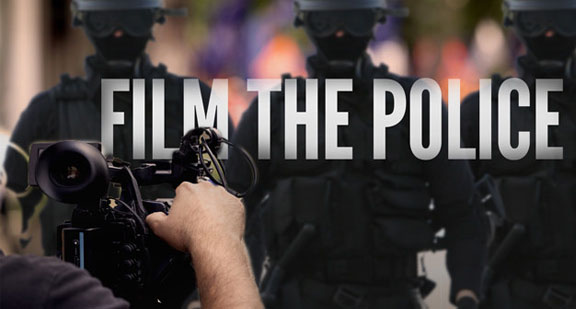
In several states, organized groups that use police scanners and knowledge of checkpoints to collectively monitor police activities by legally and peacefully filming cops on duty have said they’ve experienced retaliation, including unjustified detainment and arrests as well as police intimidation.
The groups operate under many decentralized organizations, most notably CopWatch and Cop Block, and have proliferated across the United States in the last decade – and especially in the aftermath of the events that continue to unfold in Ferguson, Missouri, after officer Darren Wilson fatally shot unarmed, black teenager Michael Brown.
Many such groups have begun proactively patrolling their communities with cameras at various times during the week, rather than reactively turning on their cameras when police enter into their neighborhoods or when they happen to be around police activity.
Across the nation, local police departments are responding to organized cop watching patrols by targeting perceived leaders, making arrests, threatening arrests, yanking cameras out of hands and even labeling particular groups “domestic extremist” organizations and part of the sovereign citizens movement – the activities of which the FBI classifies as domestic terrorism.
Courts across the nation at all levels have upheld the right to film police activity. The American Civil Liberties Union (ACLU) and photographer’s associcationshave taken many similar incidents to court, consistently winning cases over the years. The Supreme Court has ruled police can’t search an individual’s cellphone data without a warrant. Police also can’t legally delete an individual’s photos or video images under any circumstances.
“Yet, a continuing stream of these incidents (often driven by police who have been fed ‘nonsense‘ about links between photography and terrorism) makes it clear that the problem is not going away,” writes Jay Stanley, a senior policy analyst at the ACLU’s Speech, Privacy & Technology Project.
Sources who have participated in various organized cop watching groups in cities such as New York; Chicago; Cleveland; Las Vegas; Oakland; Arlington, Texas; Austin and lastly Ferguson, Missouri, told Truthout they have experienced a range of police intimidation tactics, some of which have been caught on film. Cop watchers told Truthout they have been arrested in several states, including Texas, New York, Ohio and California in retaliation for their filming activity.
More recently, in September, three cop watchers were arrested while monitoring police activity during a traffic stop in Arlington, Texas. A group of about 20 people, a few of them associated with the Tarrant County Peaceful Streets Project, gathered at the intersection of South Cooper Street and Lynda Lane during a Saturday night on September 6 to film police as they conducted a traffic stop. A video of what happened next was posted at YouTube.
Arlington police charged Janie Lucero, her husband, Kory Watkins, and Joseph Tye with interference of public duties. Lucero and Watkins were charged with obstructing a highway while Tye was arrested on charges of refusing to identify himself.
Arlington police have defended the arrests of the three cop watchers, but the watchers say they weren’t interfering with police work, and were told to move 150 feet away from the officers – around the corner of a building where they couldn’t film the officers.
“When we first started [cop watching, the police] seemed kind of bothered a little bit,” Watkins told Truthout. “There was a change somewhere where [the police] started becoming a little bit more offended, and we started having more cop watchers so I guess they felt like they needed to start bringing more officers to traffic stops.”
On the night of Watkin’s arrest, his group had previously monitored two other traffic stops without any confrontation with Arlington police officers before the incident that led to the arrests.
Sometimes, though, retaliation against cop watching groups goes far beyond arresting cop watchers on patrol.
Cops Label Cop Watch Groups Domestic Terrorists
On New Year’s Day in 2012, Antonio Buehler, a West Point graduate and former military officer, witnessed two Austin police officers assaulting a woman. He pulled out his phone.
As he began photographing the officers and asking questions about their activities, the cops assaulted and arrested him. He was charged with spitting in a cop’s face – a felony crime.
However, two witness videos of the incident surfaced and neither of them showed that Buehler spit in Officer Patrick Oborski’s face. A grand jury was finally convened in March 2013 and concluded there was not enough evidence to indict Buehler on any of the crimes he was charged with.
A few months after the New Year’s Day incident, Buehler and other Austin-based activists started the Peaceful Streets Project (PSP), an all-volunteer organization dedicated to stopping police abuse. The group has held “Know Your Rights” trainings and a Police Accountability Summit. The group also regularly organizes cop watch patrols in Austin.
Since the PSP was launched, the movement has grown, with local chapters popping up in other cities and states across the United States, including Texas’ Tarrant County chapter, which the three cop watchers arrested in Arlington were affiliated with.
But as the Peaceful Streets movement spread, police retaliation against the groups, and particularly Buehler himself, also escalated.
“[The Austin Police Department (APD)] sees us as a threat primarily because we shine a spotlight on their crimes,” Buehler said.
The group recently obtained documents from the APD through a Freedom of Information Act (FOIA) request that reveal Austin police colluded to arrest Buehler and other cop watchers affiliated with the Peaceful Streets Project. Since the New Year’s Day incident, Buehler has been arrested three more times by APD officers. At least four other members of PSP have been arrested on charges of interference or failing to identify themselves during their cop watching activities.
The emails indicate APD officers monitored Buehler’s social media posts and attempted to justify arresting him for another felony crime of online impersonation over an obviously satirical post he made on Facebook, as well as reveal that some APD officers coordinated efforts to stop PSP members’ legal and peaceful activities, even suggesting reaching out to the District Attorney’s office to see if anything could be done to incarcerate members of the group.
Another internal email from APD senior officer Justin Berry identifies PSP as a “domestic extremist” organization. Berry writes that he believes police accountability groups including PSP, CopWatch and Cop Block are part of a “national domestic extremism trend.” He believes he found “mirror warning signs” in “FBI intel.” Berry makes a strange attempt to lump police accountability activists and the hacker-collective Anonymous in with sovereign citizens groups as a collective revolutionary movement.
“Sovereign citizens” groups generally believe federal, state and local governments are illegitimate and operate illegally. Some self-described sovereign citizens create fake license plates, identification and forms of currency to circumvent official government institutions. The FBI classifies the activities of sovereign citizens groups as domestic terrorism, considering the groups a growing “domestic threat” to law enforcement.
Buehler told Truthout the APD is working with a Department of Homeland Security (DHS) fusion center to attempt to identify PSP as a sovereign citizens group to associate its members with domestic terrorism with state and federal authorities. DHS fusion centers are designed to gather, analyze and promote the sharing of intelligence information between federal and state agencies.
“They have spent a fair amount of resources tracking us, spying on us and infiltrating our group, and we are just peaceful activists who are demanding accountability for the police,” Buehler told Truthout. “They have absolutely no evidence that we’ve engaged in any criminal activity or that we’ve tried to engage in criminal activity.”
APD officials did not respond to a request for comment.
“They’ve pushed us; they’ve assaulted us for filming them; they’ve used their horses against us and tried to run us into walls; they’ve driven their cars up on us; they illegally detained us and searched us; they get in our face and they yell at us; they threaten to use violent force against us,” Buehler said. “But we didn’t realize until these emails just how deep this intimidation, how deep these efforts were to harm us for trying to hold them accountable.”
Buehler also said the group has additional internal emails which have not been released yet that reveal the APD attempted to take another charge to the District Attorney against him for felony child endangerment over the activities of a teenaged member of PSP.
He said he and other members of PSP were interested in pursuing a joint civil action against the APD over their attempts to frame and arrest them for their First Amendment activities.
This is not the first time a municipal police department has labeled a local cop watching group as an extremist organization.
In 2002, internal files from the Denver Police Department’s (DPD) Intelligence Unit were leaked to the ACLU, revealing the unit had been spying on several activist groups in the city, and keeping extensive records about members of the activist groups. Many of these groups were branded as “criminal extremist” organizations in what later became a full-scale controversy widely known as the Denver police’s “spy files.” Some of the groups falsely branded as “criminal extremist” groups included three police accountability organizations: Denver CopWatch, End the Politics of Cruelty and Justice for Mena.
Again, from October 2003 through the Republican National Convention (RNC) in August 2004, intelligence digests produced by the New York City Police Department (NYPD) on dozens of activist groups, including several police accountability organizations, were made public under a federal court order. TheNYPD labeled participants of the “Operation CopWatch” effort as criminal extremists.
Those who participated in “Operation CopWatch” during the RNC hoped to identify undercover cops who might attempt to provoke violence during demonstrations and document police violence or misconduct against protesters.
Communities Benefiting From Cop Watch Patrols Resist Police Retaliation Against Watchers
In some major urban areas, rates of police harassment of individuals drop considerably after cop watchers take to the streets – and communities band together to defend cop watch patrols that experience police retaliation, say veteran cop watchers.
Veteran police accountability activist José Martín has trained and organized with several organizations that participate in cop watch activities. Martín has been detained and arrested several times while cop watching with organized patrols in New York and Chicago.
His arrests in New York are part of a widely documented problem in the city. In fact, retaliation in New York against cop watchers has been so widespread that the NYPD had to send out an official memo to remind officers that it is perfectly legal for civilians to film cops on duty.
Martín described an experience in Chicago in which he felt police unjustly retaliated against him after a local CopWatch group formed and began regularly patrolling Chicago’s Pilsen neighborhood. After the group became well-known by the Pilsen community, residents gathered around an officer who had detained Martín after a patrol one night in 2009, calling for his release. The officer let him go shortly after.
“When cop watchers are retaliated against, if the community is organized, if there is a strong relationship between cop watch patrols and the community, but most importantly, if the cop watchers are people of the community, that community has the power to push back against retaliation and prevent its escalation,” Martín said. “Retaliation doesn’t work if you stand together.”
Another veteran cop watcher, Jacob Crawford, co-founder of Oakland’s We Copwatch, is helping the community of Ferguson, Missouri, organize cop watch patrols and prepare the community for the potential of police retaliation. His group raised $6,000 to pass out 110 cameras to organizers and residents in Ferguson, and train them to monitor police activity in the aftermath of the upheavals that rocked the city after Wilson killed Brown.
“I do expect retaliation, I do expect that these things won’t be easy, but these folks are in it,” Crawford told Truthout. “This is something that makes more sense to them than not standing up for themselves.”
Statistically speaking, Americans should be more fearful of the local cops than “terrorists.”
Though Americans commonly believe law enforcement’s role in society is to protect them and ensure peace and stability within the community, the sad reality is that police departments are often more focused on enforcing laws, making arrests and issuing citations. As a result of this as well as an increase in militarized policing techniques, Americans are eight times more likely to be killed by a police officer than by a terrorist, estimates a Washington’s Blog report based on official statistical data.
Though the U.S. government does not have a database collecting information about the total number of police involved shootings each year, it’s estimated that between 500 and 1,000 Americans are killed by police officers each year. Since 9/11, about 5,000 Americans have been killed by U.S. police officers, which is almost equivalent to the number of U.S. soldiers who have been killed in the line of duty in Iraq.
Because individual police departments are not required to submit information regarding the use of deadly force by its officers, some bloggers have taken it upon themselves to aggregate that data. Wikipedia also has a list of “justifiable homicides” in the U.S., which was created by documenting publicized deaths.
Mike Prysner, one of the local directors of the Los Angeles chapter for ANSWER — an advocacy group that asks the public to Act Now to Stop War and End Racism — told Mint Press Newsearlier this year that the “epidemic” of police harassment and violence is a nationwide issue.
He said groups like ANSWER are trying to hold officers accountable for abuse of power. “[Police brutality] has been an issue for a very long time,” Prysner said, explaining that in May, 13 people were killed in Southern California by police.
As Mint Press News previously reported, each year there are thousands of claims of police misconduct. According to the CATO Institute’s National Police Misconduct Reporting Project, in 2010 there were 4,861 unique reports of police misconduct involving 6,613 sworn officers and 6,826 alleged victims.
Most of those allegations of police brutality involved officers who punched or hit victims with batons, but about one-quarter of the reported cases involved firearms or stun guns.
Racist policing
A big element in the police killings, Prysner says, is racism. “A big majority of those killed are Latinos and Black people,” while the police officers are mostly White, he said. “It’s a badge of honor to shoot gang members so [the police] go out and shoot people who look like gang members,” Prysner argued, giving the example of 34-year-old Rigoberto Arceo, who was killed by police on May 11.
According to a report from the Los Angeles Times, Arceo, who was a biomedical technician at St. Francis Medical Center, was shot and killed after getting out of his sister’s van. The Los Angeles County Sheriff’s Department says Arceo “advanced on the deputy and attempted to take the deputy’s gun.” However, Arceo’s sister and 53-year-old Armando Garcia — who was barbecuing in his yard when the incident happened — say that Arceo had his hands above his head the entire time.
Prysner is not alone in his assertion that race is a major factor in officer-related violence. This past May, astudy from the the Malcolm X Grassroots Movement, an anti-racist activist organization, found that police officers, security guards or self-appointed vigilantes killed at least 313 Black people in 2012 — meaning one Black person was killed in the U.S. by law enforcement roughly every 28 hours.
Prysner said the relationship between police departments and community members needs to change and that when police shoot an unarmed person with their arms in the air over their head, the officer should be punished.
Culture of misconduct
“You cannot have a police force that is investigating and punishing itself,” Prysner said, adding that taxpayer money should be invested into the community instead of given to police to buy more guns, assault rifles and body armor.
Dissatisfied with police departments’ internal review policies, some citizens have formed volunteer police watch groups to prevent the so-called “Blue Code of Silence” effect and encourage police officers to speak out against misconduct occurring within their department.
As Mint Press News previously reported, a report released earlier this year found that of the 439 cases of police misconduct that then had been brought before the Minneapolis’s year-old misconduct review board, not one of the police officers involved has been disciplined.
Although the city of Minneapolis spent $14 million in payouts for alleged police misconduct between 2006 and 2012, despite the fact that the Minneapolis Police Department often concluded that the officers involved in those cases did nothing wrong.
Other departments have begun banning equipment such as Tasers, but those decisions were likely more about protecting the individual departments from lawsuits than ensuring that officers are not equipped with weapons that cause serious and sometimes fatal injuries when used.
To ensure officers are properly educated on how to use their weapons and are aware of police ethics, conflict resolution and varying cultures within a community, police departments have historically heldtraining programs for all officers. But due to tighter budgets and a shift in priorities, many departments have not provided the proper continuing education training programs for their officers.
Charles Ramsey, president of both the Major Cities Chiefs Association and the Police Executive Research Forum, called that a big mistake, explaining that it is essential officers are trained and prepared for high-stress situations:
“Not everybody is going to be able to make those kinds of good decisions under pressure, but I do think that the more reality-based training that we provide, the more we put people in stressful situations to make them respond and make them react.”
GI Joe replaces Carl Winslow
In order to help local police officers protect themselves while fighting the largely unsuccessful War on Drugs, the federal government passed legislation in 1994 allowing the Pentagon to donate surplus military equipment from the Cold War to local police departments. Meaning that “weaponry designed for use on a foreign battlefield has been handed over for use on American streets … against American citizens.”
So while the U.S. military fights the War on Terror abroad, local police departments are fighting another war at home with some of the same equipment as U.S. troops, and protocol that largely favors officers in such tactics as no-knock raids.
Radley Balko, author of “Rise of the Warrior Cop,” wrote in the Wall Street Journal in August:
“Since the 1960s, in response to a range of perceived threats, law-enforcement agencies across the U.S., at every level of government, have been blurring the line between police officer and soldier.
“Driven by martial rhetoric and the availability of military-style equipment—from bayonets and M-16 rifles to armored personnel carriers—American police forces have often adopted a mind-set previously reserved for the battlefield. The war on drugs and, more recently, post-9/11 antiterrorism efforts have created a new figure on the U.S. scene: the warrior cop—armed to the teeth, ready to deal harshly with targeted wrongdoers, and a growing threat to familiar American liberties.”
As Mint Press News previously reported, statistics from an FBI report released in September reveal that a person is arrested on marijuana-related charges in the U.S. every 48 seconds, on average — most were for simple possession charges.
According to the FBI’s report, there were more arrests for marijuana possession than for the violent crimes of murder and nonnegligent manslaughter, forcible rape, robbery and aggravated assault — 658,231 compared with 521,196 arrests.
While groups that advocate against police brutality recognize and believe that law enforcement officials should be protected while on duty, many say that local police officers do not need to wear body armor, Kevlar helmets and tactical equipment vests — all while carrying assault weapons.
“We want the police to keep up with the latest technology. That’s critical,” American Civil Liberties Union senior counsel Kara Dansky said. “But policing should be about protection, not combat.”
According to the National Law Enforcement Officers Memorial Fund, there are more than 900,000 sworn law enforcement officers in the United States. In 2012, 120 officers were killed in the line of duty. The deadliest day in law enforcement history was reportedly Sept. 11, 2001, when 72 officers were killed.
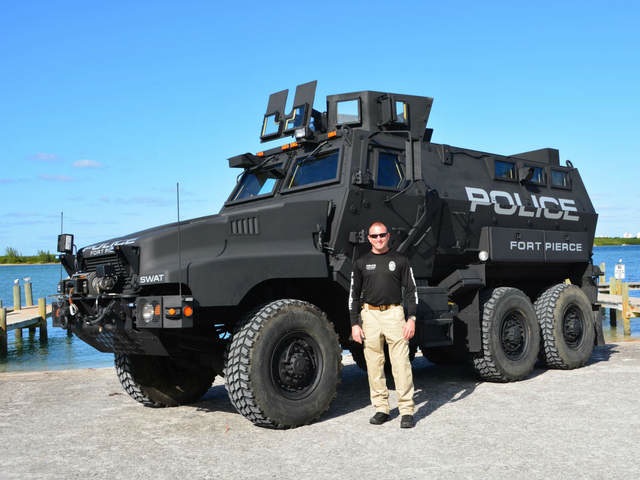
Despite far fewer officers dying in the line of duty compared with American citizens, police departments are not only increasing their use of protective and highly volatile gear, but are increasingly setting aside a portion of their budget to invest in new technology such as drones, night vision goggles, remote robots, surveillance cameras, license plate readers and armored vehicles that amount to unarmed tanks.
Though some officers are on board with the increased militarization and attend conferences such as the annual Urban Shield event, others have expressed concern with the direction the profession is heading.
For example, former Arizona police officer Jon W. McBride said police concerns about being “outgunned” were likely a “self-fulfilling prophecy.” He added that “if not expressly prohibited, police managers will continually push the arms race,” because “their professional literature is predominately [sic] based on the acquiring and use of newer weapons and more aggressive techniques to physically overwhelm the public. In many cases, however, this is the opposite of smart policing.”
“Coupled with the paramilitary design of the police bureaucracy itself, the police give in to what is already a serious problem in the ranks: the belief that the increasing use of power against a citizen is always justified no matter the violation. The police don’t understand that in many instances they are the cause of the escalation and bear more responsibility during an adverse outcome.
“The suspects I encountered as a former police officer and federal agent in nearly all cases granted permission for me to search their property when asked, often despite unconcealed contraband. Now, instead of making a simple request of a violator, many in law enforcement seem to take a more difficult and confrontational path, fearing personal risk. In many circumstances they inflame the citizens they are engaging, thereby needlessly putting themselves in real and increased jeopardy.”
Another former police officer who wished to remain anonymous agreed with McBride and told Balko,
“American policing really needs to return to a more traditional role of cops keeping the peace; getting out of police cars, talking to people, and not being prone to overreaction with the use of firearms, tasers, or pepper spray. … Don’t get me wrong, I’ve been in more than my share tussles and certainly appreciate the dangers of police work, but as Joseph Wambaugh famously said, the real danger is psychological, not physical.”
Release Us – a short film on police brutality by Charles Shaw
The militarization of police is harming civil liberties, impacting children, and transforming neighborhoods into war zones.
The “war on terror” has come home–and it’s wreaking havoc on innocent American lives. The culprit is the militarization of the police.
The weapons used in the “war on terror” that destroyed Afghanistan and Iraq have made their way to local law enforcement. While police forces across the country began a process of militarization complete with SWAT teams and flash-bang grenades when President Reagan intensified the “war on drugs,” the post-9/11 “war on terror” has added fuel to the fire.
Through laws and regulations like a provision in defense budgets that authorize the Pentagon to transfer surplus military gear to police forces, local law enforcement are using weapons found on the battlefields of South Asia and the Middle East.
A recent New York Times article by Matt Apuzzoreported that in the Obama era, “police departments have received tens of thousands of machine guns; nearly 200,000 ammunition magazines; thousands of pieces of camouflage and night-vision equipment; and hundreds of silencers, armored cars and aircraft.” The result is that police agencies around the nation possess military-grade equipment, turning officers who are supposed to fight crime and protect communities into what look like invading forces from an army. And military-style police raids have increased in recent years, with one count putting the number at 80,000 such raids last year.
In June, the American Civil Liberties Union (ACLU) brought more attention to police militarization when it issued a comprehensive, nearly 100-page (appendix and endnotes included) report titled, “War Comes Home: The Excessive Militarization of American Policing.” Based on public records requests to more than 260 law enforcement agencies in 26 states, the ACLU concluded that “American policing has become excessively militarized through the use of weapons and tactics designed for the battlefield” and that this militarization “unfairly impacts people of color and undermines individual liberties, and it has been allowed to happen in the absence of any meaningful public discussion.”
The information contained in the ACLU report, and in other investigations into the phenomenon, is sobering. From the killing of innocent people to the lack of debate on the issue, police militarization has turned into a key issue for Americans. It is harming civil liberties, ramping up the “war on drugs,” impacting the most marginalized members of society and transforming neighborhoods into war zones. Here are 11 important–and horrifying–things you should know about the militarization of police.
1. It harms, and sometimes kills, innocent people. When you have heavily armed police officers using flash-bang grenades and armored personnel carriers, innocent people are bound to be hurt. The likelihood of people being killed is raised by the practice of SWAT teams busting down doors with no warning, which leads some people to think it may be a burglary, who could in turn try to defend themselves. The ACLU documented seven cases of civilians dying, and 46 people being injured. That’s only in the cases the civil liberties group looked at, so the number is actually higher.
Take the case of Tarika Wilson, which the ACLU summarizes. The 26-year-old biracial mother lived in Lima, Ohio. Her boyfriend, Anthony Terry, was wanted by the police on suspicion of drug dealing. So on January 4, 2008, a SWAT team busted down Wilson’s door and opened fire. A SWAT officer killed Wilson and injured her one-year-old baby, Sincere Wilson. The killing sparked rage in Lima and accusations of a racist police department, but the officer who shot Wilson, Sgt. Joe Chavalia, was found not guilty on all charges.
2. Children are impacted. As the case of Wilson shows, the police busting down doors care little about whether there’s a child in the home. Another case profiled by the ACLU shows how children are caught up the crossfire–with devastating consequences.
In May, after their Wisconsin home had burned down, the Phonesavanh family was staying with relatives in Georgia. One night, a SWAT team with assault rifles invaded the home and threw a flashbang grenade–despite the presence of kids’ toys in the front yard. The police were looking for the father’s nephew on drug charges. He wasn’t there. But a 19-month-old named Bou Bou was–and the grenade landed in his crib.
Bou Bou was wounded in the chest and had third-degree burns. He was put in a medically induced coma.
Another high-profile instance of a child being killed by paramilitary police tactics occurred in 2010, when seven-year-old Aiyana Stanley-Jones was killed in Detroit. The city’s Special Response Team (Detroit’s SWAT) was looking for Chauncey Owens, a suspect in the killing of a teenager who lived on the second floor of the apartment Jones lived in.
Officers raided the home, threw a flash-bang grenade, and fired one shot that struck Jones in the head. The police agent who fired the fatal shot, Joseph Weekley, has so far gotten off easy: a jury trial ended in deadlock last year, though he will face charges of involuntary manslaughter in September. As The Nation’s Mychal Denzel Smith wrote last year after Weekley was acquitted: “What happened to Aiyana is the result of the militarization of police in this country…Part of what it means to be black in America now is watching your neighborhood become the training ground for our increasingly militarized police units.”
Bou Bou and Jones aren’t the only case of children being impacted.
According to the ACLU, “of the 818 deployments studied, 14 percent involved the presence of children and 13 percent did not.”
3. The use of SWAT teams is unnecessary. In many cases, using militarized teams of police is not needed. The ACLU report notes that the vast majority of cases where SWAT teams are deployed are in situations where a search warrant is being executed to just look for drugs. In other words, it’s not even 100% clear whether there are drugs at the place the police are going to. These situations are not why SWAT was created.
Furthermore, even when SWAT teams think there are weapons, they are often wrong. The ACLU report shows that in the cases where police thought weapons would be there, they were right only a third of the time.
4. The “war on terror” is fueling militarization. It was the “war on drugs” that introduced militarized policing to the U.S. But the “war on terror” has accelerated it.
A growing number of agencies have taken advantage of the Department of Defense’s “1033” program, which is passed every year as part of the National Defense Authorization Act, the budget for the Pentagon. The number of police agencies obtaining military equipment like mine-resistant ambush protected (MRAP) vehicles has increased since 2009,according to USA Today, which notes that this “surplus military equipment” is “left over from U.S. military campaigns in Iraq, Afghanistan and elsewhere.” This equipment is largely cost-free for the police agencies who receive them.
In addition to the Pentagon budget provision, another agency created in the aftermath of 9/11 is helping militarize the police. The Department of Homeland Security’s (DHS) own grants funnel military-style equipment to local police departments nationwide. According to a 2011 Center for Investigative Reporting story published by The Daily Beast, at least $34 billion in DHS grants have gone to police agencies to buy military-style equipment. This money has gone to purchase drones, tactical vests, bomb-disarming robots, tanks and more.
5. It’s a boon to contractor profits. The trend towards police militarization has given military contractors another lucrative market where they can shop their products. Companies like Lockheed Martin and Blackhawk Industries are making big bucks by selling their equipment to agencies flush with Department of Homeland Security grants.
In addition to the actual selling of equipment, contractors also sponsor training events for SWAT teams, like Urban Shield, a major arms expo that has attracted increasing attention from activists in recent years. SWAT teams, police agencies and military contractors converge on Urban Shield, which was held in California last year, to train and to promote equipment to buy.
6. Border militarization and police militarization go hand in hand. The “war on terror” and “war on drugs” aren’t the only wars helping police militarization. There’s also the war on undocumented immigrants.
The notorious Sheriff Joe Arpaio, infamous for brutal crackdowns on undocumented immigrants, is the paradigmatic example of this trend. According to the ACLU, Arpaio’s Maricopa County department has acquired a machine gun so powerful it could tear through buildings on multiple city blocks. In addition, he has 120 assault rifles, five armored vehicles and ten helicopters. Other law enforcement agencies in Arizona have obtained equipment like bomb suits and night-vision goggles.
Then there’s a non-local law enforcement agency on the border: the Border Patrol, which has obtained drones and attack helicopters. And Border Patrol agents are acting like they’re at war. A recent Los Angeles Times investigation revealedthat law enforcement experts had found that that the Border Patrol has killed 19 people from January 2010-October 2012, including some of whom when the agents were under no lethal, direct threat.
7. Police are cracking down on dissent. In 1999, massive protests rocked Seattle during the World Trade Organization meeting. The police cracked down hard on the demonstrators using paramilitary tactics. Police fired tear gas at protesters, causing all hell to break loose.
Norm Stamper, the Seattle police chief at the time, criticized the militarized policing he presided over in a Nation article in 2011. “Rocks, bottles and newspaper racks went flying. Windows were smashed, stores were looted, fires lighted; and more gas filled the streets, with some cops clearly overreacting, escalating and prolonging the conflict,” wrote Stamper.
More than a decade after the Seattle protests, militarized policing to crack down on dissent returned with a vengeance during the wave of Occupy protests in 2011. Tear gas and rubber bullets were used to break up protests in Oakland.Scott Olsen, an Occupy Oakland protester and war veteran, was struck in the head by a police projectile, causing a fractured skull, broken neck vertebrae and brain swelling.
8. Asset forfeitures are funding police militarization. In June, AlterNet’s Aaron Cantuoutlined how civil asset forfeiture laws work.
“It’s a legal fiction spun up hundreds of years ago to give the state the power to convict a person’s property of a crime, or at least, implicate its involvement in the committing of a crime. When that happened, the property was to be legally seized by the state,” wrote Cantu. He went on to explain that law enforcement justifies the seizing of property and cash as a way to break up narcotics rings’ infrastructure. But it can also be used in cases where a person is not convicted, or even charged with, a crime.
Asset forfeitures bring in millions of dollars for police agencies, who then spend the money for their own uses. And for some police departments, it goes to militarizing their police force.
New Yorker reporter Sarah Stillman, who penned a deeply reported piece on asset forfeitures,wrote in August 2013 that“thousands of police departments nationwide have recently acquired stun grenades, armored tanks, counterattack vehicles, and other paramilitary equipment, much of it purchased with asset-forfeiture funds.” So SWAT teams have an incentive to conduct raids where they seize property and cash. That money can then go into their budgets for more weapons.
9. Dubious informants are used for raids. As the New Yorker’s Stillman wrote in another piece,informants are “the foot soldiers in the government’s war on drugs. By some estimates, up to eighty per cent of all drug cases in America involve them.” Given SWAT teams’ focus on finding drugs, it’s no surprise that informants are used to gather information that lead to military-style police raids.
A 2006 policy paper by investigative journalist Radley Balko, who has done the most reporting on militarized policing, highlighted the negative impact using informants for these raids have. Most often, informants are “people who regularly seek out drug users and dealers and tip off the police in exchange for cash rewards” and other drug dealers, who inform to gain leniency or cash from the police. But these informants are quite unreliable–and the wrong information can lead to tragic consequences.
10. There’s been little debate and oversight. Despite the galloping march towards militarization, there is little public debate or oversight of the trend. The ACLU report notes that “there does not appear to be much, if any, local oversight of law enforcement agency receipt of equipment transfers.” One of the group’s recommendations to change that is for states and local municipalities to enact laws encouraging transparency and oversight of SWAT teams.
11. Communities of color bear the brunt. Across the country, communities of color are the people most targeted by police practices. In recent years, the abuse of “stop and frisk” tactics has attracted widespread attention because of the racially discriminatory way it has been applied.
Militarized policing has also targeted communities of color. According to the ACLU report, “of all the incidents studied where the number and race of the people impacted were known, 39 percent were Black, 11 percent were Latino, 20 were white.” The majority of raids that targeted blacks and Latinos were related to drugs–another metric exposing how the “war on drugs” is racist to the core.
This video shows the obvious build out and expansion of a Military-grade complex using unmarked, black vehicles and earth movers. There is a creepy feeling of authenticity to this video that shouldn’t be taken lightly.
According to reports from the Daily Kos and Russia Today, a company specializing in night raid equipment was awarded a 23 million dollar contract from the Department of Defense and subsequently went on to lobby for the NDAA which has given the government the power to indefinitely detain American citizens.
Surefire LLC openly lobbed for the House version of the NDAA, a bill many have claimed has effectively ended the Bill of Rights, months after receiving the 23 million dollar contact from the DOD.
Why would this company be receiving a contract which could outfit at least 30,000 troops with new and updated night raid equipment when the U.S. is supposedly pulling troops out of Iraq and, to a smaller extent, Afghanistan?
Why has this same company gone on to lobby for a bill that has turned the United States into a war zone?
So what does Surefire make? In a word, night-raid equipment, with a fresh new $23 million contract from the DoD even as we saw troops pulling out of Iraq and they are about to pull out of Afghanistan.
The product catalog main categories read things like “weapon lights, helmet lights, sound suppressors, high capacity magazines.” The equipment is relatively cheap, not big ticket items in Defense Department terms. That means this is a big contract. A $23 million contract would buy enough of these things to outfit maybe 50,000 soldiers.
If we are pulling out of Iraq and Afghanistan, what is all this stuff for? Night-raid gear? These are basically made to blind people as they awake from you busting down their door, not for open combat.
In a night firefight you don’t want any lights near you whatsoever. That gives the other guy an easy target.
Does it seem likely that the night raid gear that will be provided to the DOD under the 23 million dollar contract will be used outside the United States when the company who won the contract is lobbying for a bill that lets the military operate against American citizens inside the country?
As we have reported in the past, the plans for martial law in America have long been drawn up and the idea that either our own military, foreign military’s or a combination of both will be used against the American people has steadily gained ground as millions of people around the world have become aware of these dastardly plans.
Every week it seems more and more information is released that further proves these plans are real and already capable of becoming fully operational with 72 hours.
Whether it be Ron Paul warning about the NDAA and martial law or United Nations troops carrying out martial law drills within the US, the fact remains that the possibility of a martial law scenario in this country remains very real.
Still not convinced?
In 2008 the Pentagon openly announced their plans for a 20,000 strong military force(this is the number they admit, the actual number is sure to be much higher) set to operate within the United States. This internal force was also called for in a Rand Corporation document titled, “A Stability Police Force for the United States”
The Pentagon has an openly promoted a program(1033) that has given away close to $500 million in leftover military equipment to law enforcement in the fiscal year of 2011.
A recent document from former Halliburton subsidiary KBR outlined their need for subcontractors to be ready to provide various functions needed to establish FEMA camps in America within 72 hour notice.
Multiple cities have seen the military take part in various police work including in Florida City which had the Air Force set up a crime prevention hotline and take part in arrests at a local convenience store.
The Pentagon and Military have been actively war gaming for what they see as a looming large scale economic collapse that will lead to civil unrest.
Early this year FEMA requested information on their ability to acquire 140 million packets of food, blankets, and underwater body bags.
The examples above are no more than a small chunk of the ridiculous amount of evidence that has been released which proves that factions within our government are planning for a confrontation with the American people themselves.
Rather than live in fear, American citizens should consider preparing themselves for whatever lies ahead in the very near future.
This would include purchasing some type of storeable food,(There are many great companies that provide high quality preparedness products including Prepared.pro and Ready Made Resources) having evacuation plans ready, speaking to your friends and family about this very real possibility, and remembering that living in fear is what these tyrants WANT.



 In order to help local police officers protect themselves while fighting the largely unsuccessful War on Drugs, the federal government passed legislation in 1994 allowing the Pentagon to