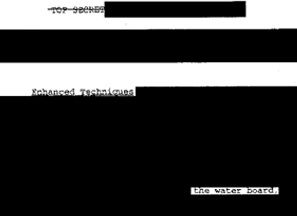
A Bloomberg investigation shows that the federal government is paying a military contractor facing allegations of torture to manage some public records work.
The Freedom of Information Act allows ordinary people to learn about behind the scenes functions of our government. There are a number of limited, discrete exemptions to the law, which allow agencies to redact or withhold documents in whole or in part. But generally speaking, the law grants us broad access into the workings of our government — and it is therefore one of the key mechanisms whereby we learn of illegal or inappropriate government activities. FOIA is a necessary transparency mechanism in our democracy.
That’s why it’s shocking to learn, as Bloomberg news reports today, that increasingly the process of managing and responding to our FOIA requests is being handled by private corporations. The investigation shows that at least 25 federal agencies are farming out their FOIA work to private companies, at a cost both to taxpayers and to the integrity of the open records system. As director of the Sunlight Foundation John Wonderlich told Bloomberg:
If I was in charge of an agency and wanted to create an unaccountable FOIA process, the first thing I would do is put an outside contractor in charge of it because fewer of our accountability laws apply to them…It would just be another layer between me and the public.
It gets worse. Not only does the contracting out of FOIA work shield the government from precisely the transparency the law is meant to institute. There could be very serious conflicts of interest involved when private companies are tasked with managing the processes whereby sensitive (and likely embarrassing or damning) government secrets are disclosed to the public.
Case in point is CACI International, a military and intelligence contractor that is facing a lawsuit alleging its employees participated in the torture of detainees at Abu Ghraib prison in Iraq. CACI is one of the companies the federal government has outsourced FOIA work to over the past ten years.
Should a company accused of serious human rights violations in a war zone have any involvement with open government processes designed to disclose precisely such abuses?
How do you make matters worse for an elusive intelligence company that has been forced to scramble for explanations about their ownership of an intricate, widespread surveillance program? Just ask Cubic, whose troubles only begin with TrapWire.
Days after the international intelligence gathering surveillance system called TrapWire was unraveled by RT, an ongoing investigation into any and all entities with ties to the technology has unturned an ever-increasing toll of creepy truths. In only the latest installment of the quickly snowballing TrapWire saga, a company that shares several of the same board members as the secret spy system has been linked to a program called Tartan, which aims to track down alleged anarchists by specifically singling out Occupy Wall Street protesters and the publically funded media — all with the aid of federal agents.
Tartan, a product of the Ntrepid Corporation, “exposes and quantifies key influencers and hidden connections in social networks using mathematical algorithms for objective, un-biased output,” its website claims. “Our analysts, mathematicians and computer scientists are continually exploring new quantification, mining and visualization techniques in order to better analyze social networks.” In order to prove as such, their official website links to the executive summary of a case study dated this year that examines social network connections among so-called anarchists, supposedly locating hidden ties within an underground movement that was anchored on political activists and even the Public Broadcasting Station [.pdf].
“Tartan was used to reveal a hidden network of relationships among anarchist leaders of seemingly unrelated movements,” the website claims. “The study exposed the affiliations within this network that facilitate the viral spread of violent and illegal tactics to the broader protest movement in the United States.”
Tartan is advertised on their site as a must-have application for the national security sector, politicians and federal law enforcement, and makes a case by claiming that “an amorphous network of anarchist and protest groups,” made up of Occupy Oakland, PBS, Citizen Radio, Crimethinc and others, relies on “influential leaders,” “modern technology” and “illegal tactics” to spread a message of anarchy across America.
“The organizers of Occupy Wall Street and Occupy DC have built Occupy networks through online communication with anarchists actively participating in the movements’ founding,” the executive summary reads. On the chart that accompanies their claim, the group lists several political activism groups and broadcast networks within a ring of alleged anarchy, which also includes an unnamed FBI informant.
Although emails uncovered in a hack last year waged at Strategic Forecasting, or Stratfor, suggested that Occupy groups had been under private surveillance, the latest discovery of publically available information implies that the extent to which the monitoring of political activists on American soil occurred may have extended what was previously imagined.
Things don’t end there, though. While the TrapWire tale is still only just beginning, the Ntrepid Corporation made headlines last year after it was discovered by the Guardian that the company was orchestrating an “online persona management” program, a clever propaganda mill that was touted as a means “to influence regional and international audiences to achieve U.S. Central Command strategic objectives,” according, at least, to the Inspector General of the US Defense Department [.pdf]. The investigation eventually revealed that the US Central Command awarded Ntrepid $2.76 million worth of taxpayer dollars to create phony Internet “sock puppets” to propagate US support.
One year later, the merits of Tartan’s analytics are now being brought into question, but so are the rest of the company’s ties. A trove of research accumulated by RT, Project PM founder Barrett Brown, PrivacySOS.org and independent researchers Justin Ferguson and Asher Wolf, among others, has linked Tartan with an even more unsettling operation.
Margaret A. Lee of Northern Virginia is listed on several websites as serving on the Ntrepid board of directors as secretary, a position she held alongside Director Richard Helms, CFO Wesley R Husted and President Michael Martinka. And although several parties are going to great lengths to deny the ties, a paper trail directly links Lee and company to Abraxas — and thus Cubic — and, of course, TrapWire, the very surveillance system that is believed to be blanketing the United States.
According to the Commonwealth of Virginia’s State Corporation Commission, TrapWire Inc. was registered to Margaret A Lee on March 7, 2009. Other publically available information reveals that, at least at one point, Wesley Husted served as chief financial officer for TrapWire, Inc., where Richard H Helms held the title of CEO.
Various sources have since claimed that Helms, a former CIA agent that once ran the agency’s European division, has severed ties with TrapWire, yet the other connections remain intact.
In RT’s earlier research in the TrapWire case, it was revealed that TrapWire’s parent company, Cubic Corporation, acquired an online identity masking tool called Anonymzer in a 2010 merger, and also controls the fare card system at some of the biggest public transportation systems in the world. According to the latest findings, Cubic’s control extends beyond just that, though. Under their Ntrepid branch, Cubic controlled an operation that spied on political activists with FBI informants and attempted to link them to crimes across America.
Whether or not the TrapWire system was implemented in such operations is unclear, and Cubic continues to maintain that they are not involved with the surveillance network.
Last week, Cubic Corporation issued a press release claiming, “Abraxas Corporation then and now has no affiliation with Abraxas Applications now known as Trapwire, Inc.”
“Abraxas Corp., a risk-mitigation technology company, has spun out a software business to focus on selling a new product,” the article reads. “The spinoff – called Abraxas Applications – will sell TrapWire, which predicts attacks on critical infrastructure by analyzing security reports and video surveillance.”
Not only does a 2007 report in the Washington Business Journal insist that the companies are practically one in the same, though, but a 2006 article in the same paper reveals that Abraxas had just acquired software maker Dauntless. Researchers at Darkernet have since linked Lee, Husted and Helms to the Abraxas Dauntless Board of Directors as well.
Justin Ferguson, the researcher who first exposed TrapWire two weeks ago, has noted that Lee, Helms and Husted were listed on Abraxas Dauntless’ filings with Virginia as recently as December 2011. They also are all present on the TrapWire filings dated September 2011 and the latest annual filing made with the Florida Department of State, Division of Corporations on behalf of Ntrepid.
Nevertheless, in a conversation this week with Project PM’s Barrett Brown, Cubic Corp. Communication Director Tim Hall dismisses this tie again.
“There is no connection at all with Abraxas Applications and Trapwire and or Ntrepid,” Hall allegedly insists, according to audio uploaded to YouTube.
Brown, on his part, says he has obtained Cubic’s 2010 tax filings that show that Ntrepd, like Abraxas, is “wholly owned” by Cubic.
Other trademark information publically available online says that the Abraxas Corporation first filed to claim the name TrapWire in 2004 and was granted a license for such in January of 2007.
TrapWire Training Courses Reveal Possible Purpose for its Creation
Although certain people reportedly playing key roles in the web-like leadership structure of TrapWire deny their involvement with the massive surveillance system, there is evidence that the engine driving this global company runs on the ambition of a common core of officers and directors.
Given the potential flood of legal challenges to its constitutionality, the corporation believed to be behind TrapWire is heading for higher ground, denying any association with the surveillance technology.
In a statement published on its website on August 13, Cubic Corporation attempted to sever the ties binding it to TrapWire. “Cubic Corporation (NYSE: CUB) acquired Abraxas Corporation on December 20, 2010. Abraxas Corporation then and now has no affiliation with Abraxas Applications now known as Trapwire, Inc. Erroneous reports have linked the company with Trapwire, Inc.,” the company insisted.
Despite such denials, many are rightly worried about any corporate connection — no matter how tenuous — between Cubic and TrapWire given the former’s access to the personal data of Americans through its other corporate interests. The synergy of such access with a massive surveillance apparatus could threaten the privacy of millions, as well as the freedom from unwarranted searches and seizures protected by the Fourth Amendment.
As for the scope and significance of TrapWire, the size of it cannot be exaggerated.
TrapWire is a massive and technologically advanced surveillance system that has the capacity to keep nearly the entire population of this country under the watchful eye of government 24 hours a day. Using this network of cameras and other surveillance tools, the federal government is rapidly constructing an impenetrable, inescapable theater of surveillance, most of which is going unnoticed by Americans and unreported by the mainstream media.
Unlike other elements of the central government’s cybersurveillance program, word about TrapWire was not leaked by Obama administration insiders. The details of this nearly unbelievable surveillance scheme were made public by WikiLeaks, the anti-secrecy group founded by Julian Assange. The TrapWire story percolated from the millions of e-mails from the Austin, Texas-based private intelligence-gathering firm Stratfor, published this year by WikiLeaks. Covering correspondence from mid-2004 to 2011, these documents expose Stratfor’s “web of informers, pay-off structure, payment-laundering techniques and psychological methods.”
This coterie of Stratfor co-conspirators is apparently angry about the leaks, considering that the WikiLeaks servers have been under near-constant Distributed Denial of Service (DDoS) attacks since the TrapWire revelations began attracting the notice of alternative journalists. Some outlets report that the cyberattacks are being carried out by agents of the American intelligence community determined to prevent the full depth of this scandal from being explored by reporters.
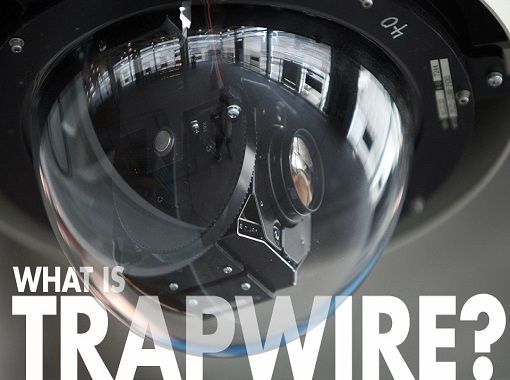
Exactly what is TrapWire? According to one description of the program, from Russia Today:
Former senior intelligence officials have created a detailed surveillance system more accurate than modern facial recognition technology — and have installed it across the US under the radar of most Americans, according to emails hacked by Anonymous.
Every few seconds, data picked up at surveillance points in major cities and landmarks across the United States are recorded digitally on the spot, then encrypted and instantaneously delivered to a fortified central database center at an undisclosed location to be aggregated with other intelligence.
Although many of the details remain undisclosed, it is known that the infrastructure of TrapWire was designed and deployed by Abraxas, an intelligence contractor based in northern Virginia headed and run by dozens of former American surveillance officers. As one article described it: “The employee roster at Abraxas reads like a who’s who of agents once with the Pentagon, CIA and other government entities according to their public LinkedIn profiles, and the corporation’s ties are assumed to go deeper than even documented.”
The network is believed to be immense. An article published by transparency advocacy group Public Intelligence claims that Stratfor e-mails suggest that TrapWire is in use by the U.S. Secret Service, the British security service MI5, the Royal Canadian Mounted Police, as well as counterterrorism divisions in both the Los Angeles and New York Police Departments and the LA fusion center. The e-mails also suggest that TrapWire is in use at military bases around the country. A July 2011 e-mail from a “Burton” to others at Stratfor describes how the U.S. Army, Marine Corps, and Pentagon have all begun using TrapWire and are “on the system now.” Burton described the Navy as the “next on the list.”
A survey of WikiLeaks e-mails containing information about TrapWire reveals another facet of this ever-expanding tool for tracking and targeting individuals.
The first course listed in the darkernet article is called the Surveillance Awareness Workshop. This class is reportedly “designed to instruct network and security personnel to use and navigate the TrapWire software system to familiarize themselves with the indicators of surveillance, terrorist surveillance methodologies, facility vulnerabilities, and the identification of probable surveillance zones that exist within each facility.”
The goal is that those with their fingers on the buttons and eyes on the consoles will learn to “view their facility the same way as would a terrorist, and then to be alert to the indicators of pre-attack surveillance.”
Pre-attack is a statist way of saying “guilty until proven innocent.” These agents — typically law enforcement or federal intelligence officers — reportedly will learn to spot suspicious behavior that points to the target’s propensity for participation in illegal activities.
This sort of advance profiling is eerily similar to the philosophy undergirding the signature strike that is becoming the go-to tactic in the Obama administration’s drone war.
A signature strike is not a strike on a particular suspect, but rather an attack on a person or group of people demonstrating behavior that is typical of those who might be associated with terror.
Perhaps the TrapWire “pre-attack surveillance” and the drone war “signature strike” are just two identifiable examples of a wider, more insidious government movement toward a society where one can be found guilty in advance of any crime based solely on one’s likelihood to act unlawfully and then be summarily executed based on that probability alone.
The second class offered by the makers of TrapWire according to the Internet investigation is designed along similar lines. It is called the Terrorist Pre-Attack Operations Course (TPOC).
Darkernet reports that participation in TPOC “will enhance overall security awareness and improve participants’ understanding of terrorist and criminal pre-attack surveillance and intelligence collection operations.”
Once again, the watchers are taught to better understand “terrorists” and what behavior they display just prior to the commission of a crime.
Unlike actual laws, these technologies and the courses improving their capabilities in the hands of users do not offer definitions of “terrorist” or “criminal.” One is left to one’s own understanding, it would seem, in the matter of conceiving of who is and is not a terrorist.
Today, the typical target might be a Muslim seen frequenting a subway station, for example. However, as the gulf separating the rulers and the ruled widens, perhaps a future TrapWire operator will target a gun-owner or attendant at a rally opposing a government policy as a potential threat and will initiate the requisite “intelligence collection operations.” The end result of those operations may be indefinite detention or death by Hellfire missile.
Finally, the last class listed in the darkernet article is called the Deception Detection and Eliciting Responses (DDER) course. This class will “teach students to detect deception and elicit responses in individuals including those which have been identified by TrapWire as having been engaged in suspicious behavior.”
So, once the target’s image pops up on one of the myriad cameras tracking the movements of every citizen (all are targets and potential terrorists, apparently) and the intelligence officers are called in to begin building a dossier on the target, the responding agents will use their newly-acquired interrogation skills to get the truth out of the target. “We have ways of making you talk,” in other words.
Given the aversion of the wizards running the surveillance state to allowing the curtain to be pulled back exposing the incredible extent of its domestic surveillance activities, it is more likely than not that TrapWire’s use in the tracking of Americans is wider and more institutional than most of us would like to believe.
A link to a complete listing of all TrapWire courses and the associated material is found here.
Indefinite detention, targeted killing and warrantless wiretapping are hot issues in the courts this week. Here’s the latest:
INDEFINITE DETENTION // The National Defense Authorization Act (NDAA) of 2012 provision that allows the government to indefinitely detain US citizens without charge or trial is once again in effect, after a Second Circuit Court overturned Judge Katherine Forrest’s permanent injunction against Section 1021 (b)(2). The fight over the widely-despised authority appears to be far from over. Read more.
UPDATE: Chris Hedges, one of the plaintiffs in the NDAA indefinite detention lawsuit, spoke with live stream journalist Tim Pool at Occupy Wall Street on Monday, September 17 about his case and the Obama administration’s appeal. Hedges put forward the thesis that the Obama administration may already be holding US citizens without due process — otherwise they wouldn’t have acted so quickly to overturn Forrest’s permanent injunction. The administration doesn’t want to be held in contempt, Hedges said, and so immediately moved to appeal her verdict. Note: This was filmed before the court overturned Forrest’s injunction, so it’s obsolete in that sense.
Watch:
TARGETED KILLING // Can the federal government talk publicly about its targeted killing drone program on television, in interviews with journalists, and before audiences of hundreds, and then turn around and deny the existence of the program in court to ensure that the public remains in the dark about its legal justifications for pursuing it? The ACLU says ‘no’:
The American Civil Liberties Union will be in federal appeals court Thursday to argue that the CIA cannot deny the existence of the government’s targeted killing program and refuse to respond to Freedom of Information Act requests about the program while officials continue to make public statements about it.
The ACLU’s FOIA request, filed in January 2010, seeks to learn when, where and against whom drone strikes can be authorized, and how the U.S. ensures compliance with international laws relating to extrajudicial killings.
“The notion that the CIA’s targeted killing program is a secret is nothing short of absurd,” said ACLU Deputy Legal Director Jameel Jaffer, who will argue the case before a three-judge panel of the D.C. Circuit Appeals Court. “For more than two years, senior officials have been making claims about the program both on the record and off. They’ve claimed that the program is effective, lawful and closely supervised. If they can make these claims, there is no reason why they should not be required to respond to requests under the Freedom of Information Act.”
WARRANTLESS SPYING // A 2005 class action lawsuit brought by AT&T customers who say the NSA illegally spied on their communications is slowly winding itself through the court system. In 2008, Congress immunized AT&T and other telecoms from lawsuits related to companies turning over customer information to the NSA, but the government still faces a number of challenges to the warrantless spying program, among them the AT&T class action suit. A judge first threw the case out in 2010, claiming that the plaintiffs didn’t have standing to bring the lawsuit because they couldn’t prove they were spied on. Another court reversed that decision a year later, instructing the court to look at whether the state secrets privilege bars the court from considering the case at all — regardless of whether there’s evidence of spying or not. As a result, the main plaintiff in the case, Carolyn Jewel, filed for summary judgment in July, providing the court with testimony from NSA whistleblowers and former AT&T employees to prove the existence of vacuum style, dragnet surveillance. The NSA makes some contradictory and utterly confusing arguments about why the plaintiffs shouldn’t have a right to challenge its spying programs. From Courthouse News:
The government has amply demonstrated in the DNI and NSA public and classified declarations that disclosure of the privileged information reasonably could be expected to cause exceptionally grave damage to national security,” a 48-page memorandum states. “The disclosure of information concerning whether plaintiffs have been subject to alleged NSA intelligence activity would necessarily reveal NSA intelligence sources and methods, including whether certain intelligence collection activities existed and the nature of any such activity. The disclosure of whether specific individuals were targets of alleged NSA activities would also reveal who is subject to investigative interest – helping that person to evade surveillance – or who is not – thereby revealing the scope of intelligence activities as well as the existence of secure channels for communication.
But those statements thoroughly contradict something else the government says:
The DNI explains that, as the government has previously indicated, the NSA’s collection of content of communications under the now inoperative TSP was directed at international communications in which a participant is reasonably believed to be associated with al Qaeda or an affiliate terrorist organization, and thus plaintiffs’ allegation that the NSA has indiscriminately collected the content of millions of communications sent or received by people inside the United States after 9/11 under the TSP is false.
The national security establishment first tells the public that it cannot disclose who is and who is not a target of its surveillance programs because doing so would tip off the bad guys, and then goes on to say that the program “was directed at…al Qaeda[.]” In other words, the government will readily admit that al Qaeda and “affiliate terrorist organization[s]” are targets of its surveillance programs, but it can’t acknowledge whether or not non-terrorist US citizens are also targets of that program because disclosure of whether non-terrorist US citizens are being spied on without constitutional protections would “cause exceptionally grave harm to national security.” As BoingBoing observed: the NSA says it can’t tell us if it is spying on us because “REASONS.”
WARRANTLESS SPYING // The ACLU has its own warrantless wiretapping lawsuit in the works to challenge the constitutionality of the FISA Amendments Act of 2008, and the government has thrown up similar roadblocks to prevent the case from being heard on the merits. Here’s the ACLU answer to the government’s claims that our clients — journalists, human rights workers and academics — don’t have a right to bring the lawsuit:
The government’s insistence that plaintiffs cannot establish standing without proving the certainty of surveillance is at bottom not a standing argument but a bid for a kind of immunity. This is because its proposed standard is one that neither plaintiffs nor anyone else will ever be able to meet—not because the surveillance they fear will never take place but because they will be unaware of it when it does…
The government theory of standing would render real injuries nonjusticiable and insulate the government’s surveillance activities from meaningful judicial review.
…
More than forty years ago, when surveillance technology was comparatively primitive, this Court recognized that “few threats to liberty exist which are greater than that posed by the use of eavesdropping devices” … and it cautioned that the threat to core democratic rights was especially pronounced where surveillance authority was exercised in the service of national security…. To accept the government’s theory of standing would be to accept that the courts are powerless to address the threat presented by surveillance authorities exercised in secret, and powerless to protect Americans’ most fundamental rights against the encroachment of increasingly sophisticated and intrusive forms of government power.
Read more about the ACLU’s challenge, which will go before the Supreme Court in late October to decide the standing issue once and for all. Just last week the House passed a reauthorization of the FISA Amendments Act, which would extend the law through December 31, 2017. Read the brief in the ACLU’s challenge, Clapper v. Amnesty, et al., here.