Wellcome Trust researchers have discovered how the brain assesses confidence in its decisions. The findings explain why some people have better insight into their choices than others.
Throughout life, we’re constantly evaluating our options and making decisions based on the information we have available. How confident we are in those decisions has clear consequences. For example, investment bankers have to be confident that they’re making the right choice when deciding where to put their clients’ money.
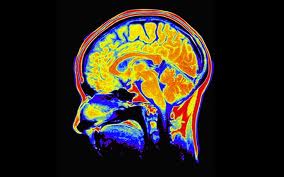
Researchers at the Wellcome Trust Centre for Neuroimaging at UCL led by Professor Ray Dolan have pinpointed the specific areas of the brain that interact to compute both the value of the choices we have in front of us and our confidence in those choices, giving us the ability to know what we want.The team used functional magnetic resonance imaging (fMRI) to measure activity in the brains of twenty hungry volunteers while they made choices between food items that they would later eat. To determine the subjective value of the snack options, the participants were asked to indicate how much they would be willing to pay for each snack. Then after making their choice, they were asked to report how confident they were that they had made the right decision and selected the best snack.It has previously been shown that a region at the front of the brain, the ventromedial prefrontal cortex, is important for working out the value of decision options. The new findings reveal that the level of activity in this area is also linked to the level of confidence participants placed on choosing the best option. The study also shows that the interaction between this area of the brain and an adjacent area reflects participants’ ability to access and report their level of confidence in their choices.
Dr Steve Fleming, a Sir Henry Wellcome Postdoctoral Fellow now based at New York University, explains: “We found that people’s confidence varied from decision to decision. While we knew where to look for signals of value computation, it was very interesting to also observe neural signals of confidence in the same brain region.”
Dr Benedetto De Martino, a Sir Henry Wellcome Postdoctoral Fellow at UCL, added: “Overall, we think our results provide an initial account both of how people make choices, and also their insight into the decision process.”
The findings are published online today in the journal Nature Neuroscience.
Reference: B. De Martino et al. Confidence in value-based choice. Nature Neuroscience, 2012. [Epub ahead of print]
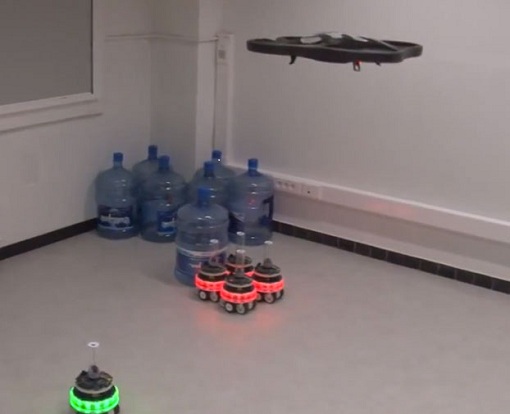
We’re used to thinking of robot swarms as consisting of lots and lots of similar robots working together. What we’re starting to see now, though, are swarms of heterogeneous robots, where you get different robots combining their powers to make each other more efficient and more capable. One of the first projects to really make this work was Swarmanoid, with teams of footbots and handbots and eyebots, and researchers presented a similar idea at IROS earlier this month, using an AR Drone to help a swarm of self-assembling ground robots to climb over a hill.
The focus of this research is communication: getting a flying robot to be able to communicate with a swarm of ground robots by relying exclusively on visual feedback from LEDs. All you need to get this to work are lights, cameras, and some mildly intelligent robots: you can leave your maps, GPS, IMU, hardware IDs, and all that stuff at home. Here’s a video of the system in action:
As interesting as the communication is, it’s the applications that really make this video worth watching. Since the ground robots can’t see very far, they rely on the quadrotor to scout ahead and estimate the parameters of upcoming obstacles. Then, the quadrotor instructs the swarm on the ground how to team up to best overcome those obstacles. With the hill, for example, the quadrotor can use stereo imagery to compute how steep it is, run an onboard simulation to see how many ground robots will have to team up to make it over, and then give instruction and direction to the robots below. Very clever.
“Spatially Targeted Communication and Self-Assembly,” by Nithin Mathews, Anders Lyhne Christensen, Rehan O’Grady, and Marco Dorigo, from Universite Libre de Bruxelles and Instituto Universitario de Lisboa, was presented at IROS 2012 in Vilamoura, Portugal.
If you like to express yourself through painting, writing, or any other form of artistic action, scientists now say that you must be suffering from a mental illness of some kind. In a new display of how truly insane the mainstream medical health paradigm has become, mainstream media outlets are now regurgitating the words of ‘experts’ who say that those who are creative are actually, more often than not, mentally ill.
After all, more than 50% of the United States is, by definition of the psychiatrists of the nation, mentally ill. Even questioning the government is considered a mental disorder. It should come as no surprise to know that upwards of 70% of the psychiatrists who write the conditions are — of course — on the payroll of those who produce the drugs to ‘treat’ the conditions. It should also therefore come as no surprise to note that the DSM (the Diagnostic and Statistical Manual of Mental Disorders, which is the foundation of the entire diagnosis system) now contains over 900 pages of bogus disorders.
And perhaps creativity may soon be added to the massive textbook, which labels people who are shy, eccentric, or have unconventional romantic lives as mentally ill.
Is it any wonder that the 4th edition of the manual, which added hundreds of new ways to diagnose patients, led to a 40 times increase in bipolar disorder diagnoses. Even the lead editor of the DSM-IV Allen Frances, MD, has stated the book is utter nonsense:
There is no definition of a mental disorder. It’s bull****. I mean, you just can’t define it, he said.
Real information like this is what has led the mainstream news to re-title their pieces regarding the new classification of creativity as a mental illness, changing the headlines to more ‘ginger’ ways of linking the two together. Meanwhile, the writers of the study claiming that creativity is part of a mental illness are quite clear in stating that creativity is literally a mental illness. The extent in which you wish to ‘treat’ your creativity, however, is apparently up to you and your doctor.
Be of caution, however, as you have to decide at ‘what cost’ you will allow your creativity to exist. As the study writer stated:
If one takes the view that certain phenomena associated with the patient’s illness are beneficial, it opens the way for a new approach to treatment. In that case, the doctor and patient must come to an agreement on what is to be treated, and at what cost.
As expected the way to ‘treat’ your creativity is of course to take pharmaceutical drugs in the form of anti-depressants or hardcore psychotropic drugs. The same drugs that virtually all suicidal massacre shooters have taken before or during their rampages.
As virtually everything we think and do is classified as a symptom of a mental disorder, the mainstream psychiatric paradigm will continue to grow like a massive parasite alongside the pharmaceutical industry that profits off of the absolute laughable diagnoses of regular adults, children, and even toddlers. Until we realize that we need to shift into a new health paradigm that is centered around personal health freedom and shed corporate science as a whole, we will continue to see insane headlines classifying thought and emotion as mental illness.
EFF activists Trevor Timm and Parker Higgins explain how widespread drones are becoming, how they’ve already been hacked, and how the situation may get a lot worse before it gets better.
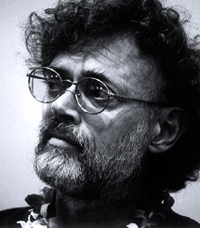
Terence Kemp McKenna (November 16, 1946 – April 3, 2000) was an American philosopher, psychonaut, researcher, teacher, lecturer and writer on many subjects, such as human consciousness, language, psychedelic drugs, the evolution of civilizations, the origin and end of the universe, alchemy, and extraterrestrial beings.
Humanists, Autobots, Scholoars, Monks, Patriots and those playing for the Good Guys. Plenty of men and women have traveled this road before us. These secrets are not secrets anymore, and thanks to them, we have information available that would otherwise never see the light of day. Look closely at what these have to share, and you will see they are each telling a very small piece of the same overall story.
Short Version: There are other events in play on this planet, that you are not being told about. Those things would completely change the way you view yourself, and the world, if known. This is all just a dream, and reality is whatever you decide. Still hungry? Keep reading.
Disclaimer: We will be the first to admit.. a few of these could easily be ‘wolves’ disguised well, in ‘whistleblower’ clothing. but who… and why..?
This is intended to evolve into a quick and efficient resource/database/archive. Check back frequently for updates….