Aug 15, 2015 | 2020 Relevant, Survivalism
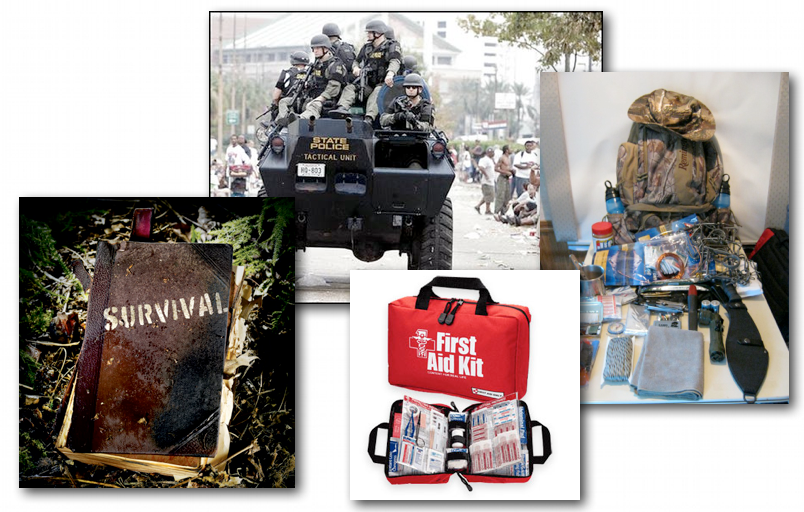
There are 8 Major Threats numerous inherent dangers in our world that can change life as we know it and even threaten our very existence, but many people choose to ignore the warning signs or simply don’t believe anything could happen to them.
Those among us who are more cautious and savvy would rather not take the risk of being unprepared for any eventuality that could put the future of a global power like America into question.
World Economic Forum lists the dangers
A good starting point when trying to assess the potential dangers that the world faces is to take a look at what the World Economic Forum considers to be the biggest dangers that threaten our stability.
The world is smaller than before and global events are increasingly likely to have a major impact on any country, regardless of where the event occurs. So even if it does not actually happen on American soil, it is likely that the impact of such an event will effect change in our lives and create a sense of panic for those that are unprepared for a geopolitical, environmental or any other crisis that might strike.
The World Economic Forum – made up of about 900 experts from around the world – have highlighted no fewer than 28 risks they believe could threaten our stability.
Geopolitical tensions
Number one of 8 Major Threats on their list, and the biggest perceived threat to world stability, is state conflict.
The crisis that is developing in Ukraine and the distinctly uneasy relationship between Russia and its European neighbors and the rest of the world, as well a stand-off between China and Japan, all suggest that there is currently a strategic power battle going on which could spill over into conflict at some point.
This is the first time in the history of the Economic Forum list of threats that geopolitical threats have made their number one spot and, just 25 years after the historic fall of the Berlin Wall, it seems that there is a very real risk of major conflict – a conflict which could drag all major powers into a scenario which could even involve nuclear power.
In search of water
Environmental concerns are rated as the second biggest threat to world stability. A lack of resources has led some commentators to suggest that water is the new oil, meaning that countries that have it will come under threat from an invasion of people who don’t have access to it.
As an estimated five billion people on the planet already have problematic access to clean water, we could easily witness the same tensions around water that we have seen surrounding the control of oil in the past.
Basically, we already need about 70% of the world’s water supply to support the agriculture that feeds the world. When you consider that the World Bank estimates that we need to increase food production by 50% by 2030 to meet the needs of the world population, it is understandable that there could be war over the control of freshwater supplies.
Be prepared
In the event of an emergency situation where your access to normal water supplies is cut off, you will need to be prepared by having a stockpile of bottled water as well as having a long term plan that goes beyond your immediate resources.
There are numerous guides on how to create an emergency water supply and how much water you might need. You might also consider reading a guide on how to create a well for your own personal water supply.
Toxins in water is another consideration. There are toxins in our water supply that present a serious health risk for humans after prolonged exposure. A simple way of combatting this threat of contaminated water is prepare your own super-water which is free of toxins, using an ingredient like Bragg Apple Cider Vinegar which will help to purify the water supply until you again have access to fresh water.
Large-scale terrorism
The terrible events that were witnessed with 9/11 set a new and unwelcome benchmark in terms of large-scale terrorism, but there are fears that further atrocities – even the use of weapons of mass destruction – could take place in the U.S and other parts of the world in the future.
The rise of Islamic State (Isil) highlights in particular how terrorism knows no boundaries. When you consider that Isil managed to grab land and mobilize some 30,000 fighters for their cause in a short space of time, large-scale terrorism is a very real threat that we should be prepared for.
Be prepared
You may be forced to defend your property and your family from a localized attack and the best way to do this is to ensure that you have a suitable cache of weapons to be able to provide the protection you need.
The Prepper Journal lists the top five firearms that you need to get your hands on, including, perhaps not surprisingly, a handgun and a shotgun.
Handguns and shotguns are relatively easy to use and if you are forced into a home defense situation that requires engaging with someone who is threatening your personal security, you can find a model that is quite forgiving if you are not an experienced shot, but still very effective. You may also consider an Aimpoint red dot sight to improve your aim.
A shotgun is also very useful if you need to hunt down small game and even larger animals if you need to go in search of food.
Trigger-happy Putin
The potential of large-scale terrorism by extremist groups like Islamic State to threaten our stability should never be underestimated but a danger that America in particular is facing is more likely to come from Russia and Vladimir Putin.
When you consider America’s history of predicting future threats, it doesn’t really inspire a great deal of confidence that Washington will judge Putin’s moves correctly or timeously.
Past events like Pearl Harbor, the Cuban Missile Crisis and the collapse of South Vietnam in the 1970’s are all major events that America’s policy elite at the time failed to predict and act accordingly.
Imposing damaging economic sanctions on the Russian president would currently appear to hurt the powerhouse based in the Kremlin. Russia has the firepower and resources to threaten America’s survival and the danger that they pose is much larger than the challenges we are currently facing in dealing with threats from ISIS.
President Putin is widely considered to believe that the revolution in Ukraine was a U.S-backed coup aimed at weakening Russia and his government has consistently and repeatedly warned against Western economic and political intervention.
In fact, America and Russia have control of over 90% of the world’s nuclear arsenal but, on the other hand, the Russians are currently struggling to keep up the U.S when it comes to investing in new warfighting technology.
The relevance of this imbalance is that Putin would consider a preemptive nuclear strike to be the best strategy to ensure they gain the upper hand. A senior Russian officer recently stated that 96% of their strategic rocket force could be launched within a matter of minutes, so pushing Putin into a corner could have serious consequences for the United States and its citizens.
Some military commentators believe that the U.S is vulnerable to a nuclear strike from Russia and it is only a matter of time before this happens.
Chemical warfare
In terms of weapons of mass destruction, chemical weapons are often perceived to be less of a danger than the one posed by nuclear and biological threats.
This is in stark contrast to the historical record of the use of chemical weapons, which are in fact the most widely used and extensively proliferated weapons of mass destruction. The effect of chemical weapons for the victim of an attack varies from experiencing severe discomfort, physical harm to death, all of which can be achieved with a relatively small amount of chemical weapons.
Many countries have stockpiled and amassed thousands of tons of chemical weapons that date back to the Cold War. The reason for this reliance on chemical weapons is that producing biological or nuclear weapons is more technologically demanding and therefore not within the capabilities of some of the potential aggressors.
There are 188 countries which have joined the Chemical Weapons Convention which means they have agreed not to develop, produce, stockpile or use chemical weapons. However, crucially, there are a number of key countries, mainly in the Middle East, which have not signed up to this treaty.
This means that one of the most volatile regions in the world could witness a rogue nation or terrorists acquiring access to these chemical weapons, which would create a very real threat to the rest of us.
Be prepared
The government has issued a guide to dealing with chemical threats and you need to be aware that these poisonous vapors, liquids or solids have a number of different effects on us, depending on which chemical is involved.
Some chemical agents can be totally odorless or tasteless and they can either affect you immediately or you might suffer a delayed effect which could take anything up to 48 hours to deliver their potentially lethal consequences.
If you have advance warning that an attack is imminent, ensure you have a supply of duct tape and plastic for doors, windows and vents as well as some scissors, so that you can create an emergency sealed shelter with some pre-measured plastic sheeting for each opening.
You should look to choose an internal room for your shelter, preferably one that is on the highest level of the house and without windows.
Cyber attacks
Congress was recently informed by U.S intelligence agencies that cyber attacks pose a greater threat to our national security than terrorism.
The report stated that intelligence had been gathered which showed that Russia, China and North Korea were the leading threats in this regard and that Russia had even set up a cyber command to carry out these attacks.
Whilst a cyber attack might not be targeted directly at you, there is a strong chance that a cyber attack on the global financial system would have far-reaching implications for many of us and could easily create a sense of widespread panic that could lead to civil unrest and a sharp rise in property crime and attacks.
Be prepared
Having a survivalists emergency supply kit will help to get through a food and resources crisis brought about by the collapse of our cyber network.
Natural disasters
Whether you consider yourself to be a prepper or a survivalist might actually be defined by your view on how to cope with a natural disaster. Many preppers like to network with other like-minded people in order to share tips and learn skills that will be useful if and when a natural disaster strikes in your area.
Learning about canning and how to build a fallout shelter are things that will help you to survive a natural disaster and cope in an emergency situation such as as an earthquake or tornado.
Be prepared
In the event of an earthquake, your primary course of action should be to crawl under a sturdy table and cover your head with your arms. If you subsequently become trapped under some debris, cover your mouth with a cloth or shirt and try to attract attention when you hear someone close by tapping against an object like a pipe. Don’t be tempted to shout out, as this will put you at risk for inhaling dangerous levels of dust which could then get into your lungs and cause breathing problems.
If there is a tornado in your area try to get shelter inside and head for the basement, if you have one. If you are outside when the tornado strikes, lie down flat in a ditch in the ground and cover your head with your hands.
If you hear a flash-flood warning, move to higher ground as soon as possible and keep away from downed power lines as they present a serious danger of electrocution.
Zombie invasion
Zombie apocalypse scenarios are very popular at the moment and the fact that there are countless movies that feature this situation only contributes to the conversation on doomsday scenarios of this nature.
Some preppers who make reference to zombies in forums use the term as a metaphor that covers any number of disaster situations and not actually a zombie invasion.
Having said that, there are a number of plausible scientific explanations that make the prospect of a zombie-like situation realistic.
Apparently half of the human population is infected with toxoplasmosis, a parasite which has the ability to turn its victims into mindless zombie-like slaves, or neurotoxins, which slow your body functions down to the point where you are almost dead.
Whether you believe in the plausibility of this particular doomsday scenario or are genuinely concerned about more tangible threats to the future of America or the world as we know it, such as nuclear war and extreme natural disasters, are you prepared?
Resources and Useful Links:
http://www.telegraph.co.uk/finance/economics/11347752/These-are-the-four-biggest-threats-to-the-world-right-now.html
http://www.nti.org/threats/chemical/
http://www.newscientist.com/article/mg21829125.900-we-must-wake-up-to-the-threats-of-new-chemical-weapons.html#.VX67HUat7A0
https://www.opcw.org/chemical-weapons-convention/
http://www.un.org/disarmament/WMD/Chemical/
http://www.globalhealingcenter.com/water/toxins-in-water
http://urbansurvivalistblog.com/emergency-water-supplies/
http://fivecitiesfireauthority.org/emergency-preparedness/assembling-an-emergency-supply-kit
http://www.ready.gov/water
http://ecohearth.com/eco-zine/home-and-renovation/1336-all-about-wells-a-guide-to-your-own-personal-water-supply.html
http://www.theprepperjournal.com/2013/03/22/top-5-firearms-you-need-to-get-your-hands-on-now/
10 Reasons You Should Become A Survivalist
How To Be A World-Class Survivalist in 5 Simple Steps
http://www.ready.gov/chemical-threats
http://www.telegraph.co.uk/finance/newsbysector/banksandfinance/11114284/World-must-prepare-for-Armageddon-style-cyber-attack-warns-US-regulator.html
http://www.apa.org/topics/disasters/
http://www.popularmechanics.com/adventure/outdoors/tips/a2031/4220516/
http://www.popularmechanics.com/technology/design/a4600/4325649/
http://www.cracked.com/article_15643_5-scientific-reasons-zombie-apocalypse-could-actually-happen.html
http://www.mayoclinic.org/diseases-conditions/toxoplasmosis/basics/symptoms/con-20025859
source via OmahaOutdoors.com
Jul 9, 2013 | Survivalism
1. Failing to inventory stored food supplies.
Guilty as charged. It is easy to amass a sizable supply of food in a short period of time. This is especially true if you tend to purchase a little bit extra each time you shop. Before you know it, you have a closet or pantry full of stuff but no clue as to what is inside. In my case, I have some well marked buckets of food but no master list. I know I have 30 pounds of coffee beans – or is it 40? And #10 tins of freeze-dried meats, fruits and veggies? They are packed away in carton boxes  and I know I have lots of cartons but just exactly what and how much?
I have been storing food for so long that I can not rely on memory alone to know what I already have and what is still needed. This is my number one mistake and one that I plan to remedy in two ways. First of all, everything new that I purchase will be inventoried right away. This is what I call my going forward plan. Then, as time allows, I will methodically inventory everything else.
The key, of course, is not to co-mingle the old with the new. Sure, I may end up with some duplicates but that is better than being so overwhelmed than to do nothing at all. Your plan may be different given the dynamics of your space and your time. All I can say is that if you are fairly new to prepping, don’t let this one slip by. Keep track of what you have from the get go and save yourself a lot of grief down the road.
2. Identifying the most likely risks and prepping for those first.
When I first started, I went off willy-nilly preparing for all sorts of calamities. Earthquakes, terrorist attacks, pandemics, nuclear melt-downs, civil disobedience – you name it, I tried to prepare for it all. These days, I recommend that one of the very first steps that you take when prepping is to evaluate the most likely risks in your area and within your personal domestic situation.
Most if not all city, county and state governments will have emergency management websites that will help you sort through the most likely disasters to occur in your area. Add to this an assessment of your location. Are you in a city where gangs, mobs or terrorist attacks are likely? Do you live in a remote area where the failure of transportations systems or the lack of fuel will cut off you off from supplies from the rest of the world? Is your employment situation tenuous requiring that you build up some cash reserves to get you by just in case the job goes away?
Clearly, at the beginning, some choices will need to be made regarding the best use of your prepping budget. Just remember that food, water and first aid supplies should be at the top of everyone’s list. After that, assess the most likely risks and plan accordingly. A good place to start is 12 Months of Prepping – The First Year which is a recap of monthly supplies, skills and tasks to get you starting on the road to preparedness.
3. Preparing mostly to bug out rather than bugging in.
We all talk about having a bug-out-bag and without question, having your most basic survival items in a pack that you can grab and go if you need to get out of dodge in a hurry is important. But beyond that, over and over I see people acquire all sorts of gear for surviving on the run – perhaps in the woods or bush in a remote location.
I know that in own case and also with the majority of the readers on Backdoor Survival, hunkering down and bugging in will always be preferred to taking off into the unknown with our stuff. For many, the choice to bug in has to do with family, health concerns or financial considerations. That, plus the availability of stored supplies makes bugging in – or staying at home – the choice when a disaster strikes.
At the end of the day, take care of your bugging in needs first and foremost. Plan for outdoor cooking facilities (perhaps an existing charcoal grill?), supplemental lighting (like this $21 Dorcy Wireless Motion LED Flood Lite), stored water, and a portable generator now. Later, down the road, you can expand your supplies to include the essentials for truly bugging out.
That said, pay attention to mistake number 4.
4. Failure to evacuate at just the right time.
 When the storm of the century is heading your way, know that it is time to evacuate. Load up your vehicle and go. As much as you feel that your are better off in your own home, if the authorities tell you to leave – and even if they do not – get out of harms way as a precautionary measure. Do so while you still have the ability to load up your vehicle with supplies and fill the tank with gas.
Sticking around when there is at least a 50% chance of a disaster occurring (hurricane, flood, landslides, tsunami,wildfire) is just plain silly. Remember mistake number 2 – failure to evaluate the risks? Part of your planning should be to determine the trigger point for evacuation as well as identification of an evacuation site and a route to get there. Better yet, plan an alternate route as well.
5. Having the gear but not knowing how to use it.
I am guilty of this one as well. I have a Kaito emergency radio as well as some Midland FRS radios. Sure, I know how basically to use them but what if I needed to use some of the more esoteric features? My bad. I also have a hand held compass – a nice one at that – and yet in these days of GPS navigation, would I know how to use it?
Get out the gear two or three times a year and put it through its paces. Not only do you need to know how to use it, but you need to make sure your gear is in good working order. Blades need to be sharpened, batteries need to be charged and skills need to be refreshed.
6. Underestimating other humans as a threat.
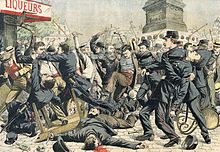 In a perfect world, we would all get along and go about our business in a mild-mannered way, not bothering anyone or causing others harm. Alas, as humans this has never been the case. From biblical times forward, man has opposed man. There have been and still are warriors, and armies, soldiers and dictators, enemies and foes.
As recent mass shootings have revealed, mental illness or drugs can make good people go bad. Add the uncertainly and chaos created by an unstable society and the potential for human threat because a major cause for concern.
Whether you embrace firearms or shun them, you still need a way to defend yourself, your family and your property. Consider pepper sprays, martial arts, and other defensive mechanisms in addition to traditional firearms. It is foolhardy to believe that having some means of defense is not needed because “there is no one out to get you”. Desperate people are dangerous people. And the lack of food, water and supplies will turn ordinary people into desperate people in a heartbeat.
7. Buying stuff while ignoring the need to develop skills.
Buying stuff is easy. Save up your money, select your merchandise and go to your local outdoor emporium or Amazon and make a purchase. On the other hand, learning new skills (or practicing old ones) takes time, patience and bit of study. Do you know how to start a fire without matches or a butane lighter? Do you know how to take advantage of natures bounty by knowing how to fish or hunt? And what about growing your own food? Could you do it?
Developing skills to become self-sufficient are every bit as important as having a closet full of the best gear money can by.
8. Lacking the knowledge to properly store your food supplies.
There are six enemies of food storage: Temperature, Moisture, Oxygen, Light, Pests and Time.
Okay, some might say there is a sixth enemy: namely the two legged type that gets into the tastier items (such a cans of brownie mix) and eats them without telling anyone.
Seriously though, storing food for the long term – meaning five years or longer – does take some care. Brush up on the basics of food storage and set up an active rotation program. You don’t necessarily have to store food for 10 years or longer but what you do store – even for a year or two – should be protected to the best of your ability.
One thing to keep in mind that except for the problem with pests, most food will still be edible even if it is not stored at optimal temperatures in a moisture and oxygen-free environment. But why not learn proper storage methods to insure maximum taste and nutrition. Here on Backdoor Survival, the following articles will help educate and there are plenty of others elsewhere on the internet including YouTube. A few hours of your time is all that it will take to make you a food storage expert.
Food storage and Beans: Using Mylar bags and a Food Saver
Food Storage Part I – A Primer on Oxygen Absorbers
Food Storage Part II: Unraveling the Mystique of Mylar Bags
Food Storage Part III: Food Grade Buckets, Lids and Gamma Seals
Food Storage Mistakes and Goofs
9. Relying only on yourself and ignoring like-minded members of your community.
When I first started prepping, I did not mention my new little “hobby” to anyone. You know, OPSEC and all that. But about a year into it, I realized that I could not do it all on my own. There were things I was having trouble grasping on my own and I needed help. As I tip toed around the edges of my community, I found some like minded people and much to my surprise, I found that I had skills and knowledge that they lacked.
The mutual exchange of skills and knowledge ensued along with some informal agreements to team up if circumstances required us to be on our own for any period of time. This included teaming up for shelter and food as well as defense.
The importance of having a peer group of like minded comrades in my own community was strengthened as I read R. P. Ruggiero’s Brushfire Plague and continues as I explore other truer than life survival stories,. How you decide to expand your community contacts is up to you but be advised that when it comes to survival 1 plus 1 will definitely add up to more than 2.
The Final Word
These days I feel fortunate that I have come so far with my prepping activities. Moving beyond obsession, the prepping way of life is now a part of my core. It is “what I do” as well as being a hobby and a passion.
Indeed, I have made some mistakes along the way and many of them are listed above. There will surely be others down the road but I know that will be okay since they will afford me an opportunity to learn and grow. At the end of the day, life is all about growth, opportunity and the ability to take care of oneself physically, mentally and spiritually. To me, that is what prepping is all about – mistakes and all.
via BackDoorSurvival.com

Sep 8, 2012 | Ancient & Lost History, Survivalism

It has been said that knowledge is power, and that applies to any area in life. Of course, it is important to arm and prepare, but it is even more important to constantly learn new aspects of survival. Some of these arts and sciences have been lost in the last century, as modern life has caused humanity to know more how to use a smartphone rather than how to build a fire. It is easy to gloss over these skills like an old memory, when you can simply pop at TV dinner in the microwave when you are hungry.
The histories of empires have told us that they are finite, and that includes that of the U.S. In this case, it is important to gain knowledge and learn about old methods that have been long forgotten by many. This knowledge may not always be accessible as it is one of the first resources that will become scarce in the event of a nation threatening disaster. Other items may be procured with relative ease, but it may be next to impossible to find gems of wisdom.
One of the best places to find knowledge about survival methods for now is on the Internet. The Internet has an incredibly high concentration and abundance of information that dwarfs libraries and can be accessed in the comfort of your home. A quick search engine inquiry will reveal answers that took hours of research in the past. This is a great place to start. Whatever useful information you find, print out, and put in a ring binder.
Community
We were not meant to survive in isolation. There are many skills we can learn from one another. Find a mentor or group that does survival activities on a regular basis. Learning from one person to another is the best way to make it a part of you. For instance, learning martial arts of some kind will be indispensable in a crisis. These arts train you to keep calm, respond properly, avoid fights, and win them with the time come.
Nothing will help people survive more than a tight knit community that cares for its members. In this community, you will find different skills, access to different resources, and a psychological morale improvement. Finding others with the same mindset will help you survive long-term, and make the situation far more bearable than braving the dark times alone.
Basic Tools
Knives are considered one of the most basic tools in any society. It has been seen as the very beginning of technology after the discovery of fire. Using the proper knife for a survival scenario is arguably the most crucial part of survival. Your world will revolve around your knife, so it is important to have one appropriately selected.
You do not want to survive on a kitchen knife, as these are only tailored for light duty. Survival knives can come in several forms but they have to perform these basic tasks:
- Chopping or Cutting Wood
- Carving Wood
- Stripping Bark for Lashing
- Hunting
- Cleaning Game
- Cutting Cords
- Fishing
- Climbing
- Fashioning Other Weapons
- Striking Fire Steel
- Shaving and Scoring Wood
- Defense
It is for this reason that your knife must be durable, and have the right shape to perform daily tasks. As opposed to many popular designs, you do not want your knife to be longer than 5”. If it is 6” and above, it will be difficult to handle and could possibly be dangerous. Also, avoid serrated edges on your knife. The most powerful cutting and carving edge is at the base near the handle, and if that area is serrated, it will be difficult to use it to chop and carve.
Also, you may need to defend yourself with your knife. This may be more preferable than using bullets, as you may not want to draw attention to the location of the shot. This means that the knife must come to a sharp point at the tip. This may also allow you to lash the knife to a long stick, creating a spear for hunting. Another possible function of your knife may allow you to throw it at a target. This is another great hunting application, but it is less for defense, in the event that your target runs away with your precious knife.
This new tool redefines the survival kit from the ground up…
There are many designs to a good survival knife; you just need to figure out what your preferred style may be. For this reason, you also may want to consider making one of your own. Creating your own knife design and manufacturing it yourself will allow you to know how to make more in the event that you lose or break your original. For less than $100, you can procure the resources necessary to shape and heat-treat your knife from bar stock.
The reason why the topic of knives is located in the “knowledge” category is because of how crucial it is to know how to use them and even perhaps know how to make them. Getting to know your knife is has to do with more than just surviving; some survivalists even say that it connects you closer to nature. The ability to survive from this most basic tool is known as more of an art form than a method.
Stealth
While the survivalist mindset might seem to stem from weathering bad times, it is actually based in a basic enjoyment of nature. Nature is a gift, and the ability to live comfortably from its provisions is one of the most life-changing experiences a person can ever have. The art of survival seems to have been lost over the years, but before the technology boom in the last century, it was commonplace to know and understand survivalist principles.
One of the most basic skills when in the wild is a combination of two methods. These methods are called the “Fox Walk” and “Wide-Angle Vision.” These were the basic “bread and butter” of how tribal populations would hunt and stalk without leaving any trace. Learning lessons from these peoples, it has enlightened us on how to live from the land.
The Fox Walk is a method on how tribal populations were able to move in the forest completely undetected by even the wildlife. These methods were also used in war as the first skirmishes took place between the Native Americans and the residents of Jamestown. Knowing how effective the Fox Walk concealed movements, the Navy Seals adopted this tactic to conceal their numbers behind enemy lines. The Fox Walk basically consists of:
- First, it is most effective to do this without footwear or wearing moccasins. This allows you to feel the ground, and helps you avoid stepping on sticks that can crack and make noise.
- Land your foot with your heal first. This requires balance; as your foot comes into contact with the ground, you may have to move to a different location to avoid a sharp rock, a stick, or leaves that may make noise.
- Then allow the outside of your foot to roll to the ground, and then the balls of your feet. This will allow you to mask your presence by lessening your footprint and noise.
- If you are traveling in a group, the battle-tested way to conceal your numbers is to Fox Walk, and with each person placing his or her foot in the print of the one ahead of them.
- Rushing about is a quick way to be found and wastes crucial energy, so the Fox Walk is a method, crafted for slow, steady movements.
These are the basics of Wide-Angle Vision:
- Wide-Angle Vision allows you to see movement and inconsistencies rather than the details that are directly in front of you.
- This type of focus allows you to spot resources more easily and sense movement, which is crucial for hunting.
- Wide-Angle Vision utilizes your peripheral vision, allowing for a much wider view and scope of sound stimulation. This causes you to be far more aware of your surroundings.
- In order to practice Wide-Angle Vision, move your hands out directly in front of you. Then, separate them slowly until your arms are stretched out all the way.
- Then, wiggle your fingers. If your peripheral vision can pick up both hands, then you have entered into Wide-Angle vision.
The best part about utilizing the Fox Walk and Wide-Angle Vision is the fact that you can move around less, maximizing the resources in your vicinity. You will use much less energy, and it will keep you calm. Some have said that it is almost like tuning in to a sixth sense, as you can extend your perception farther that you would normally be able to.
Experiencing and enjoying nature is one of the most basic principles of the art of survival, and using ancient methods is one of the best ways to do just that.
SOURCE: Offthegridnews.com
May 8, 2012 | Nature Body Mind, Survivalism

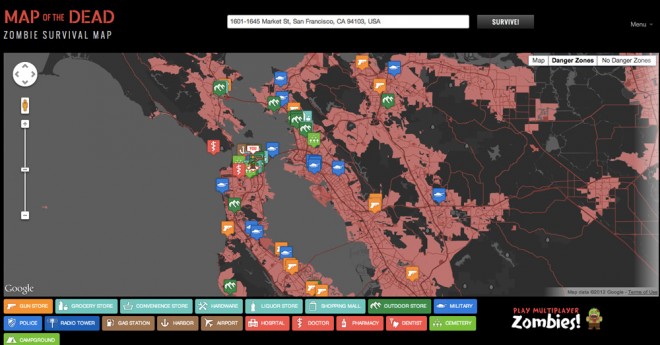
How safe are you when the zombies come for your brain? Photo: Google Maps/Doejo
The Walking Dead teaches us that well-stocked pantries and armories are paramount to the survival of the human race after a zombie infestation. Canned food and ammunition: You can never have enough of these key essentials.
Enter the Map of the Dead from Doejo, which overlays zombie danger zones and potential supply locations on a Google Map of your local haunts. Red areas denote population centers where zombies might graze, while dark gray zones cover parks and wilderness areas, which are most likely to be walker-free. Supply locations are annotated with helpful descriptions — liquor stores, hospitals, gun shops, military bases and cemeteries are just some of the locations highlighted.
The map uses Google APIs and keyword searches to determine the location types that appear on the maps. The developers at Doejo are looking into adding more location types, such as schools, pawn shops and barricades. Unfortunately, certain keywords are currently returning too many false positives for these types of landmarks.
As for user-generated content — in other words, crowd-sourced supply and hiding place annotation — it’s something Doejo is exploring, but has no definite plans to implement. Which might be good. You don’t want to share your favorite fortified sniper perch with the whole world.
Still, with the Doejo maps, you can better plan for the coming zombie apocalypse, and even other natural disasters. At Gadget Lab, we scanned not only our local San Francisco environs, but also Chicago and New York City to determine safe zones should the worst come to pass. (We briefly considered a quick survey of Los Angeles, but decided that traffic snarls will doom the City of Angels to a quick and unstoppable zombie epidemic. Sorry, LA. We’ll miss your movie blockbusters and sunny beaches.)
Here’s a quick look at how well our three metropolitan areas are set up for riding out the zombie plague.
Manhattan

Shut down the bridges and start rooting out the undead.
Photo: Google Maps/DoejoManhattan is an island, which gives it an advantage over outlaying areas, insomuch that once the city shuts down the bridges and tunnels, survivors can start rooting out the water-locked zombies. On the flipside, a quick look at the map shows only three gun stores.
Sure, you can kill a zombie with a well-placed smack to the head, but who wants to get that close to something that wants to chew on your shoulder? Also, be careful about that military base between the two cemeteries — it’s actually just a recruitment center. And, of course, stay far away from cemeteries, which are typically popular spawning points for the undead.
As with all the Doejo maps of metropolitan areas, the Manhattan map only shows major stores, and leaves out neighborhood bodegas. So make friends with the owners of these stores right now. A few pleasantries today could prove fruitful tomorrow.
Chicago

Zombies don’t want deep dish, they want brains.
Photo: Google Maps/DoejoThe Windy City is surrounded by suburbs on three sides. That much open space could help the citizens of Chicago escape early in the infestation. That said, if you’re trapped in the city, it’s best to stay near the shore, as it’s easier to defend three sides than four. Plus, if you have an escape boat, you can head to Canada where the zombies are allegedly nicer.
Four military bases are within the immediate Chicago area, and could potentially help keep zombie infestation to a minimum. Or, conversely, the soldiers could become zombies — military-trained zombies with access to guns. It’s a judgement call. You have the map, so at least you know your options.
San Francisco

All those peace rallies could suddenly become zombie buffets.
Photo: Google Maps/DoejoSan Francisco has the advantage of being at the tip of a peninsula. Shutting down the two bridges the lead into the city should be no problem. The disadvantage of San Francisco is that it’s San Francisco, home of pacifism and protest. People here may not have the gumption to mount an effective counter-attack, and no amount of pacifistic protesting will stop a zombie from popping open your skull, and devouring your brain like it’s soup inside a sourdough bread bowl.
Our lack of local gun stores is especially disturbing. Hopefully, the thin design of the MacBook Air — you can find four or five in every local hipster cafe — will help these notebooks serve as effective weapons for zombie decapitation.
San Francisco’s saving grace may be its DIY resourcefulness. Within a few days of the collapse of society, someone will probably have an open-source 3D printable weapon that not only kills zombies, but also offers a much lower carbon footprint than your average bullet.
Plus, San Francisco moved all of it’s dead to the nearby suburb of Colma. That should cut down on the first wave of zombies that wander the streets lusting for brraaaiiinnnsss.
SOURCE:
http://www.wired.com/gadgetlab/?p=96515
By: Roberto Baldwin, April 11, 2012