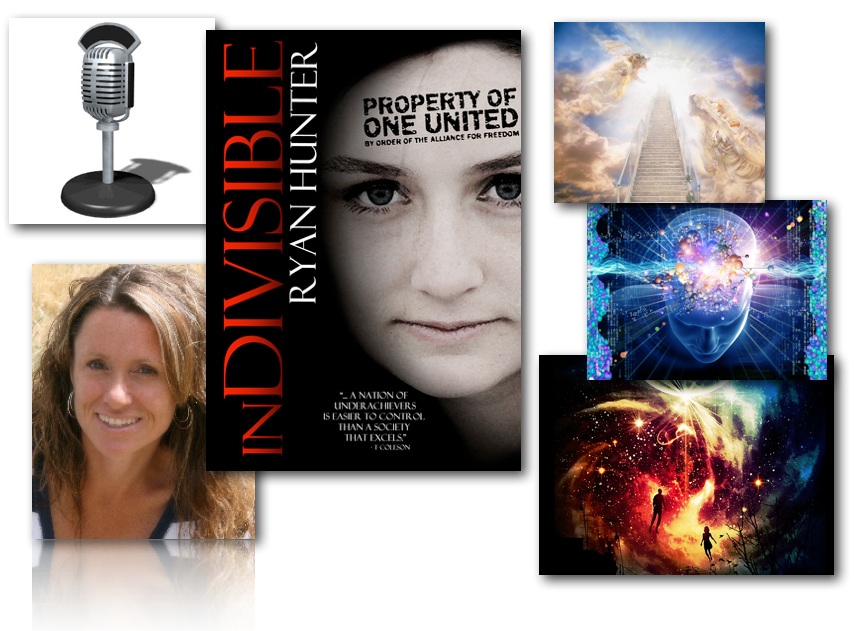
Max Interviews guest Ryan Hunter – Author of INdivisible
PLOT: Brynn Aberdie has everything but freedom … but everything has a way of changing. When Brynn loses her family, her security, and her handouts, she is left with one last option, and it guarantees one of two things: freedom or death. Brynn vows to find that freedom, and soon learns a lesson many in One United have already learned – by failing to protect their rights, Citizens have forfeited their lives with little hope to ever recover them.
Exploration of ‘Proof of Heaven’
Long before this book was ever written, Dr. Alexander was a practicing neurosurgeon and a lifelong “science skeptic.” He did not believe in consciousness, free will or the existence of a non-physical spirit. Trained in western medical school and surrounded by medical colleagues who are deeply invested in the materialism view of the universe, Dr. Alexander believed that so-called “consciousness” was only an illusion created by the biochemical functioning of the brain.
Dr. Alexander would have held this view to his own death bed had it not been for his experiencing an event so bizarre and miraculous that it defies all conventional scientific explanation: Dr. Alexander “died” for seven days and experienced a vivid journey into the afterlife. He then returned to his physical body, experienced a miraculous healing, and went on to write the book “Proof of Heaven.”
Show Transcript
Introduction: Ryan Hunter, Author of INdivisible
Welcome to Decrypted Matrix on Revealing Talk Radio. We have an exciting show tonight. We have Ryan Hunter. She’s been writing most of her life as a novelist, journalist, and really enjoying every bit of the writing scene, except for a brief stint as a product description writer. Her earliest novel was put together with construction paper and staples. Tonight, Ryan Hunter, author of INdivisible, a fascinating story, a fascinating journey. Twenty-two reviews on Amazon. This book will blow your mind. It’s a dystopian future. Some have compared it to George Orwell’s Nineteen Eighty-Four, with a level of prediction and technology and understanding that the human mind can barely fathom.
I think this can be a pretty exciting route to go around some ideas and figure out how your writing was so perfect in some of these things. I have not read this book yet. I purchased it on Kindle and I recently absolutely cannot wait. Some of the reviews you can see on Amazon for yourself are pretty awesome. One says it’s a page turner: “Just as I started this book, I was just hooked on it.” Another says, “Read the book to discover for yourself what the ending is. This book by Ryan Hunter is very well paced. Action and plot continually urge you to read just one more chapter.” So we all love ourselves a good conspiracy, a dystopian future. You’re tuned into Decrypted Matrix.
The visualization that Ryan provides in the book is a recurring theme. It is just so descriptive. How real it feels, how real these characters feel, how real the landscape feels, how real this dystopian future feels. How eerily predicted it is with the way technology controls human life, the way microchipping becomes standard and just assumed common practice. So without further ado, we do have Ryan Hunter on the phone. Let’s check out the book INdivisible. Hop on Amazon right now, read some of these reviews, and let Ryan tell the story without giving away too many spoilers. Ryan, are you with us?
Ryan Hunter’s Writing Journey and Inspiration
Ryan: I am. I am so thankful, Max, that you’ve taken time to have me on to talk with the listeners about what was on my mind.
Max: What was on your mind when you thought, “Hey, I’ve got this book to write”? I imagine maybe you didn’t know what the name would be at first. Tell us a little bit about yourself. What do you want listeners to know? What’s important about how you started on this journey of such an amazing story? For authors to be able to sit down and tell a story like that with such detail, I have the utmost respect. It takes an amazing skill set. How did you come to this point?
Ryan: Well, first off, thanks so much for having me on. I have, as you mentioned, been writing for quite a number of years. What I enjoy the most is fiction and historical accounts. My words are very visual. Other people have told me that. As I started to write things down, what’s interesting is I’m not into politics, not into anything like that. So I started telling my husband this idea. He’s a bass player, and I started telling him about it. He said, “That’s a really good story.” And his eyes lit up and he said, “You’re touching on so many little things.” That’s when I first realized there was a lot more to this story. It’s been very exciting.
Max: That is really cool. Now I gotta ask, the main character’s name is Brin. Are there elements of maybe your own personality that you’re able to express through these various characters? Was it a form of expression for you in any way?
Ryan: You know, even as hard as I try not to, I do put a little bit of myself into characters. I’m up at three o’clock in the morning writing. There isn’t anything inherent in that. The story is the surprise. As I said, I had read Orwell and an awful lot of other works. Every person in turn, you make your own way and find your best way.
Technology, Surveillance, and Control in INdivisible
Max: Some listeners are probably curious at this point. What kind of technology do you predict? The foundational principle of the Decrypted Matrix website is to expand the mind, understand what’s really out there, what questions still remain, what we know we don’t know, exposing secrets, all that taboo knowledge that has been withheld from the public and society for reasons of control and manipulation. This is definitely a recurring theme with your dystopian future, because ultimately, if I had to simplify it, the corporations and banking interests are just in self-preservation mode. There’s an ancient Chinese saying that’s quite applicable. It says, “If we don’t change direction, we’re likely to end up where we’re going.” It’s absolutely fascinating to hear that you were never really down the rabbit hole. It’s not your thing. This started as a dream and unfolded organically as you wrote it. It just flowed onto the pages, and maybe you realized, “Holy cow, where did this come from?” That higher element of yourself was able to deliver what sounds like an absolutely magnificent story. So tell us a little bit about the technology that you describe.
Ryan: The government’s ability to monitor everybody, all communications. There’s been talk of that happening. There’s been people who have been documenting it. In the book, everyone is microchipped. They’re tracked at every level. They’re ultimately able to track each individual person, where they’re going, what they’re reading. This extends into their own houses. They have to scan for groceries, scan for everything. Pretty much every moment of their day, what they’re doing, is monitored.
Max: So basically, our bodies are tracked and monitored constantly. You lose your life, your self-expression, that ability to be yourself. That’s another thing that really comes through.
Ryan: Yes. What happens is my own daughter’s elementary school experience inspired this. She told me that children at her school were not allowed to excel beyond a certain level.
Max: Wait, what? They were willingly limiting their potential? They’re going to have greater control that way.
Ryan: My character actually states that. She says it’s easier to control a society that is dumbed down. People in this country, when united, are unstoppable.
Education, Limits on Excellence, and Personal Freedom
Max: I’d love to go deeper on that specific example you mentioned about limiting how much children would be allowed to excel. Could you share more about how your daughter was wanting to excel and what was happening?
Ryan: My girls were actually good students in school. They were active, they were into music. When they wanted to get into harder work, higher-level reading, the school was basically holding them back, not nurturing their talents.
Max: That’s horrible to hear. I would love to know more so listeners can learn what to look out for. A big thing with Decrypted Matrix is learning how to take this information and make it actionable, to avoid the traps.
Ryan: Years later, I also found that there are schools that actually cause children to question themselves, to reassess. At another school, my daughter was in first grade and was immediately placed in orchestra. One week later, the respondents said she had won some awards. She actually encouraged the entire orchestra. The sixth and seventh graders who were in orchestra with her were practicing harder because of her. I think when each person excels, they inspire those around them.
Max: I couldn’t agree more, Ryan. We see it everywhere, and that is the purpose of Decrypted Matrix, to archive this information that is really being quickly censored from the internet, wiped from its original source. There’s an article on the site that talks about how police officers are denied employment for scoring too high on IQ tests, no matter how well they perform. The bogus reason given is, “Oh, you’ll get bored with police work and our resources will be put to waste.” Clearly the reason is that they want people who don’t ask questions and follow orders.
Luckily there are plenty of great officers still out there. I was recently pulled over by one that was just so respectful. It was like talking to a friend. He let me off with a warning. It is so refreshing to know that despite all the stuff we see on the news about corruption and abuse of power, there still is this glimmer of hope that humanity can continue to have empathy. Because what we see coming with the police state is a lack of empathy, humans being humans, understanding that we’re all in this together, all connected. No matter who’s doing what or who’s in control, we’re all walking together towards this dystopian future that you have outlined.
Romance, Storytelling Style, and Comparisons to The Hunger Games
Max: Tell us a little bit about the romance that unfolds in the story.
Ryan: There is a love story. The two main characters need each other to get through this tough situation. The male lead has a backstory where he is from a different city, and he’s the one who surprises her by being in the book. He explains how everything is connected and helps her get her bearings in her life. He opens her eyes to what’s really going on, and they become very close.
Max: Listeners, you can find the book INdivisible by Ryan Hunter on Amazon and Kindle. You can also find her on Facebook at facebook.com/AuthorRyanHunter.
Max: I understand people have compared INdivisible to The Hunger Games. Tell us about that. Did you read The Hunger Games?
Ryan: I did. I read all of Suzanne Collins’ novels. My world is going to be similar to other dystopian works out there. The idea that it’s brutal is part of it. Several reviewers have said, “Oh my gosh, this is so much like The Hunger Games.” I actually hadn’t read it before I wrote mine, which is a good thing, because I was not influenced by it. Several reviews mention the similarities.
Max: It sounds like the character Brin is a selfless person who puts others before herself, has empathy for those around her, and is a very likeable character. That’s what The Hunger Games heroine was like too. You wanted to root for her. It sounds like there’s a lot of that with Brin.
Ryan: Absolutely. She risks everything for those around her to bring about some semblance of freedom. When she gets the opportunity to just run away and take what seems like a happy ending, she instead chooses to ensure that other people experience freedom as well.
Max: What a great answer, such wise words. Let me remind listeners, you can get the book on Amazon and Kindle. Check out Ryan’s Facebook page at facebook.com/AuthorRyanHunter. Here’s another review: “This book is incredible. It opens your eyes to what our lives could be like without the freedoms that we now enjoy. It is a very well-written story of two young people who learn for themselves how precious freedom is and how controlled our lives are without it. It is a must read for everyone. You will not want to put it down. It is a real thought-provoker.” Five stars, September 5, 2012, titled “Enlightening” by Jeannie Walker.
Writing Process and the INdivisible Trilogy
Max: It sounds like the book is going to be a series. Is that right?
Ryan: We’re planning on making it a trilogy.
Max: Awesome! These reviews show that people want to see another story. Surveillance cameras are everywhere in the book. Tell us about how they’re used against the people.
Ryan: Everything is monitored. A family in the story has a way to escape to a foreign country to live there for a while, and in the process they discover listening devices in all the rooms in their home. The whole idea is that high-risk people are constantly being monitored, every word. Their computers are monitored. The people with the power can do that. Brin’s father was aware of this, and when she realizes that the listening devices are everywhere, it changes everything. Her parents knew but could never speak freely.
Max: It’s amazing that you’re able to write about this with such vivid visualization. We’ve been archiving information about how all the cable boxes have been installed with secret microphones and they’ve been listening for a long time, possibly through a centralized supercomputer. Insiders are saying the big push with HDTV was to expand the bandwidth and data transfer capability, requiring high-definition signals that could allow two-way communication. The technology is hidden in such a way, with compartmentalization, that even manufacturers don’t necessarily know it’s in there. We’ve seen cable companies wanting to know how many people are in the room watching. Microsoft’s Kinect technology has patents about detecting and counting the number of users in the room. Ryan, you absolutely knew what was coming.
Ryan: In INdivisible, personal connections are limited. People come up with their own ideas but are ultimately controlled. In order to combat that, when they move to a new area, they can’t even choose what school their kids go to. Everything is assigned.
Max: That’s a really big part of it. Here are these innocent people just trying to live, and that rarity of personal choice is gone. The government makes all these choices, and there’s corruption. Is there a power grab by the government?
Ryan: In the first book, it’s more about the characters knowing something is wrong. It’s told in first person, so you really get to experience everything and learn everything as the main character does. In the sequels, you’ll get a little bit closer to the powers that be.
Max: It sounds like the way you wrote this book is built off of notes. You would go experience something and take detailed notes. You must have a massive collection that created the current book and will create the trilogy.
Ryan: I do take a lot of notes. I also found that I try to get every sense into the writing. When I’m writing a scene, I want the reader to smell what the characters smell, feel what they feel, experience the sounds around them. Whether it’s a chase scene or a quiet moment, I want to get the visuals and every sense into it.
Max: Ryan, thank you so much for coming on the show. It’s been such a pleasure talking about your book INdivisible. Listeners, go out and check it out on Amazon. Ryan Hunter, author of INdivisible. Check out the Facebook page at facebook.com/AuthorRyanHunter. It’s a dystopian future that’s better than Nineteen Eighty-Four, apparently. More vivid, more realistic, and it will blow your mind as far as what’s potentially coming for the future, because that is the path of action that we’re on with this legislation, with the corporations and the government in self-preservation mode. Get over to Kindle, get over to Amazon, and check out INdivisible.
Dr. Eben Alexander and Proof of Heaven
Now for the last segment of the show, we’re going to talk about a U.S. scientist who has come forward. It looks like there may now be proof of heaven, documenting the existence of the afterlife, the multiverse, intelligent life beyond Earth, and multidimensional consciousness.
There is a secret much bigger than politics, health, freedom, science, and the entire history of the human race. That secret remains entirely unknown for the most part, even condemned by the scientific community, and yet it is the single most important secret about everything. That secret is simply this: we all survive the physical death of our bodies. I’ve personally believed that based on my own experiences. I feel like we are in a spacesuit, choosing to experience moment to moment, to archive and remember experience, emotion, people, situations, love, to express love and help people.
Those who pay attention and really dare to ask difficult questions are realizing that our consciousness lives on upon our death. In dreams, our consciousness transcends this physical reality and experiences an existence so amazing and powerful that the human language cannot even begin to describe it. This message comes from Dr. Eben Alexander, author of the newly published book Proof of Heaven. I can’t wait to read this book myself. Several people have already been reading it and found it absolutely fascinating. It would confirm several important theories that listeners have been developing about the nature of life and the creator.
We have this sense of being, this sense of higher power. The label does not matter. The name that you give it, this energy, this force, this information field, it doesn’t matter what you call it. It doesn’t even matter if you believe in it. It’s there, and it fully supports you. This energy will support you in your choice, in your decision, no matter what that is. If you believe you are limited and powerless, your reality will deliver powerless situations for you. But if you overcome those situations and simply decide, “No, I prefer my reality to be this way,” and continue to make choices that support your new belief that you are fully supported, your reality shifts.
Dr. Alexander’s Near-Death Experience and the Afterlife
As a lifelong skeptic who never believed in God, heaven, or consciousness beyond the brain, Dr. Alexander was a practicing neurosurgeon. He did not believe in consciousness as anything separate from the brain. He did not believe in free will. He ignored the existence of a non-physical spirit. Trained in western medicine, surrounded by medical colleagues who were deeply invested in a materialist view of the universe, he believed that so-called consciousness was only an illusion created by the biochemical functioning of the brain. Even mainstream scientists and physicists like Stephen Hawking say that human beings are nothing more than biological robots with no consciousness and no free will.
Dr. Alexander would have held this view until his deathbed had it not been for experiencing an event so bizarre and miraculous that it defies all conventional scientific explanation. Dr. Alexander was clinically dead for seven days and experienced a profound journey into the afterlife. He then returned to his physical body, experienced a miraculous healing, and went on to write Proof of Heaven.
It started when E. coli bacteria infected his spinal fluid and began to literally eat away at his brain. This sent him into extremely violent seizures, verbal outbursts, and muscular spasms. He lapsed into a coma, showing zero higher brain activity, kept alive only by a respirator and IV fluids. His attending physicians concluded Alexander would die within a matter of days. Even if he lived, he would be non-functioning, essentially vegetative. The death rate for patients with E. coli infections of the brain is ninety-seven percent.
Rather than experiencing nothingness during those seven days of unconsciousness, Dr. Alexander found himself awakening from the dream of his earthly life, suddenly experiencing a vast expansion of his consciousness in the afterlife. He details this experience thoroughly. He gets granular about what he experienced and put it in his book.
A couple of highlights from this book: He explains that the afterlife was so real and expansive that the experience of living as a human on Earth seems like an artificial dream by comparison. There was no sense of time as we know it. An instant could seem like an eternity. Consciousness could move through what we perceive as time without effort. This idea that all time exists simultaneously has enormous implications for understanding the nature of free will and the multiverse.
The fabric of the afterlife was pure love. Love dominated the afterlife to such a huge degree that the overall presence of evil was infinitesimally small. There was no need for spoken words and no separation between the self and everything else happening around you. The moment you asked a question in your mind, the answers were immediately apparent in breathtaking depth and detail. The question was instantly accompanied by the appearance of its answers.
On page forty-eight, Dr. Alexander says: “Through the Orb, God told me that there is not one universe but many, in fact more than I could conceive. At the center of them all, evil was present in all the other universes as well, but only in the tiniest trace amounts. Evil was necessary because without it, free will was impossible. And without free will, there could be no growth, no forward movement, no chance for us to become what God longed for us to be.”
Folks, look at the mission statement at DecryptedMatrix.com. The whole mission is rooted in the free and multidimensional nature of the universe. Hope you enjoyed the show tonight. Ryan Hunter and INdivisible were on earlier. Check out the book. You were listening to Revealing Talk Radio.