What Is the Bilderberg Group?
The Bilderberg Group is an annual, invitation-only conference that brings together approximately 120 to 140 influential figures from North America and Western Europe. Roughly one-third of attendees come from government and politics, while the remaining two-thirds represent finance, industry, labor, education, and media. All meetings are closed to the public and operate under the Chatham House Rule, meaning participants may use information discussed but may not attribute statements to specific individuals.
Origins and Founding
The first Bilderberg conference took place from May 29 to 31, 1954, at the Hotel de Bilderberg near Arnhem in the Netherlands, giving the group its name. The meeting was organized in response to growing anti-American sentiment in Western Europe during the early Cold War period.
Polish politician Jozef Retinger and others proposed an international forum where European and American leaders could build mutual understanding on political, economic, and defense matters. Prince Bernhard of the Netherlands agreed to champion the effort, along with former Belgian Prime Minister Paul Van Zeeland and Unilever executive Paul Rijkens. On the American side, CIA Director Walter Bedell Smith directed Eisenhower adviser Charles Douglas Jackson to coordinate participation.
The original guest list was structured to include two attendees from each nation, one representing conservative views and one liberal. Fifty delegates from 11 Western European countries attended alongside 11 Americans. The success of this inaugural gathering led to the establishment of annual conferences and a permanent Steering Committee, with Retinger serving as its first permanent secretary.
Early conferences received financial support from the Ford Foundation, which provided $30,000 for the 1957 meeting on St. Simons Island, Georgia, and additional funding for the 1959 and 1963 conferences.
Organizational Structure
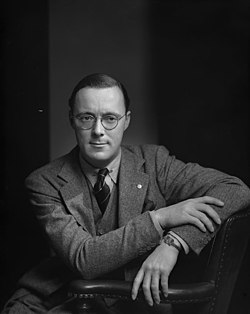
The group is organized by a steering committee with two members from each of approximately 18 nations. Official positions include a chairman and an Honorary Secretary General. Notably, there is no formal “membership” category — only “member of the Steering Committee” exists in the group’s rules. A separate advisory group also operates, though its membership overlaps with the steering committee.
Dutch economist Ernst van der Beugel succeeded Retinger as permanent secretary in 1960. Prince Bernhard served as chairman until 1976, when he stepped down following the Lockheed bribery scandal. The position of Honorary American Secretary General has been held by figures from the Carnegie Endowment, Princeton University, the U.S. diplomatic corps, and Georgetown University’s Institute for the Study of Diplomacy.
Chairmen of the Steering Committee have included:
- Prince Bernhard of Lippe-Biesterfeld (1954-1975)
- Walter Scheel (1975-1977)
- Alec Douglas-Home (1977-1980)
- Eric Roll, Baron Roll of Ipsden (1986-1989)
- Peter Carington, 6th Baron Carrington (1990-1998)
- Etienne Davignon (1998-2001)
- Henri de Castries (2001-present)
Notable Attendees and Meetings

Attendee lists have historically been weighted toward bankers, politicians, and directors of large multinational corporations. Heads of state including King Juan Carlos I of Spain and Queen Beatrix of the Netherlands have attended, along with board members from companies such as IBM, Xerox, Royal Dutch Shell, Nokia, and Daimler.
The 2009 meeting in Greece drew participants including Greek Prime Minister Kostas Karamanlis, Finnish Prime Minister Matti Vanhanen, Swedish Foreign Minister Carl Bildt, U.S. Deputy Secretary of State James Steinberg, U.S. Treasury Secretary Timothy Geithner, World Bank President Robert Zoellick, and European Commission President Jose Manuel Barroso.
That same year, the group hosted a dinner at the Castle of the Valley of the Duchess in Brussels that was widely reported as promoting Herman Van Rompuy’s candidacy for President of the European Council.
Recent conference locations have included Germany (2005), Canada (2006), Turkey (2007), Virginia (2008), Greece (2009), Spain (2010), Switzerland (2011), and Virginia again (2012).
Secrecy and Security Measures
Conference hotels are closed to all other guests for the duration of meetings and are secured by both private security personnel and local police. During the 2009 meeting at Vouliagmeni, Greece, British Guardian reporter Charlie Skelton was arrested twice after photographing vehicles near the venue.
According to a 2008 press release from the “American Friends of Bilderberg,” the group’s only activity is its annual conference, at which “no resolutions are proposed, no votes taken, and no policy statements issued.” The release noted that attendee names were available to the press.
The Influence Debate
The extent of Bilderberg’s actual influence has been debated by scholars and journalists for decades. Researcher Peter Thompson argued in a 1980 essay that while Bilderberg itself is not an executive agency, when participants reach consensus, “they have at their disposal powerful transnational and national instruments for bringing about what it is they want to come to pass.”
Policy analyst Holly Sklar observed that by the 1950s, Western elites had grown concerned about losing control of the United Nations, a concern reflected in Bilderberg’s participant selection process, which has historically excluded representatives from developing nations. Journalist Caroline Moorehead quoted an unnamed member explaining: “No invitations go out to representatives of the developing countries. Otherwise you simply turn us into a mini-United-Nations.” Moorehead characterized the group as “heavily biased towards politics of moderate conservatism and big business.”
Chairman Etienne Davignon has acknowledged the group’s appeal lies in offering influential figures the opportunity to speak candidly without fear of their comments being reported. When confronted about conspiracy allegations, Davignon told the BBC in 2005: “When people say this is a secret government of the world I say that if we were a secret government of the world we should be bloody ashamed of ourselves.”
Perhaps most revealing was Denis Healey’s 2001 statement. A founding member and 30-year steering committee veteran, Healey said: “To say we were striving for a one-world government is exaggerated, but not wholly unfair. Those of us in Bilderberg felt we couldn’t go on forever fighting one another for nothing and killing people and rendering millions homeless. So we felt that a single community throughout the world would be a good thing.”
Critical Perspectives
Suspicion of the Bilderberg Group spans the political spectrum. Critics on the left have accused the group of advancing capitalist dominance, while those on the right have suggested it works toward world government and a centrally planned economy.
Sociology professor G. William Domhoff, who has studied power structures extensively, views organizations like Bilderberg as places where elites share ideas, build consensus, and create social cohesion. He has cautioned progressives against fixating on conspiracy narratives, arguing that the same individuals are more effectively opposed in their visible roles as corporate leaders and political figures.
Author James McConnachie offered a more nuanced take, suggesting that conspiracy theorists “have a point” but fail to communicate it effectively. He argued that Bilderberg operates in a manner “consistent with a global conspiracy” but without the same “degree of nefariousness” that critics attribute to it. McConnachie credited conspiracy researchers with forcing mainstream media attention: “Would the media be running stories if there weren’t these wild allegations flying around?”
Public figures who have drawn attention to Bilderberg include the John Birch Society, political activist Phyllis Schlafly (whose 1964 book A Choice, Not an Echo alleged Republican Party control by Bilderberg-connected elites), journalist Jim Tucker, radio host Alex Jones, and former Minnesota Governor Jesse Ventura, who dedicated a 2009 episode of his television series to the group. Former Cuban President Fidel Castro also wrote about Bilderberg in 2010, citing Daniel Estulin’s book The Secrets of the Bilderberg Club.
Assessing the Flowchart
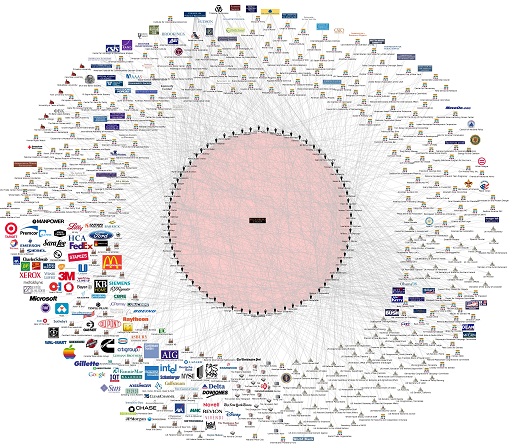
The infographic above attempts to map the interconnected relationships between Bilderberg attendees and the organizations they represent, including major banks, defense contractors, media conglomerates, pharmaceutical companies, energy firms, and government agencies. While no single diagram can capture the full complexity of these networks, the visualization illustrates why researchers have long been interested in the overlapping board memberships, policy positions, and institutional affiliations that characterize this circle of global decision-makers.
Whether one views Bilderberg as a benign networking forum or something more consequential, the documented facts are notable: some of the world’s most powerful individuals gather annually behind closed doors, under security that prevents public observation, to discuss matters of global significance. The group’s own statements confirm that its value lies precisely in this privacy, allowing participants to speak with a candor impossible in public settings.