Director Errol Morris’s ‘The Unknown Unknown’ shows Rumsfeld as unapologetic.
April 5, 2014
So what do we know now that we didn’t after documentarian Errol Morris’s 100-minute Q&A with Donald “I Don’t Do Quagmires” Rumsfeld in “The Unknown Known”? Only that the former U.S. secretary of defense is still a master strategist of evasion, contradiction, misdirection and malapropism.
As a footnote, here’s what we do know to date about that dirty little Iraq War that “Rummy,” the George W. Bush White House and their nincompoop Pentagon neo-cons cooked up and spoon fed to the omnivorous American public: more than 4400 U.S. military deaths and 32,000 wounded, at least 100,000 to as many as 500,000 Iraqi fatalities, millions more displaced, and an estimated price tag of $3 trillion, give or take a few hundred billion.
Yet like most of the questions that Morris tosses—gently—at his subject, any such factual horrors are sidestepped, parried and danced around by a fitfully nimble Rumsfeld. Relaxed, nattily dressed and imperiously self-assured as ever, Morris’ hollow yet overstuffed man does his imitation of “Hogan’s Heroes” Sgt. Schultz (“I know nothing, nothing”) while implausibly denying personal culpability for any stink that blew back from the Iraq War, whether the phony Weapons of Mass Destruction raison d’être, prisoner torture or the fictitious links between Saddam Hussein and the 9/11 World Trade Center attacks.
In his Oscar-winning “The Fog of War,” Morris at least got Lyndon Johnson-era Defense Secretary Robert McNamara to shoulder some of blame for the Vietnam War quagmire. But Rumsfeld is impishly unapologetic, even as his own words are shot down by Morris’ juxtapositions with TV news footage culled from the run-up and catastrophic letdown to the 2003 Iraq invasion and subsequent U.S. occupation. Yet it’s clear that Morris’ mission isn’t to catch his subject in a Captain Queeg-style meltdown that would cause Rummy to shout “Good gracious” or “Henny-penny” and storm off the set.
Rather, Morris is chiefly interested in the infernal meta-narrative of how those in the pinnacles of power can delude themselves for so long and so often that—perhaps—they don’t even know what the truth is anymore. This is a man seemingly without an ounce of introspection and one who surely sleeps well at night, confident he did all the right things, from his time as the youngest (44) secretary of defense, during the Gerald Ford presidency, to his Freddy Krueger-like return to the Pentagon as prime architect of the shock-and-awe Iraq and Afghanistan U.S.-led invasions.
Morris goes out of his way to humanize Rumsfeld, including humdrum details of his marriage while tracing his long career as Republican White House insider and go-to warhorse who trumpeted “peace through strength” and other hawkish mantras. We hear Morris’ off-camera questions, but the slippery answers are challenged only indirectly via news footage and period headlines, not by contrary interviews that would offer known arguments to Rumsfeld’s self-serving explanations.
The film’s title is a quote from one of the enormous number of official memos Rumsfeld generated over the decades. In one wacky rumination from 2004 (Subject: What You Know), he writes of the “things that you think you know that it turns out you do not.” For Morris, this is a four-star analogy for his subject, a polarizing public figure who indeed is a riddle wrapped in an enigma—and cloaked in an impenetrable armor of Orwellian double-talk. As running metaphor, Morris cuts back and forth to images of a deep blue sea, significantly more fathomable than Rumsfeld himself.
As to any possible policy misfires during his Washington tenures, Rumsfeld blithely chalks them up to the unintended consequences of war, executive decision-making and the inevitable inability for leaders like him to anticipate everything, for Pete’s sake: i.e., heck, Stuff Happens. This expedient philosophy can rationalize pretty much any horrors stretching from Abu Ghraib to Gitmo. If only Emily Littella were still on active duty, I know she’d just say, “Never mind.”
And so it goes in Rummy-speak, as Morris sends his cameras down the rabbit hole into an upside-down universe where government morality and mea culpas have no standing, yet mad tautologies like “the absence of evidence is not the evidence of absence” do. In the question of those well-known phantom WMDs, such inane statements can justify anything, including interminable wars in which bodies are still piling up, peace is not won, and mass Mideast destruction marches on.
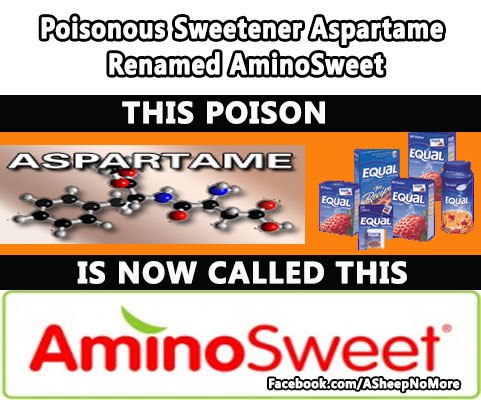
Aspartame has been renamed – AminoSweet – and is now being marketed as a natural sweetener
Aspartame, the artificial sweetener linked to cancer, heart palpitations, seizures, weight gain and other severe medical issues, is now going by the name AminoSweet. The toxic sweetener, Aspartame, has been around over 25 years after it was accidentally discovered by chemist, James Schlatter while working for the drug company G.D. Searle & Company. It was created as an anti-ulcer pharmaceutical drug, but the chemist discovered it had a sweet taste, so the drug company switched its application to the FDA from a drug to a food. It was none other than Donald Rumsfeld, who was the CEO of Searle who pushed for Aspartame to be sold on the market in 1985. If that name sounds familiar, your right, he is the same Donald Rumsfeld, former U.S. Secretary of Defense who served under George W. Bush. He is a perfect example of someone taking advantage of the “revolving door” between our government and corporations.
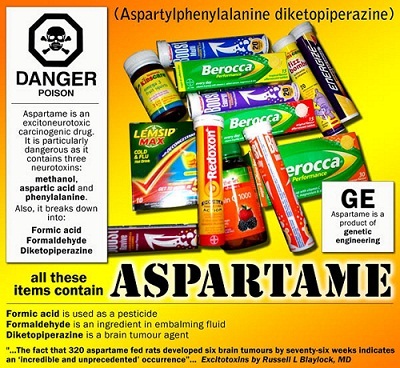
AminoSweet is Aspartame, it changed its name to fool the public, and I am guessing it did so because consumers figured out that their product made them sick. Aspartame is made up of three chemicals: aspartic acid, phenylalanine, and methanol. The book Prescription for Nutritional Healing, by James and Phyllis Balch lists aspartame under the category of “chemical poison.”
WARNING! Read labels before buying foods with the name Phenylalanine. I will go one step further — if you need to bring along a chemistry book to the store in order to understand the ingredients on the labels — DO NOT BUY IT!
Phenylalanine is an essential amino acid (that is, an amino acid which our bodies cannot make and which we must obtain from our diet). It is also one of the amino acids which is used to make aspartame. Phenylalanine is found in all protein-containing foods including milk, cheese, eggs, meat and fish.
Products which contain aspartame have a label which says ‘Contains a source of phenylalanine’. This label is there to help people with a rare inherited genetic disorder called phenylketonuria (PKU). These people cannot metabolise phenylalanine from any source and need to follow a strict diet to control their intake of this amino acid. The disorder affects approximately 1 in 10,000 babies, and is identified by screening shortly after birth. [Source]
Ten percent of this sweetener contains methanol. When it is absorbed by our intestines, it breaks down into formic acid and formaldehyde. Formaldehyde is a deadly neurotoxin that causes cancer, retinal damage, interferes with DNA replication and causes birth defects.
I went to the AminoSweet website to see what kind of “spin” they are putting on their repackaged product to entice shoppers to buy their so-called “natural” sweetener and here is their selling point:
AminoSweet aspartame is the low calorie sweetener that tastes just like sugar. It is made from two building blocks of protein just like those found naturally in many everyday foods. Aspartame is digested by the body in exactly the same way as these other protein foods and so does not bring anything new to our diet.
Makers of this artificial sweetener claim it is made from protein found “naturally” in many everyday foods. So what is the meaning of ‘natural’ when it comes to the labeling of food? The FDA’s website writes:
“From a food science perspective, it is difficult to define a food product that is ‘natural’ because the food has probably been processed and is no longer the product of the earth. That said, FDA has not developed a definition for use of the term natural or its derivatives.” [Source]
The word ‘natural’ is being thrown around to describe all sorts of genetically modified foods and AminoSweet is genetically modified. There is nothing natural about it. Why do you think these drug companies buy patents? They create them in a lab and they own it. And they know exactly what they are doing and choose to fool consumers into thinking their foods are safe when science proves differently.
In June 2013 Ben & Jerry’s Ice Cream and Campbell’s Soup became defendants in class action lawsuits that allege they misrepresented the nature of the ingredients on their product labels. The Campbell’s Soup Company is currently being sued by Florida residents for misrepresenting the genetically modified (GMO) corn in its soup as “natural.” Ben & Jerry’s decided to stop using genetically modified ingredients as a result of their suit.
Ben & Jerry’s used to be known for their healthy ‘natural’ ice creams, but I guess when they sold out to British-Dutch conglomerate Unilever, they sold their souls along with it. It looks like they haven’t updated their website since the sale either, even though Unilever has owned them since 2001. They portray themselves as another American success story — but according to the lawsuit, they are just another corporation choosing to deceive the public — much like another American success story — Monsanto who purchased Searle & Company in 1985– who make Aspartame now called AminoSweet.
As few as one diet soda daily may increase the risk for leukemia in men and women, and for multiple myeloma and non-Hodgkin lymphoma in men, according to new results from the longest-ever running study on aspartame as a carcinogen in humans. Importantly, this is the most comprehensive, long-term study ever completed on this topic, so it holds more weight than other past studies which appeared to show no risk. And disturbingly, it may also open the door for further similar findings on other cancers in future studies.
The most thorough study yet on aspartame – Over two million person-years
For this study, researchers prospectively analyzed data from the Nurses’ Health Study and the Health Professionals Follow-Up Study for a 22-year period. A total of 77,218 women and 47,810 men were included in the analysis, for a total of 2,278,396 person-years of data. Apart from sheer size, what makes this study superior to other past studies is the thoroughness with which aspartame intake was assessed. Every two years, participants were given a detailed dietary questionnaire, and their diets were reassessed every four years. Previous studies which found no link to cancer only ever assessed participants’ aspartame intake at one point in time, which could be a major weakness affecting their accuracy.
One diet soda a day increases leukemia, multiple myeloma and non-Hodgkin lymphomas
The combined results of this new study showed that just one 12-fl oz. can (355 ml) of diet soda daily leads to:
– 42 percent higher leukemia risk in men and women (pooled analysis) – 102 percent higher multiple myeloma risk (in men only) – 31 percent higher non-Hodgkin lymphoma risk (in men only)
These results were based on multi-variable relative risk models, all in comparison to participants who drank no diet soda. It is unknown why only men drinking higher amounts of diet soda showed increased risk for multiple myeloma and non-Hodgkin lymphoma. Note that diet soda is the largest dietary source of aspartame (by far) in the U.S. Every year, Americans consume about 5,250 tons of aspartame in total, of which about 86 percent (4,500 tons) is found in diet sodas.
Confirmation of previous high quality research on animals
This new study shows the importance of the quality of research. Most of the past studies showing no link between aspartame and cancer have been criticized for being too short in duration and too inaccurate in assessing long-term aspartame intake. This new study solves both of those issues. The fact that it also shows a positive link to cancer should come as no surprise, because a previous best-in-class research study done on animals (900 rats over their entire natural lifetimes) showed strikingly similar results back in 2006: aspartame significantly increased the risk for lymphomas and leukemia in both males and females. More worrying is the follow on mega-study, which started aspartame exposure of the rats at the fetal stage. Increased lymphoma and leukemia risks were confirmed, and this time the female rats also showed significantly increased breast (mammary) cancer rates. This raises a critical question: will future, high-quality studies uncover links to the other cancers in which aspartame has been implicated (brain, breast, prostate, etc.)?
There is now more reason than ever to completely avoid aspartame in our daily diet. For those who are tempted to go back to sugary sodas as a “healthy” alternative, this study had a surprise finding: men consuming one or more sugar-sweetened sodas daily saw a 66 percent increase in non-Hodgkin lymphoma (even worse than for diet soda). Perhaps the healthiest soda is no soda at all.
Did you know that Aspartame has been proven to cause brain damage by leaving traces of Methanol in the blood? It makes you wonder why Aspartame has been approved as “safe” and is found in thousands of food products. Currently more than 90 countries have given the artificial sweetener the “OK” to be used in foods.
“Multiple Sclerosis is often misdiagnosed, and that it could be aspartame poisoning” – Montel Williams
Given that Aspartame is 200 times sweeter than sugar, manufacturers are able to produce their sweet foods and market them as “low calorie” so they can market and appeal to millions of people on “diets.” There is no doubt that the less sugar you have in your diet, the better. But replacing sugar with aspartame is not the solution, and in fact is likely to be even worse for your health.
In my personal experience, Aspartame has always made my head feel very odd when I consumed it. Headaches, light headedness and overall nausea, are all symptoms I personally feel from consuming Aspartame. But that isn’t even the bad part when you look at what all of the research is suggesting. So I question, and everyone should be asking the same: With all of the research about Aspartame and its dangerous effects, even in small quantities, why is it still approved by the FDA and other health agencies as being safe for human consumption?
Let’s take a look at some research.
What is this lovely substance (Aspartame) made of?
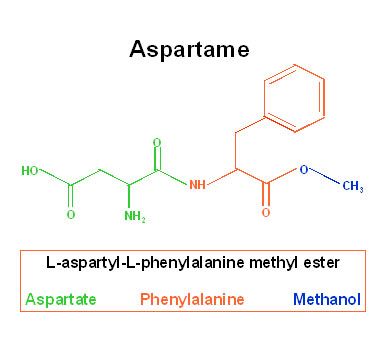
An Aspartame molecule is essentially made up of 3 different substances. 90% of it is made of two natural amino acids, 1 being aspartic acid and the other being phenylalanine. The other 10% of the molecule is made up of a methyl ester bond (includes Methanol). The methanol is released from the aspartame within hours of consumption and begins traveling through the body via the blood. Once the methyl ester bond is broken, is separtes into methyl alcohol and methanol (wood alcohol). The big problem with methanol is that it easily passes into your blood-brain barrier and once there, is converted into formaldehyde. Formaldehyde is what is causing the brain damage. While animals are able to detoxify methanol in the body, humans do not have this capability. It doesn’t really take a rocket scientist to realize that accumulating formaldehyde in the brain is not a good thing.
What’s the deal with Methanol?
As mentioned above, Methanol is the key issue here as it is what converts into formaldehyde. While it is often believed that formic acid is the issue with Aspartame, it is actually formaldehyde. Formaldehyde is a serious neurotoxin and carcinogen. According to the EPA, Methanol is considered a cumulative poison which means is accumulates in the body and very little is excreted each time it is consumed.
Methanol is a toxin that destroys the myelin tissue in your body, which is the insulating material around your nerves that allows nerve signals to travel properly. Once injured, one can have what are called demyelinating symptoms that are commonly seen in diseases like MS and also migraines that can include bizarre and inconsistent visual field disruptions.
But it must be safe in small doses!
While having NO methanol in the body makes most sense, the EPA has accepted that a limit of consumption of 7.8 mg/day is still OK. Why we accept even small amounts of toxic stuff in our body is beyond me, but some feel we can still consume this stuff in small doses. According to Woodrow Monte, Ph.D, R.D., director of the Food Science and Nutrition Laboratory at Arizona State University:
“When diet sodas and soft drinks, sweetened with aspartame, are used to replace fluid loss during exercise and physical exertion in hot climates, the intake of methanol can exceed 250 mg/day or 32 times the Environmental Protection Agency’s recommended limit of consumption for this cumulative toxin.”
Further, he states that due to the lack of a couple of key enzymes, humans are many times more sensitive to the toxic effects of methanol than animals. Therefore, tests of aspartame or methanol on animals do not accurately reflect the danger for humans.
“There are no human or mammalian studies to evaluate the possible mutagenic, teratogenic, or carcinogenic effects of chronic administration of methyl alcohol,” he said.
How can you know you are getting too much Methanol? You may experience headaches, ear buzzing, dizziness, nausea, gastrointestinal disturbances, weakness, vertigo, chills, memory lapses, numbness and shooting pains in the extremities, behavioral disturbances, and neuritis. Another very well known sign of methanol poisoning is vision problems.
Adding to the problem, one of the amino acids in aspartame, aspartic acid is capable of crossing your blood-brain barrier. There it attacks your brain cells, creating a form of cellular overstimulation called excitotoxicity, which can lead to cell death.
Your blood-brain barrier, which normally protects your brain from excess aspartate, as well as toxins, is not able to adequately protect you against the effects of aspartame consumption because it:
Is not fully developed during childhood
Does not fully protect all areas of the brain
Is damaged by numerous chronic and acute conditions
Allows seepage of excess aspartate into the brain even when intact
That excess aspartate slowly begins to destroy neurons, and the large majority (75 percent or more) of neural cells in a particular area of the brain are killed before any clinical symptoms of a chronic illness are noticed. Then, when they do occur, they may or may not be associated with aspartame consumption, even though examples of chronic illnesses that are made worse by long-term exposure to excitatory amino acid damage include: Multiple sclerosis (MS), ALS, hormonal problems, memory loss, epilepsy, hearing loss, Alzheimers, dementia, brain lesions, and Neuroendocrine disorders.
It can be easy for us to make the argument that this stuff is OK in small doses, and it hasn’t killed us yet so it can’t be that bad. But it almost seems there is something more to it why we use this reasoning. Are we just addicted to these substances? Afraid to admit we have been poisoning ourselves? Unable to accept that the FDA and health agencies have lied to us? Like to brush these truths off as conspiracies? No matter what the reason is, there comes a point where we must see what is staring us in the face and start looking at how we can begin making new choices. Returning to something that is healthier and more in line with our bodies. We are really damaging ourselves here and becoming quite numb to life. It is susbstances like Aspartame and Fluoridethat are causing these issues and the difference it makes to avoid these substances is monumental for our quality of life and consciousness.
Update: One thing I really wanted to add to this article is geared towards really looking at ourselves when it comes to not just aspartame but food, beverage, cosmetics, etc. We all at some point consumed or used products that are not all that great for our bodies. Most of the everyday products we use contain very toxic chemicals, it’s just that we spend a lot of time seeing ad’s about them, using them and looking at the nice labels that look all happy so we don’t realize how bad this stuff really is for us. You may want to check THIS ARTICLE out for more info. The question I want to raise here is, why is it that when information is presented about chemicals and toxic products do we get in a rage about the information and want to justify the continuation of its use in our bodies, on our bodies and on the planet? Even if something like Aspartame was only half as bad as it really is, why would we even want that? Why is the connection we have to our bodies so lost that we want to subject it to toxins, carcinogens, chemicals and other products that 1. are not remotely natural and 2. are not something that should be near our bodies to begin with. It just seems as though the bigger issue here is that we have become very disconnected from not only our bodies but the planet as well. It has become about convenience, money, temporary happiness, filling emotional voids and staying stagnant. When this info is presented all of those buttons get pushed at once and next thing we know we are defending the use of something that should have never been brought into existence in the first place. To look at it further, even the amount of sugar and type of sugar we use in the products we use aspartame in as an alternative, is terrible as well. Any product that currently contains aspartame shouldn’t be consumed by humans to begin with. What is wrong with fruit? Vegetables? Nuts? Seeds? Why do we always need these artificially flavored and chemically enhanced products that are terrible for our health? Aspartame or no aspartame, the real thing to observe here is our disconnection from our bodies, life and the planet.


 So what do we know now that we didn’t after documentarian Errol Morris’s 100-minute Q&A with Donald “I Don’t Do Quagmires” Rumsfeld in “The Unknown Known”? Only that the former U.S. secretary of defense is still a master strategist of evasion, contradiction, misdirection and malapropism.