If twitter is any gauge, a lot of people think this article in Wired about General Keith Alexander is just all kinds of kewl:
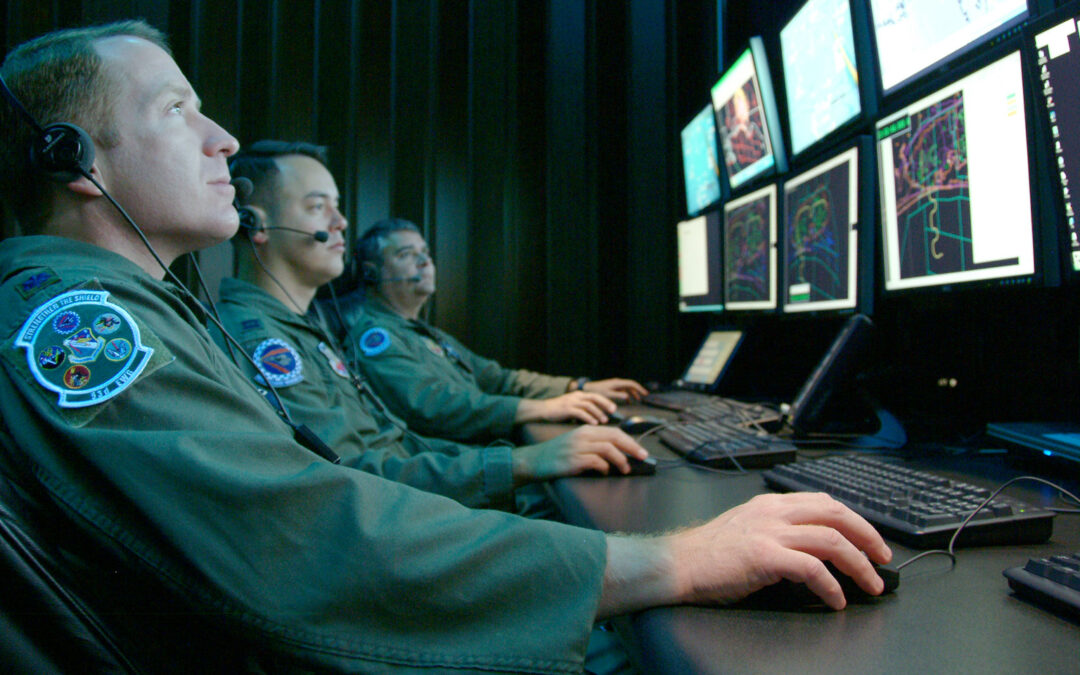
General Keith Alexander, a man few even in Washington would likely recognize. Never before has anyone in America’s intelligence sphere come close to his degree of power, the number of people under his command, the expanse of his rule, the length of his reign, or the depth of his secrecy. A four-star Army general, his authority extends across three domains: He is director of the world’s largest intelligence service, the National Security Agency; chief of the Central Security Service; and commander of the US Cyber Command. As such, he has his own secret military, presiding over the Navy’s 10th Fleet, the 24th Air Force, and the Second Army.
Alexander runs the nation’s cyberwar efforts, an empire he has built over the past eight years by insisting that the US’s inherent vulnerability to digital attacks requires him to amass more and more authority over the data zipping around the globe. In his telling, the threat is so mind-bogglingly huge that the nation has little option but to eventually put the entire civilian Internet under his protection, requiring tweets and emails to pass through his filters, and putting the kill switch under the government’s forefinger. “What we see is an increasing level of activity on the networks,” he said at a recent security conference in Canada. “I am concerned that this is going to break a threshold where the private sector can no longer handle it and the government is going to have to step in.”
In its tightly controlled public relations, the NSA has focused attention on the threat of cyberattack against the US—the vulnerability of critical infrastructure like power plants and water systems, the susceptibility of the military’s command and control structure, the dependence of the economy on the Internet’s smooth functioning. Defense against these threats was the paramount mission trumpeted by NSA brass at congressional hearings and hashed over at security conferences.
But there is a flip side to this equation that is rarely mentioned: The military has for years been developing offensive capabilities, giving it the power not just to defend the US but to assail its foes. Using so-called cyber-kinetic attacks, Alexander and his forces now have the capability to physically destroy an adversary’s equipment and infrastructure, and potentially even to kill. Alexander—who declined to be interviewed for this article—has concluded that such cyberweapons are as crucial to 21st-century warfare as nuclear arms were in the 20th.
And he and his cyberwarriors have already launched their first attack. The cyberweapon that came to be known as Stuxnet was created and built by the NSA in partnership with the CIA and Israeli intelligence in the mid-2000s. The first known piece of malware designed to destroy physical equipment, Stuxnet was aimed at Iran’s nuclear facility in Natanz. By surreptitiously taking control of an industrial control link known as a Scada (Supervisory Control and Data Acquisition) system, the sophisticated worm was able to damage about a thousand centrifuges used to enrich nuclear material.
The success of this sabotage came to light only in June 2010, when the malware spread to outside computers. It was spotted by independent security researchers, who identified telltale signs that the worm was the work of thousands of hours of professional development. Despite headlines around the globe, officials in Washington have never openly acknowledged that the US was behind the attack. It wasn’t until 2012 that anonymous sources within the Obama administration took credit for it in interviews with The New York Times.
But Stuxnet is only the beginning. Alexander’s agency has recruited thousands of computer experts, hackers, and engineering PhDs to expand US offensive capabilities in the digital realm. The Pentagon has requested $4.7 billion for “cyberspace operations,” even as the budget of the CIA and other intelligence agencies could fall by $4.4 billion. It is pouring millions into cyberdefense contractors. And more attacks may be planned.
I don’t suppose the American public have any business knowing if their government is launching such attacks. Why would we? What could possibly go wrong?
Inside the government, the general is regarded with a mixture of respect and fear, not unlike J. Edgar Hoover, another security figure whose tenure spanned multiple presidencies. “We jokingly referred to him as Emperor Alexander—with good cause, because whatever Keith wants, Keith gets,” says one former senior CIA official who agreed to speak on condition of anonymity. “We would sit back literally in awe of what he was able to get from Congress, from the White House, and at the expense of everybody else.”
Now 61, Alexander has said he plans to retire in 2014; when he does step down he will leave behind an enduring legacy—a position of far-reaching authority and potentially Strangelovian powers at a time when the distinction between cyberwarfare and conventional warfare is beginning to blur. A recent Pentagon report made that point in dramatic terms. It recommended possible deterrents to a cyberattack on the US. Among the options: launching nuclear weapons.
Like I said, what could possibly go wrong?
When the Guardian revealed this program the other day there was a spirited debate about whether this, unlike the other programs, was something we should welcome and expect. My problem with it wasn’t that the government was creating plans to defend against attacks on US cyber-infrastructure or even war plans in case such a thing happened. What I found questionable was the idea that this was conceived as 21st Century offensive war planning, and and in ways that do not necessarily fall within the traditional “national security” boundaries.
When it comes to cyber issues, I’m afraid we are seeing a confluence of commerce and security that everyone should stop and think about for a minute. How are these people defining the “national interest” and on whose behalf are they planning to launch cyberwar? What are the consequences of doing such a thing and who decides that it must be done?
And what do we think about paying huge amounts of taxpayer dollars to contractors like this?
Defense contractors have been eager to prove that they understand Alexander’s worldview. “Our Raytheon cyberwarriors play offense and defense,” says one help-wanted site. Consulting and engineering firms such as Invertix and Parsons are among dozens posting online want ads for “computer network exploitation specialists.” And many other companies, some unidentified, are seeking computer and network attackers. “Firm is seeking computer network attack specialists for long-term government contract in King George County, VA,” one recent ad read. Another, from Sunera, a Tampa, Florida, company, said it was hunting for “attack and penetration consultants.”
One of the most secretive of these contractors is Endgame Systems, a startup backed by VCs including Kleiner Perkins Caufield & Byers, Bessemer Venture Partners, and Paladin Capital Group. Established in Atlanta in 2008, Endgame is transparently antitransparent. “We’ve been very careful not to have a public face on our company,” former vice president John M. Farrell wrote to a business associate in an email that appeared in a WikiLeaks dump. “We don’t ever want to see our name in a press release,” added founder Christopher Rouland. True to form, the company declined Wired’s interview requests.
[…]
Bonesaw also contains targeting data on US allies, and it is soon to be upgraded with a new version codenamed Velocity, according to C4ISR Journal. It will allow Endgame’s clients to observe in real time as hardware and software connected to the Internet around the world is added, removed, or changed. But such access doesn’t come cheap. One leaked report indicated that annual subscriptions could run as high as $2.5 million for 25 zero-day exploits.
The buying and using of such a subscription by nation-states could be seen as an act of war. “If you are engaged in reconnaissance on an adversary’s systems, you are laying the electronic battlefield and preparing to use it,” wrote Mike Jacobs, a former NSA director for information assurance, in a McAfee report on cyberwarfare. “In my opinion, these activities constitute acts of war, or at least a prelude to future acts of war.” The question is, who else is on the secretive company’s client list? Because there is as of yet no oversight or regulation of the cyberweapons trade, companies in the cyber-industrial complex are free to sell to whomever they wish. “It should be illegal,” says the former senior intelligence official involved in cyberwarfare. “I knew about Endgame when I was in intelligence. The intelligence community didn’t like it, but they’re the largest consumer of that business.”
There are some serious implications to all of this that need to be hashed out by the American people. Of course we need to have defenses against cyber attacks. I don’t think anyone in the country thinks otherwise. But this looks like it could be a monumental financial boondoggle that is in great danger of running amok and causing some very serious problems. Frankly, this scares me much more than the threat that some would-be is going to get a hold of some beauty supplies and blow himself up.
Islamic terrorism is not and never has been an existential threat. This, I’m not so sure about. We should at least have a little chat about it before we let Cyber Buck Turgidson and his friends run wild.
US Expat Taxes: The IRS Gets You at Passport Renewal Time
WikiLeaks: US ‘to call bin Laden raid Navy Seal to testify against Bradley Manning’ UPDATE: Judge strikes down dismiss over trial delay says ‘reasonable’
The Al-Qaida Papers – Drones
The FBI is inside Anonymous: Hacker Sabu has sentencing delayed again for helping the feds
FBI employees, entrusted with stopping computer crimes, commit them too
Obama Admin Aims Keyboard Commandos at Gun Control
Net providers begin warning of illegal downloads
A Police State ‘Example’ being set, with Raw Milk drinkers…
Written by Giordano Nanni & Hugo Farrant
Welcome back, netizens, to this newest edition in
Juice media’s series of Rap News journalism with me, Robert Foster:
this evening we’re actively delving in depth
to facts which affect all of us who dwell on this internet and we’ve got to
give a special welcome to all the ladies and a-gents,
from the NSA, ASIO, MI5: glad you’re listening in;
Because today’s show is
all about surveillance and how it’s spreading from the streets into our modems
As we speak, laws are being tacitly written in
to implement ways of controlling the expanse of this internet,
to keep us safe, we’re told; but from whom?
And will this place ever be the same if these plans go through?
To find out, we connect with our first guest to comment on the matter
we’re live at the Pentopticon with General Baxter,
General – Son! – Good to have you back again with us
explain why the State is spying on us? – My Fellow Oceanians,
As you know, we’ve always been at war with Eurasia…
or is it Eastasia? Either way, it’s war ‘n we need division to wage it!
but now the proles are connecting online bypassing these
illusory divisions of race, religion and nationality…
– Sounds grand to me… – It’s a catastrophe!
Centuries of hard work are being undone, profits are vanishing
And it’s due to the internet, it’s empowering humanity
we need to get this SNAFU under control; rapidly.
– How? – Behold the latest weapon in the War of Terror
our greatest invention since nine eleven
guaranteed to keep us free and safe forever
i give you The Surveillance State, ladies and generals.
Our secret wires log your key style
monitor every single number on your speed dial
rewind straight to your position with facial recognition,
and pinpoint you within point oh-three of a mile!
we’ve put eyes everywhere without consulting you,
keeping you safe, whether or not you want us to.
Soon there’ll be no freedoms left for threatening.
Then we’ll have won the war! Take that Terrorism!
– Brilliant, thank you General, we now interview
Our resident guru, Terence Moonseed, for a different view
– Greetings. – How does this situation look?
– I have one word for you, Robert: doubleplusungood!
The world populace of seven point four billion are all heading in
the direction of Orwellian totalitarian oblivion
My voice is hoarse yelling about Stellar Winds cold chilling em
And TrapWire weaving through the world wide web we all dwelling in
Face it: the all-seeing eye’s in all of our Facebooks like a virus
and in these Eye-phones, with Siri, or should I say “Iris”.
And next in line is RFID devices and mind chips
triggered by Chemtrails the planes spray the sky with.
This time it’s too far: check out the base they’re building in Utah
where they’ll be storing all ya data for over a century; it’s Fubar!
And under the outback is an entire tunnel of wires,
an ECHELON base called Pine Gap, to hijack our Mother Gaia.
– Hey, maybe your mother’s gayer! – Boo hoo!
Why don’t you just kill yourself like most of your troops do!
– That’s it, now you’re on the Cast Iron list
– Hang on, General, why weren’t we informed about this?
– Sorry we didn’t tell you about our grand plan before,
it was meant to be a surprise, under wraps and in store.
But some spoilsports had to go and ruin it for all
by blowin’ whistles, in spite of the damn law.
– Bill Binney and Thomas Drake are Trailblazers for leaking these tactics…
– Hey, civil-liberty fagtivists… err, activists:
this is all legal: anything we do now actually is!
– How did… – You can’t question my authorit-ah, thanks to this.
– And that shit’s global, people! in Australia it’s now legal
for the government to store all SMS’s, searches and emails…
Australians, it’s taking place under your nose
unless you wake up, all your data are belong to ASIO.
– Come on! everyone knows: you can trust the government now
If you’ve got nothing to hide, you got nothing to worry about
– That might be the case with things that are happening now,
because most people agree with most of the laws that are being handed down.
But once the Illuminati reveal their agenda for you
this surveillance will enforce laws you no longer consent to,
but by then it’ll be too late to protest too
and anything you’ve ever said, typed or browsed can and will be used against you.
– I’m confused, so what should we do then?
– What should we do? Nothing! this is all an illusion,
It’s just a ride, a delusion, the matrix, the Maya deceiving us.
– Ah, you hippies really make our job so much easier…
– Sorry to interrupt but we’re picking up
a signal from beyond the space-time continuum
Quick, switch on the Juice Channelling Portal…..
…………….Wait……. is that…… George Orwell?!
– Good day to you – Wow …what do we owe this honour to?
– I tried to warn you noobs, but I see you are actually fools
or else you thought this was an instruction manual.
– Yes, ahem… so can you advise us? What would you have us do?
– An open and universal internet is the most effective tool you have
to address the issues that afflict the world at hand
therefore, protecting it is the most essential task that stands
before your generation – I think I understand… – hush, man
You must not lose the internet. Heed this mantra:
‘who controls the Internet, controls the data
and who controls the data, controls the future’
– We’re losing you – I leave you with a tool to use…
– An onion? – Don’t be simple, Robert, this is but a simile
It stands for ‘Tor’ – Tor? – Google it! It’s for anonimity:
this onion router open network helps considerably against tyrranny
But its abilities only work if all you f***kers use it consistently
and even if you don’t use it, run it so its force swells.
– Thanks, Mr. Orwell – From now on call me: George Torwell
if we’d had such tools when I wrote this, well
It would’ve been so much simpler to tell Big Brother to go f**k himself,
the motherf***king, c***-sucking piece of sh[…]
– Thanks, George Torwell, for manifesting direct from this
memory hole of history, to impress on us these messages.
We’re told we need safety; which is precious, yes,
but can a society that can enforce all its laws ever progress?
Hindsight shows that many figures guilty of “thought-crime”
turned out to be luminaries and heroes, before their time.
But if a surveillance state had reigned then in this form and design
Just think of all the progress we may’ve all been denied:
Could lobbies for women’s or gay rights have appeared and thrived
Would revolutionary ideals have materialised
Would science have pioneered or even survived,
If every word had been monitored by thought police and spies?
Big Brother brings chilling effects, freezing our collective hopes
he doesn’t protect our safety, but protects the status quo,
and threatens this internet, the one channel yet uncontrolled
whose openness we are now called upon to effect and uphold.
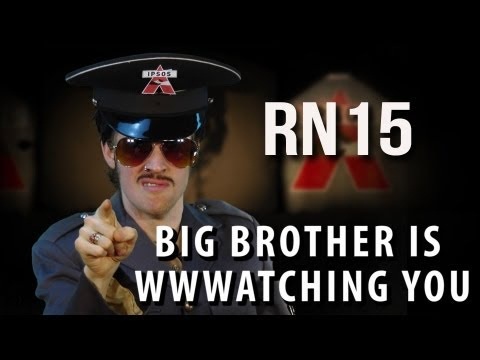
Juice Rap News: Episode 15 – Big Brother is WWWatching You. September 2012 rocks around with some crucial developments in the ongoing struggle over the future of the internet. Will it remain the one open frequency where humanity can bypass filters and barriers; or become the greatest spying machine ever imagined? The future is being decided as we type. Across Oceania, States have been erecting and installing measures to legalise the watching, tracking and storage of data of party-members and proles alike. If they proceed, will this place ever be the same? Join our plucky host Robert Foster as he conducts an incisive analysis of the situation at hand. Joining him are newly appointed Thought Police General at the Pentopticon, Darth O’Brien Baxter, and a surprisingly lucid Terence Winston Moonseed. Once again, in the midst of this Grand Human Experiment, we are forced to ask tough questions about our future. Will it involve a free internet which will continue to revolutionise the way the world communicates with itself? Or is our picture of the future a Boot stamping on this Human InterFace forever?
Written & created by Giordano Nanni & Hugo Farrant – on Wurundjeri Land in Melbourne, Australia.
– SUPPORT the creation of new episodes of Juice Rap News,
a show which relies on private donations: http://thejuicemedia.com/donate
– CREDITS:
* MAIN BEAT Produced by the Goat Beats http://www.thegoatbeats.com
* ORCHESTRATION & George-Orwell theme by Adrian Sergovich
* ARTWORK by Zoe Tame of http://visualtonic.com.au for images and website wizardry!
* EFFECTS & ANIMATIONS by Jonas Schweizer (See his work: http://www.indiegogo.com/CaribbeanNewcomer)
* PROPS: Thanks to Zoe Umlaut of Umlautronics for constructing the Juice Channeling Portal, worryingly close to spec. And to Gilles Gundermann for sourcing awesome Orwellian props.
* CAPTIONS: Merci to Koolfy from la Quadrature du Net, for creating English Captions.
* Thanks to Dave Abbott for technical advice; and deep gratitude to Lucy & Caitlin for all the ongoing support (and patience).
– TRANSLATIONS: If you would like to translate this episode into your language, please contact us via our website http://thejuicemedia.com/contact/ to obtain the SRT file.
* INTERNET ACTIVISM: We highly recommend checking out this great video-interview with Julian Assange (WikiLeaks), Jacob Appelbaum (Tor Project), Jeremie Zimmerman (La Quadrature du Net) and Andy Muller-Maguhn (Chaos Computer Club): assange.rt.com/cypherpunks-episode-eight-full-version-pt1
Big Brother is watching. No kidding. And the warning is coming from none other than Google, which says government spies may be spying on you. Some believe the Google announcement may be related to the recent discovery of the data-mining virus named “Flame.” In a June 3 New York Times article, Andrew Kramer and Nicole Perlroth write1:
“When Eugene Kaspersky, the founder of Europe’s largest antivirus company, discovered the Flame virus that is afflicting computers in Iran and the Middle East, he recognized it as a technologically sophisticated virus that only a government could create.
He also recognized that the virus, which he compares to the Stuxnet virus built by programmers employed by the United States and Israel, adds weight to his warnings of the grave dangers posed by governments that manufacture and release viruses on the internet.
“Cyberweapons are the most dangerous innovation of this century,” he told a gathering of technology company executives… While the United States and Israel are using the weapons to slow the nuclear bomb-making abilities of Iran, they could also be used to disrupt power grids and financial systems or even wreak havoc with military defenses.”
Mr. Kaspersky claims he was called in to investigate the new virus on behalf of the International Telecommunication Union, an agency of the United Nations. The virus was allegedly erasing files on computers belonging to the Iranian oil ministry.
What makes the Flame virus a major potential concern for common citizens of the world is the fact that it’s the first virus found with the ability to spread wirelessly by attaching itself to Bluetooth-enabled devices.
Once there, it can not only trace and steal information stored on those devices; according to Kramer and Perlroth the program also contains a “microbe” command that can activate any microphone within the device, record whatever is going on at the time—presumably whether you’re actually using the device or not—and transmit audio files back to the attacker. This, clearly, has huge privacy implications were it to be deployed against civilian populations.
New Revelations about the Links Between Flame and Stuxnet
While cybersecurity experts initially claimed there were no links between the earlier Stuxnet worm and the Flame virus, a recent article on The Verge now reports that the two are undoubtedly related2. Joshua Kopstein writes:
“[I]n examining an earlier version of Stuxnet, the lab’s researchers now find that they were wrong: a previously overlooked module within the virus is now providing the “missing link” between the two pieces of malware. The module in question… matches very closely with a module used by an early version Flame. “It was actually so similar, that it made our automatic system classify it as Stuxnet,” wrote Alexander Gostev… indicating that the module was likely the seed of both viruses. “We think it’s actually possible to talk about a ‘Flame’ platform, and that this particular module was created based on its source code.”
The new evidence suggests that Stuxnet and Flame are two sides of the same coin, with the former built for sabotage and the latter for surveillance. But researchers also say that the Flame platform pre-dated Stuxnet and its sister, Duqu, and was likely built in the Summer of 2008.”
InformationWeek Security recently offered the following advice3:“… Microsoft has been working quickly to patch the certificate bug exploited by Flame. Notably, Microsoft released an update Friday [June 8] for Windows Server Update Services (WSUS) 3.0 Service Pack 2 (SP2), which according to the release notes “strengthens the WSUS communication channels … [by] trusting only files that are issued by the Microsoft Update certification authority.”
Microsoft is also set to issue an update Tuesday–as part of its monthly Patch Tuesday–that will further update all supported versions of Windows to block Flame. Security experts are recommending that all users install the update as soon as possible, since attackers will likely attempt to use the certificate vulnerability before it becomes widely patched. “Apply the certificate patch released a week ago today if you haven’t done so already,” said SANS Institute chief research officer Johannes B. Ullrich in a blog post. “This way, no patch signed by the bad certificate should be accepted tomorrow. Patch Tuesday is one of the best dates to launch such an attack, as you do expect patches anyway.”
When installing the update, however, do so preferably only if using a trusted environment. “Avoid patches while ‘on the road.’ Apply them in your home [or] work network whenever possible,” said Ullrich. “This doesn’t eliminate the chance of a ‘man in the middle’ (MitM) attack, but it reduces the likelihood.”
For users who must update while on the road, perhaps because they travel frequently, always use a VPN connection back to the corporate network, said Ullrich, since hotel networks can be malware and attack hotbeds. “Hotel networks and public hotspots frequently use badly configured HTTP proxies that can be compromised and many users expect bad SSL certificates–because of ongoing MitM attacks,” he said.”
Spy Central: Utah
In related news, Wired Magazine recently reported that the US government is building a massive spy center, right in the heart of Mormon country, in Bluffdale, Utah4–so massive, in fact, that once finished, the facility will be five times larger than the US Capitol.
According to Wired Magazine:
“Under construction by contractors with top-secret clearances, the blandly named Utah Data Center is being built for the National Security Agency. A project of immense secrecy, it is the final piece in a complex puzzle assembled over the past decade. Its purpose: to intercept, decipher, analyze, and store vast swaths of the world’s communications as they zap down from satellites and zip through the underground and undersea cables of international, foreign, and domestic networks. The heavily fortified $2 billion center should be up and running in September 2013.
Flowing through its servers and routers and stored in near-bottomless databases will be all forms of communication, including the complete contents of private emails, cell phone calls, and Google searches, as well as all sorts of personal data trails—parking receipts, travel itineraries, bookstore purchases, and other digital “pocket litter.” It is, in some measure, the realization of the “total information awareness” program created during the first term of the Bush administration—an effort that was killed by Congress in 2003 after it caused an outcry over its potential for invading Americans’ privacy.
But “this is more than just a data center,” says one senior intelligence official who until recently was involved with the program. The mammoth Bluffdale center will have another important and far more secret role that until now has gone unrevealed. It is also critical, he says, for breaking codes.
And code-breaking is crucial, because much of the data that the center will handle—financial information, stock transactions, business deals, foreign military and diplomatic secrets, legal documents, confidential personal communications—will be heavily encrypted. According to another top official also involved with the program, the NSA made an enormous breakthrough several years ago in its ability to cryptanalyze, or break, unfathomably complex encryption systems employed by not only governments around the world but also many average computer users in the US.
The upshot, according to this official: “Everybody’s a target; everybody with communication is a target.”[Emphasis mine]
That about says it all. And for those of you still under the mistaken belief that the US government does not have the authority to spy on its citizens, consider the following:
“… [The NSA] has undergone the largest building boom in its history, including installing secret electronic monitoring rooms in major US telecom facilities. Controlled by the NSA, these highly secured spaces are where the agency taps into the US communications networks, a practice that came to light during the Bush years but was never acknowledged by the agency. The broad outlines of the so-called warrantless-wiretapping program have long been exposed…
In the wake of the program’s exposure, Congress passed the FISA Amendments Act of 2008, which largely made the practices legal. Telecoms that had agreed to participate in the illegal activity were granted immunity from prosecution and lawsuits. What wasn’t revealed until now, however, was the enormity of this ongoing domestic spying program.
For the first time, a former NSA official has gone on the record to describe the program, codenamed Stellar Wind, in detail…
As chief and one of the two cofounders of the agency’s Signals Intelligence Automation Research Center, [William] Binney and his team designed much of the infrastructure that’s still likely used to intercept international and foreign communications. He explains that the agency could have installed its tapping gear at the nation’s cable landing stations—the more than two dozen sites on the periphery of the US where fiber-optic cables come ashore.
If it had taken that route, the NSA would have been able to limit its eavesdropping to just international communications, which at the time was all that was allowed under US law.
Instead it chose to put the wiretapping rooms at key junction points throughout the country… thus gaining access to not just international communications but also to most of the domestic traffic flowing through the US. The network of intercept stations goes far beyond the single room in an AT&T building in San Francisco exposed by a whistle-blower in 2006. “I think there’s 10 to 20 of them,” Binney says… The eavesdropping on Americans doesn’t stop at the telecom switches. To capture satellite communications in and out of the US, the agency also monitors AT&T’s powerful earth stations…
… Binney suggested a system for monitoring people’s communications according to how closely they are connected to an initial target. The further away from the target—say you’re just an acquaintance of a friend of the target—the less the surveillance. But the agency rejected the idea, and, given the massive new storage facility in Utah, Binney suspects that it now simply collects everything…”
To learn more, I highly recommend reading the featured Wired article5 in its entirety. It’s a fascinating read, but it will not likely make you sleep better at night. The full article is available on their website and is free to view.
Google Also in the Privacy News
Beginning the first week of June, Google will warn you every time it picks up activity on your computer account that looks suspiciously like someone trying to monitor your computer activities. Google won’t say how it figured out that state-sponsored attackers may be attempting to compromise your account or computer. But it’s promised to let you know if it thinks Big Brother is tuned in to what you’re doing.
As recently reported on the New York Times’ blog6, the warning will pop up at the top of your Gmail inbox, Google home page, or Chrome browser, stating:
“Warning: We believe state-sponsored attackers may be attempting to compromise your account or computer.”
According to a Google blog post by Eric Grosse, VP of Security Engineering at Google7:
“If you see this warning it does not necessarily mean that your account has been hijacked. It just means that we believe you may be a target, of phishing or malware for example, and that you should take immediate steps to secure your account.
Here are some things you should do immediately: create a unique password that has a good mix of capital and lowercase letters, as well punctuation marks and numbers; enable 2-step verification as additional security; and update your browser, operating system, plugins, and document editors.
Attackers often send links to fake sign-in pages to try to steal your password, so be careful about where you sign in to Google and look for https://accounts.google.com/ in your browser bar. These warnings are not being shown because Google’s internal systems have been compromised or because of a particular attack.”
The Next Big War Zone = the Internet
Unless you’ve been living under a rock this past year, you’ve surely heard about the repeated attempts to restrict your online freedom and grant government near limitless control over the internet and its content.
It began in January with the introduction of two proposed laws in US Congress: the Stop Online Piracy Act (SOPA), and the Protect IP Act (PIPA). While “sold” as laws to address online copyright infringement, most of which allegedly arise from outside the US, both laws contained measures capable of severely restricting online freedom of speech and harm web sites and online communities of all kinds, including this one. After tens of millions of people rose up in various protests, both online and by hitting the pavement, both bills were “indefinitely postponed.”
Many have warned, however, that the bills are not “dead” and are likely to return.
It didn’t take long for the next round. In April, the Cyber Intelligence Sharing and Protection Act (CISPA) was brought forth, and quickly became described by opponents as an even greater threat to internet freedom than SOPA and PIPA. I won’t go into any detailed discussion on these bills here, but simply want to bring your attention to the fact that bills such as these three, while dressed up as laws that will protect you and save you money, are poorly guised attempts to gut privacy laws and open the door for a totalitarian takeover of the internet and its content.
Campaign for Liberty8 is continuing its fight to stop another government intrusion, warning that this coming December, the United Nations will also be meeting to compile even more recommendations for international internet regulations.
While it may seem hopeless at times, I urge you to take an active role anytime the opportunity presents itself to take a stand. I personally believe internet freedom and health freedom go hand in hand these days, as a majority of people get a majority of their health information from freely available web sites such as mine.
If Squelching In formation Freedom Doesn ‘t Work, What’s Next?
The draconian advancements in surveillance do not end with the erection of a massive spy central and ever-increasing attacks on internet freedom. We also have some 63 drone launch sites within the US9, and the US military has admitted it now has drone technology in the form of tiny mechanical insects, equipped with cameras, microphones, and DNA sampling capabilities10.
Besides that, there’s an ever-expanding arsenal of so-called “active denial weapons”—directed energy weapons that can scatter or incapacitate those in its path, by a variety of means11. Such weapons are already being used domestically by various law enforcement agencies for crowd control. Then there are more sinister signs of readiness for domestic combat. In April, news reports began circulating questioning the Department of Homeland Security’s rationale for purchasing 450 million rounds of hollow point bullets12
A report by RT News reads:
“The department has yet to discuss why they are ordering such a massive bevy of bullets for an agency that has limited need domestically for doing harm, but they say they expect to continue receiving shipments from the manufacturer for the next five years, during which they plan to blow through enough ammunition to execute more people than there are in the entire United States.
… the choice — and quantity — of its hollow point order raises a lot of questions about future plans for the DHS… On their website, the contractor claims that the ammunition is specifically designed so that it can pass through a variety of obstructions and offers “optimum penetration for terminal performance.” Or, in other words, this is the kind of bullet designed to stop any object dead in its tracks and, if emptied into the hands of the DHS a few hundred million times, just might do as much.
… As the DHS gains more and more ground in fighting terrorism domestically, the US at the same time has turned the tables to make its definition of terrorist way less narrow. With any American blogger or free thinking on the fringe of what the government can go after under H.R. 347, or the National Defense Authorization Act that allows for the indefinite detention of US citizens without charge, the DHS could just be blasting through what’s left of its budget to make sure that its roster of agents across the country can get in their target practice over the next few years.”
Without Online Freedom, You Cannot Exercise Health Freedom
Some of you may at this point wonder why I report on an issue such as this, so let me make this point clear. Access to health information could easily be deemed a “threat” to national welfare—especially when web sites such as this one publish information that contradicts the official government stance. Examples such as advising women against national mammography screening standards, or raising concerns about vaccine safety, or questioning conventional cancer treatments could all be considered a threat to an extremely profitable status quo.
In such a scenario, they could simply shut Mercola.com, and others like us, down; leaving you with no truth-telling, corruption-exposing, alternative voices other than the officially sponsored viewpoint. And it should be quite clear by now that the government-sanctioned stance on most issues relating to health and diet are primarily dictated by powerful lobbying groups furthering financially-driven industry agendas that have absolutely nothing to do with optimizing health and longevity.
Don’t Be Fooled—Internet Security Bills are Likely Nothing of the Sort
Interestingly enough, CISPA is promoted primarily as a cyber security bill, which brings us full circle back to where this article started. Recall, the Flame virus has surveillance capabilities that far surpass previous viruses and worms that may collect or destroy data. In fact, its capability to transfer to Bluetooth-enabled gadgets and secretly activate microphones renders it perfect for spying on anyone and everyone, anywhere, at any time… which is exactly the plan, if you believe the information detailed in the featured Wired Magazine article above.
It’s interesting to note the rationale used when trying sell us this bill. According to an April 26 report in the International Business Times13:
“Co-sponsor Rep. Dutch Ruppersberger, D-Md., says CISPA provides essential tools for repelling online security threats: “Without important, immediate changes to American cyber security policy, I believe our country will continue to be at risk for a catastrophic attack on our nation’s vital networks, networks that power our homes, provide our clean water or maintain the other critical services we use every day.”
Sounds like he was talking about an eventuality just like the Flame virus, or the older Stuxnet worm, for that matter—both of which, incidentally, appear to have targeted Iranian oil- and nuclear facilities, and neither of which has been officially traced back to any country or agency, despite our already overwhelming security apparatus—just over a month before Flame was discovered by a Russian antivirus company which, by the way, currently employs the virus hunter who discovered Stuxnet in 2010.
I’ll leave the meaning of such coincidences for you to ponder. But suffice it to say, it does not bode well if a law like CISPA is enacted that allows companies and governments to share information collected online, especially when combined with a massive data-mining virus that can skip around from one wireless piece of technology to another, from computers to cell phones to iPads, gathering data on every single social network contact every single person has, and audio files on every single conversation any one might have at any point in time. Especially now that we will shortly have the facility to store and “process” all that data.
In closing, I will simply urge you to take efforts at curbing online freedom and extending the government’s reach seriously, and whenever such efforts are launched, take action to help preserve your right to health freedom, which is closely tied to the right to online freedom of speech.
The purpose of Project PM’s wiki is to provide a centralized, actionable data set regarding the intelligence contracting industry, the PR industry’s interface with totalitarian regimes, the mushrooming infosec/”cybersecurity” industry, and other issues constituting threats to human rights, civic transparency, individual privacy, and the health of democratic institutions.
This is a crowdsourced investigation focused on research and analysis. If you care that the surveillance state is expanding in capabilities and intent without being effectively opposed by the population of the West, you can assist in making this an actionable resource for journalists, activists, and other interested parties. Consider doing a bit of research on the companies and government agencies listed on this wiki, or even adding new topic for investigation by our participants. The best place to start is the Community Portal. We also need help adding much more to Media Reports.
Do not editorialize when contributing; simply add pertinent facts and link to source material. Employ the same writing style one finds at Wikipedia. If you’d like to contribute information to our data set without editing the wiki yourself, you may do so by sending the info to us at [email protected] (more secure means of communication can be arranged if you care to send an anonymous e-mail to that account). If you have personal knowledge about this topic for any reason, please consider letting us know via that e-mail address. Better yet, you can download an IRC client and join us at ircs://project-pm.org:6697 (If you’re not familiar with IRC, you can use this Mibbit, weblink to connect to our IRC chat server) Those interested in starting groups similar to Project PM should see our Guide to Pursuants.
Editing the Wiki
Public editing has returned to the wiki, feel free to contribute research to this project. Only registered accounts may edit, and you may need to recreate your account if you had one previously.
To browse through the complete list of pages on this site, click here. Some important pages are listed below. For a list of terms used in these articles, you can check the Glossary and Acronyms
Governments turn to hacking techniques for surveillance of citizens
Surveillance firms that recently attended a US conference are accused of offering their services to repressive regimes
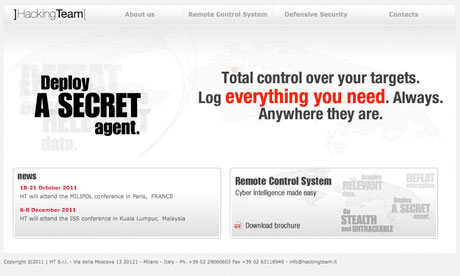
Italy’s Hacking Team offers ‘an offensive solution for cyber investigations’
In a luxury Washington, DC, hotel last month, governments from around the world gathered to discuss surveillance technology they would rather you did not know about. The annual Intelligence Support Systems (ISS) World Americas conference is a mecca for representatives from intelligence agencies and law enforcement. But to the media or members of the public, it is strictly off limits.
Gone are the days when mere telephone wiretaps satisfied authorities’ intelligence needs. Behind the cloak of secrecy at the ISS World conference, tips are shared about the latest advanced “lawful interception” methods used to spy on citizens – computer hacking, covert bugging and GPS tracking. Smartphones, email, instant message services and free chat services such as Skype have revolutionised communication. This has been matched by the development of increasingly sophisticated surveillance technology. (more…)