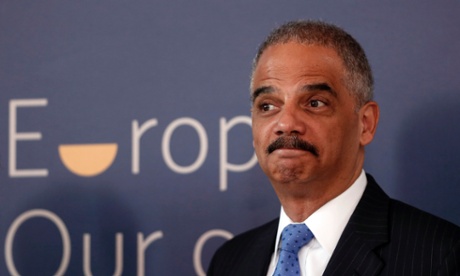
The telling sentence in NPR’s report that US attorney general Eric Holder plans to step down once a successor is confirmed came near the end of the story.
“Friends and former colleagues say Holder has made no decisions about his next professional perch,” NPR writes, “but they say it would be no surprise if he returned to the law firm Covington & Burling, where he spent years representing corporate clients.”
A large chunk of Covington & Burling’s corporate clients are mega-banks like JP Morgan Chase, Wells Fargo, Citigroup and Bank of America. Lanny Breuer, who ran the criminal division for Holder’s Justice Department, already returned to work there.
In March, Covington highlighted in marketing materials their award from the trade publication American Lawyer as “Litigation Department of the Year,” touting the law firm’s work in getting clients accused of financial fraud off with slap-on-the-wrist fines.
Covington, American Lawyer says, helps clients “get the best deal they can.”
Holder has a mixed legacy: excellent on civil and voting rights, bad on press freedom and transparency.
But if you want to understand what he did for the perpetrators of a cascade of financial fraud that blew up the nation’s economy in 2008, you only have to read that line from his former employer: he helped them “get the best deal they can.”
As for homeowners, they received a raw deal, in the form of little or no compensation for some of the greatest consumer abuses in American history.
Before Holder became Attorney General, banks fueled the housing bubble with predatory and at times, allegedly fraudulent practices.
As far back as 2004, the FBI warned of an “epidemic” of mortgage fraud, which they said would have “as much impact as the Savings & Loan crisis.”
They were wrong; it was worse.
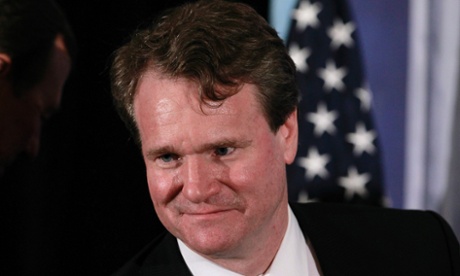
Brian T Moynihan, chief executive officer of Bank of America Corp, one of the banks accused of extensive mortgage abuses. Very little of the money from its settlements has gone to help homeowners.Photograph: Bloomberg via Getty Images
And banks and lenders carried through that fraud to every level of the mortgage process. They committed origination fraud through faulty appraisals and undisclosed trickery.
They committed servicing fraud through illegal fees and unnecessary foreclosures.
They committed securities fraud by failing to inform investors of the poor underwriting on loans they packaged into securities.
They committed mass document fraud when they failed to follow the steps to create mortgage-backed securities, covering up with fabrications and forgeries to prove the standing to foreclose.
By the time the bubble collapsed, the recession hit and Holder took over the Justice Department, Wall Street was a target-rich environment for any federal prosecutor. Physical evidence to an untold number of crimes was available in court filings and county recording offices.
Financial audits revealed large lapses in underwriting standards as early as 2005. Provisions in the Sarbanes-Oxley Act, passed during the last set of financial scandals in 2002, could hold chief executives criminally responsible for misrepresenting their risk management controls to regulators.
Any prosecutor worth his salt could have gone up the chain of command and implicated top banking executives.
In 2009, Congress passed the Fraud Enforcement and Recovery Act, giving $165m to the Justice Department to staff the investigations necessary to bring those accountable for the financial crisis to justice.
Yet, despite the Justice Department’s claims to the contrary, not one major executive has been sent to jail for their role in the crisis.
The department has put real housewives in jail for mortgage fraud, but not real bankers, saving their firepower for people who manage to defraud banks, not for banks who manage to defraud people.
Most of the “investigations” of financial institutions over the past six years have swiftly moved to cash settlements, often without holding anyone responsible for admitting wrongdoing or providing a detailed description of what they did wrong.
The headline prices of these settlements usually bore no resemblance to the reality of what they cost the banks.
The National Mortgage Settlement, for example, was touted by Holder’s Justice Department as a $25bn deal. In reality, banks were able to pay one-quarter of that penalty with other people’s money, lowering principal balances on loans they didn’t even own.
Other penalties featured similarly inflated numbers that didn’t reflect the true cost. Banks could satisfy their obligations under the settlements through routine business practices (including some, like making loans to low-income homeowners, that make them money).
A recent series of securities fraud settlements with JP Morgan, Bank of America and Citigroup, which DoJ said cost the banks $36.65bn, actually cost them about $11.5bn. And shareholders, not executives, truly bear that cost.
Incidentally, the Wall Street Journal found last week that the Justice Department only collects around 25% of the fines they impose. So the banks may have gotten off even easier.
The Justice Department has reportedly collected only 25% of the fines it has imposed on banks.Photograph: Petros Giannakouris/AP
These settlements have actually perverted the notion of justice, turning accountability into a public relations vehicle. And Holder’s Justice Department has been guilty of cooking the books: they admitted last August to overstating the number of criminal financial fraud charges by over 80%.
The DoJ’s Inspector General criticized this in a March report, and also found that DoJ de-prioritized mortgage fraud, making it the“lowest-ranked criminal threat” from 2009-2011.
As for homeowners, the biggest victims of Wall Street misconduct, they received little relief. Victims who already lost their homes got checks in the National Mortgage Settlement for between $1,500-$2,000, compensating people wrongly foreclosed upon with barely enough money for two month’s rent.
Despite claims that 1m borrowers still in their homes would get principal reductions under the settlement, when the final numbers came in this March, just 83,000 families received such a benefit, an under-delivery of over 90%.
Considering that over five million families experienced foreclosures since the end of the crisis, that relief is a drop in the bucket.
For those still eligible for relief, thanks to the expiration of a law called the Mortgage Forgiveness Debt Relief Act, any principal forgiveness will count as earned income for tax purposes, meaning that homeowners struggling to avoid foreclosure will subsequently get hit with a tax bill they cannot afford.
The Justice Department only recognized this belatedly, creating a fund in a recent Bank of America settlement to “partially” defray tax costs.
For others without that benefit, the help the Justice Department provided will look more like harm.
More important, the settlements didn’t end the misconduct.
Homeowners today continue to lose their homes based on false documents. Because the Justice Department just put a band-aid over the fraud, and didn’t convict any of the ringleaders, the problems went unaddressed, and the root causes never got fixed.
In fact, the entire banking sector’s get-out-of-jail free card gives them confidence that they could commit the same crimes again, with little if any legal implications.
The decision to protect banks instead of homeowners should be laid at the feet of the president and his administration, not one man in the Justice Department. But Holder certainly carried out the policy, even if he didn’t devise it.
We’ll soon find out if Holder merely presided over DoJ in a pause between helping corporate clients at Covington & Burling. But the failure to prosecute during his time in office certainly makes it look like Holder’s sympathies were with those clients even while serving as attorney general.
Even the mightiest have their come-uppance when their internal logic spews out destructiveness returning on the self—“blowback” in a way perhaps not seen before. I refer to James Risen’s extraordinary article in the New York Times, “Before Shooting in Iraq, a Warning on Blackwater,” (June 30), in which the customary meaning of “blowback” refers to policies, e.g., the invasions of Iraq and Afghanistan, the confrontation with Russia over Ukraine, the “pivot” of military power to the Pacific intent on the encirclement, containment, isolation of China, produce unintended, or if intended, still unwelcome, consequences for the initiator of the policy or action.
Thus: Iraq, out-of-control (from the US standpoint, a raging civil war negating massive intervention and alerting the world to America’s hegemonic purposes); Afghanistan, original support of the Taliban against the Soviet Union, resulting in their material strengthening now turned against the US, endangering its power-position in the region; use of Ukraine as a basis for bringing NATO forces to the Russian border, now an overreach which may disrupt the EU and weaken US dominance over it; and blatant confrontation with China, both military and trade, with potential for war leading to nuclear annihilation. The status and role of world policeman is losing its blackjack, its reputation as global bully being challenged through the rise of multiple power-centers and industrial-commercial-financial patterns no longer defined, supervised, indeed controlled, by American global interests and military implementation.
That is blowback in its familiar guise. Less so, the self-chosen instruments of repression spilling out of behemoth’s mouth because America’s dependence on repression to secure its aims makes it dependent as well on the executors of repression, in this case, given the extreme stress on privatization (the core of the monster’s functional existence), Blackwater at your service, a private army on hire to USG for pursuit of the dirty work, deemed necessary, yet, delegated to official forces, the cause of embarrassment and shame. Browbeating indigenous populations, with an overwhelming swagger and display in the grand tradition of conquerors, in addition to protecting representatives of the conquerors, is a mission worthy, as here, of billion dollar contracts to the private militias (euphemism: “security guards”) as insurance the military victory and occupation will hold.
Here Blackwater is, and is treated as, inseparable from the intervention (read: conquest) itself, at times assisting in the fighting on an informal basis—it has not yet been invited to join NATO(!)—but more to the point, the intimidating presence in the post-military phase, as though instilling the message: You Iraqis think the military is bad, well don’t mess around, for far worse awaits you, we former Navy SEALS know nothing can touch us. Our motto might as well be, A Law Unto Ourselves, even USG—beyond the status-of-forces agreement it forced your government to sign—afraid of us. Blowback: the cancer in the bowels of behemoth rapidly spreading to the extremities, spinal column, brain. Soon we shall all be made over in the image of Blackwater, or rather, as Blackwater would like to see, as its actions show, America become, a nation subservient to its thugs, extolling martial glory for its own sake and for the sake of global dominance. Authoritarianism once off the ground knows no limits and demands the complete adherence of its subjects. America has lived with CIA for decades; Blackwater is icing on the cake.
***
Before turning to the evidence contained in James Risen’s article, it is important to see how events from the past are converging on the present. His credentials as a whistleblower are borne out by his previous record (exposure of CIA dirty tricks, in his book State of War, with respect to Iran’s nuclear program) and current circumstances (he faces a possible jail sentence for refusing to disclose, from that account, the identity of an anonymous source). In the Bush doghouse for exposing the use of warrantless wire taps in 2005, and now, Obama contemplating more serious action, jail time for not complying with a DOJ subpoena, possibly leading to an Espionage Act prosecution, for which Obama excels over all of his predecessors combined (liberals, of course, furiously denying the sordid record), Risen not only stares down his persecutors, Obama, Holder, DOJ, but here presents an exposure in some ways more damning of US baseness from the top down, nurturing a murderous nest in the structure of government.
As for the administration hounding, Jonathan Mahler’s New York Times article, “Reporter’s Case Poses Dilemma for Justice Dept.,” (June 27), implies that Risen’s refusal to be intimidated is causing Obama and Holder second thoughts about pushing for his imprisonment. According to John Rizzo, CIA’s acting general counsel, Bush people wanted State of War kept off the market—too late, however. Risen then was subpoenaed to testify against the suspected leaker—and refused. “More than six years of legal wrangling,” in what Mahler terms “the most serious confrontation between the government and the press in recent history,” is coming to a head. Risen “is now out of challenges. Early this month, the Supreme Court declined to review his case, a decision that allows prosecutors to compel his testimony.”
But The Times, in defending its own man, cannot strongly protest, lest it antagonize the White House. Yes, Obama appears to be in a bind: “Though the court’s decision looked like a major victory for the government, it has forced the Obama administration to confront a hard choice. Should it demand Mr. Risen’s testimony and be responsible for a reporter’s being sent to jail? Or reverse course and stand down, losing credibility with an intelligence community that has pushed for the aggressive prosecution of leaks?” If Obama and USG were truly democratic (small “d”), there should not be a choice but only one course of action, moreover reigning in the “intelligence community” serving under their control.
The reporter, I believe reflecting the paper’s view, however, credits the Obama administration with actually weighing alternatives and being capable of making moral choices: “The dilemma comes at a critical moment for an administration that has struggled to find a balance between aggressively enforcing laws against leaking and demonstrating concern for civil liberties and government transparency.” What balance? What concern? Everything points the other way, on both civil liberties (e.g., due process and habeas corpus rights for detainees) and government transparency (simply, a thick protective shield in place, symbolized by the high art of redaction—and, as with Blackwater’s killing sprees, the refusal or half-heartedness about prosecution). Its reporter’s back against the wall, NYT ignores the Espionage Act prosecutions of whistleblowers.
Mahler succinctly describes the reporting: “The failed C.I.A. action at the heart of Mr. Risen’s reporting was intended to sabotage Iran’s nuclear weapons program. Intelligence officials assigned a former Russian scientist who had defected to the United States to deliver a set of faulty blueprints for a nuclear device to an Iranian scientist. But the Russian scientist became nervous and informed the Iranians that the plans were flawed.” One readily appreciates the dangers to the National Security State, especially revelations of the stupidity and dangerousness of its crown jewel, CIA, posed by investigative journalism. The Times, to its everlasting shame, bowed to Coldoleezza Rice’s request to withhold publication of the article. As a Times spokesperson later declared, “We weighed the government’s concerns and the usual editorial considerations and decided not to run the story.” Hence, James Risen—enemy of National Security; he “broke the story” later in State of War. Yet Bush is not the only culprit in this story; Obama ordered two additional subpoenas to force Risen to testify, his DOJ going after him hammer-and-tongs: “After a trial court largely quashed his third subpoena [the first under Bush] in late 2010, the Justice Department successfully challenged the ruling in a federal appeals court, arguing that the First Amendment does not afford any special protections to journalists.” Enough said about the dedication to civil liberties and freedom of the press: “The administration then urged the Supreme Court not to review Mr. Risen’s case.”
***
I have already discussed the mass killings in Nisour Square, Baghdad, in a previous article. Now we learn that this was part of a pattern in Blackwater’s behavior—again, Risen’s reporting. Even for one who is a seasoned critic, it is painful for me to write about. Organized thuggery knows no limits particularly when working for the highest authority, immunity from punishment worn as a badge of honor, as meanwhile government officials hide their eyes. Risen writes, “Just weeks before Blackwater guards fatally shot 17 civilians in Baghdad’s Nisour Square in 2007, the State Department began investigating the security contractor’s operations in Iraq. But the inquiry was abandoned after Blackwater’s top manager there issued a threat: ‘that he could kill’ the government’s chief investigator and ‘no one could or would do anything about it as we were in Iraq,’ according to department reports.” A private contractor threatens the life of a State Department investigator! No reprisal, punishment, cancellation of the contract, not even disclosure of the threat—yet Blackwater still in place years later, as part of the silence on atrocities in the Obama-Hillary era.
Those 17 killed are on America’s hands, bloody hands. There was a clear warning about what to expect: “After returning to Washington, the chief investigator wrote a scathing report to State Department officials documenting misconduct by Blackwater employees and warning that lax oversight of the company, which had a contract worth more than $1 billion to protect American diplomats, had created ‘an environment full of liability and negligence.’” Even more outrageous, Risen notes, the investigators become the criminals gumming up the security works: “American Embassy officials in Baghdad sided with Blackwater rather than the State Department investigators as a dispute over the probe escalated in August 2007, the previously undisclosed documents show. The officials told the investigators that they had disrupted the embassy’s relationship with the security contractor and ordered them to leave the country, according to the reports.”
Jean Richter, lead investigator, wrote, in a memo to the State Department only weeks prior to Nisour Square: “’The management structures in place to manage and monitor our contracts in Iraq have become subservient to the contractors themselves. Blackwater contractors saw themselves as above the law…. ‘hands off’ [management meant that] the contractors, instead of Department officials, are in command and in control.’” Now, nearly seven years later, four Blackwater guards are on trial, facing, if ever convicted, watered down charges, this being “ the government’s second attempt to prosecute the case in an American court [I wonder how serious the effort under Holder and Obama] after previous charges against five guards were dismissed in 2009.” Much of the time this is on Obama’s watch, yet, “despite a series of investigations in the wake of Nisour Square, the back story of what happened with Blackwater and the embassy in Baghdad before the fateful shooting has never been fully told.”
So much for transparency, civil liberties, and prosecuting the crimes of a predecessor (the cardinal rule of presidents, at least this one, cover-up WAR CRIMES past and present, a solemn command of the National Security State). Silence and deniability, in all matters large and small, characterize the responses of USG and private principals: “The State Department declined to comment on the aborted investigation. A spokesman for Erik Prince, the founder and former chief executive of Blackwater, who sold the company in2010, said Mr. Prince had never been told about the matter.” The $1B contract itself testifies to the fusion of patriotism, secrecy, repression, and yes, corporate profit: “After Mr. Prince sold the company, the new owners named it Academi. In early June, it merged with Triple Canopy, one of its rivals for government and commercial contracts to provide private security. The new firm is called Constellis Holdings.” Like war, private security stands to make a killing (pardon the pun), no doubt in flight from the original name for damage-control and public-relations purposes.
Previous to Nisour Square (Sept. 16, 2007) Blackwater guards “acquired a reputation…for swagger and recklessness,” but complaints “about practices ranging from running cars off the road to shooting wildly in the streets and even killing civilians typically did not result in serious action by the United States or the Iraqi government.” After firing in the Square, there was closer scrutiny, the Blackwater claim that they were fired on even US military officials denied, and “[f]ederal prosecutors later said Blackwater personnel had shot indiscriminately with automatic weapons, heavy machine guns and grenade launchers.” To no avail, given the symbiotic relationship between the company and the government. In fact, Blackwater had itself been run by Prince as a nation in microcosm, its people shortly before Nisour Square gathered by him at company headquarters in Moyock, North Carolina and made to “swear an oath of allegiance” like the one required of enlistees in the US military. They were handed copies of the oath, which, after reciting the words, were told to sign.
The State Department investigation into Blackwater in Iraq, which began Aug. 1, 2007 and was slated for one month, led early to the “volatile” situation (including the death threat), our knowledge coming from “internal State Department documents” furnished “to plaintiffs in a lawsuit against Blackwater that was unrelated to the Nisour Square shootings,” seemingly by accident then and fleshed out by Risen. In that month—or that part of it before being forced to leave– the investigators discovered “a long list of contract violations by Blackwater,” staffing changes of security details “without State Department approval,” reducing the number of guards on details, “storing automatic weapons and ammunition in their private rooms, where they were drinking heavily and partying with frequent female visitors,” and, for many, failing “to regularly qualify on their weapons” or “carrying weapons on which they had never been certified” nor “authorized to use.” Extravagance for mayhem abroad, less than peanuts for critical needs at home, education, health care, employment, beyond the means or reach of Imperial grandeur as the national obsession.
In addition to “overbilling the State Department by manipulating its personnel records, using guards assigned to the State Department contract for other work and falsifying other staffing data on the contract,” (no wonder the investigators’ poor reception by Blackwater’s resident head in Iraq), one of its affiliates forced “third country nationals” who did the dirty work at low wages “to live in squalid conditions, sometimes three to a cramped room with no bed,” according to the investigators’ report. Their conclusion: “Blackwater was getting away with such conduct because embassy personnel had gotten too close to the contractor.”
Ah, the denouement; we have a name to go with the face of the project manager who threatened Richter’s life, Daniel Carroll, who said he could kill him without anything happening to himself “as we were in Iraq” (this was witnessed by Donald Thomas, the other investigator), and Richter, in his memo to the Department stated: “I took Mr. Carroll’s threat seriously. We were in a combat zone where things can happen unexpectedly, especially when issues involve potentially negative impacts on a lucrative security contract.” Nicely put, and corroborated by Thomas, who wrote in a separate memo that “others in Baghdad had told the two investigators to be ‘very careful,’ considering that their review could jeopardize job security for Blackwater personnel.” The wonder perhaps is that Richter and Thomas were not prosecuted under the Espionage Act for spoiling the show. It didn’t matter. No one at State listened.
The two men were ordered to leave (Aug 23), and “cut short their inquiry and returned to Washington the next day.” Finally, on Oct. 5, after the Nisour Square scandal, State Department officials responded to Richter’s “August warning,” and took statements from him and Thomas about “their accusations of a threat by Mr. Carroll, but took no further action.” A special panel convened by Rice on Nisour Square “never interviewed Mr. Richter or Mr. Thomas.” The official who led the panel “told reporters on Oct. 23, 2007, that the panel had not found any communications from the embassy in Baghdad before the Nisour Square shooting that raised concerns about contractor conduct.” Voila, vanished in thin air. This State Department officer deserves the last word: “We interviewed a large number of individuals. We did not find any, I think, significant pattern of incidents that had not—that the embassy had suppressed in any way.” And my last word: fascism. Beyond all structural-cultural-societal considerations about wealth-concentration, industrial-financial consolidation, foreign expansion through preponderant power and the spirit of militarism, the rampaging privatization with government consent witnessed here, which has wreaked havoc on another people, only to be covered over by the state, aka, the National Security State, disregarding its Constitutional protections to the individual, as in sponsoring massive surveillance, is enough for me to satisfy the working definition of that single word.
via Norman Pollack has written on Populism. His interests are social theory and the structural analysis of capitalism and fascism. He can be reached at [email protected].
The Blaze A high-ranking Mexican drug cartel operative currently in U.S. custody is making startling allegations that the failed federal gun-walking operation known as “Fast and Furious” isn’t what you think it is.
It wasn’t about tracking guns, it was about supplying them — all part of an elaborate agreement between the U.S. government and Mexico’s powerful Sinaloa Cartel to take down rival cartels.
The explosive allegations are being made by Jesus Vicente Zambada-Niebla, known as the Sinaloa Cartel’s “logistics coordinator.” He was extradited to the Chicago last year to face federal drug charges.
Zambada-Niebla claims that under a “divide and conquer” strategy, the U.S. helped finance and arm the Sinaloa Cartel through Operation Fast and Furious in exchange for information that allowed the DEA, U.S. Immigration and Customs Enforcement (ICE) and other federal agencies to take down rival drug cartels. The Sinaloa Cartel was allegedly permitted to traffic massive amounts of drugs across the U.S. border from 2004 to 2009 — during both Fast and Furious and Bush-era gunrunning operations — as long as the intel kept coming.
This pending court case against Zambada-Niebla is being closely monitored by some members of Congress, who expect potential legal ramifications if any of his claims are substantiated. The trial was delayed but is now scheduled to begin on Oct. 9.
Zambada-Niebla is reportedly a close associate of Sinaloa Cartel kingpin Joaquin “El Chapo” Guzman and the son of Ismael “Mayo” Zambada-Garcia, both of which remain fugitives, likely because of the deal made with the DEA, federal court documents allege.
Based on the alleged agreement ”the Sinaloa Cartel under the leadership of defendant’s father, Ismael Zambada-Niebla and ‘Chapo’ Guzman, were given carte blanche to continue to smuggle tons of illicit drugs into Chicago and the rest of the United States and were also protected by the United States government from arrest and prosecution in return for providing information against rival cartels which helped Mexican and United States authorities capture or kill thousands of rival cartel members,” states a motion for discovery filed in U.S. District Court by Zambada-Niebla’s attorney in July 2011.
A source in Congress, who spoke to TheBlaze on the condition of anonymity, said that some top congressional investigators have been keeping “one eye on the case.” Another two members of Congress, both lead Fast and Furious Congressional investigators, told TheBlaze they had never even heard of the case.
One of the Congressmen, who also spoke to TheBlaze on the condition of anonymity because criminal proceedings are still ongoing, called the allegations “disturbing.” He said Congress will likely get involved once Zambada-Niebla’s trial has concluded if any compelling information surfaces.
“Congress won’t get involved in really any criminal case until the trial is over and the smoke has cleared,” he added. “If the allegations prove to hold any truth, there will be some serious legal ramifications.”
Earlier this month, two men in Texas were sentenced to 70 and 80 months in prison after pleading guilty to attempting to export 147 assault rifles and thousands of rounds of ammunition to Mexico’s Los Zetas cartel. Compare that to the roughly 2,000 firearms reportedly “walked” in Fast and Furious, which were used in the murders of hundreds of Mexican citizens and U.S. Border Agent Brian Terry, and some U.S. officials could potentially face jail time if they knowingly armed the Sinaloa Cartel and allowed guns to cross into Mexico.
If proven in court, such an agreement between U.S. law enforcement agencies and a Mexican cartel could potentially mar both the Bush and Obama administrations. The federal government is denying all of Zambada-Niebla’s allegations and contend that no official immunity deal was agreed upon.
To be sure, Zambada-Niebla is a member of one of the most ruthless drug gangs in all of Mexico, so there is a chance that he is saying whatever it takes to reduce his sentence, which will likely be hefty. However, Congress and the media have a duty to prove without a reasonable doubt that there is no truth in his allegations. So far, that has not been achieved.
Zambada-Niebla was reportedly responsible for coordinating all of the Sinaloa Cartel’s multi-ton drug shipments from Central and South American countries, through Mexico, and into the United States. To accomplish this, he used every tool at his disposal: Boeing 747 cargo planes, narco-submarines, container ships, speed boats, fishing vessels, buses, rail cars, tractor trailers and automobiles. But Guzman and Zambada-Niebla’s overwhelming success within the Sinaloa Cartel was largely due to the arrests and dismantling of many of their competitors and their booming businesses in the U.S. from 2004 to 2009 — around the same time ATF’s gun-walking operations were in full swing. Fast and Furious reportedly began in 2009 and continued into early 2011.
According Zambada-Niebla, that was a product of the collusion between the U.S. government and the Sinaloa Cartel.
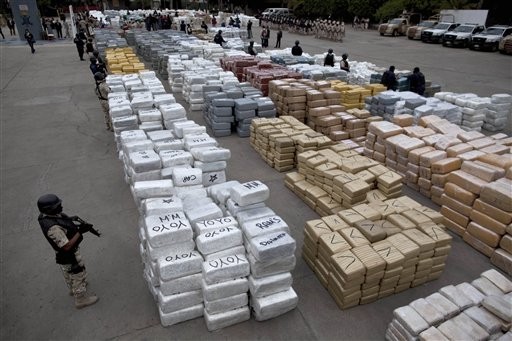
Soldiers and police officers guard packages of seized marijuana during a presentation for the media in Tijuana, Mexico. (AP Photo/Guillermo Arias)
The claims seem to fall in line with statements made last month by Guillermo Terrazas Villanueva, a spokesman for the Chihuahua state government in northern Mexico who said U.S. agencies ”don’t fight drug traffickers,“ instead ”they try to manage the drug trade.”
Also, U.S. officials have previously acknowledged working with the Sinaloa Cartel through another informant, Humberto Loya-Castro. He is also allegedly a high-ranking member of the Sinaloa Cartel as well as a close confidant and lawyer of “El Chapo” Guzman.
Loya-Castro was indicted along with Chapo and Mayo in 1995 in the Southern District of California in a massive narcotics trafficking conspiracy (Case no. 95CR0973). The case was dismissed in 2008 at the request of prosecutors after Loya became an informant for the United States government and subsequently provided information for years.
In 2005, “the CS (informant Loya-Castro) signed a cooperation agreement with the United States Attorney’s Office for the Southern District of California,” states an affidavit filed in the Zambada-Niebla case by Loya-Castro’s handler, DEA agent Manuel Castanon.
“Thereafter, I began to work with the CS. Over the years, the CS’ cooperation resulted in the seizure of several significant loads of narcotics and precursor chemicals. The CS’ cooperation also resulted in other real-time intelligence that was very useful to the United States government.”
Under the alleged agreement with U.S. agencies, “the Sinaloa Cartel, through Loya-Castro, was to provide information accumulated by Mayo, Chapo, and others, against rival Mexican Drug Trafficking Organizations to the United States government,” a motion for discovery states.
In return, the United States government allegedly agreed to dismiss the charges in the pending case against Loya-Castro (which they did), not to interfere with his drug trafficking activities and those of the Sinaloa Cartel and not actively prosecute him or the Sinaloa Cartel leadership.
“This strategy, which he calls ‘Divide & Conquer,’ using one drug organization to help against others, is exactly what the Justice Department and its various agencies have implemented in Mexico. In this case, they entered into an agreement with the leadership of the Sinaloa Cartel through, among others, Humberto Loya-Castro, to receive their help in the United States government’s efforts to destroy other cartels.”
“Indeed, United States government agents aided the leaders of the Sinaloa Cartel.”
The government has denied this and says the deal did not go past Loya-Castro.
Zambada-Niebla was arrested by Mexican soldiers in late March of 2009 after he met with DEA agents at a Mexico City hotel in a meeting arranged by Loya-Castro, though the U.S. government was not involved in his arrest. He was extradited to Chicago to face federal drug charges on Feb. 18, 2010. He is now being held in a Michigan prison after requesting to be moved from Chicago.
“Classified Materials”
During his initial court proceedings, Zambada-Niebla continually stated that he was granted full immunity by the DEA in exchange for his cooperation. The agency, however, argues that an “official” immunity deal was never established though they admit he may have acted as an informant.
Zambada-Niebla and his legal council also requested records about Operation Fast and Furious, which permitted weapons purchased in the United States to be illegally smuggled into Mexico, sometimes by paid U.S. informants and cartel leaders. Their request was denied. From the defense motion:
“It is estimated that approximately 3,000 people were killed in Mexico as a result of ‘Operation Fast and Furious,’ including law enforcement officers in the state of Sinaloa, Mexico, the headquarters of the Sinaloa cartel. The Department of Justice’s leadership apparently saw this as an ingenious way of combating drug cartel activities.”
“It has recently been disclosed that in addition to the above-referenced problems with ‘Operation Fast & Furious,’ the DOJ, DEA, and the FBI knew that some of the people who were receiving the weapons that were being allowed to be transported to Mexico, were in fact informants working for those organizations and included some of the leaders of the cartels.”
Zambada’s attorney has filed several motions for discovery to that effect in Illinois Federal District Court, which were summarily denied by the presiding judge who claimed the defendant failed to make the case that he was actually a DEA informant.
In April, 2012, a federal judge refused to dismiss charges against him.
From a Chicago Sun Times report: “According to the government, [Zambada-Niebla] conveyed his interest and willingness to cooperate with the U.S. government, but the DEA agents told him they ‘were not authorized to meet with him, much less have substantive discussions with him,’” the judge wrote.
In this courtroom artist’s drawing Jesus Vincente Zambada-Niebla appears before U.S. District Judge Ruben Castillo Tuesday, Feb. 23, 2010, in Chicago. (AP Photo/Verna Sadock)
In their official response to Zambada-Niebla’s motion for discovery, the federal government confirmed the existence of “classified materials” regarding the case but argued they “do not support the defendant’s claim that he was promised immunity or public authority for his actions.”
Experts have expressed doubts that Zambada-Niebla had an official agreement with the U.S. government, however, agree Loya Castro probably did. Either way, the defense still wants to obtain DEA reports that detail the agency’s relationship with the Sinaloa Cartel and put the agents on the stand, under oath to testify.
The documents that detail the relationship between the federal government and the Sinaloa Cartel have still not been released or subjected to review — citing matters of national security.
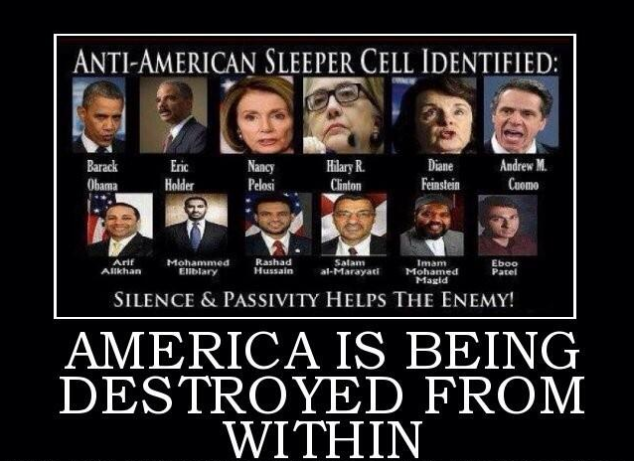
We’re being destroyed from within by a socialistic bureaucracy who’s overriding goal is its own survival at the cost of National Security, which as the historian Thomas Cahill asserts was one of the major reasons for the fall of the Roman Empire.

 The telling sentence in NPR’s report that US attorney general Eric Holder plans to step down once a successor is confirmed came near the end of the story.