Oct 29, 2012 | Ancient & Lost History

One of the oldest Maya tombs ever found has been uncovered in western Guatemala, say archaeologists.
Located at a temple site in Retalhuleu province, the grave is thought to be that of an ancient ruler or religious leader who lived some 2,000 years ago.
Carbon-dating indicated the tomb had been built between 700 and 400 BC, said government archaeologist Miguel Orrego.
A rich array of jade jewels, including a necklace depicting a vulture-headed human figure, were found.
The scientists found no bones at the tomb in the Tak’alik Ab’aj site – some 180km (110 miles) south of Guatemala City – probably because they had disintegrated.
But the vulture-headed figure appears to identify the tomb’s occupant as an ajaw – or ruler – because the symbol represented power and economic status and was given to respected elder men.
Big chief
The scientists named the grave’s occupant K’utz Chman, which in the Mayan language, Mam, means Grandfather Vulture.
“He was a big chief”, said Mr Orrego. “He bridged the gap between the Olmec and Mayan cultures in central America.”
The leader may have been the first to introduce elements which later became characteristic of the Maya culture, such as the building of pyramids and the carving of sculptures depicting the royal families, Reuters news agency cited historians as saying.
The Olmec empire began to fade at around 400 BC, while the Maya civilisation was starting to grow and develop, said Christa Schieber, another archaeologist working at the site.
The Mayas went on to rule much of Central America from 250 to 800 AD; their empire extended from modern-day Honduras to central Mexico.
via BBCNews
Oct 10, 2012 | Ancient & Lost History, News

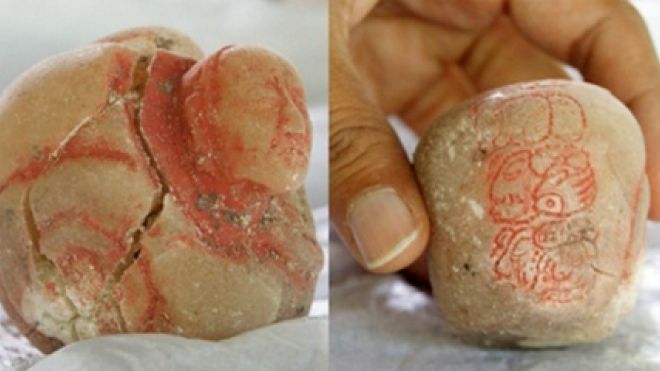
The carved alabaster vessel (shown from two sides) found in the burial chamber caused the archaeologists to conclude the tomb was that of Lady K’abel. (El Peru Waka Regional Archaeological Project)
Archaeologists say they’ve discovered what could be the tomb of one of the greatest Mayan rulers, the seventh-century warrior queen Lady K’abel.
The tomb was revealed during digging at the ancient Maya city of El Perú-Waka’ in the rain forest of northern Guatemala. Alongside the body, excavators found a white jar shaped like a conch shell with the head and arm of a woman carved at the opening. The artifact had four hieroglyphs that suggest it belonged to K’abel.
“Nothing is ever proven in archaeology because we’re working with circumstantial evidence. But in our case we have a carved stone alabaster jar that is named K’abel’s possession,” David Freidel, an archaeologist working on the site, explained in a video. Freidel, of Washington University in St. Louis, said the find is “as close to a smoking gun” as you get in archaeology.
The plazas, palaces, temple pyramids and residences of El Perú-Waka’ belong to the Classic Maya civilization (A.D. 200-900). K’abel was part of a royal family and carried the title “Kaloomte’,” which translates to “Supreme Warrior,” meaning she had even higher in authority than her king husband, K’inich Bahlam, according to Freidel and his excavation team. She was the military governor of the Wak kingdom for her family, the imperial house of the Snake King.
K’abel is believed to have reigned with her husband from about A.D. 672-692. [Top 12 Warrior Moms in History]
Ceramic vessels found in the burial chamber and carvings on a stela (stone slab) outside of it also indicate the tomb belongs to K’abel, as does a large red spiny oyster shell found on the lower torso of the remains, the researchers said.
“Late Classic queens at Waka’, including K’abel, regularly wore such a shell as a girdle ornament in their stela portraits while kings did not,” the researchers wrote in a report on the finds.
An examination of the remains indicated the buried person was a “mature individual,” the researchers wrote. But the bones were too deteriorated for scientists to determine whether they belonged to a male or female.
Excavations have been underway at El Perú-Waka’ since 2003. The K’abel find has not yet appeared in a peer-reviewed scientific journal.
