The Chicago police department operates an off-the-books interrogation compound, rendering Americans unable to be found by family or attorneys while locked inside what lawyers say is the domestic equivalent of a CIA black site.
The facility, a nondescript warehouse on Chicago’s west side known as Homan Square, has long been the scene of secretive work by special police units. Interviews with local attorneys and one protester who spent the better part of a day shackled in Homan Square describe operations that deny access to basic constitutional rights.
Alleged police practices at Homan Square, according to those familiar with the facility who spoke out to the Guardian after its investigation into Chicago police abuse, include:
Keeping arrestees out of official booking databases.
Beating by police, resulting in head wounds.
Shackling for prolonged periods.
Denying attorneys access to the “secure” facility.
Holding people without legal counsel for between 12 and 24 hours, including people as young as 15.
At least one man was found unresponsive in a Homan Square “interview room” and later pronounced dead.
Brian Jacob Church, a protester known as one of the “Nato Three”, was held and questioned at Homan Square in 2012 following a police raid. Officers restrained Church for the better part of a day, denying him access to an attorney, before sending him to a nearby police station to be booked and charged.
“Homan Square is definitely an unusual place,” Church told the Guardian on Friday. “It brings to mind the interrogation facilities they use in the Middle East. The CIA calls them black sites. It’s a domestic black site. When you go in, no one knows what’s happened to you.”
The secretive warehouse is the latest example of Chicago police practices that echo the much-criticized detention abuses of the US war on terrorism. While those abuses impacted people overseas, Homan Square – said to house military-style vehicles, interrogation cells and even a cage – trains its focus on Americans, most often poor, black and brown.
Unlike a precinct, no one taken to Homan Square is said to be booked. Witnesses, suspects or other Chicagoans who end up inside do not appear to have a public, searchable record entered into a database indicating where they are, as happens when someone is booked at a precinct. Lawyers and relatives insist there is no way of finding their whereabouts. Those lawyers who have attempted to gain access to Homan Square are most often turned away, even as their clients remain in custody inside.
“It’s sort of an open secret among attorneys that regularly make police station visits, this place – if you can’t find a client in the system, odds are they’re there,” said Chicago lawyer Julia Bartmes.
Chicago civil-rights attorney Flint Taylor said Homan Square represented a routinization of a notorious practice in local police work that violates the fifth and sixth amendments of the constitution.
“This Homan Square revelation seems to me to be an institutionalization of the practice that dates back more than 40 years,” Taylor said, “of violating a suspect or witness’ rights to a lawyer and not to be physically or otherwise coerced into giving a statement.”
Much remains hidden about Homan Square. The Chicago police department did not respond to the Guardian’s questions about the facility. But after the Guardian published this story, the department provided a statement insisting, without specifics, that there is nothing untoward taking place at what it called the “sensitive” location, home to undercover units.
“CPD [Chicago police department] abides by all laws, rules and guidelines pertaining to any interviews of suspects or witnesses, at Homan Square or any other CPD facility. If lawyers have a client detained at Homan Square, just like any other facility, they are allowed to speak to and visit them. It also houses CPD’s Evidence Recovered Property Section, where the public is able to claim inventoried property,” the statement said, something numerous attorneys and one Homan Square arrestee have denied.
“There are always records of anyone who is arrested by CPD, and this is not any different at Homan Square,” it continued.
The Chicago police statement did not address how long into an arrest or detention those records are generated or their availability to the public. A department spokesperson did not respond to a detailed request for clarification.
When a Guardian reporter arrived at the warehouse on Friday, a man at the gatehouse outside refused any entrance and would not answer questions. “This is a secure facility. You’re not even supposed to be standing here,” said the man, who refused to give his name.
A former Chicago police superintendent and a more recently retired detective, both of whom have been inside Homan Square in the last few years in a post-police capacity, said the police department did not operate out of the warehouse until the late 1990s.
But in detailing episodes involving their clients over the past several years, lawyers described mad scrambles that led to the closed doors of Homan Square, a place most had never heard of previously. The facility was even unknown to Rob Warden, the founder of Northwestern University Law School’s Center on Wrongful Convictions, until the Guardian informed him of the allegations of clients who vanish into inherently coercive police custody.
“They just disappear,” said Anthony Hill, a criminal defense attorney, “until they show up at a district for charging or are just released back out on the street.”
‘They were held incommunicado for much longer than I think should be permitted in this country – anywhere – but particularly given the strong constitutional rights afforded to people who are being charged with crimes,” said Sarah Gelsomino, the lawyer for Brian Jacob Church. Photograph: Phil Batta/Guardian
Jacob Church learned about Homan Square the hard way. On May 16 2012, he and 11 others were taken there after police infiltrated their protest against the Nato summit. Church says officers cuffed him to a bench for an estimated 17 hours, intermittently interrogating him without reading his Miranda rights to remain silent. It would take another three hours – and an unusual lawyer visit through a wire cage – before he was finally charged with terrorism-related offenses at the nearby 11th district station, where he was made to sign papers, fingerprinted and photographed.
In preparation for the Nato protest, Church, who is from Florida, had written a phone number for the National Lawyers Guild on his arm as a precautionary measure. Once taken to Homan Square, Church asked explicitly to call his lawyers, and said he was denied.
“Essentially, I wasn’t allowed to make any contact with anybody,” Church told the Guardian, in contradiction of a police guidance on permitting phone calls and legal counsel to arrestees.
Church’s left wrist was cuffed to a bar behind a bench in windowless cinderblock cell, with his ankles cuffed together. He remained in those restraints for about 17 hours.
“I had essentially figured, ‘All right, well, they disappeared us and so we’re probably never going to see the light of day again,’” Church said.
The Disappeared
Brian Church, Jared Chase and Brent Vincent Betterly, known as the ‘Nato Three’
Though the raid attracted major media attention, a team of attorneys could not find Church through 12 hours of “active searching”, Sarah Gelsomino, Church’s lawyer, recalled. No booking record existed. Only after she and others made a “major stink” with contacts in the offices of the corporation counsel and Mayor Rahm Emanuel did they even learn about Homan Square.
They sent another attorney to the facility, where he ultimately gained entry, and talked to Church through a floor-to-ceiling chain-link metal cage. Finally, hours later, police took Church and his two co-defendants to a nearby police station for booking.
After serving two and a half years in prison, Church is currently on parole after he and his co-defendants were found not guilty in 2014 of terrorism-related offenses but guilty of lesser charges of possessing an incendiary device and the misdemeanor of “mob action”.
It’s almost like they throw a black bag over your head and make you disappear for a day or two
-Brian Jacob Church
The access that Nato Three attorneys received to Homan Square was an exception to the rule, even if Jacob Church’s experience there was not.
Three attorneys interviewed by the Guardian report being personally turned away from Homan Square between 2009 and 2013 without being allowed access to their clients. Two more lawyers who hadn’t been physically denied described it as a place where police withheld information about their clients’ whereabouts. Church was the only person who had been detained at the facility who agreed to talk with the Guardian: their lawyers say others fear police retaliation.
One man in January 2013 had his name changed in the Chicago central bookings database and then taken to Homan Square without a record of his transfer being kept, according to Eliza Solowiej of Chicago’s First Defense Legal Aid. (The man, the Guardian understands, wishes to be anonymous; his current attorney declined to confirm Solowiej’s account.) She found out where he was after he was taken to the hospital with a head injury.
“He said that the officers caused his head injuries in an interrogation room at Homan Square. I had been looking for him for six to eight hours, and every department member I talked to said they had never heard of him,” Solowiej said. “He sent me a phone pic of his head injuries because I had seen him in a police station right before he was transferred to Homan Square without any.”
Bartmes, another Chicago attorney, said that in September 2013 she got a call from a mother worried that her 15-year-old son had been picked up by police before dawn. A sympathetic sergeant followed up with the mother to say her son was being questioned at Homan Square in connection to a shooting and would be released soon. When hours passed, Bartmes traveled to Homan Square, only to be refused entry for nearly an hour.
An officer told her, “Well, you can’t just stand here taking notes, this is a secure facility, there are undercover officers, and you’re making people very nervous,” Bartmes recalled. Told to leave, she said she would return in an hour if the boy was not released. He was home, and not charged, after “12, maybe 13” hours in custody.
On February 2, 2013, John Hubbard was taken to Homan Square. Hubbard never walked out. The Chicago Tribune reported that the 44-year old was found “unresponsive inside an interview room”, and pronounced dead. After publication, the Cook County medical examiner told the Guardian that the cause of death was determined to be heroin intoxication.
Homan Square is hardly concerned exclusively with terrorism. Several special units operate outside of it, including the anti-gang and anti-drug forces. If police “want money, guns, drugs”, or information on the flow of any of them onto Chicago’s streets, “they bring them there and use it as a place of interrogation off the books,” Hill said.
‘The real danger in allowing practices like Guantanamo or Abu Ghraib is the fact that they always creep into other aspects,’ criminologist Tracy Siska told the Guardian. Photograph: Chandler West/Guardian
A former Chicago detective and current private investigator, Bill Dorsch, said he had not heard of the police abuses described by Church and lawyers for other suspects who had been taken to Homan Square. He has been permitted access to the facility to visit one of its main features, an evidence locker for the police department. (“I just showed my retirement star and passed through,” Dorsch said.)
Transferring detainees through police custody to deny them access to legal counsel, would be “a career-ender,” Dorsch said. “To move just for the purpose of hiding them, I can’t see that happening,” he told the Guardian.
Richard Brzeczek, Chicago’s police superintendent from 1980 to 1983, who also said he had no first-hand knowledge of abuses at Homan Square, said it was “never justified” to deny access to attorneys.
“Homan Square should be on the same list as every other facility where you can call central booking and say: ‘Can you tell me if this person is in custody and where,’” Brzeczek said.
“If you’re going to be doing this, then you have to include Homan Square on the list of facilities that prisoners are taken into and a record made. It can’t be an exempt facility.”
Indeed, Chicago police guidelines appear to ban the sorts of practices Church and the lawyers said occur at Homan Square.
A directive titled “Processing Persons Under Department Control” instructs that “investigation or interrogation of an arrestee will not delay the booking process,” and arrestees must be allowed “a reasonable number of telephone calls” to attorneys swiftly “after their arrival at the first place of custody.” Another directive, “Arrestee and In-Custody Communications,” says police supervisors must “allow visitation by attorneys.”
Attorney Scott Finger said that the Chicago police tightened the latter directive in 2012 after quiet complaints from lawyers about their lack of access to Homan Square. Without those changes, Church’s attorneys might not have gained entry at all. But that tightening – about a week before Church’s arrest – did not prevent Church’s prolonged detention without a lawyer, nor the later cases where lawyers were unable to enter.
The combination of holding clients for long periods, while concealing their whereabouts and denying access to a lawyer, struck legal experts as a throwback to the worst excesses of Chicago police abuse, with a post-9/11 feel to it.
On a smaller scale, Homan Square is “analogous to the CIA’s black sites,” said Andrea Lyon, a former Chicago public defender and current dean of Valparaiso University Law School. When she practiced law in Chicago in the 1980s and 1990s, she said, “police used the term ‘shadow site’” to refer to the quasi-disappearances now in place at Homan Square.
I’ve never known any kind of organized, secret place where they go and hold somebody before booking for hours and hours
James Trainum, former detective, Washington DC
“Back when I first started working on torture cases and started representing criminal defendants in the early 1970s, my clients often told me they’d been taken from one police station to another before ending up at Area 2 where they were tortured,” said Taylor, the civil-rights lawyer most associated with pursuing the notoriously abusive Area 2 police commander Jon Burge. “And in that way the police prevent their family and lawyers from seeing them until they could coerce, through torture or other means, confessions from them.”
Police often have off-site facilities to have private conversations with their informants. But a retired Washington DC homicide detective, James Trainum, could not think of another circumstance nationwide where police held people incommunicado for extended periods.
“I’ve never known any kind of organized, secret place where they go and just hold somebody before booking for hours and hours and hours. That scares the hell out of me that that even exists or might exist,” said Trainum, who now studies national policing issues, to include interrogations, for the Innocence Project and the Constitution Project.
Regardless of departmental regulations, police frequently deny or elide access to lawyers even at regular police precincts, said Solowiej of First Defense Legal Aid. But she said the outright denial was exacerbated at Chicago’s secretive interrogation and holding facility: “It’s very, very rare for anyone to experience their constitutional rights in Chicago police custody, and even more so at Homan Square,” Solowiej said.
Church said that one of his more striking memories of Homan Square was the “big, big vehicles” police had inside the complex that “look like very large MRAPs that they use in the Middle East.”
Cook County, home of Chicago, has received some 1,700 pieces of military equipment from a much-criticized Pentagon program transferring military gear to local police. It includes a Humvee, according to a local ABC News report.
Tracy Siska, a criminologist and civil-rights activist with the Chicago Justice Project, said that Homan Square, as well as the unrelated case of ex-Guantánamo interrogator and retired Chicago detective Richard Zuley, showed the lines blurring between domestic law enforcement and overseas military operations.
“The real danger in allowing practices like Guantánamo or Abu Ghraib is the fact that they always creep into other aspects,” Siska said.
“They creep into domestic law enforcement, either with weaponry like with the militarization of police, or interrogation practices. That’s how we ended up with a black site in Chicago.”
Philip Schneider was born April 23, 1947 and died (many assume murdered) in January 1996. Now Philip Schneider claimed to be an ex-government geologist and structural engineer who was involved in building underground military bases around the United States (possessing a level 3 security clearance, “Rhyolite 38”).
Not only that, but Philip Schneider also claimed he was one of only three people to have survived a deadly battle in which 66 American and NATO “Delta Force” soldiers were killed. This battle allegedly occurred in 1979 between Grey aliens and U.S. military and NATO forces at an underground base at Dulce , New Mexico.
The following is taken from a letter from the ex-wife of Philip Schneider (Cynthia Drayer) after learning of his death.
“Philip’s background was as a Structural Engineer. He was an expert on explosives and their effects on geologic structures. He worked under two social security numbers. Most of his early work in underground mountain bases with Morrison-Knudsen was done using the wrong social security number.
I was later able to prove that he had two numbers through the social security office when I applied for his daughter’s death benefits.
He worked for the Army Corps of Engineers and U.S. Navy with the same wrong number. Only after he obtained SSI in 1981 did his “real” number come into play. He always told me that he had a Rhyolitic Clearance and that his father had a Cosmic Clearance from his work with NATO. And that is the second reason why Philip began lecturing.”
For the last two years of his life, Schneider gave over 30 lectures to a variety of audiences across the globe, concerning conspiracy theories in which he claimed to be leaking information exposing them. However, Schneider was never able or willing to prove his allegations (e.g. showing the entrance to Dulce Base). His claims received little mainstream notice, but caused quite a buzz in UFO enthusiast circles.
Schneider was found dead in his Wilsonville, Oregon apartment on January 17, 1996. He had apparently been dead for several days (perhaps up to a week), and reportedly had a rubber hose wrapped three times around his neck. Tim Swartz writes that “Clackamas County Coroner’s office initially attributed Philip Schneider’s death to a stroke or heart attack.” Some suggest Schneider was murdered; supposedly because he was leaking information to the public, unveiling conspiracies. He in fact claimed to have avoided 13 murder attempts taken on his life during the time in which he was lecturing on conspiracy theories. He suffered multiple physical illnesses (osteoporosis, cancer, injuries). Officially, suicide is now stated as the cause of death.
The medical examiner took blood and urine samples at the autopsy but refused to analyze them, saying that the county would not “waste their money on a suicide”. Although samples would be kept for 12 months, when asked for these samples to be sent to an independent lab 11 months later they were “missing” and presumed “destroyed”. Schneider had missing fingers on his left hand, and limited motion in his shoulders. It may have been physically impossible for him to have held the rubber hose in his left hand with missing fingers and then wrap the hose three times with shoulders that had limited motion. In order to end up where his body was, he had to sit on the edge of his bed, wrap the hose around his neck, slowly and painfully strangle to death, and fallen head first into a wheel chair. Philip was an expert in chemicals and his own medical needs. He had multiple pills at hand that could have ended his life quickly and painlessly. He also had a 9mm handgun that he had borrowed to protect himself.
Evidence exposing who put ISIS in power, and how it was done.
The Islamic militant group ISIS, formerly known as Al-Qaeda in Iraq, and recently rebranded as the so called Islamic State, is the stuff of nightmares. They are ruthless, fanatical, killers, on a mission, and that mission is to wipe out anyone and everyone, from any religion or belief system and to impose Shari’ah law. The mass executions, beheadings and even crucifixions that they are committing as they work towards this goal are flaunted like badges of pride, video taped and uploaded for the whole world to see. This is the new face of evil.
Would it interest you to know who helped these psychopaths rise to power? Would it interest you to know who armed them, funded them and trained them? Would it interest you to know why?
This story makes more sense if we start in the middle, so we’ll begin with the overthrow of Muammar Gaddafi in 2011.
The Libyan revolution was Obama’s first major foreign intervention. It was portrayed as an extension of the Arab Spring, and NATO involvement was framed in humanitarian terms.
These jihadist militants from Iraq were part of what national security analysts commonly referred to as Al-Qaeda in Iraq. Remember Al-Qaeda in Iraq was ISIS before it was rebranded.
With the assistance of U.S. and NATO intelligence and air support, the Libyan rebels captured Gaddafi and summarily executed him in the street, all the while enthusiastically chanting “Allah Akbar”. For many of those who had bought the official line about how these rebels were freedom fighters aiming to establish a liberal democracy in Libya, this was the beginning of the end of their illusions.
Now after Gaddafi was overthrown, the Libyan armories were looted, and massive quantities of weapons were sent by the Libyan rebels to Syria. The weapons, which included anti-tank and anti-aircraft missiles were smuggled into Syria through Turkey, a NATO ally. The times of Londonreported on the arrival of the shipment on September 14th, 2012. (Secondary confirmation in this NYT article) This was just three days after Ambassador Chris Stevens was killed by the attack on the U.S. embassy in Benghazi. Chris Stevens had served as the U.S. government’s liaison to the Libyan rebels since April of 2011.
While a great deal media attention has focused on the fact that the State Department did not provide adequate security at the consulate, and was slow to send assistance when the attack started, Pulitzer Prize winning journalist Seymour Hersh released an article in April of 2014 which exposed a classified agreement between the CIA, Turkey and the Syrian rebels to create what was referred to as a “rat line”. The “rat line” was covert network used to channel weapons and ammunition from Libya, through southern turkey and across the Syrian border. Funding was provided by Turkey, Saudi Arabia and Qatar.
However as the rebels gained strength, the reports of war crimes and atrocities that they were committing began to create a bit of a public relations problem for Washington. It then became standard policy to insist that U.S. support was only being given to what they referred to as“moderate” rebel forces.
This distinction, however, had no basis in reality.
In an interview given in April of 2014, FSA commander Jamal Maarouf admitted that his fighters regularly conduct joint operations with Al-Nusra. Al-Nusra is the official Al-Qa’ida branch in Syria. This statement is further validated by an interview given in June of 2013 by Colonel Abdel Basset Al-Tawil, commander of the FSA’s Northern Front. In this interview he openly discusses his ties with Al-Nusra, and expresses his desire to see Syria ruled by sharia law. (You can verify the identities of these two commanders here in this document from The Institute for the Study of War)
Moderate rebels? Well it’s complicated. Not that this should really come as any surprise. Reuters had reported in 2012 that the FSA’s command was dominated by Islamic extremists, and the New York Times had reported that same year that the majority of the weapons that Washington were sending into Syria was ending up in the hands Jihadists. For two years the U.S. government knew that this was happening, but they kept doing it.
So to review, the FSA is working with Al-Nusra, Al-Nusra is working with ISIS, and the U.S. has been sending money and weapons to the FSA even though they’ve known since 2012 that most of these weapons were ending up in the hands of extremists. You do the math.
[UPDATE 9.03.14]: Retired Lt. Gen. Tom McInerney admits: “We Helped Build ISIS”:
Note that the first version of this video I uploaded (here) was quickly taken down. To insure that this clip does not disappear we have provided a secondary download link here. So if the video below isn’t playing then use that link and upload it elsewhere.
Syria, we backed I believe, in some cases some of the wrong people and not in the right part of the Free Syrian Army (FSA) that’s a little confusing to people. So I’ve always maintained, and go back quite some time that we were backing the wrong types. I think it’s going to turn out maybe this weekend in a new special that Brett Baer is going to have Friday that’s gonna show some of those weapons from Benghazi ended up in the hands of ISIS. So we helped build ISIS.
After the second sarin gas fiasco, which was also exposed and therefore failed to garner public support for airstrikes, the U.S. continued to increase its the training and support for the rebels.
In February of 2014, Haaretz reported that the U.S. and its allies in the region, Saudi Arabia, Jordan and Israel, were in the process of helping the Syrian rebels plan and prepare for a massive attack in the south. According to Haaretz Israel had also provided direct assistance in military operations against Assad four months prior (you can access a free cached version of the page here).
Then in May of 2014 PBS ran a report in which they interviewed rebels who were trained by the U.S. in Qatar. According to those rebels they were being trained to finish off soldiers who survived attacks.
“They trained us to ambush regime or enemy vehicles and cut off the road,” said the fighter, who is identified only as “Hussein.” “They also trained us on how to attack a vehicle, raid it, retrieve information or weapons and munitions, and how to finish off soldiers still alive after an ambush.”
This is a blatant violation of the Geneva conventions. It also runs contrary to conventional military strategy. In conventional military strategy soldiers are better off left wounded, because this ends up costing the enemy more resources. Executing captured enemy soldiers is the kind of tactic used when you want to strike terror in the hearts of the enemy. It also just happens to be standard operating procedure for ISIS.
One month after this report, in June of 2014, ISIS made its dramatic entry, crossing over the Syrian border into Iraq, capturing Mosul, Baiji and almost reaching Baghdad. The internet was suddenly flooded with footage of drive by shootings, large scale death marches, and mass graves. And of course any Iraqi soldier that was captured was executed.
Massive quantities of American military equipment were seized during that operation. ISIS took entire truckloads of humvees, they took helicopters, tanks, and artillery. They photographed and video taped themselves and advertised what they were doing on social media, and yet for some reason Washington didn’t even TRY to stop them.
U.S. military doctrine clearly calls for the destruction of military equipment and supplies when friendly forces cannot prevent them from falling into enemy hands, but that didn’t happen here. ISIS was allowed to carry this equipment out of Iraq and into Syria unimpeded. The U.S. military had the means to strike these convoys, but they didn’t lift a finger, even though they had been launching drone strikes in Pakistan that same week.
Why would they do that?
Though Obama plays the role of a weak, indecisive, liberal president, and while pundits from the right have had a lot of fun with that image, this is just a facade. Some presidents, like George W. Bush, rely primarily on overt military aggression. Obama gets the same job done, but he prefers covert means. Not really surprising considering the fact that Zbigniew Brzezinski was his mentor.
Those who know their history will remember that Zbigniew Brzezinski was directly involved in the funding and arming the Islamic extremists in Pakistan and Afghanistan in order to weaken the Soviets.
By the way Osama bin Laden was one of these anti-Soviet “freedom fighters” the U.S. was funding and arming.
This operation is no secret at this point, nor are the unintended side effects.
The strategy worked. The Soviets invaded, and the ten years of war that followed are considered by many historians as being one of the primary causes of the fall of the USSR.
This example doesn’t just establish precedent, what we’re seeing happen in Iraq, Afghanistan and Syria right now is actually a continuation of a old story. Al-Nusra and ISIS are ideological and organizational decedents of these extremist elements that the U.S. government made use of thirty years ago.
The U.S. the went on to create a breeding ground for these extremists by invading Iraq in 2003. Had it not been for the vacuum of power left by the removal and execution of Saddam, Al-Qaeda in Iraq, aka ISIS, would not exist. And had it not been for Washington’s attempt at toppling Assad by arming, funding and training shadowy militant groups in Syria, there is no way that ISIS would have been capable of storming into Iraq in June of 2014.
On every level, no matter how you cut it, ISIS is a product of U.S. government’s twisted and decrepit foreign policy.
Now all of this may seem contradictory to you as you watch the drums of war against ISIS begin to beat louder and the air strikes against them are gradually widenedhttp://www.wjla.com/articles/2014/08/president-obama-considers-possible-…). Why would the U.S. help a terrorist organization get established, only to attack them later?
Well why did the CIA put Saddam Hussein in power in 1963?, Why did the U.S. government back Saddam in 1980 when he launched a war of aggression against Iran, even though they knew that he was using chemical weapons? Why did the U.S. fund and arm Islamic extremists in Afghanistan against the Soviets?
There’s a pattern here if you look closely. This is a tried and true geopolitical strategy.
Step 1: Build up a dictator or extremist group which can then be used to wage proxy wars against opponents. During this stage any crimes committed by these proxies are swept under the rug. [Problem]
Step 2: When these nasty characters have outlived their usefulness, that’s when it’s time to pull out all that dirt from under the rug and start publicizing it 24/7. This obviously works best when the public has no idea how these bad guys came to power.[Reaction]
Step 3: Finally, when the public practically begging for the government to do something, a solution is proposed. Usually the solution involves military intervention, the loss of certain liberties, or both. [Solution]
ISIS is extremely useful. They have essentially done Washington dirty work by weakening Assad. In 2014, while the news cycle has focused almost exclusively on Ukraine and Russia, ISIS made major headway in Syria, and as of August they already controlled 35% of the country.
Since ISIS largely based in Syria, this gives the U.S. a pretext to move into Syria. Sooner or later the U.S. will extend the airstrikes into Assad’s backyard, and when they do U.S. officials are already making it clear that both ISIS and the Syrian government will be targeted. That, after all, is the whole point. Washington may allow ISIS to capture a bit more territory first, but the writing is on the wall, and has been for some time now.
The Obama administration has repeatedly insisted that this will never lead to boots on the ground, however, the truth of the matter is that anyone who understands anything about military tactics knows full well that ISIS cannot be defeated by airstrikes alone. In response to airstrikes ISIS will merely disperse and conceal their forces. ISIS isn’t an established state power which can be destroyed by knocking out key government buildings and infrastructure. These are guerrilla fighters who cut their teeth in urban warfare.
To significantly weaken them, the war will have to involve ground troops, but even this is a lost cause. U.S. troops could certainly route ISIS in street to street battles for some time, and they might even succeed in fully occupying Syria and Iraq for a number of years, but eventually they will have to leave, and when they do, it should be obvious what will come next.
The puppets that the U.S. government has installed in the various countries that they have brought down in recent years have without exception proven to be utterly incompetent and corrupt. No one that Washington places in power will be capable of maintaining stability in Syria. Period.
Right now, Assad is the last bastion of stability in the region. He is the last chance they have for a moderate non-sectarian government and he is the only hope of anything even remotely resembling democracy for the foreseeable future. If Assad falls, Islamic extremist will take the helm, they will impose shari’ah law, and they will do everything in their power to continue spreading their ideology as far and wide as they can.
If the world truly wants to stop ISIS, there is only one way to do it:
1. First and foremost, the U.S. government and its allies must be heavily pressured to cut all support to the rebels who are attempting to topple Assad. Even if these rebels that the U.S. is arming and funding were moderate, and they’re not, the fact that they are forcing Assad to fight a war on multiple fronts, only strengthens ISIS. This is lunacy.
2. The Syrian government should be provided with financial support, equipment, training and intelligence to enable them to turn the tide against ISIS. This is their territory, they should be the ones to reclaim it.
Now obviously this support isn’t going to come from the U.S. or any NATO country, but there are a number of nations who have a strategic interest in preventing another regime change and chaotic aftermath. If these countries respond promptly, as in right now, they could preempt a U.S. intervention, and as long this support does not include the presence of foreign troops, doing so will greatly reduce the likelihood of a major confrontation down the road.
3. The U.S. government and its allies should should be aggressively condemned for their failed regime change policies and the individuals behind these decisions should be charged for war crimes. This would have to be done on an nation by nation level since the U.N. has done nothing but enable NATO aggression. While this may not immediately result in these criminals being arrested, it would send a message. This can be done. Malaysia has already proven this by convicting the Bush administration of war crimes in abstentia.
Now you might be thinking: “This all sounds fine and good, but what does this have to do with me? I can’t influence this situation.”
That perspective is quite common, and for most people, it’s paralyzing, but the truth of the matter is that we can influence this. We’ve done it before, and we can do it again.
I’ll be honest with you though, this isn’t going to be easy. To succeed we have to start thinking strategically. Like it or not, this is a chess game. If we really want to rock the boat, we have to start reaching out to people in positions of influence. This can mean talking to broadcasters at your local radio station, news paper, or t.v. station, or it can mean contacting influential bloggers, celebrities, business figures or government officials. Reaching out to current serving military and young people who may be considering joining up is also important. But even if it’s just your neighbor, or your coworker, every single person we can reach brings us closer to critical mass. The most important step is to start trying.
If you are confused about why this is all happening, watch this video we put out on September 11th, 2012
If this message resonates with you then spread it. If you want to see the BIG picture, and trust me we’ve got some very interesting reports coming, subscribe to StormCloudsGathering on Youtube, and follow us on Facebook, twitter and Google plus.
Even the mightiest have their come-uppance when their internal logic spews out destructiveness returning on the self—“blowback” in a way perhaps not seen before. I refer to James Risen’s extraordinary article in the New York Times, “Before Shooting in Iraq, a Warning on Blackwater,” (June 30), in which the customary meaning of “blowback” refers to policies, e.g., the invasions of Iraq and Afghanistan, the confrontation with Russia over Ukraine, the “pivot” of military power to the Pacific intent on the encirclement, containment, isolation of China, produce unintended, or if intended, still unwelcome, consequences for the initiator of the policy or action.
Thus: Iraq, out-of-control (from the US standpoint, a raging civil war negating massive intervention and alerting the world to America’s hegemonic purposes); Afghanistan, original support of the Taliban against the Soviet Union, resulting in their material strengthening now turned against the US, endangering its power-position in the region; use of Ukraine as a basis for bringing NATO forces to the Russian border, now an overreach which may disrupt the EU and weaken US dominance over it; and blatant confrontation with China, both military and trade, with potential for war leading to nuclear annihilation. The status and role of world policeman is losing its blackjack, its reputation as global bully being challenged through the rise of multiple power-centers and industrial-commercial-financial patterns no longer defined, supervised, indeed controlled, by American global interests and military implementation.
That is blowback in its familiar guise. Less so, the self-chosen instruments of repression spilling out of behemoth’s mouth because America’s dependence on repression to secure its aims makes it dependent as well on the executors of repression, in this case, given the extreme stress on privatization (the core of the monster’s functional existence), Blackwater at your service, a private army on hire to USG for pursuit of the dirty work, deemed necessary, yet, delegated to official forces, the cause of embarrassment and shame. Browbeating indigenous populations, with an overwhelming swagger and display in the grand tradition of conquerors, in addition to protecting representatives of the conquerors, is a mission worthy, as here, of billion dollar contracts to the private militias (euphemism: “security guards”) as insurance the military victory and occupation will hold.
Here Blackwater is, and is treated as, inseparable from the intervention (read: conquest) itself, at times assisting in the fighting on an informal basis—it has not yet been invited to join NATO(!)—but more to the point, the intimidating presence in the post-military phase, as though instilling the message: You Iraqis think the military is bad, well don’t mess around, for far worse awaits you, we former Navy SEALS know nothing can touch us. Our motto might as well be, A Law Unto Ourselves, even USG—beyond the status-of-forces agreement it forced your government to sign—afraid of us. Blowback: the cancer in the bowels of behemoth rapidly spreading to the extremities, spinal column, brain. Soon we shall all be made over in the image of Blackwater, or rather, as Blackwater would like to see, as its actions show, America become, a nation subservient to its thugs, extolling martial glory for its own sake and for the sake of global dominance. Authoritarianism once off the ground knows no limits and demands the complete adherence of its subjects. America has lived with CIA for decades; Blackwater is icing on the cake.
***
Before turning to the evidence contained in James Risen’s article, it is important to see how events from the past are converging on the present. His credentials as a whistleblower are borne out by his previous record (exposure of CIA dirty tricks, in his book State of War, with respect to Iran’s nuclear program) and current circumstances (he faces a possible jail sentence for refusing to disclose, from that account, the identity of an anonymous source). In the Bush doghouse for exposing the use of warrantless wire taps in 2005, and now, Obama contemplating more serious action, jail time for not complying with a DOJ subpoena, possibly leading to an Espionage Act prosecution, for which Obama excels over all of his predecessors combined (liberals, of course, furiously denying the sordid record), Risen not only stares down his persecutors, Obama, Holder, DOJ, but here presents an exposure in some ways more damning of US baseness from the top down, nurturing a murderous nest in the structure of government.
As for the administration hounding, Jonathan Mahler’s New York Times article, “Reporter’s Case Poses Dilemma for Justice Dept.,” (June 27), implies that Risen’s refusal to be intimidated is causing Obama and Holder second thoughts about pushing for his imprisonment. According to John Rizzo, CIA’s acting general counsel, Bush people wanted State of War kept off the market—too late, however. Risen then was subpoenaed to testify against the suspected leaker—and refused. “More than six years of legal wrangling,” in what Mahler terms “the most serious confrontation between the government and the press in recent history,” is coming to a head. Risen “is now out of challenges. Early this month, the Supreme Court declined to review his case, a decision that allows prosecutors to compel his testimony.”
But The Times, in defending its own man, cannot strongly protest, lest it antagonize the White House. Yes, Obama appears to be in a bind: “Though the court’s decision looked like a major victory for the government, it has forced the Obama administration to confront a hard choice. Should it demand Mr. Risen’s testimony and be responsible for a reporter’s being sent to jail? Or reverse course and stand down, losing credibility with an intelligence community that has pushed for the aggressive prosecution of leaks?” If Obama and USG were truly democratic (small “d”), there should not be a choice but only one course of action, moreover reigning in the “intelligence community” serving under their control.
The reporter, I believe reflecting the paper’s view, however, credits the Obama administration with actually weighing alternatives and being capable of making moral choices: “The dilemma comes at a critical moment for an administration that has struggled to find a balance between aggressively enforcing laws against leaking and demonstrating concern for civil liberties and government transparency.” What balance? What concern? Everything points the other way, on both civil liberties (e.g., due process and habeas corpus rights for detainees) and government transparency (simply, a thick protective shield in place, symbolized by the high art of redaction—and, as with Blackwater’s killing sprees, the refusal or half-heartedness about prosecution). Its reporter’s back against the wall, NYT ignores the Espionage Act prosecutions of whistleblowers.
Mahler succinctly describes the reporting: “The failed C.I.A. action at the heart of Mr. Risen’s reporting was intended to sabotage Iran’s nuclear weapons program. Intelligence officials assigned a former Russian scientist who had defected to the United States to deliver a set of faulty blueprints for a nuclear device to an Iranian scientist. But the Russian scientist became nervous and informed the Iranians that the plans were flawed.” One readily appreciates the dangers to the National Security State, especially revelations of the stupidity and dangerousness of its crown jewel, CIA, posed by investigative journalism. The Times, to its everlasting shame, bowed to Coldoleezza Rice’s request to withhold publication of the article. As a Times spokesperson later declared, “We weighed the government’s concerns and the usual editorial considerations and decided not to run the story.” Hence, James Risen—enemy of National Security; he “broke the story” later in State of War. Yet Bush is not the only culprit in this story; Obama ordered two additional subpoenas to force Risen to testify, his DOJ going after him hammer-and-tongs: “After a trial court largely quashed his third subpoena [the first under Bush] in late 2010, the Justice Department successfully challenged the ruling in a federal appeals court, arguing that the First Amendment does not afford any special protections to journalists.” Enough said about the dedication to civil liberties and freedom of the press: “The administration then urged the Supreme Court not to review Mr. Risen’s case.”
***
I have already discussed the mass killings in Nisour Square, Baghdad, in a previous article. Now we learn that this was part of a pattern in Blackwater’s behavior—again, Risen’s reporting. Even for one who is a seasoned critic, it is painful for me to write about. Organized thuggery knows no limits particularly when working for the highest authority, immunity from punishment worn as a badge of honor, as meanwhile government officials hide their eyes. Risen writes, “Just weeks before Blackwater guards fatally shot 17 civilians in Baghdad’s Nisour Square in 2007, the State Department began investigating the security contractor’s operations in Iraq. But the inquiry was abandoned after Blackwater’s top manager there issued a threat: ‘that he could kill’ the government’s chief investigator and ‘no one could or would do anything about it as we were in Iraq,’ according to department reports.” A private contractor threatens the life of a State Department investigator! No reprisal, punishment, cancellation of the contract, not even disclosure of the threat—yet Blackwater still in place years later, as part of the silence on atrocities in the Obama-Hillary era.
Those 17 killed are on America’s hands, bloody hands. There was a clear warning about what to expect: “After returning to Washington, the chief investigator wrote a scathing report to State Department officials documenting misconduct by Blackwater employees and warning that lax oversight of the company, which had a contract worth more than $1 billion to protect American diplomats, had created ‘an environment full of liability and negligence.’” Even more outrageous, Risen notes, the investigators become the criminals gumming up the security works: “American Embassy officials in Baghdad sided with Blackwater rather than the State Department investigators as a dispute over the probe escalated in August 2007, the previously undisclosed documents show. The officials told the investigators that they had disrupted the embassy’s relationship with the security contractor and ordered them to leave the country, according to the reports.”
Jean Richter, lead investigator, wrote, in a memo to the State Department only weeks prior to Nisour Square: “’The management structures in place to manage and monitor our contracts in Iraq have become subservient to the contractors themselves. Blackwater contractors saw themselves as above the law…. ‘hands off’ [management meant that] the contractors, instead of Department officials, are in command and in control.’” Now, nearly seven years later, four Blackwater guards are on trial, facing, if ever convicted, watered down charges, this being “ the government’s second attempt to prosecute the case in an American court [I wonder how serious the effort under Holder and Obama] after previous charges against five guards were dismissed in 2009.” Much of the time this is on Obama’s watch, yet, “despite a series of investigations in the wake of Nisour Square, the back story of what happened with Blackwater and the embassy in Baghdad before the fateful shooting has never been fully told.”
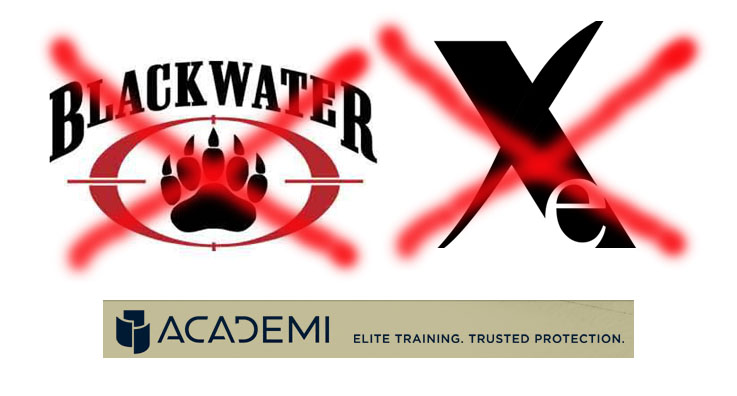
So much for transparency, civil liberties, and prosecuting the crimes of a predecessor (the cardinal rule of presidents, at least this one, cover-up WAR CRIMES past and present, a solemn command of the National Security State). Silence and deniability, in all matters large and small, characterize the responses of USG and private principals: “The State Department declined to comment on the aborted investigation. A spokesman for Erik Prince, the founder and former chief executive of Blackwater, who sold the company in2010, said Mr. Prince had never been told about the matter.” The $1B contract itself testifies to the fusion of patriotism, secrecy, repression, and yes, corporate profit: “After Mr. Prince sold the company, the new owners named it Academi. In early June, it merged with Triple Canopy, one of its rivals for government and commercial contracts to provide private security. The new firm is called Constellis Holdings.” Like war, private security stands to make a killing (pardon the pun), no doubt in flight from the original name for damage-control and public-relations purposes.
Previous to Nisour Square (Sept. 16, 2007) Blackwater guards “acquired a reputation…for swagger and recklessness,” but complaints “about practices ranging from running cars off the road to shooting wildly in the streets and even killing civilians typically did not result in serious action by the United States or the Iraqi government.” After firing in the Square, there was closer scrutiny, the Blackwater claim that they were fired on even US military officials denied, and “[f]ederal prosecutors later said Blackwater personnel had shot indiscriminately with automatic weapons, heavy machine guns and grenade launchers.” To no avail, given the symbiotic relationship between the company and the government. In fact, Blackwater had itself been run by Prince as a nation in microcosm, its people shortly before Nisour Square gathered by him at company headquarters in Moyock, North Carolina and made to “swear an oath of allegiance” like the one required of enlistees in the US military. They were handed copies of the oath, which, after reciting the words, were told to sign.
The State Department investigation into Blackwater in Iraq, which began Aug. 1, 2007 and was slated for one month, led early to the “volatile” situation (including the death threat), our knowledge coming from “internal State Department documents” furnished “to plaintiffs in a lawsuit against Blackwater that was unrelated to the Nisour Square shootings,” seemingly by accident then and fleshed out by Risen. In that month—or that part of it before being forced to leave– the investigators discovered “a long list of contract violations by Blackwater,” staffing changes of security details “without State Department approval,” reducing the number of guards on details, “storing automatic weapons and ammunition in their private rooms, where they were drinking heavily and partying with frequent female visitors,” and, for many, failing “to regularly qualify on their weapons” or “carrying weapons on which they had never been certified” nor “authorized to use.” Extravagance for mayhem abroad, less than peanuts for critical needs at home, education, health care, employment, beyond the means or reach of Imperial grandeur as the national obsession.
In addition to “overbilling the State Department by manipulating its personnel records, using guards assigned to the State Department contract for other work and falsifying other staffing data on the contract,” (no wonder the investigators’ poor reception by Blackwater’s resident head in Iraq), one of its affiliates forced “third country nationals” who did the dirty work at low wages “to live in squalid conditions, sometimes three to a cramped room with no bed,” according to the investigators’ report. Their conclusion: “Blackwater was getting away with such conduct because embassy personnel had gotten too close to the contractor.”
Ah, the denouement; we have a name to go with the face of the project manager who threatened Richter’s life, Daniel Carroll, who said he could kill him without anything happening to himself “as we were in Iraq” (this was witnessed by Donald Thomas, the other investigator), and Richter, in his memo to the Department stated: “I took Mr. Carroll’s threat seriously. We were in a combat zone where things can happen unexpectedly, especially when issues involve potentially negative impacts on a lucrative security contract.” Nicely put, and corroborated by Thomas, who wrote in a separate memo that “others in Baghdad had told the two investigators to be ‘very careful,’ considering that their review could jeopardize job security for Blackwater personnel.” The wonder perhaps is that Richter and Thomas were not prosecuted under the Espionage Act for spoiling the show. It didn’t matter. No one at State listened.
The two men were ordered to leave (Aug 23), and “cut short their inquiry and returned to Washington the next day.” Finally, on Oct. 5, after the Nisour Square scandal, State Department officials responded to Richter’s “August warning,” and took statements from him and Thomas about “their accusations of a threat by Mr. Carroll, but took no further action.” A special panel convened by Rice on Nisour Square “never interviewed Mr. Richter or Mr. Thomas.” The official who led the panel “told reporters on Oct. 23, 2007, that the panel had not found any communications from the embassy in Baghdad before the Nisour Square shooting that raised concerns about contractor conduct.” Voila, vanished in thin air. This State Department officer deserves the last word: “We interviewed a large number of individuals. We did not find any, I think, significant pattern of incidents that had not—that the embassy had suppressed in any way.” And my last word: fascism. Beyond all structural-cultural-societal considerations about wealth-concentration, industrial-financial consolidation, foreign expansion through preponderant power and the spirit of militarism, the rampaging privatization with government consent witnessed here, which has wreaked havoc on another people, only to be covered over by the state, aka, the National Security State, disregarding its Constitutional protections to the individual, as in sponsoring massive surveillance, is enough for me to satisfy the working definition of that single word.
via Norman Pollack has written on Populism. His interests are social theory and the structural analysis of capitalism and fascism. He can be reached at [email protected].
Hello This Is Anonymous… This Message Is For You North Atlantic Treaty Organization… In Recent News On Your Report…
Information and National Security” from General Rapporteur Lord Jopling of the UK discusses the potential good of social networks for fostering democracy, the WikiLeaks scandal, and how hacktivists need to be burned at the stake.
“Virtual communities operating online provide new opportunities for civil society, but they have also increased the potential for asymmetrical attacks,” the report says. “Apart from causing harm, destruction or conducting espionage, most recent cyber attacks have also been used as a means to reach, a rather different goal, ‘Hactivism’ is a relatively recent form of social protest or expression of ideology by using hacking techniques.”
The report then singles out Anonymous as an example of this new trend by relating the group’s support of Julian Assange’s WikiLeaks.But that “info-war” is only the beginning, according to NATO. “Observers note that Anonymous is becoming more and more sophisticated and could potentially hack into sensitive government, military, and corporate files.” The report then explains how Anonymous hacked government contractor HBGary’s servers and the CEO’s Twitter account. after the group revealed the government’s plans to take down WikiLeaks.
You Claim To Represent The Following.
1.Peace And Security That’s Our Mission.
2.We Want To Be Sure That We Can Walk Around Freely In A Safe And Secure Environment. Security In All Areas Of Everyday Life Is Key To Our Well-Being, But It Cannot Be Taken For Granted.
3.NATO Promotes Democratic Values And Encourages Consultation And Cooperation On Defence And Security Issues To Build Trust And, In The Long Run, Prevent Conflict.
The Manner Of Which You Try To Push The Pursuit Of Anonymous. Seems To Be More Of An Issue Of Opportunity To Censor Anonymous. Rather Than An Honest And General Concern. All Of Anonymous’ Previous Attacks And Protest Have Not Ignited Any Action Against Us From NATO. Though With The Most Recent Attack Of The United States Chamber Of Commerce Website. You Wish To Become Involved. If Your Goal Was To Start War With Anonymous. Then Why Would You Allow Visa, Pay Pal , Master Card And Countless Other Actions To Go Without Prosecution. Then A Simple Website Is Made Unavailable You Sound Your Drums Of War. Be Warned We Do Not Wish This. Nor Do We Want This. But Make No Mistake… We Will Defend Ourselves. We Are Anonymous. We Are Legion. We Do Not Forgive. We Do Not Forget. Expect Us.
Is it possible that Gaddafi was finally making progress towards ending conflict and unifying Africa? What if there was more to this story than THE NEWS is willing to portray? Look closely to see if there may be an agenda at work..
http://www.youtube.com/watch?v=aXQxTv3nB14
Do you think the people of Libya are truly thankful for NATO’s intervention? (more…)
It has come to our attention that a NATO draft report has classified Anonymous a potential „threat to member states’ security”, and that you seek retaliation against us.
It is true that Anonymous has committed what you would call ‘cyber-attacks’ in protest against several military contractors, companies, lawmakers, and governments, and has continuously sought to fight against threats to our freedoms on the Internet. And since you consider state control of the Internet to be in the best interest of the various nations of your military alliance, you therefore consider us a potential threat to international security. (more…)