Tip of the day- for the parents: Teach your child the importance of applying their knowledge, and critical thinking abilites to solving of Social Problems
TRACK: Beast 1333 Mad World feat K-Rino, Space Age Slaves
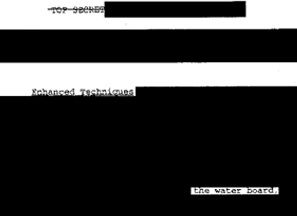
What the FBI Doesn’t Want You To Know About Its “Secret” Surveillance Techniques
Vibration, Synchronicity, Energy Healing, Holographic Universe
Cannabis & the Pineal Gland?
Quick Headlines
It Will Take The Fed Seven Years To Deliver 300 Tons Of German Gold
Ben Fulford: Signs of cabal defeat are proliferating, What’s the ‘real’ truth?
Developer Sacked for Outsourcing His Entire Job to China
Just over two weeks ago, Khalid Sheikh Mohammed and other 9/11 terror suspects had a pre-trial hearing before the Guantanamo Bay commission. The judge presiding over the commission is Army Colonel James L. Pohl. Key issues argued were whether a forty-second daly between the press and courtroom was constitutional and whether the suspects could testify about being tortured by CIA interrogators or not.
John Knefel for The Nation traveled to Guantanamo Bay to cover the hearing. His dispatch on the proceedings he witnessed has been posted and it is worth reading.
As he reports, the court heard argument on ”whether the five co-defendants can be barred from testifying about their own experiences on the grounds that their thoughts, emotions and memories are classified information. The prosecution, on behalf of the government, has argued that all utterances by the accused should be “presumptively classified”—that is, every possible statement by should be treated as secret government information—but this request has since been weakened.”
He adds, “The prosecution’s argument is that the five defendants are in a “particularly credible position to confirm or deny” elements of the CIA’s rendition, detention and interrogation program. Having been tortured, they are in possession to describe it, and the government has clear incentives to keep them from doing so.”
The American Civil Liberties Union has opposed the effort to censor torture testimony. Hina Shamsi, director of the ACLU’s National Security Project, declares, “The government’s claim that it can keep from the public the defendants’ testimony about their ‘thoughts and experiences’ of torture is legally untenable and morally abhorrent.”
I was covering the latest hearing in the court martial of Pfc. Bradley Manning, the soldier accused of releasing classified information to WikiLeaks, when this was all unfolding weeks ago. I did not get a chance to highlight some of the government’s argument, but I think this is an appropriate opportunity to share some more of what the government’s argument is on classifying the memories of terror suspects. It nicely complements the totalitarian arguments proffered by government attorneys in support of the indefinite detention provision of the National Defense Authorization Act of 2012 and the FISA Amendments Act of 2008, which essentially legalized warrantless wiretapping that had been occurring under the administration of President George W. Bush.
Justice Department lawyer and deputy trial counsel for the prosecution Theresa Baltes stated in court on October 16 that an executive order issued by President Barack Obama was in force that authorized classification of “orally conveyed information that falls within the subsection of foreign or intelligence sources and methods.” Baltes was alluding to observations and memories of torture or, to use Vice President Dick Cheney’s phrase, “enhanced interrogation techniques.” The “intelligence sources” are the agents who tortured them. The “methods” are how they were tortured and that is not something the government thinks the press or American public should ever find out about.
Baltes said to Judge Pohl later in the proceedings on October 16 the government had originally proposed an order that required defense attorneys to treat everything their client said as classified, including details on what their client had for lunch a day or two ago. The order was narrowed to protect statements on what occurred while in CIA custody.
“The prosecution is proposing that they only treat as classified and handle as classified statements that they know to be classified based on their security clearance,” Baltes told the commission. “And that would specifically include — or believe to be classified, and specifically include information about the CIA RDI program and their prior custody, detention, interrogation.” (RDI being the CIA’s Rendition, Detention and Interrogation program.)
Navy Lieutenant Commander Kevin Bogucki, who represents former CIA captive and former translator for Osama bin Laden, Muhammad Rahim, tried to outline the draconian and preposterous nature of the government’s position. He argued, “When the government voluntarily exposes someone outside their control to information, they are voluntarily relinquishing control over that information.” For example:
..[L]et’s say we are just imagining, for the sake of argument, that there is a classified CIA assassination program and one of the agents in this program goes and attempts to take out a target but fails, wounds the target but doesn’t kill him. That victim is now unable to describe the circumstances of the assault upon him because it might tend to reveal the personnel involved in this secret program, the means by which this program executes its duties? Clearly that makes no sense. It doesn’t matter how secret they kept it when they were planning and when they were working through the techniques of this secret program. Once they decide to execute that program in the real world and expose people outside their control to the essentially mechanisms or the product of that planning, they have now relinquished control over that. And to simply say, well, it relates to the secret program and therefore you can’t talk about it, goes far beyond what can properly be classified… [emphasis added]
Judge Pohl, at one point in the proceedings, notes that the government is not seeking to classify all experiences and memories. They have sough to limit the classification to certain dates and places. Bogucki countered by arguing the information has to be owned, produced or under the control of the US government.
…Now, the only one of those that the government can even arguably rely upon is under the control of the United States Government. If you can go to the next slide, please. So again here, they are relying upon the prong that this statement is arguably under the control of the United States Government….Okay, but the only reason that they think they have control over this information, the only reason that theythink that final prong is satisfied is because they are holding our clients essentially in isolation…
What Bogucki is suggesting is his client has been completely dehumanized. To the government, he is not a person. He is a vessel containing details that if disseminated would invite scrutiny or possibly undermined current operations or missions against terrorism. Therefore, this vessel cannot come in contact with other prisoners or else those prisoners might come into possession of this information that the government wishes to keep secret. So, Bogucki’s client must be held in solitary confinement and suffer under those conditions because some agents used classified methods of interrogation or torture on him.
Let’s return to Knefel’s piece. He puts this all into the larger context hinting at the reality that what the military commissions system is a second-class system of legal justice that has been constructed to ensure convictions. He also highlights how Obama says he intends to close Guantanamo but a person suspected of being involved in the Benghazi attack could potentially end up at Guantanamo. The moment new prisoners start arriving at Guantanamo under Obama is the moment that any more platitudes about closing Guantanamo are exposed to be completely hollow.
And Knefel writes, “The military commissions are just one piece of a larger, disturbing trend toward centralized presidential power with virtually no oversight or transparency.” He contends:
…The bigger problem is that a once radical idea—that the executive branch should have its own legal system to try so-called enemy combatants—has been normalized and codified under two separate administrations. Recent claims that the CIA and FBI are attempting to send a suspect in the Benghazi killing of Libya Ambassador Christopher Stevens to Guantánamo Bay underscore critics’ skepticism that military commissions will be a limited tool with a definite ending.
The same, of course, is true for the “War on Terror” more broadly, as evidenced by a chilling Washington Postreport on the “disposition matrix,” a counterterrorism tool that further entrenches the policy of “targeted killing” embraced by the Obama administration. As Spencer Ackerman writes, “Obama did not run for president to preside over the codification of a global war fought in secret. But that’s his legacy.” Indeed, as John Kiriakou, a whistleblower recently prosecuted for trying to shed light on the CIA’s torture program, knows too well, the Obama administration has charged more whistleblowers under the Espionage Act of 1917 than all previous presidents combined…
The case of Kiriakou is a kind of bookend to the first term of a president, who pledged to be different from Bush and then decided to be completely subservient to the national security state like previous presidents. Kiriakou was subjected to a prosecution for revealing the name of a covert agent involved in the RDI program, who multiple people in the human rights community are believed to have known. He was prosecuted after he went on television and said the CIA had an official policy of torture because it did use waterboarding on detainees. That the CIA did not like and it made him a target. The government went after Kiriakou and in the process destroyed his life and the lives of his wife and five children by putting them through a prosecution that has left him impoverished and ruined.
What has happened to the torturers? How many people who actually engaged in torture of terror suspects have you heard about, whose lives have been wrecked because they were savages toward human beings? How many people have you read about in the news who authorized this policy and now are in jail because they instructed people lower than them to engage in torture and sought to cover it up with crafty legal justifications?
The answer is none. The answer is nobody. The answer is the US government remains committed to concealing details on methods of torture that were used on people now imprisoned at Guantanamo because the continuity of government was more important to the Obama administration than justice. And, the classification of the experiences and memories of terror suspects is supported by the government so agents, who engaged in torture, do not go through the kind of life-wrecking experience Kiriakou did.
Study found war against violent Islamists has become increasingly deadly
Researchers blame common tactic now being used – the ‘double-tap’ strike
Drone strikes condemned for their ineffectiveness in targeting militants
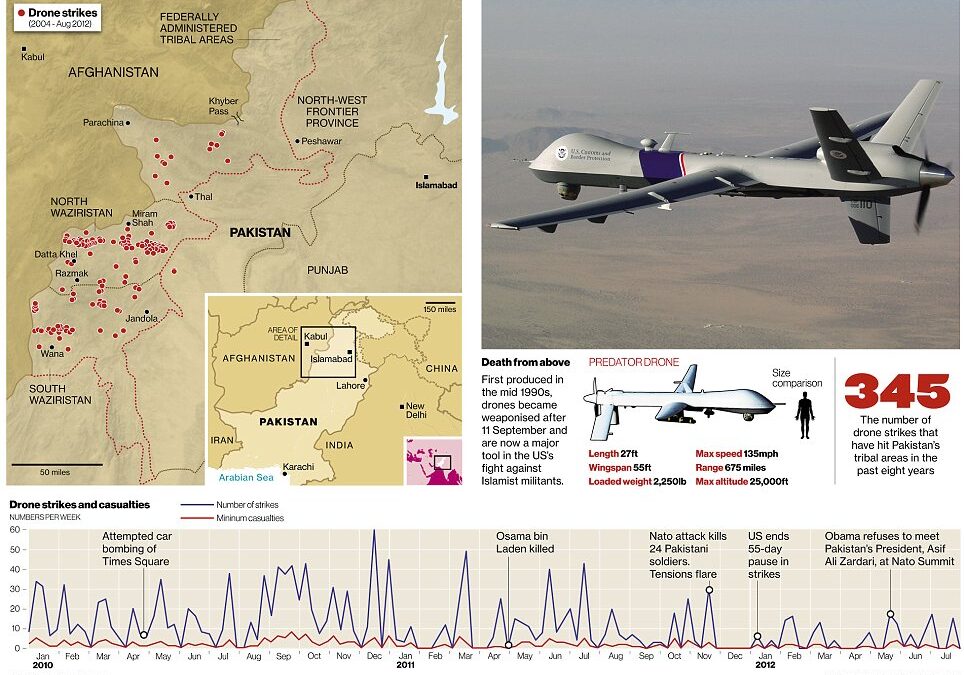
Just one in 50 victims of America’s deadly drone strikes in Pakistan are terrorists – while the rest are innocent civilians, a new report claimed today.The authoritative joint study, by Stanford and New York Universities, concludes that men, women and children are being terrorised by the operations ’24 hours-a-day’.
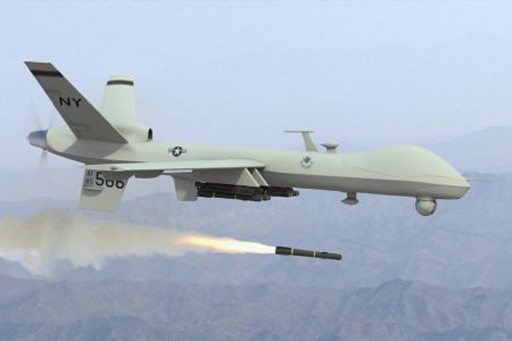
And the authors lay much of the blame on the use of the ‘double-tap’ strike where a drone fires one missile – and then a second as rescuers try to drag victims from the rubble. One aid agency said they had a six-hour delay before going to the scene.
The tactic has cast such a shadow of fear over strike zones that people often wait for hours before daring to visit the scene of an attack. Investigators also discovered that communities living in fear of the drones were suffering severe stress and related illnesses. Many parents had taken their children out of school because they were so afraid of a missile-strike.
Today campaigners savaged the use of drones, claiming that they were destroying a way of life.
Clive Stafford Smith, director of the charity Reprieve which helped interview people for the report, said: ‘This shows that drone strikes go much further than simply killing innocent civilians. An entire region is being terrorised by the constant threat of death from the skies. ‘
There have been at least 345 strikes in Pakistan’s tribal areas near the border with Afghanistan in the past eight years.
‘These strikes are becoming much more common,’ Mirza Shahzad Akbar, a Pakistani lawyer who represents victims of drone strikes, told The Independent.
‘In the past it used to be a one-off, every now and then. Now almost every other attack is a double tap. There is no justification for it.’
The study is the product of nine months’ research and more than 130 interviews, it is one of the most exhaustive attempts by academics to understand – and evaluate – Washington’s drone wars.
Despite assurances the attacks are ‘surgical’, researchers found barely two per cent of their victims are known militants and that the idea that the strikes make the world a safer place for the U.S. is ‘ambiguous at best’.
Researchers added that traumatic effects of the strikes go far beyond fatalities, psychologically battering a population which lives under the daily threat of annihilation from the air, and ruining the local economy.
They conclude by calling on Washington completely to reassess its drone-strike programme or risk alienating the very people they hope to win over.
They also observe that the strikes set worrying precedents for extra-judicial killings at a time when many nations are building up their unmanned weapon arsenals.
The Obama administration is unlikely to heed their demands given the zeal with which America has expanded its drone programme over the past two years.
Washington says the drone program is vital to combating militants that threaten the U.S. and who use Pakistan’s tribal regions as a safe haven.
The number of attacks have fallen since a Nato strike in 2011 killed 24 Pakistani soldiers and strained U.S.-Pakistan relations.
Pakistan wants the drone strikes stopped – or it wants to control the drones directly – something the U.S. refuses.
Reapers and Predators are now active over the skies of Somalia and Yemen as well as Pakistan and – less covertly – Afghanistan.
But campaigners like Mr Akbar hope the Stanford/New York University research may start to make an impact on the American public.
‘It’s an important piece of work,’ he told The Independent. ‘No one in the U.S. wants to listen to a Pakistani lawyer saying these strikes are wrong. But they might listen to American academics.’
Today, Pakistani intelligence officials revealed a pair of missiles fired from an unmanned American spy aircraft slammed into a militant hideout in northwestern Pakistan last night.
The two officials said missiles from the drone aircraft hit the village of Dawar Musaki in the North Waziristan region, which borders Afghanistan to the west.
Some of the dead were believed to be foreign fighters but the officials did not know how many or where they were from.
The Monday strike was the second in three days. On Saturday a U.S. drone fired two missiles at a vehicle in northwest Pakistan, killing four suspected militants.
That attack took place in the village of Mohammed Khel, also in North Waziristan.
North Waziristan is the last tribal region in which the Pakistan military has not launched an operation against militants, although the U.S. has been continually pushing for such a move.
The Pakistanis contend that their military is already overstretched fighting operations in other areas but many in the U.S. believe they are reluctant to carry out an operation because of their longstanding ties to some of the militants operating there such as the Haqqani network.
Andrew Sullivan says he’ll use it less scrupulously than the president. But based on what evidence? Current policy is plenty unscrupulous already.
Asked about drone strikes during Monday’s foreign policy debate, Mitt Romney basically said that President Obama is right to use them. Expect more drone warfare in 2013 regardless of who wins the election. Does that mean that the two candidates are indistinguishable on the issue? My friend and former boss Andrew Sullivan doesn’t think so. “Memo to Conor Friedersdorf,” he wrote while live-blogging at The Dish. “You think Romney would be as scrupulous in drone warfare as Obama?” Implicit is the judgment that Obama has been “scrupulous.”
But it isn’t so.
Sullivan and I agree that Obama won last night’s debate, and that he’d be likely to preside over a more prudent, reality-based foreign policy than Romney, based on the respective campaigns that they’ve run. On drones, however, Romney appears to have the exact same position as Obama. And Obama has been egregiously unscrupulous. I don’t want to hear the dodge about how drone strikes are necessary. It’s beside the point. This is about the specific ways Obama has waged the drone war. Even if you agree in theory with drone strikes, Obama’s actions ought to bother you.
Let me be specific:
As Jane Mayer noted when describing the CIA’s drone strikes, “The program is classified as covert, and the intelligence agency declines to provide any information to the public about where it operates, how it selects targets, who is in charge, or how many people have been killed.”
The Obama Administration avoids judicial accountability by arguing that the drone program is secret, even as it acknowledges the existence of the program when bragging about killing terrorists.
As the Mayer article goes on to state, “because of the C.I.A. program’s secrecy, there is no visible system of accountability in place, despite the fact that the agency has killed many civilians inside a politically fragile, nuclear-armed country with which the U.S. is not at war. Should something go wrong in the C.I.A.’s program — last month, the Air Force lost control of a drone and had to shoot it down over Afghanistan — it’s unclear what the consequences would be.”
According to The New York Times, “Mr. Obama embraced a disputed method for counting civilian casualties that did little to box him in. It in effect counts all military-age males in a strike zone as combatants, according to several administration officials, unless there is explicit intelligence posthumously proving them innocent.”
The Obama Administration permits the CIA to carry out “signature strikes” even though they don’t know the identity of the people they’re trying to kill!
As Glenn Greenwald explained, “In February, the Bureau of Investigative Journalism documented that after the U.S. kills people with drones in Pakistan, it then targets for death those who show up at the scene to rescue the survivors and retrieve the bodies, as well as those who gather to mourn the dead at funerals.”
As a report published by the law clinics at NYU and Standford document, innocent people in Waziristan are being terrorized and traumatized daily by Obama’s drone war. And the policy has killed, at minimum, hundreds of innocent people, a judgment that is supported even by data from the New America Foundation, whose methods almost certainly under-count dead innocents.
So to sum up, Obama has implemented a global killing program with zero checks and balances; he’s operated it out of the CIA rather than the Department of Defense; he invokes the state-secrets privilege to avoid defending it in court, even as he brags about its efficacy; it includes killing people whose identities we don’t even know; all military-aged males we kill are presumed to be “militants”; the Pakistani government reportedly gets to pick some of the targets; at minimum, hundreds of innocents have been killed, including rescuers and funeral-goers; a 16-year-old American citizen was among those killed; and Sullivan, having been exposed many times to all the information I’ve just included, thinks its accurate to call Obama’s drone program “scrupulous,” though it could easily be made more transparent, accountable, and lawful.
What really gets me is that, in addition to arguing that Obama has run this program scrupulously (something implied in Sullivan’s question, and explicitly argued in threads like this one), Sullivan has also himself articulated almost all of the reasons why the program has been unscrupulous — that is to say, why Obama’s drone policy “disregards, or has contempt for, laws of right or justice with which he is perfectly well acquainted, and which should restrain his actions.”
“One thing I’ve learned this past decade is that the CIA is pretty much its own judge, jury and executioner,” Sullivan wrote. “It is much less accountable to the public, more likely to break the laws of war and destroy the evidence, more likely to do things that could escalate rather than ameliorate a conflict.” Is it scrupulous to pick an organization like that to run your drone program?
Says Sullivan’s post from June of 2011 (emphasis added):
Obama is now engaged in two illegal wars — in Libya and in Yemen. There was no Congressional debate or vote on these wars — and one is being waged by the CIA with unmanned drones. I think we have learned a little about what happens when you give the CIA carte blanche to run a war with no accountability except to a president who has a vested interest in covering up errors.
Said Sullivan on another occasion, “Put drones in the hands of an executive who is empowered to do anything without any input from the other branches of government … and we have a problem indeed.” He is also on record stating that “counting every military-age man in the vicinity of a Jihadist as a terrorist is a total cop-out,” and he even wrote that “if the CIA, based on its own intelligence, can launch a war or wars with weapons that can incur no US fatalities, the propensity to be permanently at war, permanently making America enemies, permanently requiring more wars to put out the flames previous wars started, then the Founders’ vision is essentially over. I think it’s a duty to make sure their vision survives this twenty-first century test.”
So let’s get back to Sullivan’s debate night question. “You think Romney would be as scrupulous in drone warfare as Obama?” My best guess is that, on drone warfare, their policies would be about the same — that is to say, alarmingly unscrupulous, with unpredictable consequences. That’s what happens when you give someone the power to kill without checks in secret.
I have no reason to think one or the other would predictably kill more innocent people with drones. Does Sullivan? If Romney wins, what odds would Sullivan give on the proposition that Romney ultimately kills more civilians with drones than Obama has? Based on what evidence? Obama has already killed an American citizen without trial and conducted drone strikes in a country where no war has been declared, so I don’t see how Romney would set any precedents that are even more alarming. (What precedent would that be?) Overall, I have no idea whose drone war would be more damaging. Having watched Sullivan strongly denounce and other times defend Obama’s drone war in posts that cannot be reconciled with one another, I don’t think he knows either.
So what if Romney is elected and turns out to be much worse on drones? It could totally happen. I wouldn’t be surprised. I’ll be opposing his unaccountable killing policy from day one regardless, just as I’ve opposed Obama’s policy due to its manifold flaws. And if Romney’s drone policy turns out to have all sorts of catastrophic consequences? I hope Sullivan remembers that Obama established the bipartisan consensus behind a worldwide drone-strike strategy and set all the necessary precedents without losing the support of backers like Sullivan. (He didn’t even lose support for continuing his current drone policy itself.) A Romney drone fleet, operating in numerous countries with zero oversight from the judiciary or Congress, with American citizens in the crosshairs? Obama and his supporters built that. It would be ready for President Romney on day one.
A Bloomberg investigation shows that the federal government is paying a military contractor facing allegations of torture to manage some public records work.
The Freedom of Information Act allows ordinary people to learn about behind the scenes functions of our government. There are a number of limited, discrete exemptions to the law, which allow agencies to redact or withhold documents in whole or in part. But generally speaking, the law grants us broad access into the workings of our government — and it is therefore one of the key mechanisms whereby we learn of illegal or inappropriate government activities. FOIA is a necessary transparency mechanism in our democracy.
That’s why it’s shocking to learn, as Bloomberg news reports today, that increasingly the process of managing and responding to our FOIA requests is being handled by private corporations. The investigation shows that at least 25 federal agencies are farming out their FOIA work to private companies, at a cost both to taxpayers and to the integrity of the open records system. As director of the Sunlight Foundation John Wonderlich told Bloomberg:
If I was in charge of an agency and wanted to create an unaccountable FOIA process, the first thing I would do is put an outside contractor in charge of it because fewer of our accountability laws apply to them…It would just be another layer between me and the public.
It gets worse. Not only does the contracting out of FOIA work shield the government from precisely the transparency the law is meant to institute. There could be very serious conflicts of interest involved when private companies are tasked with managing the processes whereby sensitive (and likely embarrassing or damning) government secrets are disclosed to the public.
Case in point is CACI International, a military and intelligence contractor that is facing a lawsuit alleging its employees participated in the torture of detainees at Abu Ghraib prison in Iraq. CACI is one of the companies the federal government has outsourced FOIA work to over the past ten years.
Should a company accused of serious human rights violations in a war zone have any involvement with open government processes designed to disclose precisely such abuses?
To: “Whalen, Jeanne” <Jeanne.Whalen[at]wsj.com>
From: John Young <jya[at]pipeline.com>
Date: Sun, 22 Aug 2010 12:45 +0600
Subject: RE: from the WSJ
Jeanne,
Following up our telephone exchange on Friday:
1. You said the WSJ editor turned down the use of Rupert Murdoch’s
penthouse for an inteview because editorial and business are kept
separate and Murdoch is business. That is hoarily disingenuous for
no media keeps editorial and business separate, the two are
inseparable with business always in control.
2. I said there is no need for me to comment further on Wikileaks,
the story is now a churn of publicity stunts by Wikileaks, its
supporters and detractors.
3. You said there was interest in reporting on Cryptome in addition
to Wikileaks. I said that is another story, not related to Wikileaks.
To amplify 3, Cryptome shares with Wikileaks and many others
older and newer, the aim of reducing secrecy in government,
business, organizations, institutions and individuals.
Pervasive secrecy corrupts as an essential protector of those who
want control and manipulate the citzenry and subjects. Those who
advocate secrecy always justify it by claims of threats that require
secrecy to prevent or fight.
In truth, secrecy protects and empowers those who use it and
weakens those for whom it is invoked to protect.
Secrecy hides privilege, incompetence and deception of
those who depend on it and who would be disempowered
without it.
The very few legitimate uses of secrecy have served as the
seed for unjustified expanded and illegitimate uses.
A vast global enterprise of governments, institutions, organizations,
businesses and individuals dependent up the secrecy of abuse
of secrecy has evolved into an immensely valuable practice whose
cost to the public and benefits to its practitioners are concealed
by secrecy.
Secrecy has led to a very large undergournd criminal enterprise
dealing with stolen, forged, faked, and planted “secret” information
involving governments, businesses, NGOs, institutions and
individuals. Its value likely exceeds that of the drug trade, with
which it works in concert to hide assets, procedures and operators
that is keep the secrets in emulation of the secretkeepers.
Ex-secretkeepers are involved in this undergroung enterprise
as beneficiares, informants, facilitators of exchanges with
the agoveground secretkeepers and as spies for hire.
Secrecy is the single most threatening practice against democracy
and democratic procedures such that it is highly likely that there is
no democracy or democratic institutions unsullied by secrecy.
Secrecy poses the greatest threat to the United States because
it divides the poplulation into two groups, those with access to
secret information and those without. This asymmetrial access
to information vital to the United States as a democracy will
eventually turn it into an autocracy run by those with access
to secret informaton, protected by laws written to legitimate
this privileged access and to punish those who violate these
laws.
Those with access to secret information cannot honestly
partake in public discourse due to the requirement to lie
and dissumlate about what is secret information. They can
only speak to one another never in public. Similarly those
without access to secret information cannot fully
debate the issues which affect the nation, including
alleged threats promulagsted by secretkeepers who
are forbidden by law to disclose what they know.
Senator Patrick Moynihan, among others, has explored
the damaging consequences of excessive secrecy. Attempts
to debate these consequences have been suppressed
or distorted by secrecy practices and laws.
Efforts, governmental and private, to diminish secrecy
have had modest effects, and the amount of secret information
continues to grow virtually unchecked and concealed by
the very means questioned, secrecy itself.
These secrecy-reduction efforts are continually being attacked
by the secrets enterprise by secrecy-wielding oveseers, including
presidents, legislators and the courts.
While some of the privileged media challenge these practices,
most do not and thereby reinforce the unsavory.
It should not be surprising that this leads to an increase in
efforts to challenge secrecy practices by those excluded,
including such initiatives as, among many others around
the globe, Cryptome and Wikileaks.
Cryptome disagrees with the use of secrecy by Wikileaks
and its monetization of secret information which mimics
those it ostensibly opposes, say, Rupert Murdoch, among
untold others.
Companies ‘all too willing’ to comply with FBI requests for personal information, EFF says
As the US prepares once again to extend the Patriot Act, a new report from a privacy watchdog indicates that the FBI’s use of the law and other surveillance powers may have led to as many as 40,000 violations of the law by the bureau in the years since 9/11.
According to documents obtained by the Electronic Frontier Foundation, from 2001 to 2008 the FBI reported nearly 800 violations of surveillance law and the Constitution to the Intelligence Oversight Board, a civilian monitoring group that reports to the president.
The EFF also determined that the FBI investigated some 7,000 potential violations of the law that occurred during surveillance operations. The group estimated that, based on the rate of reporting of violations, the FBI may have violated the law as many as 40,000 times during investigations since 9/11.
“The documents suggest the FBI’s intelligence investigations have compromised the civil liberties of American citizens far more frequently, and to a greater extent, than was previously assumed,” the EFF stated in its report.