If you were murdered today, there’s only a 60% chance of police catching the person who did it. That number drops to 3% if you’re raped. 50 years ago, that number was much higher. What happened?
Despite overwhelming disapproval from the public, the war on drugs wages on and we are witnessing the inevitable materialization of a fascist police state before us.
The irony here is that no matter how much money the state steals from us to fund themselves, and no matter how many tanks or AR-15s they acquire, they are solving far fewer crimes than before.
Police aren’t getting any closer to “winning” this ridiculous and immoral war on drugs either.
So, why aren’t police solving crimes?
The answer to that question can be found by looking at where police allocate much of their time and resources.
Civil asset forfeiture pays. Busting low-level drug dealers by the dozen and confiscating their drugs, guns, cars, houses, and money pays. Writing tickets for victimless crime pays. Pulling you over for window tint, seat belts, arbitrary traveling speeds, and expired license plates; these are the things that pay, not solving crimes.
In criminal justice, clearance rates are used as a measure of crimes solved by the police. The clearance rate is calculated by dividing the number of crimes that are “cleared” (a charge being laid) by the total number of crimes recorded.
In the United States, the murder clearance rate in 1965 was more than 90 percent. Since the inception of the war on drugs, the murder clearance rate has plummetted to an average of less than 65 percent per year.
Despite the near complete erosion of the constitutional protections against unlawful search and seizure, the clearance rate for murder continued its free fall. This highlights the fact that no matter how many rights are given up or freedoms diminished, police cannot guarantee your safety.
It’s not just murders that police fail to investigate, it’s rapes too.
According to the Department of Justice, there are currently over 400,000 untested rape kits collecting dust in police evidence rooms nationwide, and many other estimates suggest that this number could be as high as one million.
As a result of this horrific negligence, roughly 3% of rape cases in America are actually solved. This is in spite of the fact that many rape kits have a high chance of leading to an arrest since most rapists are career criminals who have their DNA on file.
In some cases, the victims even know who their attackers were, but they can not prosecute these criminals because the evidence has yet to be processed by police.
Arresting rapists and murderers simply falls short in the two areas police are worried about; revenue collection and keeping their inflated drug war budgets flowing.
It’s not that police are incapable of solving these crimes either; they’re just not interested in doing so.
“Take for example, homicides of police officers in the course of their duty,” University of Maryland criminologist Charles Wellfordpoints out. On paper, they’re the kind of homicide that’s hardest to solve — “they’re frequently done in communities that generally have low clearance rates … they’re stranger-to-stranger homicides, they [have] high potential of retaliation [for] witnesses.” And yet, Wellford says, they’re almost always cleared.
This is why people don’t like the police.
This lack of solving crimes coupled with the increase in shakedowns of non-violent citizens has created a rift between the rest of society and police.
“One of the consequences of the war on drugs is people have stopped looking at police as their protectors and more see them as their potential persecutors,” explains Sean Dunagan, Former DEA Senior Intelligence Specialist.
The war on drugs has driven a wedge between citizens and police. If you keep locking up millions of people for victimless crimes, eventually you’ll effect enough lives to vastly tarnish your reputation.
“The police department basically becomes the “other” to the community. Once you have that breakdown, then information stops flowing, so you don’t learn about crimes. And the only crime you become interested in is the one you can solve, which is locking up people up for using drugs,” says Ed Burns, Former Baltimore Narcotics and Homicide Detective.
Locking up drug users has proven to be quite the profitable venture.
It is much easier to walk out on the street corner and shakedown a teenager who may have an illegal plant in his pocket than it is to examine the evidence in a rape or murder case. The so-called “Private” Prisons know this and have subsequently found their niche in this immoral war on drugs.
The term Private Prison is a farce from the get-go.
A truly Private prison would not be solely funded by taxpayer dollars. These Private prisons are nothing more than a fascist mixture of state and corporate, completely dependent upon the extortion factor of the state, i.e., taxation, as a means of their corporate sustenance.
A truly Private prison would have a negative incentive to boost its population for the simple fact that it is particularly expensive to house inmates. On the contrary, these fascist, or more aptly, corporatist prisons contractually require occupancy rates of 95%-100%.
The requirement for a 95% occupancy rate creates a de facto demand for criminals. Think about that for a second; a need or demand for people to commit crimes is created by this corporatist arrangement. The implications associated with demanding people commit crimes are horrifying.
Creating a completely immoral demand for “criminals” leads to the situation in which we find ourselves today. People, who are otherwise entirely innocent, are labeled as criminals for their personal choices and thrown in cages. We are now witnessing a vicious cycle between law enforcement, who must create and arrest criminals, and the corporatist prison system which constantly demands more prisoners.
The police and prison corporations know that without the war on drugs, this windfall of money, cars, and houses — ceases to exist.
If you want to know who profits from ruining lives and throwing marijuana users in cages, we need only look at who bribes (also known as lobbies) the politicians to keep the war on drugs alive.
Below is a list of the top five industries who need you locked in a cage for possessing a plant in order to ensure their job security.
Police Unions: Coming in as the number one contributor to politicians for their votes to lock you in a cage for a plant are the police themselves. They risk taking massive pay cuts and losing all their expensive militarized toys without the war on drugs.
Private Prison Corporations: No surprise here. The corporatist prison lobby is constantly pushing for stricter laws to keep their stream of tax dollars flowing.
Pharmaceutical Corporations: The hypocrisy of marijuana remaining a Schedule 1 drug, “No Medical Use Whatsoever,” seems criminal when considering that pharmaceutical companies reproduce a chemical version of THC and are able to market and sell it as such. Ever hear of Marinol? Big pharma simply uses the force of the state to legislate out their competition; which happens to be nature.
Prison Guard Unions: The prison guard unions are another group, so scared of losing their jobs, that they would rather see thousands of non-violent and morally innocent people thrown into cages, than look for another job.
What does it say about a society who’s resolute in enacting violence against their fellow human so they can have a job to go to in the morning?
The person who wants to ingest a substance for medical or recreational reasons is not the criminal. However, the person that would kidnap, cage, or kill someone because they have a different lifestyle is a villain on many fronts.
When does this vicious cycle end?
The good news is, that the drug war’s days are numbered. Evidence of this is everywhere. States are defying the federal government and refusing to lock people in cages for marijuana. Colorado and Washington state served as a catalyst in a seemingly exponential awakening to the government’s immoral war.
Following suit were Oregon, D.C., and Alaska. Medical marijuana initiatives are becoming a constant part of legislative debates nationwide. We’ve even seen bills that would not only completely legalize marijuana, but unregulate it entirely, like corn.
As more and more states refuse to kidnap and cage marijuana users, the drug war will continue to implode. We must be resilient in this fight.
If doing drugs bothers you, don’t do drugs. When you transition from holding an opinion to using government violence to enforce your personal preference, you become the bad guy.
We’ve all been part of these discussions, and we’ve all read a ton of them on forums and blogs over the years: “if you could have only one gun for TEOTWAWKI, what would it be?” A more enlightened-seeming variant on this same theme are discussions that start with, “if you could pick only three guns for TSHTF…”
Here’s what’s wrong with so many of these discussions: no matter what flavor of civilization-ending apocalypse you contemplate — meteor strike, supervolcano, global pandemic , EMP blast, etc. — a SHTF scenario is likely to play out in phases, and for each phase you’re going to need a different skill set and a different load-out — not just a gun, but a complement of tools and skills.
Below is my brief attempt to sketch out the three phases that society would go through in a total collapse, and to think about some load-out options for each. Sure, you could read this and then pick three guns — one gun per phase — but by the end you’ll see that this attitude is putting the cart before the horse. The smarter thing to do is to put together a set of load-outs that will give you multiple options for dealing with each phase. You may still end up with three guns, but the point is that “which three guns… ” is not the question that you start with. Instead, the right question is “what mix of weapons and accessories are the best fit for each of the scenarios I’m envisioning?”
Phase 1: martial law and trigger-happy authorities
In the initial phase of a catastrophe, a phase that admittedly may last only a day or two depending on the swiftness and severity of the cataclysm, there will be some attempt by authorities to maintain law and order. During this phase, if you’re walking around with an AR or AK strapped to your back, you’re likely to be taken for a looter and shot on sight.
This is the red dot or reflex sight + polymer frame pistol phase. Mobile, concealable, accurate, quiet, and 100% reliable are what you’re looking for. Don’t worry about how long the batteries will last in your Aimpoint right now — you just have to get through this phase without getting arrested or shot.
If you think you’re going to get through this phase with a bow or a crossbow, then all I can say is that I’ll be glad to use your bow in phase 3 when I stumble across your corpse clutching it.
My personal fantasy load-out for this phase would be a suppressed Glock 17 paired with something like the Daniel Defense ISR-300 (a short-barreled rifle chambered in .300 Blackout with an integrally attached suppressor).
Why the focus on stealth? Because if you do have to shoot someone or something during this phase, there’s a good chance that you may not want the whole neighborhood to know that shots were fired at your house. The authorities will be dealing with mass chaos and won’t have time to sort out who shot first, so if they show up at your house and you’re armed to the teeth and standing over a pile of corpses, then it may not go well for you. So a suppressed short-barreled rifle is your best bet for home defense here, because at least you have the option of not involving an organized gang of heavily armed, yet frightened and confused people (i.e. the police or whoever is trying to maintain order) who may decide that you’re a threat.
Note that now is the time for you to either start your NFA paperwork, or obtain the theoretical know-how to build a homemade can. I’m not saying go out and build a silencer, because that’s illegal. But maybe download the info and print it out, and store it as part of your bug-out gear. Do not under any circumstances attempt to actually make a homemade silencer, though, because that’s a felony. You do it, you get caught, you go to jail — end of story. I’m not winking or smiling here — do not do it, and in fact don’t even gather the materials for it because you don’t want to be guilty of constructive possession of such a thing.
Experienced pistol shooters (which does not describe me) will no doubt be fine skipping the CQB personal defense weapon (PDW) and using a suppressed semi-auto pistol for this phase. This is great, because as I mentioned above, you’ll need a pistol anyway.
So get your phase 1 load-out together, and learn to shoot and move with it. And for God’s sake just pick the best tools for the immediate job at hand, without worrying about whether or not the batteries will last another 20 years. You’ll need every technological advantage, no matter how fragile and/or short-lived that technology may seem, to fight your way through this temporary phase. If you can afford some good night-vision equipment, then by all means add it to your phase 1 load-out, and quit worrying about whether your grandchildren will still be able to use it to defend the homestead.
Phase 2: lawlessness and die-off
This is the open-carry assault rifle phase. Very few people are going to make it past this phase, but if you do, it’s because you have reliable long gun, plenty of ammo, a good optic, some training, and a few capable allies at your side.
The people who have survived phase 1 are not going to be happy campers. They’ll be hungry, justifiably terrified, and aggressive. They’ll also be gathered together in groups and gangs, which is exactly how you should plan to roll during this phase. More allies with guns means a better chance for you and yours to survive, which is why the training that you do for this phase should involve learning to shoot and move as part of a group.
You’ll want carbine and shotgun options — the pistol that got you through phase 1 will probably become a rarely used backup weapon, and your long guns will become your primary weapons. My personal pick for phase 2 is an AR-15 with a Trijicon ACOG, but that’s because I know the AR platform pretty well. Others will choose the AK. There’s also the Tavor, SCAR, and numerous other options. I won’t wade into this debate, because this is what most people are thinking of when they post “what gun and optic should I get for SHTF?” in various forums.
Phase 3: long-term survival
At some point your optics will run out of batteries, and depending on your stockpiles you may run out of ammo even before then. When this happens, it’s all about trapping and snares, fishing, farming, and finding ways to harvest a few thousand calories per day per family member.
Note that taking wild game of any kind is difficult, and it involves a lifetime of practice. Depending on the terrain you’re in and your skill set, hunting for food will range from very difficult to downright impossible. Farming is an order of magnitude easier and more predictable, so if you really want to be prepared then you should learn to grow your own food.
Of course, you will still do some shooting — this is the phase where you get to bust out that double-barreled shotgun with the multi-caliber barrel inserts, and go scavenging for ammo. If that shotgun was your phase 1 weapon, then you probably didn’t make it this far, but it will make a fine phase 3 hunting and home/farm defense gun.
This is the phase where a lot of people plan to rely on archery to take game. Please. Bowhunting is hard. Trapping isn’t a cakewalk, but it’s a vastly easier and more reliable way to get protein that stalking around in the woods with a bow; it also relies far less on expensive consumables (i.e arrowheads and strings) that you’d need to stockpile.
I personally think that .once-again-cheap 22LR ammo is the best thing to stock up on for this phase, and judging by the recent shortage, plenty of people agree with me.
Conclusion
Many of you will disagree with some, or even all, of my recommendations. But I hope if you take away anything from this article, it’s the idea that any catastrophe will unfold in series of distinct phases or stages, and you’ll need to prepare for each one. The tools and skills that will get you through the initial phase won’t necessarily be the best suited for the next phase, and so on. So the answer is to have specialized load-outs for different types of situations. You want to have options, so that you can improvise, adapt, and overcome. Don’t think in terms of “one gun” or “three guns” — think in terms of scenarios and loadouts.
This is actually how US Special Forces operate. They have different load-outs that fit different mission profiles; sometimes this involves selecting different weapons and tools, and sometimes it involves reconfiguring the same weapon or tool. But the main thing is that they have options, and they adapt their load-out to fit their situation.
What types of scenarios do you imagine that you’ll face in a catastrophe, and what type of load-out (gun, optic, ammo, clothing, tools) would be the best fit for each scenario? Don’t get sucked into the game of trying to put together one single loadout that will fit every scenario, because I promise you, when you’re watching the chaos unfold and you’re wetting your pants, you’re going to wish dearly that you hadn’t tied yourself to a one-size-fits-all, jack-of-all-trades-master-of-none solution. You’re going to want to reach for the very best tool for the job that is immediately staring you in the face, and you won’t be happy if you’re stuck with the second- or third-best tool for wide a range of jobs that you may or may not encounter.
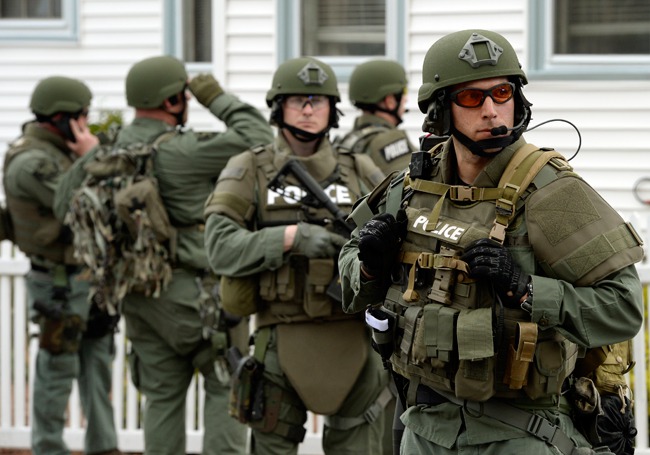
The militarization of police is harming civil liberties, impacting children, and transforming neighborhoods into war zones.
The “war on terror” has come home–and it’s wreaking havoc on innocent American lives. The culprit is the militarization of the police.
The weapons used in the “war on terror” that destroyed Afghanistan and Iraq have made their way to local law enforcement. While police forces across the country began a process of militarization complete with SWAT teams and flash-bang grenades when President Reagan intensified the “war on drugs,” the post-9/11 “war on terror” has added fuel to the fire.
Through laws and regulations like a provision in defense budgets that authorize the Pentagon to transfer surplus military gear to police forces, local law enforcement are using weapons found on the battlefields of South Asia and the Middle East.
A recent New York Times article by Matt Apuzzoreported that in the Obama era, “police departments have received tens of thousands of machine guns; nearly 200,000 ammunition magazines; thousands of pieces of camouflage and night-vision equipment; and hundreds of silencers, armored cars and aircraft.” The result is that police agencies around the nation possess military-grade equipment, turning officers who are supposed to fight crime and protect communities into what look like invading forces from an army. And military-style police raids have increased in recent years, with one count putting the number at 80,000 such raids last year.
In June, the American Civil Liberties Union (ACLU) brought more attention to police militarization when it issued a comprehensive, nearly 100-page (appendix and endnotes included) report titled, “War Comes Home: The Excessive Militarization of American Policing.” Based on public records requests to more than 260 law enforcement agencies in 26 states, the ACLU concluded that “American policing has become excessively militarized through the use of weapons and tactics designed for the battlefield” and that this militarization “unfairly impacts people of color and undermines individual liberties, and it has been allowed to happen in the absence of any meaningful public discussion.”
The information contained in the ACLU report, and in other investigations into the phenomenon, is sobering. From the killing of innocent people to the lack of debate on the issue, police militarization has turned into a key issue for Americans. It is harming civil liberties, ramping up the “war on drugs,” impacting the most marginalized members of society and transforming neighborhoods into war zones. Here are 11 important–and horrifying–things you should know about the militarization of police.
1. It harms, and sometimes kills, innocent people. When you have heavily armed police officers using flash-bang grenades and armored personnel carriers, innocent people are bound to be hurt. The likelihood of people being killed is raised by the practice of SWAT teams busting down doors with no warning, which leads some people to think it may be a burglary, who could in turn try to defend themselves. The ACLU documented seven cases of civilians dying, and 46 people being injured. That’s only in the cases the civil liberties group looked at, so the number is actually higher.
Take the case of Tarika Wilson, which the ACLU summarizes. The 26-year-old biracial mother lived in Lima, Ohio. Her boyfriend, Anthony Terry, was wanted by the police on suspicion of drug dealing. So on January 4, 2008, a SWAT team busted down Wilson’s door and opened fire. A SWAT officer killed Wilson and injured her one-year-old baby, Sincere Wilson. The killing sparked rage in Lima and accusations of a racist police department, but the officer who shot Wilson, Sgt. Joe Chavalia, was found not guilty on all charges.
2. Children are impacted. As the case of Wilson shows, the police busting down doors care little about whether there’s a child in the home. Another case profiled by the ACLU shows how children are caught up the crossfire–with devastating consequences.
In May, after their Wisconsin home had burned down, the Phonesavanh family was staying with relatives in Georgia. One night, a SWAT team with assault rifles invaded the home and threw a flashbang grenade–despite the presence of kids’ toys in the front yard. The police were looking for the father’s nephew on drug charges. He wasn’t there. But a 19-month-old named Bou Bou was–and the grenade landed in his crib.
Bou Bou was wounded in the chest and had third-degree burns. He was put in a medically induced coma.
Another high-profile instance of a child being killed by paramilitary police tactics occurred in 2010, when seven-year-old Aiyana Stanley-Jones was killed in Detroit. The city’s Special Response Team (Detroit’s SWAT) was looking for Chauncey Owens, a suspect in the killing of a teenager who lived on the second floor of the apartment Jones lived in.
Officers raided the home, threw a flash-bang grenade, and fired one shot that struck Jones in the head. The police agent who fired the fatal shot, Joseph Weekley, has so far gotten off easy: a jury trial ended in deadlock last year, though he will face charges of involuntary manslaughter in September. As The Nation’s Mychal Denzel Smith wrote last year after Weekley was acquitted: “What happened to Aiyana is the result of the militarization of police in this country…Part of what it means to be black in America now is watching your neighborhood become the training ground for our increasingly militarized police units.”
Bou Bou and Jones aren’t the only case of children being impacted.
According to the ACLU, “of the 818 deployments studied, 14 percent involved the presence of children and 13 percent did not.”
3. The use of SWAT teams is unnecessary. In many cases, using militarized teams of police is not needed. The ACLU report notes that the vast majority of cases where SWAT teams are deployed are in situations where a search warrant is being executed to just look for drugs. In other words, it’s not even 100% clear whether there are drugs at the place the police are going to. These situations are not why SWAT was created.
Furthermore, even when SWAT teams think there are weapons, they are often wrong. The ACLU report shows that in the cases where police thought weapons would be there, they were right only a third of the time.
4. The “war on terror” is fueling militarization. It was the “war on drugs” that introduced militarized policing to the U.S. But the “war on terror” has accelerated it.
A growing number of agencies have taken advantage of the Department of Defense’s “1033” program, which is passed every year as part of the National Defense Authorization Act, the budget for the Pentagon. The number of police agencies obtaining military equipment like mine-resistant ambush protected (MRAP) vehicles has increased since 2009,according to USA Today, which notes that this “surplus military equipment” is “left over from U.S. military campaigns in Iraq, Afghanistan and elsewhere.” This equipment is largely cost-free for the police agencies who receive them.
In addition to the Pentagon budget provision, another agency created in the aftermath of 9/11 is helping militarize the police. The Department of Homeland Security’s (DHS) own grants funnel military-style equipment to local police departments nationwide. According to a 2011 Center for Investigative Reporting story published by The Daily Beast, at least $34 billion in DHS grants have gone to police agencies to buy military-style equipment. This money has gone to purchase drones, tactical vests, bomb-disarming robots, tanks and more.
5. It’s a boon to contractor profits. The trend towards police militarization has given military contractors another lucrative market where they can shop their products. Companies like Lockheed Martin and Blackhawk Industries are making big bucks by selling their equipment to agencies flush with Department of Homeland Security grants.
In addition to the actual selling of equipment, contractors also sponsor training events for SWAT teams, like Urban Shield, a major arms expo that has attracted increasing attention from activists in recent years. SWAT teams, police agencies and military contractors converge on Urban Shield, which was held in California last year, to train and to promote equipment to buy.
6. Border militarization and police militarization go hand in hand. The “war on terror” and “war on drugs” aren’t the only wars helping police militarization. There’s also the war on undocumented immigrants.
The notorious Sheriff Joe Arpaio, infamous for brutal crackdowns on undocumented immigrants, is the paradigmatic example of this trend. According to the ACLU, Arpaio’s Maricopa County department has acquired a machine gun so powerful it could tear through buildings on multiple city blocks. In addition, he has 120 assault rifles, five armored vehicles and ten helicopters. Other law enforcement agencies in Arizona have obtained equipment like bomb suits and night-vision goggles.
Then there’s a non-local law enforcement agency on the border: the Border Patrol, which has obtained drones and attack helicopters. And Border Patrol agents are acting like they’re at war. A recent Los Angeles Times investigation revealedthat law enforcement experts had found that that the Border Patrol has killed 19 people from January 2010-October 2012, including some of whom when the agents were under no lethal, direct threat.
7. Police are cracking down on dissent. In 1999, massive protests rocked Seattle during the World Trade Organization meeting. The police cracked down hard on the demonstrators using paramilitary tactics. Police fired tear gas at protesters, causing all hell to break loose.
Norm Stamper, the Seattle police chief at the time, criticized the militarized policing he presided over in a Nation article in 2011. “Rocks, bottles and newspaper racks went flying. Windows were smashed, stores were looted, fires lighted; and more gas filled the streets, with some cops clearly overreacting, escalating and prolonging the conflict,” wrote Stamper.
More than a decade after the Seattle protests, militarized policing to crack down on dissent returned with a vengeance during the wave of Occupy protests in 2011. Tear gas and rubber bullets were used to break up protests in Oakland.Scott Olsen, an Occupy Oakland protester and war veteran, was struck in the head by a police projectile, causing a fractured skull, broken neck vertebrae and brain swelling.
8. Asset forfeitures are funding police militarization. In June, AlterNet’s Aaron Cantuoutlined how civil asset forfeiture laws work.
“It’s a legal fiction spun up hundreds of years ago to give the state the power to convict a person’s property of a crime, or at least, implicate its involvement in the committing of a crime. When that happened, the property was to be legally seized by the state,” wrote Cantu. He went on to explain that law enforcement justifies the seizing of property and cash as a way to break up narcotics rings’ infrastructure. But it can also be used in cases where a person is not convicted, or even charged with, a crime.
Asset forfeitures bring in millions of dollars for police agencies, who then spend the money for their own uses. And for some police departments, it goes to militarizing their police force.
New Yorker reporter Sarah Stillman, who penned a deeply reported piece on asset forfeitures,wrote in August 2013 that“thousands of police departments nationwide have recently acquired stun grenades, armored tanks, counterattack vehicles, and other paramilitary equipment, much of it purchased with asset-forfeiture funds.” So SWAT teams have an incentive to conduct raids where they seize property and cash. That money can then go into their budgets for more weapons.
9. Dubious informants are used for raids. As the New Yorker’s Stillman wrote in another piece,informants are “the foot soldiers in the government’s war on drugs. By some estimates, up to eighty per cent of all drug cases in America involve them.” Given SWAT teams’ focus on finding drugs, it’s no surprise that informants are used to gather information that lead to military-style police raids.
A 2006 policy paper by investigative journalist Radley Balko, who has done the most reporting on militarized policing, highlighted the negative impact using informants for these raids have. Most often, informants are “people who regularly seek out drug users and dealers and tip off the police in exchange for cash rewards” and other drug dealers, who inform to gain leniency or cash from the police. But these informants are quite unreliable–and the wrong information can lead to tragic consequences.
10. There’s been little debate and oversight. Despite the galloping march towards militarization, there is little public debate or oversight of the trend. The ACLU report notes that “there does not appear to be much, if any, local oversight of law enforcement agency receipt of equipment transfers.” One of the group’s recommendations to change that is for states and local municipalities to enact laws encouraging transparency and oversight of SWAT teams.
11. Communities of color bear the brunt. Across the country, communities of color are the people most targeted by police practices. In recent years, the abuse of “stop and frisk” tactics has attracted widespread attention because of the racially discriminatory way it has been applied.
Militarized policing has also targeted communities of color. According to the ACLU report, “of all the incidents studied where the number and race of the people impacted were known, 39 percent were Black, 11 percent were Latino, 20 were white.” The majority of raids that targeted blacks and Latinos were related to drugs–another metric exposing how the “war on drugs” is racist to the core.
“I do solemnly swear that I will support and defend the Constitution of the United States against all enemies, foreign and domestic…”
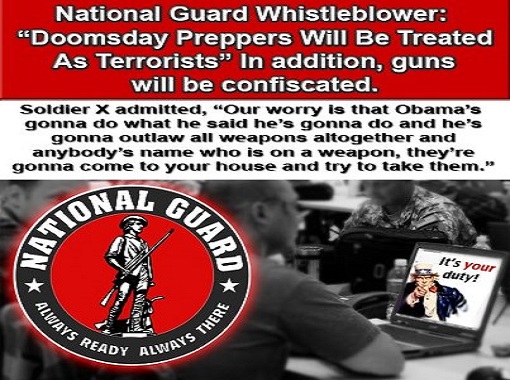
So begins the Oath of Enlistment for the U.S. military, but in an explosive interview with a National Guard whistleblower shown below, soldiers are now being advised they will be ordered to break that oath should civil unrest erupt across the country.
Referred to only as “Soldier X” under promise of anonymity, an Army National Guardsman spoke via phone with Infowars Nightly News Producer Rob Dew regarding a recent briefing his unit underwent on actions the military would take in the event that an Obama election loss sparked rioting in America’s streets.
Citing not only recent widespread threats to riot if Mitt Romney were to become the next U.S. president, but threats to actually assassinate him should he win, Soldier X’s superiors dispensed plans of how the National Guard would be responsible for “taking over” and quelling such unrest.
The soldiers were reportedly told “Doomsday preppers will be treated as terrorists.”
In addition, guns will be confiscated.
“They have a list compiled of all these doomsday preppers that have gone public and they plan to go after them first,” Soldier X said. He claimed those in charge are acting under the belief that preppers will be “the worst part” of any potential civil unrest.
Soldier X was also told that any soldiers in the ranks who are known as preppers will be deemed “defects.” He explained the label meant these soldiers would be treated as traitors. “If you don’t conform, they will get rid of you,” he added.
Unit members also warned not to associate with any fellow soldiers who are preppers.
Not only does the military reportedly plan to target preppers should mass chaos break out, but Soldier X also voiced his concerns regarding civilian gun confiscation.
Soldier X admitted, “Our worry is that Obama’s gonna do what he said he’s gonna do and he’s gonna outlaw all weapons altogether and anybody’s name who is on a weapon, they’re gonna come to your house and try to take them.”
It would not be the first time the National Guard has been used to unconstitutionally disarm law-abiding citizens, robbing them of their Second Amendment right to bear arms. In the aftermath of hurricane Katrina, police and military took to the streets disarming lawful gun owners, including those who were on dry land and had plenty of stored food and water.
Fast forward to this past summer when a leaked Army manual dated 2006 entitled, “Civil Disturbance Operations” surfaced outlining plans not only to confiscate firearms domestically during mass unrest, but to actually detain and even kill American citizens who refuse to hand over their guns. This manual works in conjunction with “FM 3-39.40 Internment and Resettlement Operations,” another Army manual leaked this year, which instructs troops on how to properly detain and intern Americans into re-education camps, including ways that so-called “psy-op officers” will “indoctrinate” incarcerated “political activists” into developing an “understanding and appreciation of U.S. policies and actions.”
Add these manuals to the plethora of Executive Orders Obama has signed during his term which have dismantled our Constitution piece by piece, including the martial law implementing National Defense Resources Preparedness Executive Order which gives the president the power to confiscate citizens’ private property in the event of any national emergency, including economic.
Add it all to the National Defense Authorization Act (NDAA) in which Obama granted powers to disappear and indefinitely detain American citizens without any due process, and it is easy to see the tyrannical big picture our government has painted.
When asked if he would go along with gun confiscation, Soldier X replied he and his fellow like-minded guardsmen planned to stand down — not answer the phone or show up to post.
“I’m sorry but I don’t believe in suicide,” he said.
Preppers are becoming regular government targets these days, most recently when a Missisippi prepper group member with a clean record was suddenly taken off his flight halfway to Japan and informed he was on the no-fly list, an FBI terrorist watchlist, stranding him in Hawaii. Other preppers have been denied their Second Amendment rights without legitimate cause.
It is beyond glaringly obvious at this point the U.S. government is gearing up for mass civil unrest. Not only has the DHS sparked controversy by purchasing billions of rounds of ammo, but the department even went so far as to begin classifying further purchases, blacking out bullet figures it is using taxpayer money to buy.
In addition, while FEMA can procure a billion dollars in bulk food supplies, the FBI’s Communities Against Terrorism project released a flier instructing military surplus store owners to report any customers who “make bulk purchases of items” including “meals ready to eat”.
Should society as we know it collapse following the election, it would seem the ultimate prepper and the ultimate terrorist is, indeed, the U.S. government.
For the second time this year, self-proclaimed Anonymous spokesman Barrett Brown was raided by the FBI.
The latest dramatic incident occurred late Wednesday evening while Brown and another woman identified by some as his girlfriend were participating in an online chat on TinyChat with other individuals.
Two minutes into the recorded chat session, loud voices could be heard in the background of Brown’s residence in Texas while the woman in the room with him was in front of the computer screen. She quickly closed the computer screen, but the audio continued to capture events in the room as the FBI appeared to strong-arm Brown to put handcuffs on him. Brown could be heard yelling in the background.
A spokeswoman in the Dallas County sherriff’s office confirmed to Wired that Brown was raided last night and was booked into the county jail around 11 p.m. She said the FBI removed him from the jail this morning to take him to a different facility, but she did not know where he was headed.
California attorney Jay Leiderman, a member of Brown’s legal team, told Wired that Brown was scheduled to be arraigned today in Texas on making threats to a federal agent.
Asked if the FBI agents were aware that Brown was online at the time of their raid, Leiderman said, “They problaby would have preferred to raid him when he was not online.” He noted that the audio from the raid was “certainly less than flattering when they’re marching through these doors dropping F-bombs…. I imagine they would not want to have that captured if they could help it.”
A transcript of the TinyChat session has been posted online. Just moments before the arrest, there were jokes about whether one of the chat participants was real or just an animated GIF. Moments later, the chat participants faced a different conundrum: trying to figure out whether they’d just witnessed an FBI raid.
A voice that appeared to come from one of the arresting agents was heard saying something to the effect: “You’re going down! Get your hands down!”
Right as the noise began, another participant in the chat room showed up in a video window with a white handkerchief covering his lower face. “Is Barrett Browm getting fuckin’ raided by the FBI?” he appeared to say. “Holy shit!”
Brown’s latest raid came after he posted a long and rambling YouTube video in which he talked about taking drugs (though not today, he noted) and about retaliating against an FBI Agent named Robert Smith after he learned that his mother might be hit with obstruction of justice charges. The threat of charges was apparently related to a laptop of Brown’s that he apparently hid.
“So that’s why Robert Smith’s life is over,” Brown said in the video (beginning around minute 9:40). “When I say his life is over, I’m not saying I’m going to kill him, but I am going to ruin his life and look into his fucking kids. Because Aaron Barr did the same thing and he didn’t get raided for it. How do you like them apples?” he said, smiling.
The video, titled “Why I’m Going to Destroy FBI Agent Robert Smith Part Three: Revenge of the Lithe” was accompanied by a note apparently posted by Brown that reads: “Send all info on Agent Robert Smith to [email protected] so FBI can watch me look up his kids. It’s all legal, folks, Palantir chief counsel Matt Long already signed off on it when Themis planned worse.”
Brown also talked about being a target of the Zeta drug cartel and mentioned that he was heavily armed and was concerned that the cartel would come after him posed as federal officers.
“Any armed official of the U.S. government, particularly the FBI, will be regarded as potential Zeta assassin squads,” he said in the video. “As FBI knows … they know that I’m armed and I come from a military family and I was taught to shoot by a Vietnam veteran … and I will shoot all of them and kill them if they come and do anything…. I have reason to fear for my life.”
He signed off the video saying: “Frankly, it was pretty obvious I was going to be dead before I was 40 or so, so I wouldn’t mind going out with two FBI sidearms like a fucking Egyptian pharaoh. Adios.”
Asked about Brown’s comments, Leiderman said that he hadn’t seen the full video and wasn’t aware of everything Brown had said, but he noted that his client had a reputation for hyperbole and joking around, and that things he said might appear to be a threat when they weren’t really intended to be that way.
“It’s hard to understand the context [of what he said], Leiderman said. “But this is speech, so ordinarily we go to a First Amendment defense, but obviously there are lines that can be crossed where you can lose your First Amendment protection.”
An FBI spokeswoman had no comment to make on Brown’s arrest.
Police State Inbound! Writing on the Wall, Numerology Explained, Reasons for Practical Emergency Preparation. Government Insiders, Geological Activity, Extra Olympics Security, Numerology & the Mayan Calender connection!
The High Court of New Zealand has ruled that the police raid on Kim Dotcom’s mansion was unlawful along with seizure of the hard drives that were later cloned and illegally taken from New Zealand to the US by the FBI.
The warrants issued to search Dotcom’s mansion were general and did not clearly describe the offences they stipulated, ruled Justice Helen Winkelmann.
“They were general warrants, and as such, are invalid,” she explained.
The New Zealand police force is currently holding talks with the Crown Law on the next course of action and has refrained from commenting on the judgment.
The ruling released on Thursday by Justice Helen Winkelmann insists the warrants were too vague concerning the scope of the search and the items authorized to be seized by police.

 We’ve all been part of these discussions, and we’ve all read a ton of them on forums and blogs over the years: “if you could have only one gun for TEOTWAWKI, what would it be?” A more enlightened-seeming variant on this same theme are discussions that start with, “if you could pick only three guns for TSHTF…”