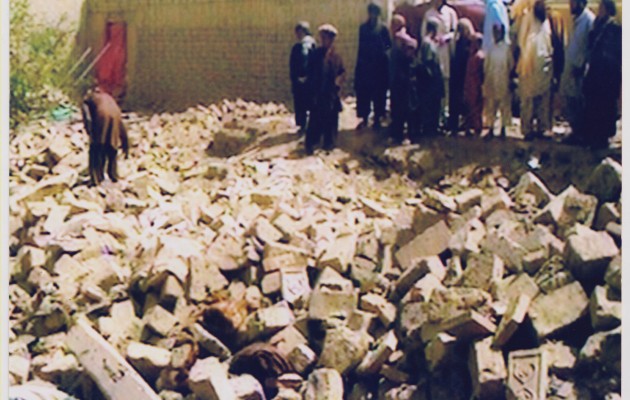
Saudi militants were behind the massive car bombing and assault on Yemen’s military headquarters that killed more than 50 people, including foreigners, investigators said in a preliminary report released Friday.
Al-Qaeda claimed responsibility for the attack, saying it was retaliation for US drone strikes that have killed dozens of the terror network’s leaders.
The attack – the deadliest in Sanaa since May 2012 – marked an escalation in the terror network’s battle to undermine the US-allied government and destabilise the impoverished Arab nation despite the drone strikes and a series of US-backed military offensive against it.
US forces also have been training and arming Yemeni special forces, and exchanging intelligence with the central government.
Military investigators described a two-stage operation, saying heavily armed militants wearing army uniforms first blew up a car packed with 500 kilograms of explosives near an entrance gate, then split into groups that swept through a military hospital and a laboratory, shooting at soldiers, doctors, nurses, doctors and patients.
Officials earlier said 11 militants were killed, including the suicide bomber who drove the car. It was not clear if the 12th attacker was captured or escaped.
The investigative committee led by Yemen’s Chief of Staff Gen. Ahmed al-Ashwal, said militants shot the guards outside the gates of the military hospital, allowing the suicide bomber to drive the car inside, but a gunfight forced him to detonate his explosives before reaching his target.
It said the 12 militants killed, included Saudis.
Two military officials told The Associated Press that wounded soldiers had told them the assailants who stormed the hospital separated out the foreigners and shot everybody in the head.
Other military officials said American security agents were helping with the investigations, but that could not be confirmed. All officials spoke on condition of anonymity because they were not allowed to brief reporters.
Yemeni commandos and other security forces besieged the militants before they could reach the ministry’s main building, preventing them from going further than the ministry’s entrance gate. All the attackers were killed by 4:30 pm Thursday, according to the committee.
Yemeni security forces launched a manhunt in the capital to find the perpetrators, sparking gun battles that killed five suspected militants and a Yemeni commando, officials said.
The committee, which sent its report to Yemeni President Abed Rabbo Mansour Hadi, did not explain how it came to its conclusions.
The report, read on state TV, raised the death toll to 56 and said more than 200 people were wounded.
The foreigners killed included two aid workers from Germany, two doctors from Vietnam, two nurses from the Philippines and a nurse from India, according to Yemen’s Supreme Security Commission.
But a spokesman for the Philippines’ Department of Foreign Affairs, Raul Hernandez, said on Friday that seven Filipinos were killed in the attack, including a doctor and nurses, while 11 others were wounded.
The victims were among 40 Filipino workers in the hospital. Hernandez said that the Philippines’ honorary consul reported that the others survived by pretending to be dead.
It was not immediately possible to reconcile the conflicting accounts. But officials from the military hospital said Friday that at least 10 foreigners had been killed.
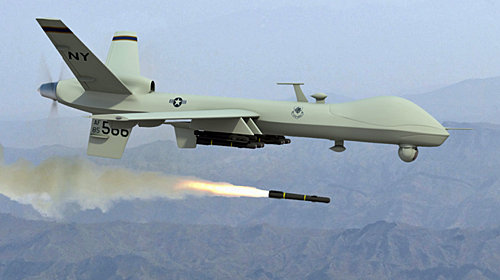
The United States considers the Yemeni al-Qaeda branch to be the most active in the world and it has escalated drone attacks against the militants in Yemen.
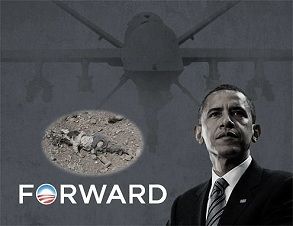
When Barack Obama took office, drone strikes were a once-in-a-while thing, with an attack every week or two. Now, they’re the centerpiece of a global U.S. counterterrorism campaign. Obama institutionalized the strikes to the point where he could hand off to the next president an efficient bureaucratic process for delivering death-by-robot practically on autopilot. Only now he’s the next president. Welcome to Obama’s second-term agenda for dealing with the world. As the Ramones sang: second verse, same as the first.
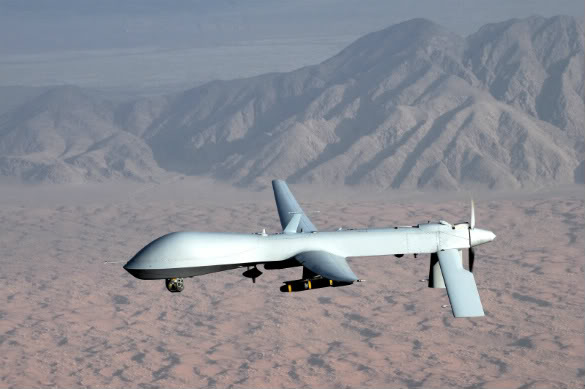
Early in the first term, then-CIA director Leon Panetta observed that drones were the “only game in town” for attacking al-Qaida in Pakistan. By that he meant invading a country for the third time in a decade was a nonstarter, and the flesh-and-blood spies needed to do a traditional intelligence operation weren’t available in sufficient numbers. So the Obama administration all but crafted its counterterrorism strategy around the drones, turning their surveillance and lethal operations into a bureaucratic apparatus led by White House aides with minimal outside oversight. The CIA and the Joint Special Operations Command, elite forces that rarely operate visibly, have the lead for implementing the robot-based agenda — and augmenting it with commando raids. Backstopping them are new tools to invade and disrupt enemy data networks.
The strikes have spread from Pakistan to Yemen to Somalia. And now that Obama’s been reelected, expect them to spread to Mali, another country most Americans neither know nor understand. The northern part of the North African country has fallen into militant hands. U.S.-aligned forces are currently plotting to take it back. The coming arrival of Army Gen. David Rodriguez, the former day-to-day commander of the Afghanistan war, as leader of U.S. forces in Africa is a signal that Obama wants someone experienced at managing protracted wars on a continent where large troop footprints aren’t available. Instead, Rodriguez will have to track, check and erode the spread of al-Qaida in northern and eastern Africa using drones and commando forces, available from his expanding bases in places like Djibouti. If all of this seems routine, that’s the point.
The Obama administration is doing something similar with cyber weaponry. It’s trying to make them a normal part of everyday conflict. Gone are the days when senior officers equivocated in public about their ability to disrupt enemy data networks. Now the Air Force talks openly about spending $10 million on new tools “to destroy, deny, degrade, disrupt, deceive, corrupt, or usurp the adversaries [sic] ability to use the cyberspace domain for his advantage.” The Pentagon’s futurists at Darpa have launched a new “Plan X” to routinize the corruption of enemy networks and the exfiltration of data within normal military operations. Routinization may actually be the wrong word: Darpa wants military malware that works like “the auto-pilot function in modern aircraft.” The Stuxnet worm that messed with Iran’s centrifuges was only the beginning.
All this might seem aggressive for a president who liked to say on the campaign trail that “the tide of war is receding.” But the tide of war never actually goes out. And the wicked-hard problems facing Obama’s national security team may only be getting under way.
Next comes Iran. Israel’s Benjamin Netanyahu has suggested that he will feel the need to strike Iran by next summer. Obama has a stronger hand with Netanyahu now that he doesn’t have to worry about reelection, but he’s still committed himself rhetorically to preventing an Iranian nuclear weapon. Even if Obama can avert a war, his clear preference, Iran will continue to consume a tremendous amount of the White House and the Pentagon’s attention. The alternative to a massive bombing campaign might not be so benign, either: the point of Stuxnet was to make the Iranians distrust the industrial controls on their nuclear program’s centrifuges.
Then comes Afghanistan, a war that Obama does not discuss candidly. He’s fond of saying, as he did in one of his final ads, that he plans on “ending the war in Afghanistan, so we can do some nation-building here at home.” His real policy is way more complex than that. Yes, Obama is committed to withdrawing most troops and ending a formal U.S. combat role by 2014. Obama plans to keep a residual troop presence in the country, even after the 2014 “withdrawal,” and negotiations with the Afghans about what shape that presence will take — and for what purpose — are supposed to begin shortly. Among the things Obama is likely to seek: Afghanistan’s permission to keep its air bases as launchpads for drone strikes into Pakistan. The charitable interpretation is to say Obama is caveating his out-of-Afghanistan pledge. The uncharitable interpretation is that he’s misleading the country on it.
The Obama administration is still grappling with the implications of its sprawling, robot-led war. Some of its top officials are just starting to question how long the strikes have to persist. But they haven’t addressed concerns about the precedent the U.S. is setting by sending robots to violate the sovereignty of nations, which are unavoidable as drone technology advances and proliferates. Micah Zenko, a scholar at the Council on Foreign Relations, sees a reckoning with the robots on the horizon.
“There is a recognition within the administration that the current trajectory of drone strikes is unsustainable,” Zenko says. “They are opposed in countries where strikes occur and globally, and that opposition could lead to losing host-nation support for current or future drone bases or over-flight rights.” In other words, tomorrow’s America diplomats may find that drones overshadow the routine geopolitical agenda they seek to advance. The trouble is, the administration’s early search for less-lethal policies to supplement or supplant the drones isn’t promising.
Obama’s broader foreign policy agenda keeps getting derailed. He barely talks about his expansive goal of eliminating global nuclear weapons anymore. Any route to an Israeli-Palestinian peace runs through Netanyahu, who only wants to talk about Iran. The much-heralded “pivot” of the U.S. defense posture toward Asia, a relatively modest goal, keeps getting deferred by the crises of the moment: the Navy’s newest and more advanced ships are going to confront Iran, not to preserve the freedom of the Pacific shipping lanes. A former Obama Pentagon official, Rosa Brooks, recently lamented the Obama team’s chronic inability to shape global events.
Civil libertarians rightly point to Obama’s reversals on expanding warrantless surveillance; the indefinite detention of terrorism suspects; military tribunals at Guantanamo Bay; prosecuting whistleblowers; and embracing an expensive definition of the war on terrorism’s executive powers. But there’s little evidence that Obama will change course. In an insightful blog post, the Brookings Institution’s Benjamin Wittes writes that Obama’s civil-liberties and national security record is best explained by a policy “consensus” in D.C., running through George W. Bush’s second term and Obama’s first, that basically agrees on a definition of executive power that civil libertarians dislike. It’s uncomfortable with torture, but basically comfortable with expansive domestic spying and detention powers.
As Obama’s second term dawns, it’s time to put away ideological illusions about his approach to foreign affairs. Liberals keep waiting for an agenda that’s less killer-robot-y. Conservatives are unable to see him as anything but a peacenik: “We’ll get to see what jimmy carter’s 2nd term would have looked like,” tweeted Jim Carafano, a defense analyst at the conservative Heritage Foundation.
But the evidence is staring everyone in the face. Obama has elevated a practice of stealthy robotic warfare to the tactic of choice for U.S. security priorities, and built around it a system that operates it practically on bureaucratic inertia. Obama has a powerful incentive of all to continue his trajectory: with the one major exception of the Benghazi consulate disaster, Obama’s handling of global affairs has been notably free of high-profile screwups. That’s the sort of thing that propels a foreign policy agenda — to borrow a term — forward.
A law professor at Notre Dame leads a lonely campaign to stop the targeted killings in Pakistan and elsewhere, insisting they violate international law.
Notre Dame law professor Mary Ellen O’Connell is a leading critic of the U.S. targeted-killing program against Al Qaeda militants. (Los Angeles Times, Ken Dilanian / October 9, 2012)
SOUTH BEND, Ind. — Notre Dame law professor Mary Ellen O’Connell was in her office last month when Imran Khan, a former cricket star who could be Pakistan’s next prime minister, phoned to ask for help.
Pakistanis are furious about the CIA‘s covert campaign of drone missile strikes, Khan told her. Was she aware that the CIA often doesn’t know who it is killing?
“Yes, of all Americans, I think I have a pretty good handle on the facts,” she replied, recounting the call.
O’Connell, a fierce critic of America’s drone attacks outside a war zone, insists the targeted killings are illegal under international law.
“We wouldn’t accept or want a world in which Russia or China or Iran is claiming authority to kill alleged enemies of the state based on secret evidence of the executive branch alone,” O’Connell said. “And yet that’s the authority we’re asserting.”
O’Connell, 54, has led a lonely campaign to stop the drones since she wrote a paper branding the first CIA drone strike, in 2002, as unlawful. She rejected claims by the George W. Bush administration that the attack, which killed several Al Qaeda militants and a U.S. citizen, was a legitimate act of self-defense in the war on terrorism.
Since then, President Obama has sharply increased drone attacks, and O’Connell has jousted with government officials, debated other academics and outlined her critique in scholarly publications.
“Her views are definitely taken seriously,” said Sean Murphy, a former State Department lawyer who argues the drone strikes are permitted under the law. “She’s on the leading edge of this argument.”
She remains in a small minority of U.S. legal scholars, but her views are gaining currency as targeted killings continue.
A report issued last month by researchers at the law schools of New York University and Stanford University argued that many U.S. drone strikes appear unlawful because they don’t meet the strict legal test for killing outside a war zone — to stop an imminent threat to life when no other means is available.
In June, Christof Heyns, the United Nations special rapporteur on extrajudicial killings, told a conference in Geneva that “double tap” drone strikes, in which a second missile is fired at people coming to aid the wounded, could constitute a war crime. Pakistan claims several such attacks have occurred in its tribal areas.
O’Connell and her intellectual allies agree the United States is fighting a lawful war in Afghanistan because it gave shelter to terrorists who attacked America on Sept. 11, 2001. But they argue that killing militants in Pakistan, Yemen and Somalia is not a legitimate part of that conflict, and thus violates laws of war intended to protect noncombatants.
If the U.S. government has a case against an Al Qaeda militant in Yemen or Somalia, they argue, it must try to arrest him and give him a chance to surrender unless lives are in immediate danger.
That view strikes O’Connell’s many critics as a naive reading of international law that fails to account for modern stateless terrorists. But the U.S. government held a similar view until the Sept. 11, 2001, attacks.
U.S. officials criticized Israel for killing Palestinian militants on the West Bank in the 1990s, for example, and CIA officials believed they lacked the authority to kill Osama bin Laden even after he was indicted for the 1998 bombings of two U.S. embassies in East Africa.
National Security Council spokesman Tommy Vietor declined to comment for this article, but he noted that White House counter-terrorism advisor John Brennan publicly explained the administration’s view on targeted killings in April.
“As a matter of international law, the United States is in an armed conflict with Al Qaeda, the Taliban, and associated forces, in response to the 9/11 attacks, and we may also use force consistent with our inherent right of national self-defense,” Brennan said.
Under Obama, the United States has launched 284 drone missile strikes in Pakistan and 49 in Yemen, according to independent groups that track reported attacks. That’s up from 46 in Pakistan and one in Yemen under Bush. Strikes have also been reported in Somalia.
So-called high-value targets typically are named on a classified “kill list,” which is reviewed by lawyers from the White House, the CIA, the Pentagon and other agencies. Many others are killed in “signature strikes” that target unidentified militants based on activities deemed suspicious.
In September, Obama sought to explain who gets targeted and why.
“It has to be a threat that is serious and not speculative,” Obama told CNN. “It has to be a situation in which we can’t capture the individual before they move forward on some sort of operational plot against the United States.”
O’Connell and other critics say no evidence suggests that all those killed met Obama’s standard. Drone strikes have killed up to 3,000 people, according to the New America Foundation, a nonpartisan public policy institute in Washington.
O’Connell sees her effort as an exercise in moral suasion, similar to the public outcry that erupted after news reports detailed how the CIA had used waterboarding and other harsh interrogation techniques against several Al Qaeda detainees after Sept. 11.
A trim woman with brown hair, O’Connell isn’t a pacifist. Her husband is a former Army interrogator who served in the first Gulf War. They met while she was working for the Defense Department, teaching soldiers about international law.
O’Connell praises the Navy SEAL mission that killed Bin Laden, and supports using drones to target enemy fighters in Afghanistan. “I do think drones can be a more accurate weapon, and I’m all in favor of saving our troops’ lives,” she said.
Benjamin Wittes, a Brookings Institution fellow who supports the drone strikes, put O’Connell on the defensive in a debate two years ago by challenging her to take her position to its logical conclusion — as he put it, “that President Obama is a serial killer.”
She fumbled her response. But upon reflection, she sees some parallels to the abortion debate. One can believe, as she does strongly, that abortion is deeply immoral, without labeling women who have abortions as murderers.
“I feel the same way about targeted killing,” she said. “I understand that Americans don’t … see it, but we want the practice to end. I don’t think President Obama should go to jail for it.”
Last week, Venezuelan President Hugo Chavez showcased his country’s first unmanned drone. It seems that an international race to dominate the sky has gone underway and the South American country has become a player in the game of drones with the help of Iran, Russia and China. Retired Army Colonel Douglas Macgregor joins us to explain why more and more countries are rushing to get their hands on an unmanned aircraft.
The United States Air Force, through the use of unmanned aerial drones, is set to be deployed inside the United States to collect data, investigate places of interest, and share data with local police agencies.
An unclassified Air Force Memo from late April documents the fact that the military is operating drone aircraft domestically and that, through a complete end run around the Constitution, can essentially share it with local law enforcement even if it has no relation to terrorism.
While many articles have already been published detailing the fact that the military is or will be sharing information they collect with local law enforcement, a more startling fact has been largely ignored by the corporate controlled media. (until now)
In a recently published op-ed, Andrew Napolitano outlined the fact that once the military identifies something of interest they can apply to a military commander for permission to conduct searches of American property and or citizens which in turn is a form of martial law.
“It gets worse. If the military personnel see something of interest from a drone, they may apply to a military judge or “military commander” for permission to conduct a physical search of the private property that intrigues them. And, any “incidentally acquired information” can be retained or turned over to local law enforcement. What’s next? Prosecutions before military tribunals in the U.S,” wrote Napolitano.
The Electronic Frontier Foundation has also publicly commented on the fact that the Air Force is now openly recording information on the American people in domestic situations.
“We’ve seen in some records that were released by the Air Force just recently, that under their rules, they are allowed to fly drones in public areas and record information on domestic situations,” explained Jennifer Lynch, of the EFF.
Madison Ruppert, writing for EndtheLie.com, detailed the broad exceptions to a guideline that is supposed to limit the military from non-consensual surveillance.
While the U.S. Air Force’s guidelines claim that drones are not allowed to carry out “non-consensual surveillance” on U.S. citizens or property, there are plenty of exceptions to this allowing such surveillance to occur.
Some of these many exceptions outlined in the Air Force documents include:
– Investigating or preventing clandestine intelligence activities by foreign powers, international narcotics activities, or international terrorist activities
– Protecting DoD employees, information, property and facilities
– Preventing, detecting or investigating other violations of law
Seems pretty broad, doesn’t it? “Other violations of law” leaves the door wide open for the drones to be used for just about everything. After all, jaywalking is a violation of law. Does this mean that if a drone captures someone jaywalking, the use of military drones in U.S. airspace is somehow justified?
That’s right, the Air Force now has the authority to carry out drone surveillance on American citizens for essentially any violation of law.
Sadly, we now live in a country were 30,000 drones are set to be launched by various law enforcement agencies, the military, and private companies.
The idea of the military not being used against the American people has now been completely thrown out the window with the only hope citizens of this country have left being the support of individual military members who choose to go against these Unconstitutional directives.
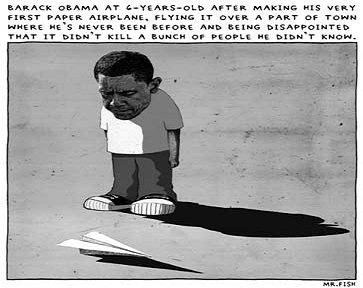
Barack Obama at 6 Years Old after making his first paper airplane, flying it over a part of town where he’s never been before, and being disappointed that it didn’t kill a bunch of people he didn’t know.
Today Andrew Rosenthal of The New York Timespublished a thoughtful columndiscussing the untenable position taken by the government in response to the ACLU’s two Freedom of Information Act lawsuits seeking information about the CIA’s targeted killing drone strike program, including its targeting of U.S. citizens. As Rosenthal explains, “the government is blocking any consideration of these petitions with one of the oldest, and most pathetic, dodges in the secrecy game. It says it cannot confirm or deny the existence of any drone strike policy or program.”
Rosenthal goes on to highlight the reasons why the government’s position is untenable:
That would be unacceptable under any condition, but it’s completely ridiculous when you take into account the fact that a) there have been voluminous news accounts of drone strikes, including the one on Mr. Awlaki, and b) pretty much every top government official involved in this issue has talked about the drone strikes in public.
He also highlights the arguments made in the ACLU’s latest legal brief in the cases, excerpting from our “13 pages of examples of how ‘the government has already specifically and officially acknowledged the program that the CIA now says is secret.'”
Perhaps most telling is Rosenthal’s comment about how little progress we have made since the worst secrecy abuses of the Bush era:
Governments have good reasons for keeping secrets – to protect soldiers in battle, or nuclear launch codes, or the identities of intelligence sources, undercover agents and witnesses against the mob. (Naturally that’s not an exhaustive list.) Governments also have bad reasons for keeping secrets – to avoid embarrassment, evade oversight or escape legal accountability.
The Bush administration kept secrets largely for bad reasons: It covered up its torture memos, the kidnapping of innocent foreign citizens, illegal wiretapping and other misdeeds. Barack Obama promised to bring more transparency to Washington in the 2008 campaign, but he has failed to do that. In some ways, his administration is even worse than the Bush team when it comes to abusing the privilege of secrecy.
He concludes:
So this is not a secret program, but the government continues to hide behind the secrecy shield to avoid turning over the legal document justifying (or at least rationalizing) it. It’s even using the “can’t confirm or deny” fabrication about the existence of the document itself.
My guess is that the Obama administration just wants to avoid public disclosure, scrutiny and accountability. I’d ask someone at the Justice Department, but they wouldn’t be able to tell me, because it’s a secret.
Rosenthal’s column joins the chorus of voices calling for greater transparencyaround targeted killing and for a sensible government response to the ACLU’s FOIA requests. The government must provide the public with the information it needs to assess the legality and wisdom of the CIA’s global targeted killing campaign.
Two major investigations have provided fresh evidence that civilians are continuing to be killed in Pakistan’s tribal areas by CIA drones – despite aggressive Agency denials.
In a study of ten major drone strikes in Pakistan since 2010, global news agency Associated Press deployed a field reporter to Waziristan and questioned more than 80 local people about ten CIA attacks. The results generally confirm the accuracy of original credible media reports – and in two cases identify previously unrecorded civilian deaths.
In a further case, in which an anonymous US official had previously attacked the Bureau’s findings of six civilian deaths in a 2011 strike, AP’s report has confirmed the Bureau’s work.
Anglo-American legal charity Reprieve has also filed a case with the United Nations Human Rights Council, based on sworn affidavits by 18 family members of civilians killed in CIA attacks – many of them children. Reprieve is calling on the UNHRC ‘to condemn the attacks as illegal human rights violations.’
New casualties
The Associated Press investigation, authored by the agency’s Islamabad chief Sebastian Abbot, represents one of the largest field studies yet into casualties of CIA drone strikes.
AP’s field reporter interviewed more than 80 local civilians in Waziristan in connection with 10 major CIA strikes since 2010. It found that of 194 people killed in the strikes, 138 were confirmed as militants:
The remaining 56 were either civilians or tribal police, and 38 of them were killed in a single attack on March 17, 2011. Excluding that strike, which inflicted one of the worst civilian death tolls since the drone program started in Pakistan, nearly 90 percent of the people killed were militants, villagers said.
In two of the ten cases AP has turned up previously-unreported civilian casualties.
On August 14 2010 AP found that seven civilians died – including a ten year old child – alongside seven Pakistan Taliban. The deaths occurred during Ramadan prayers. Until now it had not been known that civilians had died in the attack. US officials told AP that its own assessments indicated all those killed were militants.
On April 22 2011, AP confirms that three children and two women were among 25 dead in an attack on a guest house where militants were staying. Three named eyewitnesses in the village of Spinwan confirmed that the civilians had died – two had attended their funerals.
Bureau findings confirmed
The AP investigation has also independently confirmed that six civilians died alongside ten Taliban in an attack on a roadside restaurant on May 6 2011.
Last year the Bureau’s field researchers in Waziristan identified by name six civilians killed in the attack by the CIA. An anonymous US official used the New York Times to mock the Bureau at the time: ‘The claim that a restaurant was struck is ludicrous.’
Now AP’s investigation endorses the Bureau’s findings, stating: ‘Missiles hit a vehicle parked near a restaurant in Dotoi village, killing 16 people, including 10 Taliban militants and six tribesmen.’
United Nations
In the second new report confirming civilian casualties in US drone strikes, Reprieve has filed a major case with the United Nations Human Rights Council.
The study details a dozen drone strikes in Pakistan during President Obama’s time in office. Each is supported by witness affidavits, mostly from family members of civilians killed.
For example on Valentine’s Day 2009, just weeks after Obama came to office, a CIA drone attack struck a village in North Waziristan. Between 26 and 35 people died in the attack, nine of them civilians. One of those killed was an eight year old boy, Noor Syed. The complaint to the UNHRC draws on evidence from Noor’s father:
Maezol Khan is a resident of Makeen in South Waziristan, Pakistan. In the early morning of February 14, 2009, he and his son were sleeping in the courtyard of their home when a missile from a drone struck a nearby car. As a result of the explosion, a missile part flew into the courtyard, killing Maezol’s eight-year-old son. In addition, there were approximately 30 people killed or injured in the attack.
Noor Syed Aged 8 (Photo: Noor Behram)
Another complaint reports that four civilians died on June 15 2011 when a CIA missile hit their car in Miranshah, North Waziristan.
Far from being Taliban, the men were a pharmacist and his assistant; a student; and an employee of the local water authority.
That attack so enraged local opinion that at the mens’ funeral their coffins were used to block the main highway in a spontaneous protest at CIA attacks.
Clive Stafford Smith, Reprieve’s director, said that the CIA was ‘creating desolation and calling it peace.’
The UN must put a stop to it before any more children are killed. Not only is it causing untold suffering to the people of North West Pakistan – it is also the most effective recruiting sergeant yet for the very ‘militants’ the US claims to be targeting.
Pakistan barrister Mirza Shahzad Akbar runs the Foundation for Fundamental Rights, and prepared the UNHCR submission. He told the Bureau:
‘The US needs to address the question of a large number civilian victims, and also has to respect the well established international laws and norm. The UN is the best forum to discuss drones-related humanitarian issue as well as its far reaching impact on world politics.’

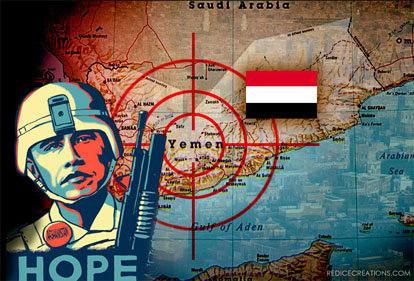
 Saudi militants were behind the massive car bombing and assault on Yemen’s military headquarters that killed more than 50 people, including foreigners, investigators said in a preliminary report released Friday.