Mars Probe Captured Images Resembling Trees
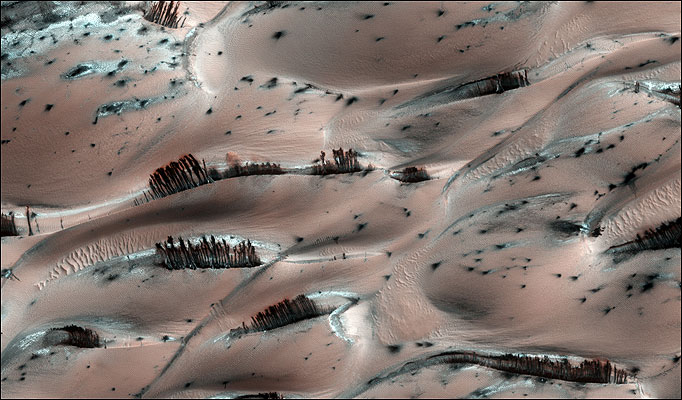
A NASA Mars orbiter transmitted images back to Earth that appeared to show rows of dark conifer-like formations sprouting from the Martian surface. The photographs, taken by the HiRISE camera aboard the Mars Reconnaissance Orbiter, sparked widespread public fascination and confusion about what was actually being observed on the Red Planet.
The Optical Illusion Explained
Despite their striking resemblance to terrestrial vegetation, the dark formations were not trees at all. The images captured sand dunes located less than 240 miles from the Martian north pole, coated with a thin layer of frozen carbon dioxide, commonly known as dry ice.
As the Martian spring arrived and temperatures rose, the dry ice began to sublimate. This process destabilized dark basaltic sand beneath the frozen layer, causing it to cascade down the slopes of the dunes. The resulting trails of debris created long, branching streaks that bore a remarkable resemblance to coniferous trees when viewed from orbit.
Catching an Avalanche in Progress
One detail in the photograph drew particular attention from researchers. Just left of center in the image, a visible cloud of dust marked a landslide caught in the act, providing real-time evidence of the geological process responsible for the tree-like formations.
NASA scientist Candy Hansen explained the phenomenon: the streaks were composed of sand dislodged as surface ice evaporated, sliding down the dune faces under gravity. At that point in the Martian year, the entire scene remained covered in carbon dioxide frost, making the dark sand trails stand out even more dramatically against the bright frozen surface.
HiRISE: The Most Powerful Interplanetary Camera
The images were captured by HiRISE (High Resolution Imaging Science Experiment), the most powerful camera ever sent to another planet. Capable of resolving surface features as small as one meter across, HiRISE has been instrumental in revealing the dynamic geological processes still actively reshaping the Martian landscape.