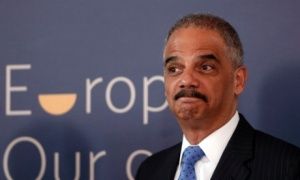
Holder’s Revolving Door Between Justice Department and Wall Street
When NPR broke the news that U.S. Attorney General Eric Holder intended to resign once his replacement was confirmed, the most revealing detail appeared buried at the bottom of the story. According to NPR, insiders expected Holder would likely rejoin Covington & Burling, the powerful corporate law firm where he had previously spent years representing major financial institutions.
That firm’s roster of corporate clients reads like a who’s who of Wall Street megabanks: JP Morgan Chase, Wells Fargo, Citigroup, and Bank of America all relied on Covington & Burling for legal representation. Lanny Breuer, who had led the criminal division under Holder’s Department of Justice, had already gone back through the revolving door to rejoin the firm.
Just months earlier, Covington & Burling proudly showcased a prestigious honor from the trade journal American Lawyer, which named them “Litigation Department of the Year.” The firm openly boasted about its track record of securing minimal penalties for clients accused of financial misconduct.
A Divided Record on Civil Liberties and Financial Accountability
Holder’s tenure produced a contradictory track record. His department earned praise for its strong positions on civil rights and voter protections, yet drew heavy criticism over press freedom and government transparency issues.
However, regarding the architects of the catastrophic financial fraud that devastated the American economy in 2008, Holder’s approach was unmistakable. His former employer’s own marketing language told the whole story: they specialized in helping clients secure the most favorable outcomes possible. Meanwhile, millions of ordinary homeowners received virtually nothing in return for enduring some of the worst consumer abuses in modern American history.
How Banks Engineered the Housing Bubble Through Systemic Fraud
Prior to Holder’s appointment as the nation’s top law enforcement official, major financial institutions had inflated the housing bubble through predatory lending and practices that were, in many cases, allegedly criminal.
The FBI had sounded the alarm as early as 2004, identifying what they described as a sweeping epidemic of mortgage fraud that they predicted could rival the devastation of the Savings & Loan collapse. Their forecast turned out to be conservative by orders of magnitude.
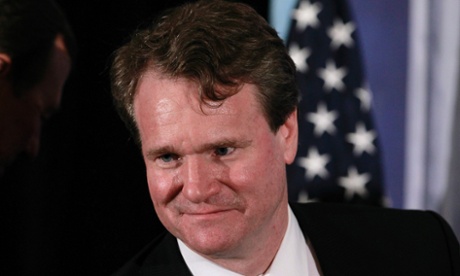
Financial institutions embedded fraudulent practices at every stage of the mortgage pipeline. At origination, they employed manipulated appraisals and concealed unfavorable terms from borrowers. During servicing, they tacked on illegal fees and pushed through unnecessary foreclosures. In the securities market, they sold mortgage-backed instruments to investors without disclosing the dangerously poor underwriting standards behind the underlying loans. When their failure to properly construct these securities came to light, they papered over the gaps with fabricated documents and forged paperwork to establish foreclosure standing.
A Target-Rich Environment That Prosecutors Left Untouched
By the time the bubble burst, the economy cratered, and Holder assumed control of the Justice Department, Wall Street presented an extraordinary landscape of prosecutable offenses. Documentary evidence of countless potential crimes sat in plain sight within court filings and county land records across the nation.
Internal financial audits had already exposed major breakdowns in underwriting practices dating back to 2005. The Sarbanes-Oxley Act of 2002 contained provisions that could have held chief executives personally liable for misrepresenting their institutions’ risk management practices to federal regulators.
A competent prosecutor could have built cases that reached the highest levels of bank leadership. In 2009, Congress even passed the Fraud Enforcement and Recovery Act, allocating $165 million specifically for the Justice Department to staff investigations aimed at holding those responsible for the financial meltdown accountable.
Despite all of this, not a single top banking executive was imprisoned for their role in engineering the worst financial disaster since the Great Depression.
Small Fish Prosecuted While Big Banks Got Cash Settlements
The Justice Department found the resources to send reality television personalities to prison for mortgage fraud, but could not muster the will to prosecute the actual bankers whose institutions perpetrated fraud on a massive scale. Federal prosecutors reserved their toughest enforcement actions for individuals who cheated banks, rather than for banks that systematically cheated the public.
The overwhelming majority of investigations into major financial institutions during Holder’s six-year tenure were quickly funneled toward monetary settlements. In most cases, no individual was required to admit wrongdoing, and the public received no meaningful accounting of what crimes had actually been committed.
The headline figures attached to these settlements consistently obscured the true cost to the banks. The National Mortgage Settlement, which Holder’s Justice Department trumpeted as a $25 billion agreement, allowed banks to satisfy roughly one-quarter of their obligations using money that belonged to other parties, reducing principal balances on loans the banks did not even hold.
A string of securities fraud settlements with JP Morgan, Bank of America, and Citigroup that the Department of Justice valued at a combined $36.65 billion actually cost those institutions closer to $11.5 billion. And it was shareholders who absorbed those losses, not the executives who oversaw the misconduct.
To compound the problem, the Wall Street Journal discovered that the Justice Department managed to collect only about 25 percent of the penalties it imposed, meaning the banks may have paid even less than the already-reduced figures suggest.
Settlements That Rewarded Misconduct Instead of Punishing It
These negotiated outcomes effectively transformed the concept of accountability into a corporate public relations exercise. The Holder Justice Department was itself caught manipulating the numbers, admitting in August 2013 that it had inflated criminal financial fraud charges by more than 80 percent.
The Department’s own Inspector General issued a damning report in March documenting how the Justice Department had actively deprioritized mortgage fraud investigations, categorizing the issue as the lowest-ranked criminal threat between 2009 and 2011.
Homeowners Left With Almost Nothing While Banks Moved On
The people who suffered most from Wall Street’s predatory behavior received almost no meaningful relief. Families who had already lost their homes to wrongful foreclosure received settlement checks ranging from just $1,500 to $2,000, barely enough to cover two months of rent.
While Justice Department officials initially claimed that one million homeowners still in their properties would receive principal reductions under the National Mortgage Settlement, the final accounting in March revealed that only 83,000 families actually benefited, representing an under-delivery of more than 90 percent.
Set against the backdrop of over five million families who experienced foreclosure in the crisis aftermath, this relief amounted to almost nothing.
For homeowners who were still eligible for assistance, the expiration of the Mortgage Forgiveness Debt Relief Act meant any principal reduction would be treated as taxable income. Struggling families facing potential foreclosure would then be hit with tax bills they had no ability to pay. The Justice Department acknowledged this problem only after the fact, creating a limited fund through a Bank of America settlement to partially offset tax consequences.
Unresolved Fraud Continues to Harm Homeowners
Perhaps most critically, none of these settlements actually stopped the underlying misconduct. Homeowners continued to lose their properties based on fraudulent documentation because the Justice Department had merely applied a bandage to the wound without addressing the root causes.
The failure to convict any senior banking figures effectively communicated to the entire financial sector that these crimes carried no meaningful consequences. This implicit guarantee of immunity created a moral hazard suggesting the same fraudulent practices could be repeated without fear of prosecution.
While responsibility for the policy of shielding banks at the expense of ordinary Americans ultimately rested with the president and his administration rather than any single official, Holder was the one who executed that policy throughout his tenure. His anticipated return to the very firm that represented those same banks cast his entire time in office in a deeply unflattering light.
Originally reported by The Guardian. Content has been independently rewritten and expanded for editorial purposes.