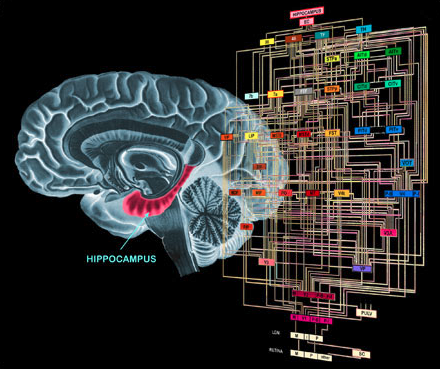
Competing with the US during the Arms Race, the Soviet Union put extensive effort in unconventional research seeking to outflank its rival in understanding behavior control, remote influencing and parapsychology, a new survey by Cornell University Library has revealed.
The survey published by Cornell University Library is based on open scientific and journalistic materials and provides an overview of unconventional research in the USSR and then in its successor, Russia, in the period between 1917 and 2003 – as compared to the USA.
The report by Serge Kernbach showed that unconventional weapons took the scientists in both countries to areas bordering sci-fi which nowadays would be seen in TV programs featuring UFOs, the supernatural and superpowers.
Due the Iron Curtain, Soviet and American scientists knew little about each other’s secret work – still, they focused on same themes.
In the Soviet Union, among the areas of particular interest, were, for instance, “the impact of weak and strong electromagnetic emission on biological objects, quantum entanglement in macroscopic systems, nonlocal signal transmission based on the Aharonov-Bohm effect, and ‘human operator’ phenomena,” the survey says.
Soviet scientists were developing a field they dubbed “psychotronics.” The country spent between $0.5-1 billion on research of the phenomena, Kernbach who works, at the Research Center of Advanced Robotics and Environmental Science in Stuttgart, Germany, found out.
Some of the programs in psychotronic research – even those launched decades ago – have not been officially published.
“For instance, documents on experiments performed in OGPU and NKVD – even 80 years after – still remain classified,” Kernbach noted. The OGPU (Joint State Political Directorate) was the Soviet secret police and the NKVD (The People’s Commissariat for Internal Affairs) was the main law enforcing body, which was later transformed into the Internal Ministry and a security organization which was part of it – into the KGB.
According to the survey, Soviet and American areas of interest often mirrored each other. In particular, Kernbach recalls the Central Intelligence Agency’s (CIA) scandalous human research program MKUltra which involved the use of various methods to manipulate an individual’s mental states and alter brain functions.
“As mentioned in the public documents, the program to some extent was motivated by the corresponding NKVD’s program, with similar strategies of using psychotropic (e.g. drugs) substances and technical equipment,” Kernbach said.
In the 60s and the 70s, the Soviet Union was actively researching the influence of electromagnetic fields on human physiological and psychological conditions. Several authors point to the application of research results in the form of new weapons in the USA and the Soviet Union.
“Over the past years, US researchers have confirmed the possibility of affecting functions of the nervous system by weak electromagnetic fields (EMFs), as it was previously said by Soviet researchers. EMFs may cause acoustic hallucination (’radiosound’) and reduce the sensitivity of humans and animals to some other stimuli, to change the activity of the brain (especially the hypothalamus and the cortex), to break the processes of formation processing and information storage in the brain. These nonspecific changes in the central nervous system can serve as a basis for studying the possibilities of the direct influence of EMFs on specific functions of CNS,” read an article in Nauka (Science) magazine in 1982.
A US Marine Corps truck is seen carrying a palletized version of the Active Denial System, March 9th, 2012, at the US Marine Corps Base Quantico, Virginia. It is a US DoD non-lethal weapon that uses directed energy and projects a beam of man-sized millimeter waves up to 1000 meters that when fired at a human, delivers a heat sensation to the skin and generally makes humans stop what they are doing and run. (AFP Photo/Paul J. Richards)
Kernbach’s analysis lacks details on practical results of unconventional research in the USSR.
He mentions though a device invented by Anatoly Beridze-Stakhovsky – the torsion generator ‘Cerpan’. The exact structure of the device is unknown, as the scientist feared it would be put to unethical uses. Cerpan was designed on the “shape effect” produced by torsion fields. Some sources claim that the device – a 7-kilo metal cylinder – was used to heal people, including Kremlin senior officials.
Kernbach’s overview of unconventional research in USSR and Russia suggests that following the collapse of the USSR in 1991, these programs were first reduced and then completely closed in 2003.
“Due to academic and non-academic researchers, the instrumental psychotronics, denoted sometimes as torsionics, still continue to grow, but we cannot speak about government programs in Russia any longer,” he said.
However, based on the number of participants at major conferences, the number of psychotronics researchers in Russia is estimated between 200 and 500, the report said.
Last year, the now-fired Defense Minister Anatoly Serdyukov said his ministry was working on futuristic weaponry.
“The development of weaponry based on new physics principles; direct-energy weapons, geophysical weapons, wave-energy weapons, genetic weapons, psychotronic weapons, etc., is part of the state arms procurement program for 2011-2020,”Serdyukov said at a meeting with the then Prime Minister Vladimir Putin, cited RIA Novosti.
That followed a series of Putin’s presidential campaign articles, one of which focused on national security guarantees. Speaking about new challenges that Russia may face, and which armed forces should be ready to respond to, he wrote:
“Space-based systems and IT tools, especially in cyberspace, will play a great, if not decisive role in armed conflicts. In a more remote future, weapon systems that use different physical principles will be created (beam, geophysical, wave, genetic, psychophysical and other types of weapons). All this will provide fundamentally new instruments for achieving political and strategic goals in addition to nuclear weapons.”
FEMA Camp Freak-Out! Crash Course & Fact Finding into the Federal Emergency Management Agency, Overreaching Executive Orders, Empty and Ready ‘Detainment Camps’ & Plans for Continuity of Government.
WASHINGTON – The co-owner of a major Pentagon propaganda contractor publicly admitted Thursday that he was behind a series of websites used to discredit two USA TODAY journalists who had reported on the contractor.
Screengrab from home page of leoniegroup.comCamille Chidiac, a minority owner of Leonie Industries, says he acted independently of the company when he created web sites and social media accounts in an effort to discredit two USA TODAY journalists.
Camille Chidiac, a minority owner of Leonie Industries, says he acted independently of the company when he created web sites and social media accounts in an effort to discredit two USA TODAY journalists.
The online “misinformation campaign,” first reported last month, has raised questions about whether the Pentagon or its contractors had turned its propaganda operations against U.S. citizens. But Camille Chidiac, the minority owner of Leonie Industries and its former president, said he was responsible for the online activity and was operating independent of the company or the Pentagon.
“I take full responsibility for having some of the discussion forums opened and reproducing their previously published USA TODAY articles on them,” he said a statement released by his attorney, Lin Wood, of Atlanta.
“I recognize and deeply regret that my actions have caused concerns for Leonie and the U.S. military. This was never my intention. As an immediate corrective action, I am in the process of completely divesting my remaining minority ownership from Leonie,” Chidiac said.
Chidiac, who stepped down as president of Leonie in 2008, said he used only personal funds to create the websites using proxy services to hide his involvement. Although Chidiac has continued to represent Leonie at various conferences, the company said any involvement was “informal and unofficial.”
The Pentagon said Defense Secretary Leon Panetta was aware of the statement and “has directed the department to review this matter and to take appropriate action.”
“We were deeply disappointed to read this disclosure from Leonie Industries. Smear campaigns — online or anywhere else — are intolerable, and we reject this kind of behavior,” said Pentagon press secretary George Little.
In February, USA TODAY reported on the Pentagon’s “information operations” program, which was coming under criticism even within the Pentagon for spending hundreds of millions for poorly monitored marketing campaigns in Iraq and Afghanistan.
Leonie, which was founded by Chidiac and his sister, Rema DuPont, has received at least $120 million in Pentagon contracts since 2009. DuPont owns 51% of the company; Chidiac 49%. The pair had $4 million in liens for unpaid federal income taxes, although federal records show those tax liens have since been paid off.
Even before the stories ran, USA TODAY Pentagon reporter Tom Vanden Brook noticed that someone registered the site tomvandenbrook.com. Twitter and Facebook accounts were also registered in his name, and a Wikipedia entry and discussion group postings misrepresented his reporting on the West Virginia Sago Mine disaster.
Chidiac said he clearly labeled the websites as “fan sites” of Vanden Brook and his editor, Ray Locker, but said comments on the websites “quickly degenerated from legitimate criticism to immature and irrelevant rhetoric by unknown users.”
Chidiac’s attorney said the Twitter and Wikipedia entries were created by someone else with “absolutely no relationship or connection with Leonie Industries,” whom he did not name.
One online reputation expert, Andy Beal, said the effort appeared to be coordinated and called it a “sophisticated reputation attack.”
The distribution of federally funded propaganda for domestic targets could be a violation of a federal law prohibiting the Defense Department from spending money for “propaganda purposes within the United States.” The company said no federal funds were used.
“Mr. Chidiac does not have access to Leonie’s bank accounts and other financial resources, derived from government contracts or otherwise, and he used non-Leonie funds to participate in the online activity,” said a statement from Gar Smith, Leonie’s director of marketing and communications. “This was the act of an individual, not the company.”
Smith said Chidiac was in the process of divesting himself of his 49% stake, but that the terms of that deal were a matter between DuPont and Chidiac.
Leonie said it’s “in the process of informing government officials of the situation,” though it’s unclear whether the episode will affect Leonie’s Pentagon contracts.
In March, the Pentagon’s inspector general told members of Congress that the Defense Criminal Investigative Service had launched an investigation into issues raised by the USA TODAY report. Last week, a House committee voted to cut the Pentagon’s “information operations” budget by one-third.
Rep. Hank Johnson, D-Ga., a critic of the information operations program, called for congressional hearings on the matter.
“Now we know the truth about these online smear campaigns,” he said. “There must be zero tolerance for attacks on the press.”
Chidiac’s attorney said Chidiac was “personally offended” by USA TODAY’s reporting on his tax troubles, which he felt were unfairly characterized. “I do not believe the previous reporting has properly recognized the excellent work that has been performed by the employees of Leonie in support of U.S. military efforts over the past several years,” Wood said.
Susan Weiss, executive editor of USA TODAY, said the newspaper would continue reporting on the information operations industry. “I am glad to see that we now know who was responsible for these false attacks on Tom Vanden Brook, Ray Locker and USA TODAY. We stand behind our reporters and our stories,” she said.
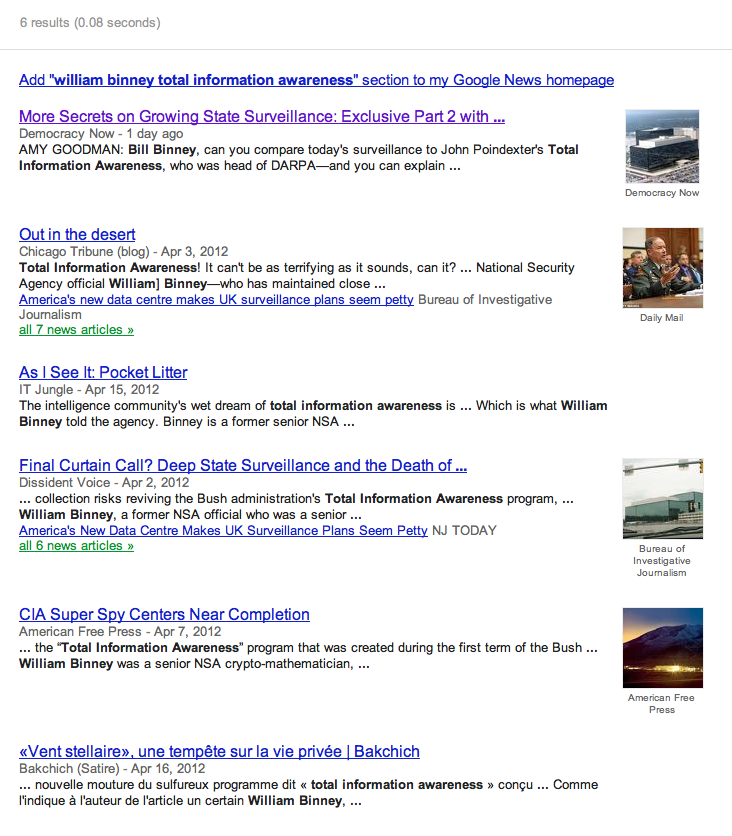
NSA whistleblower William Binney said some pretty explosive things during his interview with DemocracyNow! late last week, but arguably his most newsworthy comments have thus far elicited hardly any reaction among the mainstream press.
One of the most disturbing revelations Binney provided is that the Bush administration’s NSA had already begun deploying its “Total Information Awareness” (TIA) program well before it sent the program’s director, John Poindexter, to the public to leak evidence of the project. We’ll get to that in a moment.
But first, listen to Binney describe why he became a whistleblower, risking his entire life — forty years in government service, his family, everything — to tell the truth about a problem he saw as fundamentally threatening to our society.
First of all it was a very depressing thing to have happen that they would turn their capabilities that I built for them to do detection of foreign threats, to have that turned on the people of the United States, that was an extremely depressing thing for me. And that made it all the more important for me to try to do things to get the government to correct its own criminal activity.
Binney then describes what he did initially, how he spoke out:
And I did that by going to the House intelligence committees. I also attempted to see Chief Justice Renquist, to try to address that issue to him. And I also visited the Department of Justice Inspector General’s office, after Obama came in to office, by the way, to no avail.
Now that was before the 2009 joint IG report on surveillance. Which basically said you need to have better and more active monitoring of these surveillance programs. It didn’t say anything else, so, it just did simply, absolutely nothing.Because the oversight that’s given to the intelligence community is virtually nonexistent from Congress. I mean they are totally dependent because they have no way of really knowing what’s happening inside the agencies involved unless they have people come forward to tell them, like me. They would not know those things.
Binney says that he blew the whistle to a Justice on the Supreme Court, to the House intelligence committees that are supposedly tasked with oversight of the 16 secretive intelligence agencies, and to the DOJ’s Inspector General. The results?He was investigated, and the FBI busted into his house, guns drawn.
But what of the information he leaked?
Much has been made over the past few days about his admittedly stunning statement to the effect that the NSA has copies of every email in the United States, but hardly anyone has talked about something equally stunning: evidence of rank manipulation of the press and the public.
In the DN! interview embedded above, Amy Goodman asks Binney to compare the system the NSA was running when he blew the whistle to the infamous “Total Information Awareness” program, which John Poindexter — formerly a convicted felon — oversaw at the Department of Defense. (TIA aimed to do just what it sounds like: collect every bit of information about every single person and store it in vast databases, producing digital dossiers on all of us, all without warrants or anything approaching probable cause.)
Binney elaborates:
[Poindexter] was actually pushed out, to test the waters, to see how Congress would be receptive to what they were already doing. In other words that process of building that information about everybody, getting ‘total information’, was already happening. And they threw Poindexter out with DARPA…but it was actually already happening. And the question was, would it be acceptable to Congress, because they were keeping it very closely held in Congress, calling it a covert program. So that would make it a process to find out what the reaction would be if they expose to Congress what they were already doing.
In other words, the DoD sent Poindexter out to “test the waters” in the House intelligence committee, to see what the reaction would be to the Total Information Awareness program that they were already running.
The New York Timespiece that broke the TIA story to the public on November 9, 2002 told us that the program “will” and “would” do a host of unsavory things:
As the director of the effort, Vice Adm. John M. Poindexter, has described the system in Pentagon documents and in speeches, itwill provide intelligence analysts and law enforcement officials with instant access to information from Internet mail and calling records to credit card and banking transactions and travel documents, without a search warrant.
…
In order to deploy such a system, known as Total Information Awareness, new legislation would be needed, some of which has been proposed by the Bush administration in the Homeland Security Act that is now before Congress. That legislation would amend the Privacy Act of 1974, which was intended to limit what government agencies could do with private information.
…
The system would permit a team of intelligence analysts to gather and view information from databases, pursue links between individuals and groups, respond to automatic alerts, and share information efficiently, all from their individual computers.
The project calls for the development of a prototype based on test data that would be deployed at the Army Intelligence and Security Command at Fort Belvoir, Va. Officials would not say when the system would be put into operation.
According to Binney, the NSA was already providing this information to “intelligence analysts” and police, all without warrants, judicial oversight, or Congressional authorization. The program had been developed and it was already operating when Poindexter told Congress that the DoD was developing it. The NYTimes might want to correct that story.
Binney’s remarks raise the question: if the DoD and the federal government were lying about TIA then, having already implemented the program, should we trust the government when it says that it disbanded the operation after the public said “hell no”?
No, it’s probably unwise to trust the DoD in light of this revelation.
Should we therefore assume that NSA has been spying on our digital data for the past ten years, all without warrants, Congressional or judicial oversight, or Constitutional blessing? Stranger things have happened.
Another important piece of the interview describes the means by which the FBI, collaborating with the NSA in its investigations of William Binney and Thomas Drake, built its case against the whistleblowers.
Juan Williams asked Binney: “The NSA is a huge agency, aren’t there others who are disturbed by this?”
Binney:
I’m sure there are. And I know a number of them that are but they’re so, they’re so afraid to do anything. I mean, they’ve seen what happened to us — they sent the FBI to us. So they’re afraid of being indicted, prosecuted, and even if you win the case if you’re indicted, you’re still going to lose, because you’ve had to hire a lawyer and all like Tom [Drake] did and we did. So you lose anyway you speak of it. When they have unlimited funds to do whatever they want, and you don’t, they can indict you on any number of things like they tried to do with us.
Binney says that the FBI was monitoring his and Drake’s communications, and had prepared indictments against them alleging a conspiracy to leak classified information. The FBI apparently backed off when Binney told Drake, over a phone line that Binney assumed the FBI was monitoring, that he had evidence of illegal FBI investigatory tactics. Spy v. Spy, indeed.
Since the drug war has become so unpopular with the electorate, instead of politicians actually changing the drug laws, the Department of Defense seeks to reduce and conceal the real costs by transferring the “dirty work” to private contractors to do what “U.S. military forces are not allowed or not encouraged to do.”
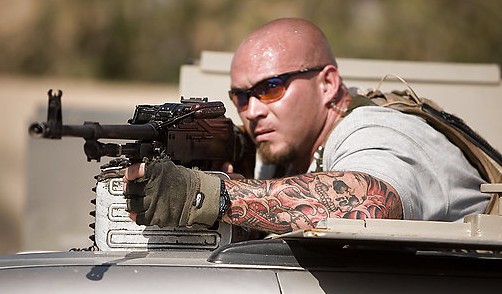
The BBC (in Spanish) is reporting that the U.S. Department of Defense is delegating the war on drugs to private mercenary companies. Of those companies, the increasingly infamous organization previously known as Blackwater is said to have received several multimillion-dollar government contracts for “providing advice, training and conducting operations in drug producing countries and those with links to so-called “narco-terrorism” including Latin America.”
The “no bid”contracts, issued under the Counter-Narcoterrorism Technology Program Office’s $15 billion dollar budget, are described as “non-specific” and are said to be “juicy” for the private contractors. The Pentagon says “the details of each cost in very general contracts do not go through bidding processes.”
An unnamed analyst says “the responsibility of the public and national security changing from a state’s duty to be a private business…has become the trend of the future.”
Although parts of the drug war have been privatized for years, the BBC reports this “transfer” of responsibilities is an attempt to placate those looking for Pentagon budget cuts in an election year.
According to Larry Birns, director of the Council on Hemispheric Affairs (COHA), “the drug war is unpopular and has no political weight except in an election year like this, so the Department of Defense wants to remove that spending from their accounts.”
“They surreptitiously want to reduce anti-drug budget by transferring it to private agencies,” said Birns.
Bruce Bagley, head of International Studies at the University of Miami, agrees with Birns that the main reason for privatizing the drug war is to sidestep “the high political cost.”
But this move is not without risk, as private mercenaries have known to operate outside of national and international laws. ”Here we go into a vague area where the rules of engagement are not clear and there is almost zero accountability to the public or the electorate,” said Bagley.
The Pentagon maintains that it’s perfectly legal, and mercenaries must follow strict parameters. However, Bagley points out that “few members of the Oversight Committees of the Senate and the House are aware, but they are required to keep secret, so all this flies under the radar.”
There are concerns that contractors acting independently will threaten the sovereignty of the “key countries” in which they will operate. The Pentagon says the largest efforts will occur in Latin America including Mexico, Central America, Caribbean, Columbia and other Andean countries.
Professor Bagley says these private armies could “generate a nationalist backlash if the public came to realize the situation” of operations in their countries.
Once again, the war on drugs creates the opportunity to place troops in countries where having American soldiers would be politically disadvantageous, or simply impossible.
Ultimately, the Pentagon claims they will save money because private contractors don’t have the bureaucracy and hierarchy involved in operations and because “if any of its employees dies, they are responsible.”
Apparently, humanity is the last concern for the Pentagon budget, which always seems to have plenty of money for advanced weapons systems (also privatized), but is consistently lacking in benefits for its veterans. By privatizing the drug war, they no longer have to concern themselves with paying for benefits for warriors who pledge allegiance to the United States and take an oath to defend its Constitution.
As the war on drugs is increasingly viewed as a money-draining failure, it’s unlikely that this move to privatize it will succeed in anything but creating demand for more profit, thus fueling its continuance through corporate lobbying to prevent a political end to such lunacy.
Quotes are translated from Google translator, and Eric Blair speaks adequate Spanish as a second language.
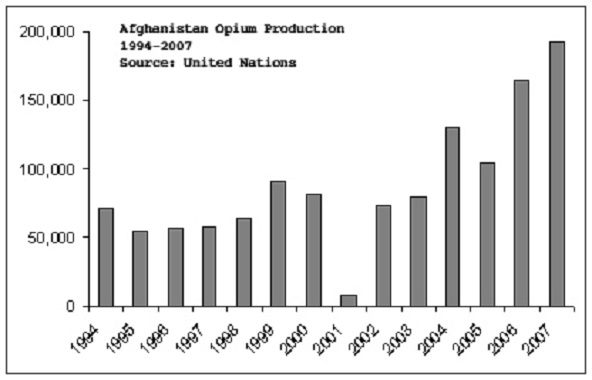
(NaturalNews) Afghanistan is, by far, the largest grower and exporter of opium in the world today, cultivating a 92 percent market share of the global opium trade. But what may shock many is the fact that the US military has been specifically tasked with guarding Afghan poppy fields, from which opium is derived, in order to protect this multibillion dollar industry that enriches Wall Street, the CIA, MI6, and various other groups that profit big time from this illicit drug trade scheme.
Prior to the tragic events of September 11, 2001, Afghanistan was hardly even a world player in growing poppy, which is used to produce both illegal heroin and pharmaceutical-grade morphine. In fact, the Taliban had been actively destroying poppy fields as part of an effort to rid the country of this harmful plant, as was reported by the Pittsburgh Post-Gazette on February 16, 2001, in a piece entitled Nation’s opium production virtually wiped out (http://news.google.com/newspapers?nid=gL9scSG3K_gC&dat=20010216&printsec=…).
But after 9/11, the US military-industrial complex quickly invaded Afghanistan and began facilitating the reinstatement of the country’s poppy industry. According to the United Nations Drug Control Program (UNDCP), opium cultivation increased by 657 percent in 2002 after the US military invaded the country under the direction of then-President George W. Bush (http://www.infowars.com/fox-news-makes-excuse-for-cias-afghan-opium-culti…).
CIA responsible for reinstating opium industry in Afghanistan after 9/11
More recently, The New York Times (NYT) reported that the brother of current Afghan President Hamid Karzai had actually been on the payroll of the CIA for at least eight years prior to this information going public in 2009. Ahmed Wali Karzai was a crucial player in reinstating the country’s opium drug trade, known as Golden Crescent, and the CIA had been financing the endeavor behind the scenes (http://www.infowars.com/ny-times-afghan-opium-kingpin-on-cia-payroll/).
“The Golden Crescent drug trade, launched by the CIA in the early 1980s, continues to be protected by US intelligence, in liaison with NATO occupation forces and the British military,” wrote Prof. Michel Chossudovsky in a 2007 report, before it was revealed that Ahmed Wali Karzai was on the CIA payroll. “The proceeds of this lucrative multibillion dollar contraband are deposited in Western banks. Almost the totality of revenues accrue to corporate interests and criminal syndicates outside Afghanistan” (http://www.thirdworldtraveler.com/Afghanistan/US_Forces_Narcotics_Trade.html).
But the mainstream media has been peddling a different story to the American public. FOX News, for instance, aired a propaganda piece back in 2010 claiming that military personnel are having to protect the Afghan poppy fields, rather than destroy them, in order to keep the locals happy and to avoid a potential “security risk” — and FOX News reporter Geraldo Rivera can be heard blatantly lying about poppy farmers being financially supported by the Taliban, rather than the CIA and other foreign interests.
So while tens of thousands of Americans continue to be harmed or killed every year by overdoses from drugs originating from this illicit opium trade, and while cultivation of innocuous crops like marijuana and hemp remains illegal in the US, the American military is actively guarding the very poppy fields in Afghanistan that fuel the global drug trade. Something is terribly wrong with this picture.
That’s been the key question asked of Wall Street’s biggest banks since the September 2008 collapse of Lehman Brothers, which sent shock waves through the global financial system and led to the worst recession this country has seen since the Great Depression.
But, there is another firm far from the circles of Wall Street for which that same question should be asked, says William Hartung, author of the new book Prophets of War. The subtitle of his book says it all: Lockheed Martin and the Making of the Military-Industrial Complex.
With $40 billion in annual revenue, Lockheed Martin is the single largest recipient of U.S. tax dollars. The company receives about $36 billion in government contracts per year. In 2008, $29 billion of that was for U.S. military contracts – a dollar figure 25% higher than its competitors Boeing Co. and Northrop Grumman.

 Competing with the US during the Arms Race, the Soviet Union put extensive effort in unconventional research seeking to outflank its rival in understanding behavior control, remote influencing and parapsychology, a new survey by Cornell University Library has revealed.








 The BBC (in Spanish)