NSA and FBI Duck Dive Dodge Accountabilty, Absolute Figures on Search

NSA and FBI Duck Dive Dodge Accountabilty, Absolute Figures on Search

NSA says it has no idea how much US info it collects, but FBI searches for it so much it can’t count how many times.


NSAgoogleThe blowback against the National Security Agency has long focused on the unpopular Patriot Act surveillance program that allows the NSA to vacuum up billions of US phone records each year. But after a rush of attention this week, some much deserved focus is back on the surveillance state’s other seemingly limitless program: the warrantless searches made possible by Section 702 of the Fisa Amendments Act, which allows the NSA to do all sorts of spying on Americans and people around the world – all for reasons that, in most cases, have nothing to do with terrorism.

The long awaited draft report from the independent Privacy and Civil Liberties Board (PCLOB) on this subject was finally released Tuesday night, and it gives Americans a fairly detailed look unclassified at how the NSA spies through its notorious Prism program – and how it snoops “upstream” (a euphemism for the agency’s direct access to entire internet streams at telecoms like AT&T). The board issued a scathing report on the Patriot Act surveillance months ago, but oddly they went the opposite route this time around.

While many of the details are interesting, the board’s new report recommends no systematic changes to the several disturbing privacy issues covered therein. The Electronic Frontier Foundation (my former employer) issued a scathing PCLOB review late Tuesday night, calling the report “legally flawed and factually incomplete” and saying it ignored the “essential privacy problem … that the government has access to or is acquiring nearly all communications that travel over the Internet.”

As usual, it’s the Edward Snowden revelations that give context to all the snooping – and provide the impetus to keep pushing for real reform. Some 36 hours before the latest PCLOB report was made public, the Washington Post’s Ellen Nakashima and Barton Gellman disclosed previously unreleased Snowden documents showing that true scope of “702”-style information sweeps:

Virtually no foreign government is off-limits for the National Security Agency, which has been authorized to intercept information from individuals ‘concerning’ all but four countries on Earth.

As the Post reports, the Foreign Intelligence Surveillance Court’s interpretation of the the Fisa Amendments Act is so broad, it “could allow for surveillance of academics, journalists and human-rights researchers.”

Fisa Amendments Act surveillance also includes scanning the emails of Americans never even accused of a crime. It’s the Snowden revelations that originally led the New York Times to report last year any conversation you’ve ever had with someone outside the country may be fair game under the act, as the NSA “is searching the contents of vast amounts of Americans’ e-mail and text communications into and out of the country who mention information about foreigners under surveillance.”

Perhaps in an attempt to pre-empt the PCLOB report, Director of National Intelligence James Clapper finally just released what he promised Sen Ron Wyden months ago: the number of warrantless searches by the US government on American communications in its vast databases of information collected under the Fisa Amendments Act. This is the second giant problem with 702 surveillance. Wyden refers to these as “backdoor” searches since they’re performed using data supposedly collected for “foreign intelligence” purposes – even though they still suck up huge amounts of purely US information. And it’s exactly the type of search the House overwhelmingly voted to ban in its surprise vote two weeks ago.

The NSA conducted “backdoor” searches 198 times in 2013 (and another 9,500 for internet metadata on Americans). Curiously, the CIA conducts far more warrantless searches of American information in the NSA databases than the NSA itself – almost 10 times more. But the FBI was the worst culprit, querying data on Americans so many times it couldn’t even count. The DNI left it at this: “the FBI believes the number of queries is substantial.”

The FBI has always been the NSA’s silent partner in all its surveillance and has long been suspected of doing the dirty work on Americans’ data after it’s been collected by NSA.

Wyden, who has for years repeatedly pushed for this information to be released to the public, responded:

When the FBI says it conducts a substantial number of searches and it has no idea of what the number is, it shows how flawed this system is and the consequences of inadequate oversight. This huge gap in oversight is a problem now, and will only grow as global communications systems become more interconnected.

The PCLOB also went on to reveal in its report that the FBI can search the vast Prism database for crimes that have nothing to do with terrorism, or even national security. Oh, and how many US persons have had their data collected through Prism and other 702 programs? That government has no idea.

Unfortunately, the PCLOB chickened out of making any real reform proposals, leading Politico’s Josh Gerstein to point out that the Republican-controlled House already endorsed more aggressive reforms than the civil liberties board. More bizarrely, one of the holdouts on the panel for calling for real reform is supposed to be a civil liberties advocate. The Center for Democracy and Technology’s vice president, James Dempsey, had the chance to side with two other, more liberal members on the five-person panel to recommend the FBI get court approval before rummaging through the NSA’s vast databases, but shamefully he didn’t.

Now, as the Senate takes up a weakened House bill along with the House’s strengthened backdoor-proof amendment, it’s time to put focus back on sweeping reform. And while the PCLOB may not have said much in the way of recommendations, now Congress will have to. To help, a coalition of groups (including my current employer, Freedom of the Press Foundation) have graded each and every representative in Washington on the NSA issue. The debate certainly isn’t going away – it’s just a question of whether the public will put enough pressure on Congress to change.

via Trevor Timm at TheGuardian.com


Newly Released Drone Records Reveal Extensive Military Flights in U.S.

Newly Released Drone Records Reveal Extensive Military Flights in U.S.

us-navy-mq-8-drone

Via: Electronic Frontier Foundation:

Today EFF posted several thousand pages of new drone license records and a new map that tracks the location of drone flights across the United States.

These records, received as a result of EFF’s Freedom of Information Act (FOIA) lawsuit against the Federal Aviation Administration (FAA), come from state and local law enforcement agencies, universities and—for the first time—three branches of the U.S. military: the Air Force, Marine Corps, and DARPA (Defense Advanced Research Projects Agency).

While the U.S. military doesn’t need an FAA license to fly drones over its own military bases (these are considered “restricted airspace”), it does need a license to fly in the national airspace (which is almost everywhere else in the US). And, as we’ve learned from these records, the Air Force and Marine Corps regularly fly both large and small drones in the national airspace all around the country. This is problematic, given a recent New York Times report that the Air Force’s drone operators sometimes practice surveillance missions by tracking civilian cars along the highway adjacent to the base.

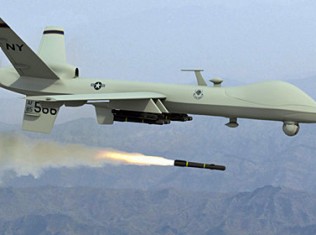
The records show that the Air Force has been testing out a bunch of different drone types, from the smaller, hand-launched Raven, Puma and Wasp drones designed by Aerovironment in Southern California, to the much larger Predator and Reaper drones responsible for civilian and foreign military deaths abroad. The Marine Corps is also testing drones, though it chose to redact so much of the text from its records that we still don’t know much about its programs.

via Cryptogon

Spy Back: How to View Your NSA or FBI File

Spy Back: How to View Your NSA or FBI File

fbialtDo you know what FOIA is? No? Don’t be alarmed, most Americans don’t. It is better known as the Freedom of Information Act (introduced by Sen. Edward V. Long in 1965 and signed into law by President Lyndon B. Johnson in 1966), and is most often used by Americans looking for answers into the deep mysteries of government activity. There is something else you should know, however: Freedom of Information Act requests aren’t just for those who are seeking information on black ops activities.


You can use it yourself to discover what organizations like the National Security Agency or the Federal Bureau of Investigation have on your file. Amazingly, FIOA can be used by you to get whatever files that the NSA or FBI or any other three letter agency has on you. And with the latest round of leaks covered by Anthony Gucciardi detailing how the NSA is tracking your activity through just about all of the major social websites, this is big news.


Perhaps you are politically active and have gone to a few protests and were arrested, or maybe you post a lot of political articles on your favorite social networking site.


Grabbing Your File


There are two ways you can get your file. Your first option is to get it straight from the source. For the NSA file, you can go to the FOIA request form. Or for the FBI, you can go to their official request form as well. Or perhaps you don’t feel comfortable going through that process and would rather use another party, in which case you can utilize the website Get My FBI File. This website provides the forms for most agencies, CIA, DIA, FBI, NSA, etc.


Since the conception of FOIA in 1966, it has been amended eleven times. Most notably by President Gerald Ford in 1974. At first, President Ford was for bolstering various privacy-related amendments, however he then performed a complete 180 on the issue (after being persuaded by his Chief of Staff Donald Rumsfield, and Deputy Richard Cheney), signing a Presidential veto that was eventually overturned by Congress. This was only one of twelve vetoes that were overturned by congress in regards to President Ford.


Additional Sources:


DailyKos

By Gordon Rupe
Story Leak

‘Freedom of Information Act’ Processes Increasingly Managed by Private Companies

‘Freedom of Information Act’ Processes Increasingly Managed by Private Companies

A Bloomberg investigation shows that the federal government is paying a military contractor facing allegations of torture to manage some public records work. 

The Freedom of Information Act allows ordinary people to learn about behind the scenes functions of our government. There are a number of limited, discrete exemptions to the law, which allow agencies to redact or withhold documents in whole or in part. But generally speaking, the law grants us broad access into the workings of our government — and it is therefore one of the key mechanisms whereby we learn of illegal or inappropriate government activities. FOIA is a necessary transparency mechanism in our democracy.

That’s why it’s shocking to learn, as Bloomberg news reports today, that increasingly the process of managing and responding to our FOIA requests is being handled by private corporations. The investigation shows that at least 25 federal agencies are farming out their FOIA work to private companies, at a cost both to taxpayers and to the integrity of the open records system. As director of the Sunlight Foundation John Wonderlich told Bloomberg:

If I was in charge of an agency and wanted to create an unaccountable FOIA process, the first thing I would do is put an outside contractor in charge of it because fewer of our accountability laws apply to them…It would just be another layer between me and the public.

It gets worse. Not only does the contracting out of FOIA work shield the government from precisely the transparency the law is meant to institute. There could be very serious conflicts of interest involved when private companies are tasked with managing the processes whereby sensitive (and likely embarrassing or damning) government secrets are disclosed to the public.

Case in point is CACI International, a military and intelligence contractor that is facing a lawsuit alleging its employees participated in the torture of detainees at Abu Ghraib prison in Iraq. CACI is one of the companies the federal government has outsourced FOIA work to over the past ten years.

Should a company accused of serious human rights violations in a war zone have any involvement with open government processes designed to disclose precisely such abuses?

via PrivacySOS

Calling out the CIA: Secrecy Killings

Calling out the CIA: Secrecy Killings

Today Andrew Rosenthal of The New York Times published a thoughtful columndiscussing the untenable position taken by the government in response to the ACLU’s two Freedom of Information Act lawsuits seeking information about the CIA’s targeted killing drone strike program, including its targeting of U.S. citizens. As Rosenthal explains, “the government is blocking any consideration of these petitions with one of the oldest, and most pathetic, dodges in the secrecy game. It says it cannot confirm or deny the existence of any drone strike policy or program.”

Rosenthal goes on to highlight the reasons why the government’s position is untenable:

That would be unacceptable under any condition, but it’s completely ridiculous when you take into account the fact that a) there have been voluminous news accounts of drone strikes, including the one on Mr. Awlaki, and b) pretty much every top government official involved in this issue has talked about the drone strikes in public.

He also highlights the arguments made in the ACLU’s latest legal brief in the cases, excerpting from our “13 pages of examples of how ‘the government has already specifically and officially acknowledged the program that the CIA now says is secret.'”

Perhaps most telling is Rosenthal’s comment about how little progress we have made since the worst secrecy abuses of the Bush era:

Governments have good reasons for keeping secrets – to protect soldiers in battle, or nuclear launch codes, or the identities of intelligence sources, undercover agents and witnesses against the mob. (Naturally that’s not an exhaustive list.) Governments also have bad reasons for keeping secrets – to avoid embarrassment, evade oversight or escape legal accountability.

The Bush administration kept secrets largely for bad reasons: It covered up its torture memos, the kidnapping of innocent foreign citizens, illegal wiretapping and other misdeeds. Barack Obama promised to bring more transparency to Washington in the 2008 campaign, but he has failed to do that. In some ways, his administration is even worse than the Bush team when it comes to abusing the privilege of secrecy.

He concludes:

So this is not a secret program, but the government continues to hide behind the secrecy shield to avoid turning over the legal document justifying (or at least rationalizing) it. It’s even using the “can’t confirm or deny” fabrication about the existence of the document itself.

My guess is that the Obama administration just wants to avoid public disclosure, scrutiny and accountability. I’d ask someone at the Justice Department, but they wouldn’t be able to tell me, because it’s a secret.

Rosenthal’s column joins the chorus of voices calling for greater transparencyaround targeted killing and for a sensible government response to the ACLU’s FOIA requests. The government must provide the public with the information it needs to assess the legality and wisdom of the CIA’s global targeted killing campaign.

SOURCE:
http://www.aclu.org/blog/national-security/calling-out-cia-its-secrecy-game-targeted-killing

By: Nathan Freed Wesser, March 29, 2012