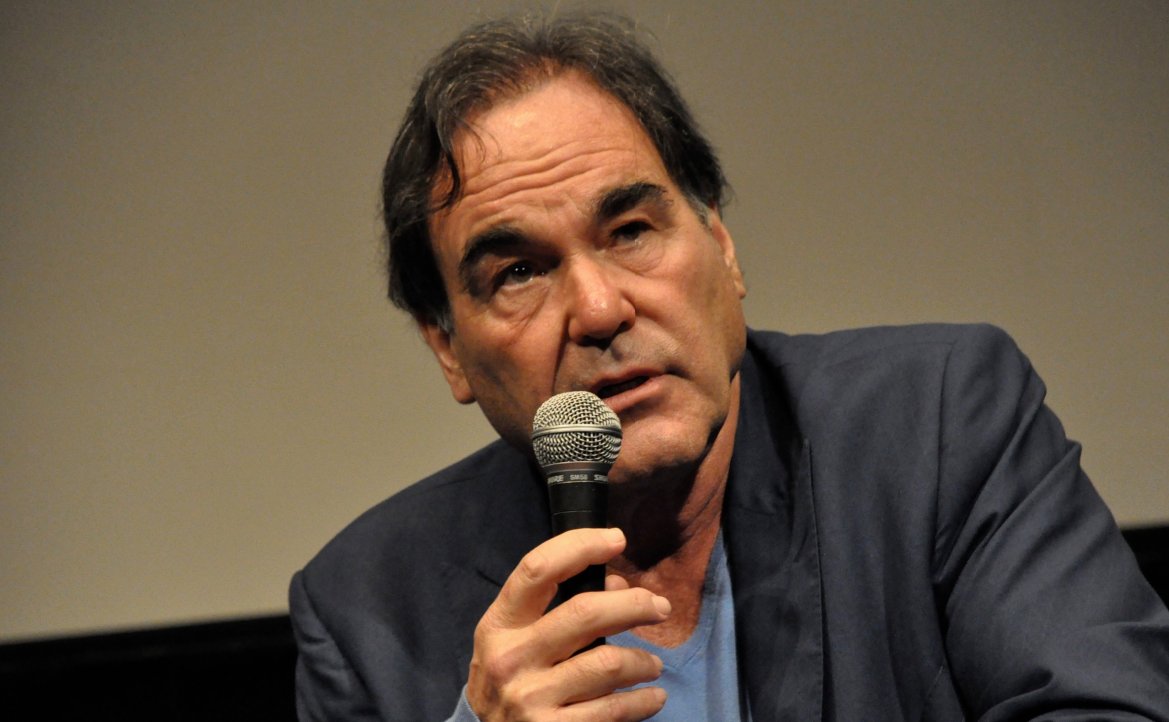
Oliver Stone, byname of William Oliver Stone (born September 15, 1946, New York, New York, U.S.), American film director, screenwriter, and producer known for his ambitious and often controversial movies.
Stone, the son of a wealthy stockbroker, was raised in New York City. He briefly studied at Yale University before dropping out to teach English in South Vietnam. Upon his return, Stone lived in Mexico for a year and again attended Yale for a short period. In 1967, during the Vietnam War, he enlisted in the U.S. Army. He distinguished himself in combat, earning two Purple Hearts and a Bronze Star. Stone then enrolled in film school at New York University (B.A., 1971), studying under director Martin Scorsese.
Stone was deeply affected by his war experiences, and his student films, such asLast Year in Viet Nam (1971), dealt directly with the consequences of the Vietnam conflict. After graduating, he directed the horror movies Seizure! (1974) and The Hand (1981), the latter of which starred Michael Caine. Stone also began experimenting with screenwriting, and he won an Academy Award for best adapted screenplay for Midnight Express (1978), which was based on the true story of a man brutally abused while imprisoned for drug smuggling in Turkey.
Stone devoted much of the early 1980s to writing screenplays, including Conan the Barbarian (1982), Scarface (1983), which was directed by Brian De Palma and starred Al Pacino, and Year of the Dragon (1985). He returned to directing withSalvador (1986), which he also wrote. In the film, a journalist (played by James Woods) documents the atrocities committed during the El Salvador uprisings of 1980–81. Stone again drew on the trauma of the Vietnam War in Platoon (1986), for which he won another Academy Award, this time for directing. The film navigates the perils of war from the perspective of a new recruit who quickly realizes that the idealism that motivated his decision to enlist was misguided. Stone drew upon personal experience once more for Wall Street (1987), using memories of his father’s career as a stockbroker to conjure an indictment of the greed and deceit governing the financial world. In 1988 he adapted Eric Bogosian’s Off-Broadway play Talk Radio to film.
Stone emphasized the continuing ramifications of the Vietnam War with Born on the Fourth of July (1989). The film, based on the autobiography of Vietnam veteran Ron Kovic, chronicles the evolution of a young man, played by Tom Cruise, from patriotic soldier to paraplegic antiwar activist. Stone won an Academy Award for directing that movie and received a fourth career nomination for his writing. The year 1991 saw the release of both JFK, a polarizing investigation of the circumstances surrounding the assassination of Pres. John F. Kennedy, and The Doors, a stylish account of the rise and fall of the titular American rock band. InHeaven and Earth (1993), Stone approached the Vietnam War and its aftermath from the perspective of a young Vietnamese woman.
Stone again courted controversy with Natural Born Killers (1994), a film, written byQuentin Tarantino, about the savagely violent exploits of a married couple, played by Woody Harrelson and Juliette Lewis. While Stone claimed that the film was meant to be critical of sensationalized violence, some critics found it guilty of exactly what it purported to condemn. Stone then cast Anthony Hopkins in the title role of Nixon (1995), a measured take on the life of the U.S. president. He also developed the screenplay for Evita (1996), an adaptation of the Andrew Lloyd Webber musical about Argentine politician Eva Perón (played by Madonna).
Stone revisited some of his favoured motifs, power and violence, in Any Given Sunday (1999), about professional football, and in Alexander (2004), a poorly received biography of Alexander the Great. World Trade Center (2006), a retelling of the events of September 11, 2001, from the viewpoint of two police officers, returned Stone to the centre of public debate. While the film was critically acclaimed, some questioned the propriety of making the film so soon after the tragedy. W. (2008), his biopic of Pres. George W. Bush, drew ire from both extremes of the political spectrum for its refusal to pass definitive judgment, positive or negative, on its subject. Stone later directed Wall Street: Money Never Sleeps(2010), a sequel to the 1987 film that was set amid the global financial crisis of 2008, and Savages (2012), an ensemble thriller about marijuana trafficking that, in its depiction of seedy mayhem, was reminiscent of his earlier U Turn (1997).
In addition to directing and writing, Stone produced many of his own movies. Besides narrative films, he made two documentaries about Latin American politics: Comandante (2003), about Cuban dictator Fidel Castro, and South of the Border (2009), which focused on several other left-wing leaders, notably Venezuelan Pres. Hugo Chávez. With Peter Kuznick, he also created Oliver Stone’s Untold History of the United States (2012), a 10-part television documentary (and accompanying book) that took an unorthodox look at the preceding century of American political history. In 1997 Stone published a semiautobiographical novel,A Child’s Night Dream.
Sean Stone, son of controversial filmmaker Oliver Stone has acted in his father’s films such as Wall Street, The Doors, JFK, Natural Born Killers and many more. He has starred and directed in his own feature film Greystone Park. Sean joined the team of investigators for the Tru TV hit Conspiracy Theory with Jesse Ventura. Sean currently hosts an alternative media show ‘Buzzsaw’ featuring interviews with whistleblowers, styling itself as the ‘real X files’ looking into the hidden agendas behind the news.
Jesse Ventura About.com 3/10/10 “I would say the biggest one to me was the killing of John F. Kennedy because of what happened after that. Imagine if you can kill the president and get away with it. Well, then you are going to be bold enough and do just about anything.”About.com 3/10/10 “I would say the biggest one to me was the killing of John F. Kennedy because of what happened after that. Imagine if you can kill the president and get away with it. Well, then you are going to be bold enough and do just about anything.”About.com 3/10/10 “I would say the biggest one to me was the killing of John F. Kennedy because of what happened after that. Imagine if you can kill the president and get away with it. Well, then you are going to be bold enough a
nd do just about anything.”About.com 3/10/10 “I would say the biggest one to me was the killing of John F. Kennedy because of what happened after that. Imagine if you can kill the president and get away with it. Well, then you are going to be bold enough and do just about anything.”
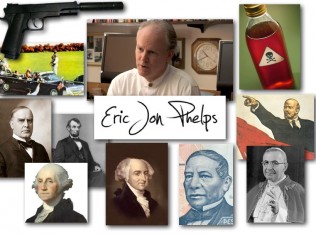
Max Interviews guest Eric Jon Phelps on the Jesuits Part IV
Topics Covered:
Assassinations Throughout History!
14 American Presidents
Vatican Popes
Mexican Leaders
Russian Leaders
Iranian Leaders
Ireland Leaders
Bolshevick Leaders
and other Various opponents of the Jesuits / Knights of Malta
Political Assassinations throughout history, Targeted killing and the Obama ‘hit list’, Black Ops, Conspiracy, Drones, and the technology that makes it all possible.
Short Version: For those too busy to follow this all the way through…. George HW Bush is ultimately responsible for the planning & execution of JFK, as sanctioned by his masters – The Federal Reserve families. This explains his subsequent rise in power, from novice CIA spook, to CIA Director, Presidential Cabinet, Vice President, President…. to 33 Degree Iluminati Freemason..? Details to prove this conclusively are best conveyed by John Hankey. The connections back to GW Bush are absolutely astounding, and numerous enough for one to lose count. -DCMX
ABOUT THIS DOCUMENTARY
Relying exclusively on government documents, statements from the best witnesses available, and the words from the mouths of the killers themselves, Dark Legacy produces a thoroughly substantiated criminal indictment of George Herbert Walker Bush, establishing beyond a reasonable doubt his guilt as a CIA supervisor in the conspiracy to assassinate John F. Kennedy. If we could present this evidence to a jury in Texas, he would pay with his life.
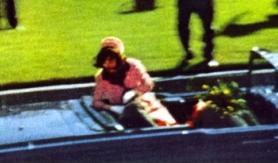
Part one presents the overwhelming mountain of evidence that President Kennedy was hit by bullets from the front and rear. Every witness in the Dallas emergency room attests, on camera, to the fact that a bullet from the right front blew a fist-sized whole in the back of the President’s head. The New York Times carried these statements on the day of the murder; and has covered them up ever since.
*************
Part two presents the on-camera testimony of the witnesses who actually handled the President’s body, the FBI report, and the photographic evidence all proving unequivocally that the President’s body was stolen from the Secret Service and the wounds altered, before the body was delivered to Bethesda Naval hospital for the autopsy. Jackie Kennedy accompanied an empty casket on the plane flight home. Who had the power to do all this without attracting public attention? It’s a short list.
************
Part three presents the Nazi-connections of the Bush family, which prompted the FBI to seize their assets during WW II, as Nazi assets. It presents the suppressed fact that Watergate burglar and CIA operative E. Howard Hunt was found by a jury to have been in Dallas and involved in the conspiracy to kill Kennedy. Hunt was a supervisor of the misguided CIA-led anti-Castro Cubans who broke into the Watergate. He is not only connected to Bush through Watergate; and through Bush’s father, Prescott; but five days after the assassination, the head of the FBI, J. Edgar Hoover, wrote a memo, titled “Assassination of President John Fitzgerald Kennedy” in which he named “George Bush of the Central Intelligence Agency” as the supervisor of what Hoover himself called the “misguided anti-Castro Cuban” killers of the President. Bush has said he doesn’t remember the events of that day, but FBI documents place him in Dallas.
It is difficult to assess the stature and significance of someone who has been dead as long as John Kennedy. His killers have also been his detractors, actively desecrating his memory, as they did his body. The movie begins with a short presentation of some of his most powerful and important speeches; including a stunning speech to the UN in which Kennedy calls for the complete abolition of the military industrial complex. These same men the military industrial complex, ripped him from us, and the darkest features of our history since that time are all directly the result of his murder.
******* JFK ASSASSINATION EXPLAINED *******
I don’t think we are much encouraged to see History as science. Quite the opposite, actually. And of course, that’s all politics. The winners write history, and the truth be damned. Even science can have trouble trying to act like science when political issues are involved, as we see with evolution, tobacco-and-cancer, and global warming. But I think History does have a lot in common with physical science. For example, I can remember when “Continental Drift”, the idea that Africa and America were once stuck together, was very much considered “just a theory”; ridiculed by some, and regarded with amusement by many, and promulgated as likely by a tiny minority. But as time goes by, the evidence accumulates; and the meaning of old evidence begins to settle in; and ideas that were once considered outrageous gradually get worn in and start to be regarded as obvious common sense. Part of this process is the continual accumulation of new evidence. New pieces are added to the puzzle and the picture becomes more clear. And sometimes the hidden meaning of old evidence, that has been lying around for years, suddenly jumps out. Evidence of the fossils and minerals that can be found on the east coast of Africa, and on the west coast of Brazil, may have been lying around for years, before someone decided to look and see if they matched, and found that they did; and proved conclusively that west Africa and Brazil were once attached.
With regard to George HW Bush and the murder of John Kennedy, Joseph McBride found this memo in 1988.
FBI director J. Edgar Hoover wrote this memo 5 days after the assassination, naming George Bush as a CIA officer.
The last, and most crucial paragraph, is very hard to read. The following is a transcription:
“The substance of the forgoing information was orally furnished to Mr. George Bush of the Central Intelligence Agency and Captain William Edwards of the Defense Intelligence Agency on November 23, 1963, by Mr. V.T. Forsyth of this Bureau.”
When it was first released in 1978, George Bush was an obscure bureaucrat, a virtual unknown. So when the best researchers on the planet saw this memo in 1978, they didn’t pay much attention to it. When Bush became vice president two years later, no one was able to connect his now well-known name to this obscure memo. But when Joseph McBride was messing around in 1988, Bush was running for president; and when McBride saw the memo, he jumped up and shouted “Hey, this memo is about Bush! It says he was in the CIA, way back in 1963!”
And for the longest time, the focus was on this simple isolated fact: that Hoover said Bush was in the CIA in ’63. Bush said the memo must be referring to another “George Bush,” because he wasn’t in the CIA at that time. But over the years, people were able to assemble the facts from Bush’s personal life, showing his deep involvement with the CIA at that time, and with the CIA’s anti-Castro Cubans (in the memo, Hoover calls them “misguided anti-Castro Cubans”). And over time, it has become undeniable; that Hoover was referring, in his memo, to none other than George Herbert Walker Bush. And for a while, that was it. End of story.
But the title of this Hoover memo is, “Assassination of President John Fitzgerald Kennedy”. Isn’t that important? Well, you’d think so. But for the longest time, no one made much out it. Besides, Hoover scarcely mentions the assassination in the memo, instead focusing on these “misguided anti-Castro Cubans.” The body of the memo does not appear, at first, to be in any way related to the title of the memo “the assassination of President John F Kennedy”. But then Mark Lane, in his book Rush to Judgment, did the fabulous work of demonstrating, and in fact persuading a jury, that E. Howard Hunt, a major lieutenant in the CIA’s “misguided anti-Castro Cuban” program, was in Dallas and involved in the assassination. With this background, with this framework to guide the researcher, it was then possible to assemble the considerable evidence linking Bush to Hunt.
People might have taken some notice before that Bush made the unusual request, as Nixon’s ambassador to the UN, to be given an office in the White House. They may have noticed that Hunt, although he was not being paid by anyone in the White House, or answering to anyone that we know of in the White House, also had a White House office. But with the Hoover memo in hand, establishing Bush as a supervisor of the CIA’s “misguided anti-Castro Cuban” operation, it is possible to connect Bush to Hunt at the Bay of Pigs. With this memo in hand, it is possible to connect Bush and Hunt as two CIA operatives with offices inside the White House. With this memo in hand, it is possible to answer who it was that Hunt answered to inside the White House; and how he got the office in the first place. And with all that, it is possible to connect Bush to Hunt, and therefore to Dallas, to Hunt in Dallas, and to the “misguided anti-Castro Cuban” assassins of John Kennedy. Which is what Hoover did for us when he wrote the title of the memo. Little by little, the pieces start to fall into place. And pieces that in isolation meant nothing, become key parts of a whole picture.
But even so, this is not a rock-solid connection: Hunt was directly involved in the murder of JFK. And Bush supervised Hunt. But Bush probably supervised a lot of CIA people, not all of whom were directly involved in the assassination. A high-ranking officer may be connected to all of the acts of all of his troops, by reason of his being their commander. But it’s not a direct connection. It doesn’t establish that the officer knew about, or approved of, or was involved in, all the actions of those troops.
Enter FBI memo # 2:
It will come up again in a minute, so please read the first line carefully. Bush identifies himself to the FBI as an independent oil man from Houston.
This memo establishes that sort of direct connection between Bush and Hunt, in Dallas, on the day of the assassination. This memo records Bush’s phone call to the FBI, precisely an hour and fifteen minutes after the assassination. When I first encountered this memo, and when I first put it into my movie, JFK II, I simply called it “weird”. I saw it only in isolation, a weird, isolated connection between Bush and the assassination. It took me years to see it in context. That is, to see that this phone call demonstrates, clearly, that George Bush, was on duty that day.
He was staying at the Dallas Sheraton because his duty assignment was in Dallas. His phone call to the FBI cannot have been random. This James Parrott worked for Bush as a sign-painter; he was not an assassin; this phone call is not what it purports to be; Bush was fulfilling some obscure under-cover function in making this call. So the phone call has to be seen as part of his CIA assignment; which was clearly connected to the assassination. This memo then establishes that Bush was in the Dallas area, and on duty; and that his duty assignment was connected to the assassination. And if his men were in Dallas shooting the President, as they were, he was certainly on duty supervising them. If he were not supposed to be supervising them, his bosses would have assigned him to be at his home office in Houston, Texas; or on his oil rigs in the Caribbean.
But, even in context, this memo and the phone call it describes is still weird, no? I mean, how could Bush have been so stupid as to make this insanely incriminating phone call? Without this FBI memo, recording this phone call, we don’t know, or even have a good clue as to where Bush was, or what he was doing the day of the assassination. Do we? Bush has, until recently, simply said that he did not remember what he was doing the day of the assassination. But with this memo, Bush tells us where he was and what he was doing — he hands us his head on a silver platter. What could possibly have motivated him to make such a stupid error as making this phone call to the FBI? It’s a valid question. It’s not an essential question. We can still value this memo, and extract a great deal of important content from it without answering the question of why, but the question remains.
And we can make a stab at answering it. Russ Baker in his fine book, Family of Secrets suggests that Bush was attempting to establish an alibi. Now, by making this phone call, he, in fact, establishes that he was in the Dallas area, and that he was on duty, related to the assassination. So if he’s trying to establish an alibi to cover-up where he actually was and what he was actually doing, what he is trying to cover up must be some pretty bad stuff, some pretty incriminating stuff, if it’s worse than what he gives us with this alibi.
And what could be worse than what he gives us? Well, obviously, he must have actually been in Dallas. In fact, I think, this situation suggests he must have actually been in Dealey Plaza. I mean seriously. Think about it. He’s so panicked about the truth coming out, that he puts his head in a noose and hands it to us. It makes me think he must have been in Dealey Plaza, he must have been in the company of the shooters, and he must have felt that there would be evidence to prove that.
We’re just speculating at the moment. We’ll get to the evidence right now, but I’m trying to set the scene. If a guilty party is in a panic, trying to cover evidence connecting them to a crime, they may invent an explanation, or an alibi, that seems like a good idea at the time; but that in fact constitutes a very damaging admission. Anyway, stew on that while you consider this photo:
You see this tall thin man in a suit, with a receding hair line. Many people claim this is Bush, standing in front of the Texas School Book Depository. And it might be. It might be a lot of people. And perhaps, when he called the FBI and incriminated himself, Bush was concerned that he might show up in a better picture than this, where he was positively recognizable, looking towards the camera.
Personally, I don’t think this photo looks much like Bush; and in fact, I didn’t think he’d be stupid enough to just be hanging around the murder scene. I thought he was sufficiently high ranking that he’d leave such on-scene stuff to his underlings. Right? At least in my mind, if you’re an officer like Bush, you’re the coach. You plan, you train and prepare your people, and then you stand back and watch it happen. Or so I thought. Fletcher Prouty was certain that he saw pictures of Ed Lansdale, a military operative of the highest rank, signaling to the “tramps” arrested behind the grassy knoll to “be cool,” that everything was alright. Hunt was a high-ranking CIA officer, chief of the CIA’s Mexico station; and his son says he is one of the “tramps” who show up in several photos of men who were arrested behind the grassy knoll. So, some of the highest ranking members of the killers’ operation were apparently there, on the front line, to make sure that when things went wrong, as they inevitably do, these high ranking officers could be there to fix whatever the problem was. So, given that high- and low- ranking CIA officers were present, this photo of this thin man in a suit might, indeed, be Bush. It’s possible.
And now, look at this picture of the Dal-Tex building. The Dal-Tex building is across the street from the Book Depository, and many leading researchers into the assassination, including Jim Garrison, say there was certainly a team of shooters in this building:
[click for larger]
And as you can see, some imaginative individual has added some color to indicate three men in this window. Very creative, very imaginative; and at least plausible. Still, it takes way too much imagination and effort, to see Bush’s face. But now observe this link: http://www.ratical.com/ratville/JFK/WTKaP.html
Actually, You don’t have to stop and read it, because I’ll quote the relevant part. It’s a statement from Roger Craig, winner of the deputy of the year award for Dallas in 1960, and one of the most honest men working that day in Dallas. He’s an amazing and heroic fellow, worthy of all the time you could take looking into his background and character. And here, in the following passage, he is describing a conversation he had with Jim Garrison, and he says,
“Jim also asked me about the arrests made in Dealey Plaza that day. I told him I knew of twelve arrests, one in particular made by R. E. Vaughn of the Dallas Police Department. The man Vaughn arrested was coming from the Dal-Tex Building across from the Texas School Book Depository. The only thing which Vaughn knew about him was that he was an independent oil operator from Houston, Texas. The prisoner was taken from Vaughn by Dallas Police detectives and that was the last that he saw or heard of the suspect.” (emphasis added)
Holy Moe Lee! Please notice that, in speaking to Jim Garrison, Craig says “in particular”. Apparently he and Vaughn thought this was the most significant arrest made that day; pretty amazing given that E.Howard Hunt was arrested in the rail yard behind the grassy knoll. And the only thing Craig knew about this “particular” arrestee was that he had exactly the same singular CIA-cover, “an independent oil operator from Houston, Texas”, that George Bush had used that same day in his contact with the FBI.
Now. There are a very limited number of possible explanations for who this “independent oil operator” was. Let’s look at them.
It is conceivable that the CIA had two men in Dallas area that day, supervising the shooters, who both had the designated cover of being an “independent oil operator from Houston.” Bush was one, as the evidence above clearly shows; and perhaps there was another who was with the shooters in the Dal-Tex building, supervising them directly. But unless the CIA overlords were trying to set Bush up, they would not have told anyone else to use Bush’s CIA cover to identify themselves to the police. If another man was involved in the crime, and was arrested for it, and he told the cops he was an “independent oil operator from Houston,” this would tend to throw suspicion in Bush’s direction. Bush’s association with the CIA’s Cubans was already widely known. Fletcher Prouty knew and wrote of it. Fabian Escalante, the head of Cuban counter intelligence, knew and has written about it. James Files, who claims very credibly, to have been a driver for the Mafia shooters in Dallas, has spoken on-camera about it. And FBI director J. Edgar Hoover, knew about it and wrote about it in his memo. So Bush was already a suspect in Hoover’s eyes. The CIA planners, then, would not have told anyone else, “in case you get arrested, tell the cops you’re an independent oil man from Houston”. Right? They would not have done this, since it would tend to incriminate Bush, who was already in a highly visible, highly suspicious position.
Another unlikely possibility is that this “independent oil operator from Houston” was just some innocent oil operator, who somehow managed to attract suspicion, and was arrested. Do you think it’s possible that another oil man from Houston just happened to be in that corner of Dealey Plaza? I hope you think it’s possible. Because, as unlikely as it seems, if you think it was possible, then certainly Bush would have been reasonable in thinking that, as he was being arrested, there were other independent oil operators in the crowd who witnessed his arrest. You see, Bush spoke to a group of oil men in Dallas the night before the assassination*2. If it were possible that some of them were in Dealey Plaza, he would need to be terrified of the possibility that some of them might actually have seen the arrest, and would have been able to identify him as the object of that arrest.
No wonder, then, that Bush freaked out, and made this stupid incriminating phone call to the FBI. Even if it showed that he was not in Houston, or in the Caribbean, but in Dallas, at least it suggested that he was not in police custody for the murder of the President, in Dealey Plaza.
But now stop and think a minute: why was he arrested? What was he doing that drew this cop’s attention at all? What could he possibly have been doing to make this cop think that he needed to arrest Bush? Perhaps walking out of a building without attracting attention is harder than it sounds; and it reasonable to suppose that the crowd outside the Dal-Tex building had heard the shots, had heard that the President had been wounded, and they were carefully scrutinizing anyone who came out of the building. But this story shows clearly that Bush was not the sort of cold-blooded killer who could take part in the murder of a man, and then act and look like nothing was going on as he tried to leave the scene of the crime. And it turns out that as an old man, Bush continues to suffer from this character trait, of being unable to hide feelings that need to be kept secret. As you can see in this link, http://www.youtube.com/watch?v=ft3eGWZd7LE , at Gerry Ford’s funeral, Bush suddenly breaks into a wide grin while speaking of the Kennedy assassination. This is not a Mona Lisa smile. This is face-wrenching spasm of glee.
In a minute we’ll take up the question of why Bush would grin at his recollection of watching John Kennedy’s brains splatter; the point for us now is that he apparently had a similarly inappropriate, show-stopping expression on his face as he attempted to exit the Dal-Tex building; he had the look of a murderer in his eye, so clearly that it could not be missed; as this funereal-grin could not be missed. And the guilt plastered all over Bush’s face drew people’s attention. And this cop, Vaughn, arrested him.
Now remember, Roger Craig tells this story in the context of his discussions with New Orleans District Attorney Jim Garrison about the suspects who were arrested that day and who then evaporated without leaving a mugshot, interview, fingerprint, or name. Garrison spoke not only to Roger Craig, but he no-doubt spoke to Vaughn, who made the arrest. And Garrison adds the following:
“At least one man arrested immediately after the shooting had come running out of the Dal-Tex Building and offered no explanation for his presence there. Local authorities hardly could avoid arresting him because of the clamor of the onlookers. He was taken to the Sheriff’s office, where he was held for questioning. However, the Sheriff’s office made no record of the questions asked this suspect, if any were asked; nor did it have a record of his name. Later two uniformed police officers escorted him out of the building to the jeers of the waiting crowd. They put him in a police car, and he was driven away. Apparently this was his farewell to Dallas, for he simply disappeared forever.”
— On the Trail of the Assassins, p. 238 —
This vision of the panicked Bush being arrested, no-doubt terrified as he was taken to the police station, and possibly even booked (though the record of any such booking has been destroyed) provides a context that explains a number of Bush’s otherwise-mysterious actions. Certainly Bush was freaked out and panic-stricken! An angry crowd clamored for his arrest, and jeered his release.
Being a newbie in these dark affairs, Bush didn’t have confidence in the ability of the old devils at CIA to make water run uphill, to make time run backwards, to silence the witnesses, to destroy the records, and make it all go away. And so he panicked; he acted on his own, stupidly; he called the FBI, thinking that he was “cleverly” providing evidence that it wasn’t him who was arrested in front of the Dal-Tex building that day. In his panic-stricken state, this seemed like a good idea. He was unable to see that he was actually creating a permanent absolutely-positive record of his involvement.
We can now also explain the grin. He grins ridiculously at Gerry Ford’s funeral, at the mention of John Kennedy’s murder, not because he is such a ghoul that he thinks splattering the contents of Kenney’s head all over Jackie Kennedy was funny; but because mentioning the assassination causes him to recall the comedy of errors that produced his own ridiculous panic, arrest, more panic, and so on.
Garrison wrote his paragraph about Bush’s arrest in 1988. Deputy Craig’s article was written in 1971 and posted in 1992. But the significance of these paragraphs was discovered last week. There hardly was an internet in 1992 when Craig’s article was posted. And for 19 years, no one noticed that this phrase, “independent oil man from Houston”, is a very unique description of Bush. No one noticed until last month, when one of the moderators of JFKMurderSolved showed it to me. And I wrote about it to some friends, and one of them suggested I read what Jim Garrison had to say.
So the pieces continue to fall into place. Little by little, the picture is filled in, the questions get answered. And the conclusions become more incontrovertible. This is just the sort thing that happened with the theory of Evolution and the Big Bang theory; and the theory of continental drift. And someday they may start to teach history, as a science, based on evidence, in the universities. Really! It could happen! At which point, Bush’s involvement in JFK’s murder will be taught, like evolution, as the only plausible explanation of the available reliable evidence.
Final note: Until recently, Bush had nothing more to say about his whereabouts the day of the assassination than that he doesn’t remember where he was. That in itself is extraordinarily incriminating. Everyone who was alive at the time remembers where they were on 9-11, and on the day Kennedy was murdered. But, saying that he doesn’t remember, however improbable, is at least consistent with Bush’s autobiography, which mentions nothing.
Lately, however, perhaps at least partly in response to my work, Bush and Co. have concocted a story that he was speaking in Tyler, Texas to the Rotary Club. The vice-president of the Rotary Club, Aubrey Irby, says that Bush was speaking when the bellhop came over and told him, that Kennedy was dead*1. Mr. Irby passed the information on to Mr. Wendell Cherry, who passed it on to Bush; who stopped his speech. Irby says that Bush explained that he thought a political speech, under the circumstances, was inappropriate; and then he sat down. As a would-be alibi proving Bush’s innocence, there are at least three huge problems with this story.
The first is that it is inconceivable that Bush would not have remembered such an event; or that he would have left it out of his autobiography, since it shows what a fine and respectful fellow he is. If he didn’t remember it sooner, or include it in his autobiography, it’s clearly because it never happened.
The second huge problem with this story is that it couldn’t possibly have happened; that is, it is made impossible by Bush’s original alibi, his phone call to the FBI, as you’ll see:
The witness who tells this story, Aubrey Irby, says that Bush excused himself and sat down. It doesn’t say that he rushed out of the room in a frantic search for a phone. The problem is that Walter Cronkite’s announcement to the world that Kennedy was dead came at 1:38 (http://www.youtube.com/watch?v=76gl3NZAdxo). Certainly, no one was listening to Walter Cronkite in the same room in which Bush was speaking. Therefore we can be sure that this bellhop, who told Irby that Kennedy was dead, was in another room. The bellhop had to make the decision that he had heard enough of the news to leave off listening to the news. This is no small point. Texas governor Connally was severely wounded. Lyndon Johnson was reportedly wounded. There was much other news to be confirmed. At some point, then, the bellhop decided to stop listening and go make an announcement. There’s no reason to think Irby would be the first person he would tell. But at some point he went to the room where Bush was speaking and informed Mr. Irby that the president was dead. This walk to find Irby took time, of course. Mr. Irby had to receive the information, and then he had to decide to inform Mr. Wendell Cherry, the president of the Kiwanis. Mr. Cherry had to decide that he should interrupt Bush’s speech; Mr. Cherry had to then walk over to Bush and tell him the news.
Bush had to decide what to say; and he had to say it. And, according to the only witness, Mr. Irby, Bush “then sat down”. Somehow, when he was finished sitting, without attracting Mr. Irby’s attention, Bush had to seek and find a phone. This would have been a hotel phone, so he would likely have had to go through the hotel switchboard to get an outside line. Do you suppose the switchboard was busy after the announcement of the President’s death? It’s a good guess. In Washington D.C. so many people rushed to make a phone call that the phone system went down. In any case, once he got through to the hotel operator and got an outside line, Bush then had to call information and get the number of the FBI. After getting through to information, and getting the number, he then had to call the FBI; and penetrate their switchboard, which was, no doubt, very busy; and he had to locate an agent, on what must have been the busiest day in the history of the Dallas bureau. How many minutes do you suppose that would take? Twenty seems a fair guess, though it seems implausible that a civilian could even get through, given all the official police business going on at the time. We know that the Dallas FBI was all over the murder scene, confiscating camera film and intimidating witnesses; so it’s hard to imagine how Bush, an hour after the shooting, was able to reach an agent at all. Given the “sitting” that Mr. Irby observed Bush doing, for all this to have transpired in 45 minutes would be tidy work. But Bush had to do all of this, as the FBI memo states, by 1:45, seven minutes after the news of Kennedy’s death first went out; which is blatantly impossible.
The third problem is this question of why Bush would feel that it was necessary to concoct such a story at all? Why does he have to tell us this lie? Why does he have to get others, like Irby, to lie for him? The irony is that the harder he tries to make himself appear innocent, by lying, the more evidence he gives us of his guilt.
*1 Kitty Kelley, The Family: the Real Story of the Bush Dynasty, p.213; cited by Russ Baker in Family of Secrets, p.54
*2
There are some people who manage to point to this and say “ahah! That’s why Bush was in Dallas! Not to kill the President, but to speak to the other oilmen!” But as the Hoover memo shows, being an oilman was just a cover for Bush’s real occupation as a CIA supervisor of trained killers. He needed an excuse for being in Dallas. This speaking engagement provided him with one.
———————-
FROM THE DIRECTOR
George Bush killed Kennedy. Or was it the Mafia? Maybe Castro did it. Who cares? It was 40 years ago. What difference does it make?
It matters.
The day he died we lost an invaluable treasure. This video documents that we lost a man of peace, who tried to cool off the cold war, and to get the American people to see their Russian enemies, not as despicable inhuman monsters, but as people like us.
On November 22, 1963, you lost the man who saved your life on October 17, 1962. At the height of the missile crisis, Kennedy’s generals and advisors were urging him to launch a first strike attack against Cuba. They assured Kennedy that the Russian missiles in Cuba were not nuclear and were not ready; but that he and they should quietly slip away to the safety of bomb shelters anyway, just to be safe; and then launch an attack, leaving the rest of us out to die. Kennedy thought about it. And then he told them that nobody was going anywhere. If anyone died, they would be the first to go, sitting as they were in the Whitehouse, the prime target of those Russian missiles. Together they then figured out a safer plan. Robert McNamara, Secretary of Defense at the time, recently learned from the Russians that the missiles were armed, were ready, were nuclear, and that their commanders were authorized to use them in case of an attack. If you live in the northern hemisphere, the lives of your parents, and your future, were certainly saved by John Kennedy on that day. It matters that his killers be exposed.
In his farewell address, President Eisenhower had warned Kennedy, and the rest of us, of the threat posed to democracy by what Eisenhower called “the military industrial complex.” And while Kennedy famously went after the CIA, and refused to commit troops to Vietnam, I always wondered why he didn’t more openly attack this military industrial complex. And then I stumbled upon a speech he gave at the United Nations. As you will see in the video, he called upon the Russians, and United Nations, to help him to take on this military industrial complex, in order to “abolish all armies and all weapons.” But he was swept away. And in the years since, millions have died in needless wars, trillions of dollars have been wasted on “defense”, and millions more people have lived and died needlessly in poverty. It matters that we lost him.
In 2007, Bruce Willis told Vanity Fair magazine, “They still haven’t caught the guy that killed Kennedy. I’ll get killed for saying this, but I’m pretty sure those guys are still in power, in some form. The entire government of the United States was co-opted.”
Now Willis probably would not mind my suggesting that he’s no genius. At best, his observation is common sense. 80% of the American people agree with him. Indeed, this video, proving that Kennedy was brought down by the most powerful men in the world and their hired thugs, is not based on secret documents. It is all information that has merely been suppressed. Oswald allegedly shot Kennedy from behind. But the day he died, the NY Times carried the story, told by the doctors in Dallas, that Kennedy had an entrance wound in his throat, another in his right temple, and a large gaping exit wound in the back of his head. After talking to the emergency room doctors, Kennedy’s press secretary described, to the assembled press, a shot to the right temple from the right front that went “right through the head.” All of the witnesses near the right front, the grassy knoll, described hearing shots from that direction, and dozens of witnesses raced up the knoll in pursuit of the shooters. These witnesses talked to the press. But all of this information has been suppressed for the last 50 years. By whom? Who could?
You will also see in this video the overwhelming best evidence, from the best witnesses, proving beyond a reasonable dispute, that Kennedy’s body was stolen from Air Force One, and the wound to his right temple was mutilated, before the autopsy. Jackie Kennedy kept watch over an empty casket on the flight from Dallas to Bethesda Naval Hospital. Then the body was quietly taken to Bethesda for the autopsy, arriving 20 minutes before Jackie and the empty casket. Who had the power to arrange this? Who HAS the power today to suppress all this evidence?, and to continue to bombard us with ridiculous lies about a lone gunman? It’s a short list, isn’t it? It doesn’t include the mafia, or the Russians, or Castro. It does include the Bush family – or rather their masters in Big Oil; the banking elite; the backbone of the military industrial complex. These men, and their successors, carried out the attacks of 9-11. It matters.
NEW DOWNLOADABLE EXTRAS!
To compliment the DVD, here are four audio extras with increased appreciation for the events described in the film:
I am very sorry to report that the Camelot witness, Ed Laughrin has died suddenly of a heart attack. Apparently, he died on May 3rd. This has been reported to me tonight from Stew Webb who was in fairly regular communication with him.
He was contacted by Ed’s wife who said that Ed had received a threat over the phone, threatening him and his wife. and shortly after that had a massive heart attack. She called Stew tonight to give him the news.
Stew is looking into the situation. He said that Ed’s wife is not staying at the house at this time as she does not feel safe there.
Please join me in sending loving energy and thanks to this brave man, who toward the end of his life came forward to give evidence on the ballistics of the Kennedy assassination and was also investigating other situations that he found suspicious.
Ed was a profoundly principled man and an American patriot who dedicated his life to his country. He had a great admiration for John Kennedy and wanted to see the truth come out about the assassination as well as many other matters.
For those that would like to listen to the interview here is the link.
Thank you Ed for your service to humanity.
I will post updates to this story as they are received.
Thursday, 17 May 2012 21:43
Written by Kerry Cassidy
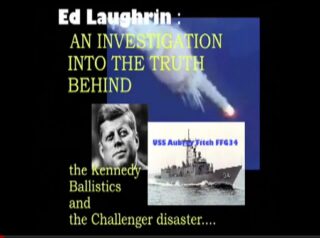
Ed Laughrin is a retired ex-Navy/intelligence specialist with a background in ballistics who in his spare time has thoroughly investigated the Kennedy assassination. In this recorded phone call he describes the exact trajectory of the bullets fired during the event.
This audio interview was recorded without pretense or preparation due to an impending operation Ed was about to undergo where he wanted to make sure that his testimony was taken by someone who would document for the public the areas of his research.
From that point we moved onto the Challenger disaster because as it happens, he was onboard the first Navy vessel to encounter the downed capsule when it hit the water after the crash. What he reveals here is clear evidence of supreme negligence on the part of NASA which leads to the possible conclusion that there was malice and intent in this lack of action to save our astronauts.
This testimony brings into sharp relief evidence of a organization working toward a particular agenda that does not safeguard the well being of Americans and specifically our astronauts under circumstances whereby the agenda they are working with takes precendence. This is unconscionable.
Prior evidence of the hidden mission behind NASA is well documented by Richard C. Hoagland and Mike Bara in their groundbreaking book “Dark Mission“. Highly recommended.
Given the rough quality of this impromptu testimony with regard to the Challenger disaster evidence of negligence obviously requires a great deal more investigation. I encourage researchers to take this testimony and investigate further. There must be others out there who were on board the Navy vessel and witnessed the events causing their ship to be turned away from attempting to rescue the astronauts at that critical juncture.
As we move into the future whistleblowers from within the Matrix who have witnessed events where the agenda of the PTB swings into play and alters the world from that point forward should begin to surface. History was made but it was also witnessed. Those witnesses are everywhere. They are your brothers, sisters, mothers, fathers… As awareness grows they will begin to come forward and the real truth behind the curtain of secrecy will be revealed provided they have the courage to realize that they have nothing to fear but fear itself.
Kennedy Ballistics and the Challenger Crash
October 9, 2011
Ed Laughrin (Ed): …[over] this… material, and use your own judgment, because I don’t want to put you or anybody associated with you, in trouble, [in] any danger. And also too, I was sort of taken back with your audio [interview] with Gordon Novel, because he knew a lot about this.
Kerry Cassidy (Kerry): Right.
Ed: And he said it was a perfect operation. Well, you might say, yes. But I would never laugh or joke about the seriousness of this. I remember when I was 11 years old, and… when it happened, and I grew up in the Mahoning Valley. And, well, in 1960, I was just a wee little kid, eight years old. And I sat on my dad’s shoulders and there’s quite a turnout in Youngstown, and we listened to John F. Kennedy’s speech. So, I was close enough that I saw him. I looked at him. I heard him loud and clear, and I was cheering like everybody else. But, anyhow, maybe that should be up to your own personal discretion. ____
Kerry: Okay. Well, at this moment, because we are recording and because you’ve come to me, this is… what I’d like to do, is just qualify this recording and say this is Sunday, October 9th, 2011.
Ed: Okay. [Correct.]
Kerry: And your name… Are you coming out under your name? Do you want your name on the material or not?
Ed: Yeah. Might as well take credit for it. And I’ve already been threatened. People know who I am. [But who…]
Kerry: Please state your name.
Ed: It’s Edward Gerard Laughrin.
Kerry: Okay. And if you give a slight background as to who you are and how you got involved, before you explain what the information is.
Ed: Well, I’m [a] retired civil service and I’m a former United States Navy sailor. And I’ve been around the world quite a bit. And I was engaged in two special operational groups, during my time in the United States Navy. Prior to that, I was involved with aviation, general aviation. And I enjoyed flying and I was into that, and I did a little stint as a skydiver. And my educational background — I hold a bachelor’s degree in human relations. Okay? And… [I got started…]
Kerry: And how did you get involved in this… in investigating this material?
Ed: Well, my father was a World War II Navy veteran. And he was one of the first ‘Seabees,’ and he and some of his veteran friends, on the 22nd of November, when this took place in 1953… As a kid, I’d hang out with him. I’d go places with my dad, naturally I would. And [heed] me up [when] it was a topic of conversation. And a lot of World War II veterans view the Zapruder film. And they noticed that the President, when he was hit [by] the fatal gunshot, that his head recoiled back. And any of them that were in combat and witnessed or had to take actions against our enemies through World War II… And even our G.I.s — a head shot to the front, always there’s a recoil back. It will snap your head back.
And that result is a mystery. Lee Harvey Oswald was always… was he really the one, the shooter? Because the sniper’s nest didn’t really make a lot of sense in the Texas School Book Depository. There’s a question that should be asked about that. When President Kennedy came up Houston Street, to the intersection of the Elm, that was a perfect shot, from the Texas School Book Depository — straight down, unimpeded, clear shot on Houston Street.
Another opportunity to take the shot would have been right at the intersection turn onto Elm Street. No shot was taken. There were credible witnesses that knew that Lee Harvey Oswald was standing on the corner of Houston and Elm Street. And then, after the presidential limousine passed by, he went up to the second floor break room. Now, it’s my opinion that the Texas School Book Depository was an observational platform. And… because it’s located where it could coordinate a sniper team.
So, [sighs] what I have come up with, is based on Dr. Crenshaw’s work, ‘Conspiracy of Silence,’ in my review of that book and thoroughly going over it. And also in the book, ‘Conspiracy of Silence,’ there are morgue pictures, post-mortem of President John F. Kennedy, and there are untainted. They are actual. And they denote a wound in the neck. And then also, fragments on the back of the neck in the upper shoulder midline. And also a small dime-sized entrance point above the right eyebrow, just below the hairline, on the right side. And then the catastrophic exit wound. So, that is obviously… you have gunshots in the front. Now, the wound in the front of the neck, it so happens to be a tracheotomy, because they opened that wound up, to ventilate the President. [coughs] Excuse me. [clears throat]
But I’ve worked everything out from an aerial picture. And part of my education is, I think of all the [firings in it], to give ballistic analysis, because I was trained in the Navy, and I went through course studies as an intelligence specialist, which dealt with aerial pictures. So, what I did, I blew this aerial picture up, scaled it, and worked the problem, based on [morgue] pictures from Parkland Hospital. Now, the sequence of shots are as follows. And I think I’m relatively pretty accurate on this.
When the presidential limousine came up to, up Houston and made a left-hand [a tree’s yard] turn onto Elm Street, the first shot that was fired, was from an upper floor area on the rooftop of the building, which is right adjacent on the same side of the street, on Elm Street. That bullet flew down the centerline with good elevation, good angle, unimpeded, clear line of shot, intentionally trying to hit the President in the back of the head. It missed. It passed over President Kennedy’s right shoulder and it struck Governor Connally. That’s bullet number one.
Bullet number two was fired directly in front of the limousine, and there’s a triple highway underpass bypass, and there’s railroad tracks there, right down on the center line in front of the limousine, with good elevation, clear line of shot. That’s the second bullet that was fired. It struck President Kennedy in the neck. [That’s number two.] Okay. President Kennedy raised his arms, and he looked in the direction of Mrs. Kennedy. And Mrs. Kennedy leaned in.
The third shot was fired, but it was pulled. Direct miss. Because the sniper on the grassy knoll did not want to penetrate President Kennedy’s right side of his head and have the bullet pass into Mrs. Kennedy. It missed. It struck the curb. And you can denote… you can go put your finger on the… on the nick on the curb. It corresponds.
Okay. Bullet number four penetrated to the right. [Pfizer.] And you can see it if you run it frame-by-frame, and the [Pfizer] is in the upright, right above a Secret Service agent in the limousine. Okay, that’s bullet number four.
Bullet number five is the kill shot. It strikes John F. Kennedy above the right eye, below the hairline. Those are the ballistics. Those are facts. That’s what happened. And there you have it. One, two, three, four, [and] five.
Kerry: Okay. But, what I… if… correct me if I’m wrong here, but basically, you are telling me where you think the bullets went. You’re not telling me who shot them.
Ed: Who shot them? I gave you positions, which just automatically, this should be strong evidence to clear the name of Lee Harvey Oswald, that he is not the sniper. Absolutely not. Now, I can’t prove this one way or another, but in my research and going over a lot of material, there’s a guy by the name of Sarti, and that’s on the internet, and he was a Corsican Sicilian. And then also, I talked to an individual. I’m not going to give you his name. And he’s 85 years old. And like your friend, Command Master Sergeant Bob Dean, he also was a command master sergeant in the United States Army. And he’s been there, and he went over this material with me. And he confirms the location of the kill shot, because he’s been there when he was in the Army, in Army Intelligence. And he’s 85, and he’s a resident of Florida. I spent three hours with him. And then also, I have, I know an individual who’s a Navy SEAL, who has gone over this material, and he agrees with it, based on ward pictures from Parkland Hospital, thanks to Dr. Crenshaw.
So, it’s pretty tight-knit here. I mean, there’s no room for sloth. But the blowback on this material and this work, is that it… I’m sorry to say this, but I absolutely cannot agree with the Warren Commission or Arlen Specter and the single-bullet [theory]. It’s just not factual. It just didn’t happen that way. Based on the entrance and the exit wounds on President Kennedy. And it was a horrific, horrific event. It’s absolute treason, even to this day, to murder a president, the President of the United States of America. But I understand, through a lot of my other work and everything… Well, this is basically my work — ballistics.
But all the factors, Kerry, that have come into play, all the enemies that John F. Kennedy happened to accumulate during his time in the White House, all came down on him, all at once. And that was in the Dealey Plaza on 22nd of November, 1963. And you can see today, currently, right now, that the American people are getting quite fed up with the Powers That Be. And basically, I think it’s time for people to try and get their country back by peaceful protest. And this, in and of itself, should be a motivator too, to bring back what our Founding Fathers intended for all of us, as Americans.
So, do you have any questions Kerry, for me, in addition to this? ___ [of mine. Go ahead.]
Kerry: Well, first of all, are you familiar with the work of Robert Morningstar?
Ed: The name’s familiar, but I can’t stay I’m really familiar with any of his work. No, I’m not. _____
Kerry: Okay. Well, I did an interview with him quite some time ago. We talked in brief about the Kennedy assassination. He’s been investigating it for years and has also written books about them. There… I believe that you may have some information that might be useful to some other researchers, but to tell you the truth, you don’t really have anything, that I can tell, that is more over-the-top than what is generally known at this point. No one believes there was a lone gunman, unless they’re just part of the mainstream and they’re just so programmed, they really can’t see straight.
Ed: Yeah. You’re right there. Yeah.
Kerry: So, at this moment, there’s no doubt that it was a conspiracy. There’s no doubt that there was a number of individuals and organizations involved. Certainly the CIA, certainly the mob at the time. And…
Ed: Yeah.
Kerry: And from what I understand, there could be some other elements including the Israelis. But at this moment, what you were telling me doesn’t really constitute anything too [radical]. So, if you keep it quiet, it’s when they bother you. It’s when they’re trying to intimidate you, just to get you to shut up or just to mess with you, because they’ve got nothing better to do with themselves.
Ed: Well, _______. The one thing that concerns me, I agree with your good advice that you’re giving me. But Phil Schneider — why in the world did they knock him off? I mean, I’ve listened to him, and I… about deep military underground bases [so on and so forth].
Kerry: Right.
Ed: And then [they turned around]. And then I found out that Phil Schneider was left-handed. And he died from a gunshot wound of the right temple, Kerry. And there’s no possible way that he shot himself if you’re left-handed in the right temple. It’s quite awkward.
Kerry: I mean, look. If you’re a ballistics expert of sorts… I’m not sure if that’s…
Ed: Of sorts. Of sorts. I’ve studied it.
Kerry: That can be very useful at looking at evidence across the board. There are many, many people that have been suicided in various ways. And so, I… Why don’t you start a YouTube channel and start going over all the cases out there, not just the Kennedy assassination, from the point of view of ballistics.
Ed: That would give me something to do. That would give me something to do, to pass my time as a retired civil servant. [laughs] ___________
Kerry: Well, yeah. If you have expertise like that, it can be valuable to the mainstream.
Ed: Well, I have a knack for things. I have a way of cutting down and being… can discern and unravel things. And look for the truth, like you do. But we all do it in a different way.
Kerry: Sure.
Ed: Yeah. Yeah, we do. But, anyhow, I’ve given you complete ballistics. And I have talked to the Federal Bureau of Investigation about this, and they have all this material. But if… And then the individual that I talked to, I don’t feel comfortable telling you his complete name. But…
Kerry: That’s fine.
Ed: He said that they were picked up, this Sarti… Lucien Sarti. He was involved with [coverup].
Kerry: Yes. I’m familiar with the name Sarti. I’m familiar with this.
Ed: You’re familiar with him? Okay. But, they were picked up by the Dallas Police. And there are other witnesses that saw a man in front of the limousine coming down off that highway underpass/overpass and then the railroad tracks looped around. They loop around from… in front there. And then they go past the grassy knoll onward. But I have [came across] E. Howard Hunt for his deathbed confession. This was known, according to him, as ;Operation 40,’ the Big Event. And he considers himself a benchwarmer. And, from what I understand, from the internet, which is in public domain, there were like 27 individuals involved in it. And then also, another one that’s very, very dirty, is Lyndon Baines Johnson. And that’s from testimony from his mistress, that she came out with all that.
Kerry: Yes.
Ed: But, they were murdering people left and right over this thing. _________
Kerry: Right. And, I mean, you’re asking why they killed Phil Schneider. I mean, Phil Schneider came forward at a time with key information. Had he come forward at this time, when the information was already out there en masse, maybe he wouldn’t have been knocked off.
Ed: Yeah.
Kerry: But obviously, he came forward at a certain juncture. We’re at a different time right now, and there’s the knowledge about the things he talked about, are well known in part because of him. And so, they do knock off people. They kind of pick and choose, I guess, who they decide to do that to. I like to think that they’re not doing that quite as much anymore, because they really have little to lose, because it’s becoming pretty obvious, what’s going on.
Ed: Right. Yeah.
Kerry: In some ways, they are still threatening people, because I’ve been threatened, and other people I know agree, but there’s a lot more leeway at this time. And especially with regard to past events. So, in the sense of what you’re talking [about], we can put this out, as it is, as an audio recording. It’s going to be fairly rough, but it is…
Ed: Well, what I’d like to do, I’d really like to get through this ordeal, because I’m overwhelmed with what I have to go through, to get myself back in shape. It’s not going to be very pleasant, but I’m just going to have to just do this. But I’m going to wait later on. Once I get back up to feeling right, and then I can pursue this and maybe get some help from others that are far more computer-savvy in my area than I am.
Kerry: Okay.
Ed: But I think maybe you should just take this raw, the way it is, because I gave you the sequence of shots, and you won’t… I’ve never heard the sequence of shots, and I have studied this and pondered it, and laid awake at night. I’ve gotten up in the middle of the night and worked on it, and gone over everything. And it’s all because that I was eight years old, I sat on my dad’s shoulders at a rally for John F. Kennedy in Youngstown, Ohio. And… I was for Kennedy. And I think that was horrific the way he just got himself destroyed in Dallas. And my opinion is, that it’s high treason and there’s no statute for the limitations on treason.
Kerry: [laughs]
Ed: Absolutely, yeah.
Kerry: Okay. I hear you. All right. Well, well said. Let me say this. As far as your ballistics background, can you go into more detail as to why you’re… why you think you’re sort of a semi-expert in this field. In other words what was your exact training?
Ed: Well, when I went in the United States Navy, I had a choice. I went through a horrific de force process, because I was a fool and an idiot to get married at the age of 22. What was I thinking? But, I… It just didn’t work out. And after a nine-year period, I was getting a little on the hot… upper end. And it all just fell apart. So, I was there alone in my apartment one night, feeling sorry for myself. And I got to thinking, there’s gotta be some adventure for me. And my first thoughts were, ‘Hey, you know the French Foreign Legion might be a good way to go. You know, on second thought, I don’t speak French, so I’d be at a disadvantage. I’d have to be an extremely fast learner.’
And my second choice, actually, was the United States Navy, because my dad always used to tell me, when I was kid growing up, and my [father] used to call me ‘Edward.’ And he said, ‘Edward, if you’re ever at loose ends, just take time out and join the Navy. Be a fleet sailor and see the world.’ So, I did. And I was 30 years old when I went in, and absolutely out of shape. And I went through Great Lakes [Navy Station]. And I was in… the ‘state flags and sailors.’ You wouldn’t know what that means. And then we had ‘Triple Threat’ with us. And I sort of represented the State of Maryland. And we were like a parade unit. We were pretty fancy-looking recruits.
But I transitioned from that and graduated from boot camp. And to my great surprise, I was in extremely good physical shape and completely focused on the Navy, completely committed. And there was our division officer. There were two of us that were selected. And there was another sailor and myself. They wanted us to go to BUD School. Are you familiar with that term, ‘BUD School,’ Kerry?
Kerry: [chuckles] No.
Ed: Well, they wanted to transform me into a United States Navy SEAL. Well, it so happened, before I got on the bus to leave for boot camp, I [came across] Jimmy. He’s a retired Navy SEAL. And, well anyhow, he… It was too adventurous, as far as my mother was concerned, because she was a cousin to his mother, and really worried his parents quite a bit, what Jimmy was doing, especially during the Vietnam War. Because he used to take [reaper eaters] [24:59] and go in and recon the Hai Phong harbor, and things of that nature. And I promised my mother — but I thought it was a real long shot. Why would they want me to be a Navy Seal? Really. Well, for some odd reason, they thought they… They pick you. You don’t pick them, more or less. You could put a request in for it. But I was one of these characters that was getting picked on. So I declined it.
And then I went through Gunner’s Mate ‘A’ School and did quite well in that. And then I was assigned my ship. And it was the U.S.S. Aubrey Fitch (FFG-34). And I was a member of Destroyer Squadron 8 in Mayport, Florida. And our claim-to-fame was, we were the first Navy vessel to go on-scene when the Challenger exploded. And we picked up debris down there. And we all have [night] certificates and I still have mine. Presidential commendation from Ronald Reagan. But I’ve been to El Salvador… special operations, Operation Blue Light. I’ve been involved in the Persian Gulf. And I’m a Blue Nose. I’ve been up over the Arctic Ocean or Arctic Circle, rather. And I’m also a Shellback. I’ve crossed the Equator and I sailed down through the Suez Canal. And I’ve been to Karachi, and I don’t recommend it. We were there for R&R for a week. And you have to be very careful. And you be very careful when you’re in India. The Karachi’s a heck of a lot worse, let me tell you. This [is the way it is] today.
So, as I went along, I requested another additional school in the Navy. And it was intelligence specialist. So, I went through that. And… well, anyhow, the reason why I really didn’t make a career out of the United States Navy [is] my mother, we discovered she had Parkinson’s Disease. And she really wanted me to come home, because I only got two weeks’ leave out of the year, so I carried a lot of leave. We get thirty days a year. And I went… I was a member of the Naval Reserve. And then I met my second wife. And things are fine and I settled down in… here in Warren, Pennsylvania. [chuckles, clears his throat] So, that’s my background.
Kerry: Okay…
Ed: But I also hold a Federal Fire Arms License too, and I’m a… I do instruct as a fire arms instructor. So, I’m familiar with weapons. I’m familiar with a variety of handguns, rifles and [because I was] in the Navy, I’m very familiar with assault weapons. ______
Kerry: Okay. It sounds like maybe you’re a little modest in terms of calling yourself a possible expert. It sounds like you are an expert.
Ed: Well, I’ll tell you what. With the new modern technology and everything, you can’t really miss a target with some of the advanced weapons that we have today. And computers. It’s not like old school. And… it’s just absolutely amazing, how they’ve advanced on a lot of stuff. I was watching a YouTube video the other day about this new camouflage that they have, special forces, our guys. And it actually refracts light, someway, somehow. Must be nano or something, but it actually is sort of similar to… oh, you’ve seen the Arnold Schwarzenegger movie, ‘Terminator.’ Or no, it’s not. Yeah. The first… not actually ‘Terminator.’ I’ve got my movies mixed up. ‘Predator,’ with the alien that could cause himself to be relatively invisible.
Kerry: Right, yes. Yes.
Ed: You have that [fight there] in Central America. And Jesse Ventura got zapped in the chest with a laser. [laughs] But it’s similar to that, but the technology is so advanced, all the way around. I mean, completely, and weaponry. And then I know another individual who states that our military now has the capability to shoot somebody with ultraviolet laser. And what that does is, it causes your heart to stop. And you’re done. And you never see it. So… And I have to take issue with a lot of this stuff. I have a problem with a lot of this weapons technology. I mean, we should only use and get involved in wars — it’s my personal belief — is if we’re really threatened, our way of life. And for defensive purposes only. We should never be out running around, looking for a war. But there again, that’s the military industrial complex.
Kerry: Right.
Ed: Because peace is cheaper… or not cheaper, more expensive. Excuse me. Peace is more expensive than war.
Kerry: Yes.
Ed: For some unknown, crazy reason.
Kerry: Okay. So…
Ed: [sighs]
Kerry: Let’s get back to this… to some of the things that you’ve done. One of the questions I have is the Challenger explosion.
Ed: Okay.
Kerry: You said you got a piece of it. And I wonder if you ever tried to investigate whether that was a natural occurrence.
Ed: Well, I didn’t really get a piece of the Challenger. We got quite a bit of it. It was spread out. And what we were doing on that day, we were coming up, we were on an exercise, our squadron. And other Navy ships. And we go down there, what’s called a ‘PACFIRE’ in the Caribbean. And we did a missile shoot. And at that time, we had a Mark 13 missile launcher, so we fired it, at target drones. And anti-submarine warfare. That was roughly about a week’s worth. It was a work-up of exercises and drills. And we were coming up the coast. And right at the time, we were right off of the Kennedy Space Center. And we went on-deck and we tracked the ascension of the Challenger on our surface search radar. And all of a sudden, it blew up. I mean, and that was it. And then, you have the booster rockets were out of control, but they can detonate them from the ground, to destroy them.
So we tracked all the debris, and it took us twenty minutes to pull up on the crew compartment. And we had them on our surface search. And it floated for about ten minutes. And when we pulled up on it, where we were at, the ocean was relatively pretty clear and we could see the windows in the front, because it was sinking stern-first, or the back of the compartment. And we had a couple divers on-board, and we weren’t allowed to put them over the side. But the depth there on our fathometer was 90 feet. And we pulled up on the crew compartment. They submerged about 40. And then, through the grapevine in the Navy, after they waited forty-some days and pulled the bodies out, they couldn’t bail out of that thing. And there were a couple of survivors, as we found out later from Navy divers. Because there’s a grapevine. We know. I mean, there’s like, whatever. Like… ___________
Kerry: Okay. What are you saying? You’re saying that the seven people who died, some of them survived?
Ed: They survived the initial impact, because the… we got the aspect. When it reached terminal velocity, when it came out, I was… its ordinance dropped. It was blown free, because that’s the compartment where the crew is at, is extremely strong. It’s like a diving bell, more or less. And it fell and it hit on the left side. And the door was sprung, but they tried to jettison the door. From what we did understand, and we did see movement when we pulled up on-scene. There was movement, because the windows were pointed up and it was sinking. The back end was going under, and then we were pinging them with sonar, to get their location. And we had a medium range sonar on my ship. And they were definitely at forty feet. And they were decompressing. We could see air escaping.
But… then we were ordered off because there was an AGI, and what an AGI is, it was Russian. And it looks like a fishing trawler, but they’re intelligence-gathering ships. And we had to an intercept on the AGI, keep them out of that restricted area. Because there was quite a lot of debris that was thrown free. And you’re talking manuals. Some… There were several manuals. And one of the gloves we picked up, that they use on their suits, when they go outside into the space environment. And we would pick up debris and we also recovered a lot of assemblies, because it’s made out of titanium. And it was amazing, because we actually recovered the right landing gear assembly. And then we would run it into the cape, and they’d offload it, photograph everything. And then we’d go back out. But the USS Aubrey Fitch (FFG‑34) was the first ship and that was the ship I served on, that was first on-scene during the Challenger accident.
Kerry: Okay. But, there seems to be some confusion as to whether or not, what the astronauts actually died of, and also, from John Lear…
Ed: [coughs]
Kerry: …I recall that the Challenger situation was actually, that there is some unknown information out there about it, possibly some intended effects of actions that were taken on the ground, before the thing took off.
Ed: Well, the thing…
Kerry: Do you know anything about what, why the astronauts were not rescued?
Ed: They were written off, as far as we could determine. And it was poor judgment by Mr. Truly. ______
Kerry: Okay. They were written off by us?
Ed: Yeah. They gave up on them. They assumed, because of the catastrophic explosion, they were dead. And then we desperately, my commanding officer, gave them all the information. ‘We think there are survivors.’ And then we were ordered off. And then a lot of the guys… ________
Kerry: So, you were there first on… wait, wait, wait. You were there first on the scene.
Ed: Correct.
Kerry: In theory, you could have helped recover the bodies or help get people to safety, but you were ordered off.
Ed: Yes, ma’am. Yeah, we were. Yeah. That’s the way it was.
Kerry: So why, as an investigator, have you never, like, gone down this road at all?
Ed: Well, because… I mean, you can’t really take on an error that NASA made. And that was their big blunder, because they didn’t have a real picture of the situation out there and they weren’t paying attention to a United States Navy ship.
Kerry: Why would they not do that, though? I mean, in other words, I’m Project Camelot, right? So, I’m looking for conspiracies everywhere I turn. Some would say that’s foolish and others would say that you’d be foolish not to look for that, at this point in this juncture of our history. So, what I’m asking you is, if your ship was there, if you were first on the scene, if you were on the crew, didn’t something strike you as being wrong, and not just because of human error or foolhardy judgments, because you’ve got people in NASA who are… they’re sending astronauts out into space. They have to have good judgment to even get their jobs. So…
Ed: I understand that, Kerry. But they didn’t have any good judgment. Their judgment flew out the window that morning at 11:35[am], roughly, or whenever. [Plus, the actual…]
Kerry: Okay. Is it possible they were under orders? They were under orders to tell you to leave the scene?
Ed: Well, I can only tell you how it was and we had to go chase after an AGI, a Russian trawler, and we were told to pull back. However, I have heard stories, we’ll call them, that they had an in-… an on-board computer. They do have black boxes. And the Challenger had one. And it was reported that they were actually, saw us, [some part of our] ship pulling up, and they were quite excited about rescue. And they heard us, because we did a back-down, and what that is, we threw our propeller… It’s like an umbrella. And you can shift the blades — it’s hydraulic — and you get cavitation… when you’re on forward momentum, and then you reverse the propeller, and it bites backwards. It will… [the thing] turns inside-out. All hydraulic. And you cavitate the ship, and it will vibrate.
On their flight recorders in the Challenger, they heard our cavitation. And all that stuff we sealed up and put away. But I’m getting my certificate out, and I’ll just briefly read this to you. And it… manned flight awareness certificate of appreciation is what it is for NASA, presented to Edward G. Laughrin. ‘The appreciation of your dedication to the critical task you performed in support of presidential commission investigating the Space Shuttle Challenger accident. Your valuable contribution assisted in identifying the actions required to return the national space transportation system to flight status.’ And… there you have it. They…
Kerry: Okay. But in reality, that’s… that sounds like a ticket to be quiet.
Ed: A ticket to be quiet? Eh, maybe, I guess. [laughs]
Kerry: Okay. [chuckles] Uh-huh.
Ed: I don’t…
Kerry: No, I mean, Look, I have a commendation from some work I did as a contractor over at JPL. So, I understand how they dole these kind of things out. Look, in terms of what goes on with your being there, you said that there was an ‘AGI.’ Is that how you termed it? A Russian trawler?
Ed: A Russian trawler. AGI. Correct.
Kerry: Now, what was the role of the Russian trawler. Were they trying to help? Why were they there?
Ed: No. Not at all. What they do, they would monitor our activities here at the Cape. They did have real special interest in filming the… anything that NASA would launch, from shuttles to satellites to whatever they do, whatever launch, launches they happen to have. And they were always trailing us. When we go out on deployment, we’d go out as individual ships and then we’d form up into a battle group. And they would follow us around. [laughs]
Kerry: Okay. So, but at this point, you’re the first ship on the scene, and then there’s a Russian trawler, and you’re told to leave the scene. Does the Russian trawler follow you, or do they stay on the scene?
Ed: We backed them off. We forced them out of the area. They were warned off. ‘Leave.’
Kerry: So, you guys left. Who went in, when you left?
Ed: Well, there was like a lull right there, because they had to gather their resources. And our _____
Kerry: Why would they do that? I mean, that’s not… it doesn’t sound intelligent, if you’ve got a…
Ed: They’re not prepared for accidents. They were caught flat-footed on this thing.
Kerry: Right. But you were there. You were there and able to assist, but you were turned away. Why were you turned away? Did you ever not report that there was something very suspicious about… If I’m in a distressful situation, I see a ship in the vicinity, and that ship turns away and goes away, I’m going to be extremely upset.
Ed: Well, the deal was, in the Navy, we have to follow orders.
Kerry: Sure.
Ed: And it’s a chain of command.
Kerry: But you are able to question an order that is illegal or…
Ed: Not really. Well, if you can really prove it’s illegal, you have the Unified Code of Military Justice, but you have to have witnesses. But by and large, you have to follow an order. You don’t ask why _________
Kerry: Okay. But you were… How many people were on your ship?
Ed: My frigate… we had roughly about 185. ______
Kerry: So, 185 people were witnesses, right?
Ed: Correct. Not of all them. Some of them down in the engine room are the cooks and store keepers.
Kerry: Okay.
Ed: They weren’t really privy, but everybody, all hands on deck, when we were recovering wreckage and debris. So everybody basically chipped in and they were aware…
Kerry: I see.
Ed: …after the event. _____
Kerry: I mean, is there some danger that your ship posed to the survivors of the Challenger?
Ed: No. None at all. No. Negative. No. Not at all.
Kerry: Okay. So then, I don’t understand, in good conscience, if I’m captain of a ship and I… and the Challenger with these very famous astronauts is in danger, how in good conscience, do I turn my ship around and leave?
Ed: You follow orders. Now, [that’s] orders.
Kerry: And never question, never question, never investigate further?
Ed: No. You don’t. You follow orders. And that’s your primary objective, serving in the armed forces. And I was an enlisted man. So, my thoughts belong to me. But… _________.
Kerry: Okay. What about among your crewmates? Did you guys ever discuss the idea that possibly the… and the fact that you guys were turned away, that that was the last chance that those people had, to stay alive?
Ed: Well, we’re human beings, too. And you’re correct. We did discuss it. And it was disturbing to us.
Kerry: Wow.
Ed: It was. It bothered a lot of us. I mean, all of us. It bothered us. It was horrific.
Kerry: That’s incredible.
Ed: Yes, it was. Well, you see, our Navy, the admiral up there in Mayport, turned us over to NASA, to take our orders from them. But then, our duty was to protect the scene. And there’s the North Atlantic drift, and a lot of material was drifting up from… up towards the Northeast. It started to spread out. And… I mean, it was just… I mean, the sea was just littered with debris. And then the heavier objects sunk down to 90 feet, because that was the depth on our fathometer we were pinging off the sea bed.
Kerry: Right.
Ed: And you know, and I don’t know if you, being from California there, you’d probably… Have you ever done scuba diving? If you have, you know you can go to 90 feet. You just have to be careful on your decompression up. ________
Kerry: So are you saying… Maybe I don’t understand, because I have done scuba diving, but I’m… I don’t know much about it. I only tried it once, I think.
Ed: Yeah.
Kerry: But at any rate, not here in California. Are you saying that the Challenger landed in water that was 90 feet deep?
Ed: Yeah, which is… They landed short of the continental drop-off…
Kerry: Right.
Ed: …that runs out [clears throat]. Yeah. Because we, they could not have… Well, they could have recovered them, but they was in relatively shallow water, 90 feet.
Kerry: Well then… Okay. So… Even here again… So, there had to be some pretty significant evidence that they were able to recover, right?
Ed: Well, we took our orders. And then they… we did what we did. We followed orders. We were [all]… Well, I’ll be honest with you. It was sort of an assumption that they were gonna, they had a search-and-rescue operation within their capability at NASA. Now, it turns out, Kerry, they do not. They did not. They had nothing going for them. They had to rely on the Navy and the Coast Guard. They had no capability, at all. Their only way was to… like, if something went snafu through the vehicle, to turn around and land. [laughs] And… ________
Kerry: Well, I guess I’m not understanding… Maybe I just don’t get what you’re talking about. Are you saying NASA or the space shuttle itself had no capability to deal with a crashed… craft?
Ed: Of that catastrophic event… there’s no way. I mean, they were done. I mean, they had no wings. They were blown apart except for the crew compartment, which you have an upper tier and a lower tier. I mean, that was it, in a nutshell. And they dropped and they hit the water. And they… it was the left side where the hatch apparently was at, and we had them on radar. I mean, we actually painted them, plotted them, had them right on the button. And it was through our CIC. And we were relating all this information. We were in… It’s like it was too much for them. They went into like a vapor lock. The Powers That Be, their managers and the ones… because it was a shock factor. Naturally, it caught them off-guard.
But let’s roll this back a little bit. As to what I understand, being in the United States Navy, what caused the accident? What caused the accident, from what we understood in the Navy afterwards, was that they were had a boom, and you have the external tank. Then you have the forward strut attachment point, where the Challenger attached to the forward… Well, forward strut on the external tank. They had a boom that got away from, some way, somehow. And it punctured that tank. And they did a repair job. I mean, they patched it. Whatever.
And then that morning, it was very, very cold, because we had some relatively warm jackets on, that morning. The ones that were on the rev watch. And I believe the story where the O-rings on the solid fuel rockets. I mean, they were frozen, so they contracted. It wasn’t proper seal. So on the ascension, that patch let loose, and you can see a flame if you watch the video, where it ignited and a flame shot out of the one side of the one rocket booster, igniting in a blue flame. Look for a blue flame. And it travels all the way up, right behind the front attachment point of the Challenger to the external fuel tank. And then a split-second later, you have a catastrophic explosion. And that’s how… [it wiped out].
Kerry: Okay. Well… I’m actually on the internet, as your speaking, looking up fatal events involving NASA astronauts. And what you said was, they were unprepared, as if they had no idea that such a thing could happen. And we are saying this happened in the year 1986.
Ed: Correct.
Kerry: Okay? January 28th.
Ed: Correct. _____
Kerry: So, NASA had been operation for what? Twenty, at least twenty years at that point?
Ed: Well, quite a while, but… _____
Kerry: [chuckles] You know, I don’t buy it. I’m sorry. I appreciate…
Ed: They’re all type-A personalities. [laughs]
Kerry: Yeah. I appreciate that. But I don’t buy it. I have to say that, they have to prepared for anything and everything, under their circumstances of what they do for a living. And I…
Ed: Well, you might be a little biased, because you worked for the… for those folks.
Kerry: That’s right.
Ed: So, I understand where you’re coming from. And I appreciate that. And I respect you. But, however, this event, psychologically, this was a mind-blowing experience.
Kerry: [laughs]
Ed: My goodness [the] shockwave… _______
Kerry: Even so, but if… Let’s put yourself in that situation of a mind-blowing experience, and you’ve got people in NASA who are on, I guess, on the floor or on the board, whatever you call that, watching events. And at the same time, in connection, in communication with your ship, and telling your ship to back away. See, there is something very, very profound going on there. I don’t understand. As far as I’m concerned — and I know we started talking about the Kennedy assassination — but this is just one more…
Ed: This is really transitioned, hasn’t it, Kerry? It’s a big transition. Yes, it is. Well, I’ll be… I’m being as honest and straight-up with you as I possibly could be. But you might say we critiqued NASA. I mean, we most definitely did. And… I mean, we’re trained for disasters. We look awful cute in our crackerjacks. You’ve seen sailors. I’m sure you have. Aren’t we cute. However, our business is warfare at sea. To destroy. To sink. To smash submarines. That was the mission of my ship. And that’s what we were trained to do. And we see the world differently.
And if it was a Navy operation from the get-go, you probably would have had a different end result, because NASA is actually civilians. Sure, they’re rolled into the federal government. Whatever. But they don’t have mind-set of… of the military. And I can’t really speak for the other branches, because I don’t know that much about them. But I do feel comfortable about addressing what it was like to be a member of the United States Navy. And… I don’t know why they dropped the ball.
Kerry: Okay.
Ed: I can only speculate. Really… I mean, it would have been a little different outcome, I think. And I guess what _______
Kerry: Right. But dropping the ball. I’m sorry to interrupt you here, but dropping the ball and sending a rescue vessel away. And not having that investigated further. I don’t know that it’s ever been investigated. I don’t know if there are books written, investigating suspicious aspects of this event or not. I haven’t really gone down that road. It doesn’t sound as though you have either.
Ed: Well, we’re compartmentalized. I mean, the Navy, we did our thing. We were… we would have done more, if called upon to do. And we stayed there. We finished the mission. And we finished our mission. And then we were released after several days, to go back up to Mayport and Liberty Hall, Liberty Hall. And while the married the fellas wanted to get home to their wives and their kids. And then we go about our business. What’s the next agenda for us to do? What’s our next deployment? And then we prepare for that and do our work-ups. And we’re a tight group on a Navy ship. It might be steel, aluminum, brass wires, but the soul of a ship is her crew. And… we did what we did, and we followed our orders.
And it’s actually amazing that we got into this subject, because I had no idea I was going to go over this. None whatsoever. I thought we were just going to talk about my ballistics with Jack Kennedy. But anyhow, you’re getting a bonus here. [laughs]
Kerry: [laughs]
Ed: [laughs]
Kerry: Okay. Well, I appreciate that. At this time, what I would suggest is that we wrap this up. It’s been going for a while. I think that I will just put it out with the Kennedy information and that the… the sort of questions that are now raised about the Challenger. I know there will be investigators out there. I am doing a quick search on the net, to see if there are other people who have started to investigate it. And it looks like there are some. And possibly this will sort of pique some interest out there, and you may get some feedback. Do you want to give out an email address or anything like that, so people can reach you, if they have more information about either subject?
Ed: Well… I don’t know how I’m going to be feeling, after I go through all this business I have to go through medically. And… I can give you my email address at a later date, if that’s okay with you.
Kerry: No problem. So, if people are interested in this subject, and they want to talk to Ed Laughrin, why don’t you write to me, [email protected], and then I will forward the emails along to Ed. And then he can answer them, if and when he gets a chance.
Ed: Yeah. The last name’s pronounced… It’s very Scotch-Irish, Kerry. I go all the way back to [Aries] Loch, and that’s 50 A.D. in Scotland.
Kerry: Okay.
Ed: I had… I mean, one of my cousins and then an aunt and several other ones, kept track of the family record. And it’s pronounced ‘lock,’ like the lock on your car, lock on your door. And the ‘rin’ is Irish, because we had to evacuate, along Hadrian’s Wall, because we weren’t doing very good against the Romans. And they made a tactical withdrawal to the Isle of Man in Northern Ireland. So, that’s my lineage. And ‘Aries,’ by the way, means Mars. So, what does that mean? [laughs] We can get into a whole new topic, couldn’t we? Very easily, yeah.
Kerry: Sure. Absolutely. Okay, at this point, I’d like to wish you good luck. If you haven’t already read Richard Hoagland’s book about NASA, I highly recommend it, which is called ‘Dark Mission.’
Ed: Oh yeah. Yeah, yeah. I’m a little bit familiar through you…
Kerry: Uh-huh.
Ed: …you and Project Camelot about it, and I’ve thoroughly found these very educational. And I really enjoy Bob Dean. I’ve never met him, but you… give him my respects from a former fleet sailor. [laughs]
Kerry: Okay.
Ed: And… Yeah. He’s pretty remarkable, but he… I’m really amazed that a retired command master sergeant has such a fantastic pigtail. How far down does that actually go down his back? Pretty darn far. But, anyhow…
Kerry: [chuckles]
Ed: I appreciate this. And the reason why I never really went public on any of this business about the Challenger, is because respect for the families and also, too, what used to gall us, was that they were blown to bits, on the media and national news. ‘Oh, they were blown to bits.’ And then speculation — ‘They must have been blown to bits.’ Well, they weren’t blown to bits. The fallen astronauts, the seven, were laid to rest in coffins. They were in… they had their toes and their fingers.
Kerry: Right.
Ed: The ones on the bottom deck, they suffered shrapnel. But Judy used up all her air, and she was on zero and she had a dry head. And… if you go on the internet, you might be able to get that up. But that was all what we heard through the grapevine in the United States Navy at that time. So, [sighs] again, I want to thank you and thank you for Project Camelot. And give my respects to Bill Ryan, who, by the way, did an interview with — you could him a friend of mine — and that is Paul Hellyer, former Minister of Defense. I know Paul. I helped him a little bit with his book, ‘Light at the End of the Tunnel,’ and I set up the interview that he did with Travis Walton. And I also know Travis.
And I’ve had the same type of experience but not so profound, back in March of ’75 with a crescent-shaped vehicle. And we have quite a bit in common, and there were… if there’s ever points where he gets down a little bit, I try to cheer him up about it, such as, ‘Well, Travis, they didn’t eat us.’ [laughs] So, I know Travis and Paul.
Kerry: Okay.
Ed: Yeah. So, yeah.
Kerry: All right. Well, listen, Ed. Thank you very much for your testimony at this point. And possibly we can continue this when you return and you feel better.
Ed: Okay.
Kerry: And I would appreciate it, if you possibly would consider looking further into the Challenger information, if it interests you at all, simply because, if you were a ship on the scene, and you were turned away, and these astronauts could have been rescued, and some could have survived, then we have a whole different ballgame happening. And it’s just more of this sort of kind of conspiracy that has been plaguing NASA since the beginning, and that there are other very, very strong elements, even happening now. And you can… I’ll give you free access to my — if I haven’t already — to my ‘Awake and Aware Conference.’
Ed: Okay. Thank you.
Kerry: So you can listen. And I advise you to listen to Richard Hoagland’s presentation on Elenin and other matters, because you can see, in following his train of investigation, that there is a lot of evasion going on by NASA on a constant basis, and obviously, it didn’t start yesterday. It started many, many years ago. And this involves the secret space program, etc., etc. So, the rabbit hole goes very deep.
Ed: Yes, it does.
Kerry: And I appreciate the level that which you’re trying to investigate, but I think that you could go a lot farther.
Ed: Well, thank you for that. And also, too, you did an interview with Andrew Basiago. [pronounces it BA-sa-go]
Kerry: Basiago. [pronounces it ba-SAJ-yo]
Ed: Basiago. ___________
Kerry: Basiago. Yeah, we have not interviewed him. We did interview him in a TV show that is handled by truTV, and we are waiting for the release of that TV show. It is sitting on the shelf right now. They’ve gone outside of their contract and have not shown it yet. And we are still waiting for an air date.
Ed: Well, I don’t get along with him. I’ve had conversations with him, and I have problems with the ethics, human rights violations. I… we talked about timelines — and I’ll be straight with you, Kerry — he accused of me of… a possible individual to interfere with the timeline. Now, that’s… We got into a little argument over the phone. And he vented on me pretty good. But personally, I don’t hold anything against him, but we don’t see eye-to-eye on Pegasus. And certain…
Kerry: That’s all good. I’m sure that we could cover that at another date. I mean, it’s very important for people to compare notes and to cross-correlate information. So, if you have a different information, we’re happy to listen to it.
Ed: Okay. yeah.
Kerry: Whatever.
Ed: But I believe in our autonomy as human beings. I believe that we shouldn’t be modified and we should not be enslaved. Absolutely not.
Kerry: Right.
Ed: And that’s my point of view. I’m very pro-human and pro-planet. And that’s just the way I’m put together. And Andy seemed to be a little obtuse. A little impersonal. And me, I take it very seriously, especially the business out there. It… what do you call it, Dulce, human experiments, bio-genetic stuff is outrageous.
Kerry: Right.
Ed: Yeah. It’s absolutely an abomination, in my opinion. And I’m very pro-human. And I’m going to be that way for the rest of my life. And we are royalty — I’m convinced of that — in the universe. We are very unique, our species. We’re special. [laughs]
Kerry: I hear you, and I agree with you, Ed. Okay. Well, thank you very much. Like I said, I’m going to wrap this up, and I hope the recording came out, so it’s audible and understandable. Let’s reconvene at some point in the near future. I’ll be in India for about a little over two weeks. And I’m sure you’ll be recovering. Good luck with your surgery. If… I highly recommend natural healers rather than going through the medical establishment, if you could avoid it, but I assume you’re following your own… inner dictate[s].
Ed: Yeah. I did have a very sore chest. So, I’m going to have to have a very good pillow if I cough.
Kerry: Okay.
Ed: [laughs]
Kerry: All right. Well, you hang in there, all right?
Ed: I’ll do that, Kerry, and you have a very safe trip.