Fraud Holiday: The Truth About Christopher Columbus

Fraud Holiday: The Truth About Christopher Columbus

“What we committed in the Indies stands out among the most unpardonable offenses ever committed against God and mankind, and this trade [in Indian slaves] as one of the most unjust, evil, and cruel among them.” – Bartolomé de las Casas

Christopher Columbus

Age Of Exploration

Christopher Columbus was not the first to discover the Americas, nor was he the first to realize that the earth is round. He was the first, however, in other exploits, namely genocide and the transatlantic slave trade. Doesn’t sound familiar? Read on.

The Afro-Phoenicians are described as having sailed from Egypt to the coast of Mexico as early as 750 B.C. Though Columbus may not have been the first to discover the Americas, his exploits there marked a turning-point in European thought and conquest. Five factors made this new “Age of Exploration” possible:

  1. Advances in military technology. Around 1400, due to ongoing wars, European rulers began to improve their guns and refine their warfare strategies, prompting a European arms race. Nations with less military ability would now easily succumb to the European nations who chose to conquer them.
  2. The printing press. Increased information now allowed rulers to govern distant lands more easily. News of Columbus’ findings traveled quickly back to the King and Queen of Spain.
  3. Winning esteem through wealth. The amassing of great wealth was now seen not just as something positive, but also as a way in which to dominate others and allow for their “salvation.”
  4. Proselytizing religion. European Christianity believed that religion legitimatized conquest. They would land and say a few words (in an unfamiliar language) to get the inhabitants to convert to Christianity. If they were not instantly converted, the Europeans felt relieved of their religious duties, and free to do whatever they wanted with them.
  5. Disease. European strains of smallpox and the plague were transmitted to those they met in their travels, allowing for easier and faster domination of them.

“Tomorrow morning before we depart, I intend to land and see what can be found in the neighborhood.” – Christopher Columbus

The ships Niña, Pinta, and Santa Maria

The ships Niña, Pinta, and Santa Maria

Resistance Was Futile

Resistance Was Futile

Source: WordPress

Discovery And Domination

In 1492, Columbus “discovered” the Americas when he landed in Haiti and several islands in the Caribbean. The Arawak Indians inhabited these islands, and at first Columbus described them as “very handsome,” and went into great detail about their formidable wooden boats that could hold 40-45 men. In little time, though, and after noticing their gold nose rings, he got to the point: “I was very attentive to them, and strove to learn if they had any gold.” In search of this gold, he sailed the next day around the island, ending with the ominous statement: “I could conquer the whole of them with fifty men and govern them as I pleased.” On this first voyage, Columbus captured 20-25 Arawak slaves, who he then transported back to Spain.

For the second voyage to Haiti the following year (1493), Ferdinand and Isabella gave him the resources needed to subdue the population. When he returned to Haiti, Columbus demanded food, gold, and cotton thread, and was increasingly met with resistance. This resistance gave him the opportunity he needed to declare war on the Arawaks. According to Bartolomé de Las Casas, who was there with the Spanish, Columbus chose “200 foot soldiers and 20 cavalry, with many crossbows and small cannon, lances, and swords, and a still more terrible weapon against the Indians, in addition to the horses: this was 20 hunting dogs, who were turned loose and immediately tore the Indians apart.”

The Spanish won the war, of course, for the Arawaks had only rudimentary weapons. As Columbus still could not find the gold he sought, and having to bring something back to Spain, he rounded up 1,000 Arawaks to be used as slaves. Five hundred of these he brought back to Spain, and the remaining 500 he gave to the Spanish then “governing” the island.

“These people are very unskilled in arms; with 50 men they could all be subjected and made to do all that one wished.” – Christopher Columbus

Columbus's "Tribute System" in Hispaniola

Columbus’s “Tribute System” in Hispaniola

Source: WordPress
Hawk's Bell of Gold Dust

Hawk’s Bell of Gold Dust

Source: Stp

Tribute System

Though now in control of the Arawak Indians and their island Haiti, Christopher Columbus still could not find the gold that he was sure was somewhere on the island. The Arawaks, I’m sure, were not very willing to tell him where it was. Therefore, he set up a “tribute system” which worked thus:

Every three months, each Haitian over 14 years of age would be required to pay Columbus with either 25 pounds in cotton or a large “hawk’s bell” of gold dust (a lot of gold dust.)

Once the slaves paid this, they would receive a metal token. This token was worn around their necks as a signal that they were home-free for another 3 months (during which time they saved up for their next token, of course.)

Those who did not pay had both of their hands chopped off.

“Gold is a treasure, and he who possesses it does all he wishes to in this world, and succeeds in helping souls into paradise.” – Christopher Columbus

Hispaniola[get directions]is a major island in the Caribbean, [now] containing the two sovereign states of the Dominican Republic and Haiti

Genocide

Due to the tribute system, the Arawaks were forced to work in the mines instead of growing food in their fields, which led to generalized malnutrition. According to a letter written by Pedro de Cordoba to King Ferdinand, “As a result of the sufferings and hard labor they endured, the Indians choose and have chosen suicide. The women, exhausted by labor, have shunned conception and childbirth…Many, when pregnant, have taken something to abort and have aborted. Others after delivery have killed their children with their own hands, so as not to leave them in such oppressive slavery.”

The initial Arawak population was estimated at 8,000,000. By 1516 only around 12,000 were still alive. By 1542, less than 200 remained. By 1555, the Arawaks were all gone.

Thus, the crime of genocide began with our very own Christopher Columbus. He completely exterminated an entire race of 8,000,000 people –and that’s only counting one of the cultures he decimated. “Haiti under the Spanish is one of the primary instances of genocide in all human history.” – Dr. James W. Loewen

“After having dispatched a meal, I went ashore, and found no habitation save a single house, and that without an occupant; we had no doubt that the people had fled in terror at our approach, as the house was completely furnished.” – Christopher Columbus

The Santa Maria

The Santa Maria

Slaves "Packed In Below Deck"

Slaves “Packed In Below Deck”

Source: Blogspot

Transatlantic Slave Trade

Columbus wasn’t just into subjugating and decimating; he was also interested in the sexual aspect of slavery. According to a letter written by Michele de Cuneo, before his first voyage had even reached Haiti in 1492, “Columbus was rewarding his lieutenants with native women to rape.” Columbus wrote in 1500: “A hundred castellanoes are as easily obtained for a woman as for a farm, and it is very general and there are plenty of dealers who go about looking for girls; those from nine to ten are now in demand.” This is not exactly the character of Christopher Columbus that was portrayed in public school.

Aside from sexual slavery, there existed, of course, the aspect of using slavery for profit. When there were no more Arawaks to mine his gold for him–for they no longer existed–Columbus systematically depleted the Bahamas of their peoples for this task. Tens of thousands of slaves from the Bahamas were transported to Haiti, leaving the islands behind deserted. Peter Martyr reported in 1516: “Packed in below deck, with hatchways closed to prevent their escape, so many slaves died on the trip that a ship without a compass, chart, or guide, but only following the trail of dead Indians who had been thrown from the ships could find its way from the Bahamas to Hispaniola.”

After the new batch of slaves died, Columbus depleted Puerto Rico, and then Cuba. When they had all succumbed, he turned his eyes to Africa, thus establishing the transatlantic slave trade and the concept of “race.” Through his exploits in Haiti, Columbus lead the way for other European nations to begin seeking wealth through domination, conquest, and slavery. In essence, Columbus changed the world, and we recognize this in one way or another by delineating history as being either pre- or post-Columbian.

“Columbus’ government was characterized by a form of tyranny. Even those who loved him had to admit the atrocities that had taken place. Now one can understand why he was sacked and we can see that there were good reasons for doing so. The monarchs wanted someone who did not give them problems. Columbus did not solve problems, he created them.” – Francisco de Bobadilla

Help Spread The Word About Columbus

Help Spread The Word About Columbus

Source: Photobucket

The second Monday of each October, The United States of America celebrates “Columbus Day” with a public holiday and parades. Grade school kids write about how wonderful he was, and high school students write reports proclaiming his brilliance and enduring courage. He is virtually made into a sort of God, carefully placed upon a pedestal of complete ignorance.

Many college students who take history classes, and many indigenous peoples, in contrast, opt to protest the holiday in respect for the countless nations decimated by Columbus. As George P. Horse Capture writes, “No sensible Indian person can celebrate the arrival of Columbus.” Nor, I should add, can any sensible person who knows anything of his history.

“The worshipful biographical vignettes of Columbus in our textbooks serve to indoctrinate students into a mindless endorsement of colonialism that is strikingly inappropriate in today’s post-colonial era.” – Dr. James W. Loewen

“Here was a man lived long ago,
Who dreamed a special dream –
Christopher Columbus,
Dreamed a special dream.”

– Nursery rhyme

Research Credit via Kate. P

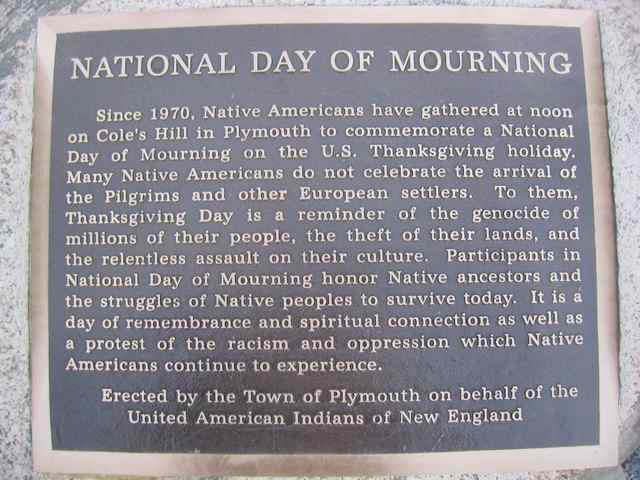
ThanksGiving: Native American Day of Mourning

ThanksGiving: Native American Day of Mourning


The National Day of Mourning is an annual protest organized since 1970 by Native Americans of New England on the fourth Thursday of November, the same day as Thanksgiving in the United States. It coincides with an unrelated but similar protest, Unthanksgiving Day, held on the West Coast.

The organizers consider the national holiday of Thanksgiving Day as a reminder of the democide and continued suffering of the Native American peoples. Participants in the National Day of Mourning honor Native ancestors and the struggles of Native peoples to survive today. They want to educate Americans about history. The event was organized in a period of Native American activism and general cultural protests. The protest is organized by the United American Indians of New England (UAINE). Since it was first organized, social changes have resulted in major revisions to the portrayal of United States history, the government’s and settlers’ relations with Native American peoples, and renewed appreciation for Native American culture.

Background

The United American Indians of New England (UAINE) organized their protest to bring publicity to the continued misrepresentation of Native American and colonial experience. They believed that people needed to be educated about what happened when the Pilgrims arrived in North America.

A century ago heavy immigration brought millions of southern and eastern Europeans to the United States. Educators and civic groups thought it necessary to assimilate the new citizens. The new arrivals were taught to view the Pilgrims as models for their own families. The tale of the “First Thanksgiving” was an essential element of this curriculum. The story of the Native Americans and Pilgrims sharing a meal of turkey became part of United States tradition. The story tells of the mutually beneficial relationship between these groups.

UAINE, by contrast, says that the Pilgrims did not find a new and empty land. Every inch of land they claimed was Indian land. They also say that the Pilgrims immigrated as part of a commercial venture and that they introduced sexism, racism, anti-homosexual bigotry, jails, and the class system.[1]

Governor John Winthrop proclaimed the first official “Day of Thanksgiving” in 1637 to celebrate the return of men that had gone to Mystic, Connecticut to fight against the Pequot, an action that resulted in the deaths of more than 700 Pequot women, children, and men, which their people called a massacre. In 1863, during the American Civil War, President Abraham Lincoln authorized that the fourth Thursday of November be set aside to give thanks and praise for the nation’s blessings. Thanksgiving became part of American culture.

UAINE believes that the Native American and colonial experience continue to be misrepresented. It asks why the “First Thanksgiving” was not celebrated or related back to the first colony at Jamestown. According to UAINE, the circumstances at Jamestown were too terrible to be used as a national myth. The settlers turned to cannibalism to survive. The UAINE used the National Day of Mourning to educate people about the history of the Wampanoag people. UAINE representatives say the only true element of the Thanksgiving story is that the pilgrims would not have survived their first years in New England without the aid of the Wampanoag.[2]

History

Since 1921, the 300th year after the first Thanksgiving, the Commonwealth of Massachusetts stages an annual reenactment of Thanksgiving. People gather at a church on the site of the Pilgrims’ original meeting house, in 17th century costume. After prayers and a sermon, they march to Plymouth Rock. This annual event had become a tourist attraction.

The UNAINE organized the first National Day of Mourning on the 350th anniversary of the Pilgrims’ arrival on Wampanoag land. The Commonwealth of Massachusetts planned to celebrate friendly relations between English ancestors and the Wampanoag. Wampanoag leader Frank James, also known as Wamsutta, was invited to make a speech at the celebration.[3] But, when the anniversary planners reviewed his speech in advance, they decided it was not appropriate for the celebration. The reason given was, “…the theme of the anniversary celebration is brotherhood and anything inflammatory would have been out of place.” (Source: UAINE)

Wamsutta based his speech on a Pilgrim’s account of the first year on Indian land. The book recounted the opening of graves, taking the Indians’ corn and bean supplies, and selling Wampanoag as slaves for 220 shillings each.[citation needed] After receiving a revised speech, written by a public relations person, Wamsutta decided he would not attend the celebration. To protest the silencing of the American Indian people, he and his supporters went to neighboring Cole’s Hill, near the statue of Massasoit, the leader of the Wampanoag when the Pilgrims landed. Overlooking the Plymouth Harbour and the Mayflower replica, Wamsutta gave his speech. This was the first National Day of Mourning.

Later protests

Today,[when?] the UNAINE continues leading the National Day of Mourning protest in Plymouth. The son of the founder, James, participates as well. The more recent protests have been held on Cole’s Hill and a location overlooking Plymouth Rock. The organizers have been joined by other minority activists in protest as well. Typically several hundred protesters appear. The protest generally begins at 12:00 noon on Thanksgiving Day with a march through the historic district of Plymouth. All are welcome, but the UNAINE remind participants that this is a day when the Native people speak about their history and struggles, including contemporary ones. Speakers are by invitation only. Following the march and the speeches, they have a social time. Guests are asked to bring non-alcoholic beverages, desserts, fresh fruits and vegetables, or pre-cooked items.

In 1996 the Latinos for Social Change marched to the Plymouth Commons at the same time the Mayflower Society had their Pilgrim Progress parade, to show support of UAINE. The police rerouted the Pilgrim parade to avoid conflict. In 1997 the Pilgrim Progress parade was held earlier and went undisturbed.

In 1997 those who gathered to commemorate the 28th National Day of Mourning had a more difficult time. State troopers and police met the protesters. Some accounts state that pepper spray was used on children and the elderly.[citation needed] Twenty-five people were arrested on charges ranging from battery on an officer to assembling without a permit. In an effort to avoid another conflict, the state reached a settlement with UNAINE in October 1998. It stated the UNAINE were allowed to march without a permit, as long as they gave the town advanced notice.

The 35th National Day of Mourning was held on Thursday, November 25, 2004, and was dedicated to Leonard Peltier, a Native American activist convicted and sentenced to two consecutive terms of life imprisonment for first degree murder in the shooting of two FBI agents. Many American Indians and supporters gathered again at the top of Coles Hill, overlooking Plymouth Rock. They honored their Native ancestors and the struggles of Native peoples to survive today.

Will the protest ever end?

According to a speech by Moonanum James, Co-Leader of UNAINE, at the 29th National Day of Mourning, November 26, 1998:[4]

Some ask us: Will you ever stop protesting? Some day we will stop protesting: We will stop protesting when the merchants of Plymouth are no longer making millions of dollars off the blood of our slaughtered ancestors. We will stop protesting when we can act as sovereign nations on our own land without the interference of the Bureau of Indian Affairs and what Sitting Bull called the “favorite ration chiefs”. When corporations stop polluting our mother, the earth. When racism has been eradicated. When the oppression of Two-Spirited people is a thing of the past. We will stop protesting when homeless people have homes and no child goes to bed hungry. When police brutality no longer exists in communities of color. We will stop protesting when Leonard Peltier and Mumia Abu-Jamal and the Puerto Rican independentistas and all the political prisoners are free. Until then, the struggle will continue.

References

Bibliography

  • Guns, Germs, and Steel: The Fates of Human Societies by Jared Diamond (1997).
  • “Death by Disease” by Ann F. Ramenofsky in “Archaeology” (March/April 1992).
  • Mayflower: A Story of Courage, Community, and War by Nathaniel Philbrick (2006).

External links

American Holocaust of Native American Indians (FULL Documentary)

American Holocaust of Native American Indians (FULL Documentary)

http://youtu.be/gTrbVf6SrCc

The powerful and hard-hitting documentary, American Holocaust, is quite possibly the only film that reveals the link between the Nazi holocaust, which claimed at least 6 million Jews, and the American Holocaust which claimed, according to conservative estimates, 19 million Indigenous People.

It is seldom noted anywhere in fact, be it in textbooks or on the internet, that Hitler studied Americas Indian policy, and used it as a model for what he termed the final solution.

He wasnt the only one either. Its not explicitly mentioned in the film, but its well known that members of the National Party government in South Africa studied the American approach before they introduced the system of racial apartheid, which lasted from 1948 to 1994. Other fascist regimes, for instance, in South and Central America, studied the same policy.

Noted even less frequently, Canadas Aboriginal policy was also closely examined for its psychological properties. America always took the more wide-open approach, for example, by decimating the Buffalo to get rid of a primary food source, by introducing pox blankets, and by giving $1 rewards to settlers in return for scalps of Indigenous Men, women, and children, among many, many other horrendous acts. Canada, on the other hand, was more bureaucratic about it. They used what I like to call the gentlemans touch, because instead of extinguishment, Canada sought to remove the Indian from the Man and the Women and the Child, through a long-term, and very specific program of internal breakdown and replacement call it assimilation. America had its own assimilation program, but Canada was far more technical about it.

Perhaps these points would have been more closely examined in American Holocaust if the film had been completed. The films director, Joanelle Romero, says shes been turned down from all sources of funding since she began putting it together in 1995.

Perhaps its just not good business to invest in something that tells so much truth? In any event, Romero produced a shortened, 29-minute version of the film in 2001, with the hope of encouraging new funders so she could complete American Holocaust. Eight years on, Romero is still looking for funds.

American Holocaust may never become the 90-minute documentary Romero hoped to create, to help expose the most substantial act of genocide that the world has ever seen one that continues even as you read these words.

watch – Native American Holocaust Exterminate Them! The California Story (FULL)

Native American Survival Skills

Native American Survival Skills

It has been said that knowledge is power, and that applies to any area in life. Of course, it is important to arm and prepare, but it is even more important to constantly learn new aspects of survival. Some of these arts and sciences have been lost in the last century, as modern life has caused humanity to know more how to use a smartphone rather than how to build a fire. It is easy to gloss over these skills like an old memory, when you can simply pop at TV dinner in the microwave when you are hungry.

The histories of empires have told us that they are finite, and that includes that of the U.S. In this case, it is important to gain knowledge and learn about old methods that have been long forgotten by many. This knowledge may not always be accessible as it is one of the first resources that will become scarce in the event of a nation threatening disaster. Other items may be procured with relative ease, but it may be next to impossible to find gems of wisdom.

One of the best places to find knowledge about survival methods for now is on the Internet. The Internet has an incredibly high concentration and abundance of information that dwarfs libraries and can be accessed in the comfort of your home. A quick search engine inquiry will reveal answers that took hours of research in the past. This is a great place to start. Whatever useful information you find, print out, and put in a ring binder.

Community

We were not meant to survive in isolation. There are many skills we can learn from one another. Find a mentor or group that does survival activities on a regular basis. Learning from one person to another is the best way to make it a part of you. For instance, learning martial arts of some kind will be indispensable in a crisis. These arts train you to keep calm, respond properly, avoid fights, and win them with the time come.

Nothing will help people survive more than a tight knit community that cares for its members. In this community, you will find different skills, access to different resources, and a psychological morale improvement. Finding others with the same mindset will help you survive long-term, and make the situation far more bearable than braving the dark times alone.

Basic Tools

Knives are considered one of the most basic tools in any society. It has been seen as the very beginning of technology after the discovery of fire. Using the proper knife for a survival scenario is arguably the most crucial part of survival. Your world will revolve around your knife, so it is important to have one appropriately selected.

You do not want to survive on a kitchen knife, as these are only tailored for light duty. Survival knives can come in several forms but they have to perform these basic tasks:

  • Chopping or Cutting Wood
  • Carving Wood
  • Stripping Bark for Lashing
  • Hunting
  • Cleaning Game
  • Cutting Cords
  • Fishing
  • Climbing
  • Fashioning Other Weapons
  • Striking Fire Steel
  • Shaving and Scoring Wood
  • Defense

It is for this reason that your knife must be durable, and have the right shape to perform daily tasks. As opposed to many popular designs, you do not want your knife to be longer than 5”. If it is 6” and above, it will be difficult to handle and could possibly be dangerous. Also, avoid serrated edges on your knife. The most powerful cutting and carving edge is at the base near the handle, and if that area is serrated, it will be difficult to use it to chop and carve.

Also, you may need to defend yourself with your knife. This may be more preferable than using bullets, as you may not want to draw attention to the location of the shot. This means that the knife must come to a sharp point at the tip. This may also allow you to lash the knife to a long stick, creating a spear for hunting. Another possible function of your knife may allow you to throw it at a target. This is another great hunting application, but it is less for defense, in the event that your target runs away with your precious knife.

This new tool redefines the survival kit from the ground up…

There are many designs to a good survival knife; you just need to figure out what your preferred style may be. For this reason, you also may want to consider making one of your own. Creating your own knife design and manufacturing it yourself will allow you to know how to make more in the event that you lose or break your original. For less than $100, you can procure the resources necessary to shape and heat-treat your knife from bar stock.

The reason why the topic of knives is located in the “knowledge” category is because of how crucial it is to know how to use them and even perhaps know how to make them. Getting to know your knife is has to do with more than just surviving; some survivalists even say that it connects you closer to nature. The ability to survive from this most basic tool is known as more of an art form than a method.

Stealth

While the survivalist mindset might seem to stem from weathering bad times, it is actually based in a basic enjoyment of nature. Nature is a gift, and the ability to live comfortably from its provisions is one of the most life-changing experiences a person can ever have. The art of survival seems to have been lost over the years, but before the technology boom in the last century, it was commonplace to know and understand survivalist principles.

One of the most basic skills when in the wild is a combination of two methods. These methods are called the “Fox Walk” and “Wide-Angle Vision.” These were the basic “bread and butter” of how tribal populations would hunt and stalk without leaving any trace. Learning lessons from these peoples, it has enlightened us on how to live from the land.

The Fox Walk is a method on how tribal populations were able to move in the forest completely undetected by even the wildlife. These methods were also used in war as the first skirmishes took place between the Native Americans and the residents of Jamestown. Knowing how effective the Fox Walk concealed movements, the Navy Seals adopted this tactic to conceal their numbers behind enemy lines. The Fox Walk basically consists of:

  • First, it is most effective to do this without footwear or wearing moccasins. This allows you to feel the ground, and helps you avoid stepping on sticks that can crack and make noise.
  • Land your foot with your heal first. This requires balance; as your foot comes into contact with the ground, you may have to move to a different location to avoid a sharp rock, a stick, or leaves that may make noise.
  • Then allow the outside of your foot to roll to the ground, and then the balls of your feet. This will allow you to mask your presence by lessening your footprint and noise.
  • If you are traveling in a group, the battle-tested way to conceal your numbers is to Fox Walk, and with each person placing his or her foot in the print of the one ahead of them.
  • Rushing about is a quick way to be found and wastes crucial energy, so the Fox Walk is a method, crafted for slow, steady movements.

These are the basics of Wide-Angle Vision:

  • Wide-Angle Vision allows you to see movement and inconsistencies rather than the details that are directly in front of you.
  • This type of focus allows you to spot resources more easily and sense movement, which is crucial for hunting.
  • Wide-Angle Vision utilizes your peripheral vision, allowing for a much wider view and scope of sound stimulation. This causes you to be far more aware of your surroundings.
  • In order to practice Wide-Angle Vision, move your hands out directly in front of you. Then, separate them slowly until your arms are stretched out all the way.
  • Then, wiggle your fingers. If your peripheral vision can pick up both hands, then you have entered into Wide-Angle vision.

The best part about utilizing the Fox Walk and Wide-Angle Vision is the fact that you can move around less, maximizing the resources in your vicinity. You will use much less energy, and it will keep you calm. Some have said that it is almost like tuning in to a sixth sense, as you can extend your perception farther that you would normally be able to.

Experiencing and enjoying nature is one of the most basic principles of the art of survival, and using ancient methods is one of the best ways to do just that.

SOURCE: Offthegridnews.com

Hopi Prophecy: Spritiual Awareness & Balance

Hopi Prophecy: Spritiual Awareness & Balance

The end of all Hopi ceremonialism will come when a “Kachina” removes his mask during a dance in the plaza before uninitiated children [the general public]. For a while there will be no more ceremonies, no more faith. Then Oraibi will be rejuvenated with its faith and ceremonies, marking the start of a new cycle of Hopi life.

World War III will be started by those peoples who first revealed the light (the divine wisdom or intelligence) in the other old countries (India, China, Islamic Nations, Africa.)

The United States will be destroyed, land and people, by atomic bombs and radioactivity. Only the Hopis and their homeland will be preserved as an oasis to which refugees will flee. Bomb shelters are a fallacy. “It is only materialistic people who seek to make shelters. Those who are at peace in their hearts already are in the great shelter of life. There is no shelter for evil. Those who take no part in the making of world division by ideology are ready to resume life in another world, be they Black, White, Red, or Yellow race. They are all one, brothers.”

The war will be “a spiritual conflict with material matters. Material matters will be destroyed by spiritual beings who will remain to create one world and one nation under one power, that of the Creator.”

That time is not far off. It will come when the Saquasohuh (Blue Star) Kachina dances in the plaza and removes his mask. He represents a blue star, far off and yet invisible, which will make its appearance soon. The time is foretold by a song sung during the Wuwuchim ceremony. It was sung in 1914 just before World War I, and again in 1940 before World War II, describing the disunity, corruption, and hatred contaminating Hopi rituals, which were followed by the same evils spreading over the world. This same song was sung in 1961 during the Wuwuchim ceremony.

The Emergence to the future Fifth World has begun. It is being made by the humble people of little nations, tribes, and racial minorities. “You can read this in the earth itself. Plant forms from previous worlds are beginning to spring up as seeds [as described in SW-II, Effects and Coming Events # 1]. This could start a new study of botany if people were wise enough to read them. The same kinds of seeds are being planted in the sky as stars. The same kinds of seeds are being planted in our hearts. All these are the same, depending how you look at them. That is what makes the Emergence to the next, Fifth World.

“These comprise the nine most important prophecies of the Hopis, connected with the creation of the nine worlds: the three previous worlds on which we lived, the present Fourth World, the three future worlds we have yet to experience, and the world of Taiowa, the Creator, and his nephew, Sotuknang.”

The Hopi and others who were saved from the Great Flood made a sacred covenant with the Great Spirit never to turn away from him. He made a set of sacred stone tablets, called Tiponi, into which he breathed his teachings, prophecies, and warnings. Before the Great Spirit hid himself again, he placed before the leaders of the four different racial groups four different colors and sizes of corn; each was to choose which would be their food in this world. The Hopi waited until last and picked the smallest ear of corn. At this, the Great Spirit said:

“It is well done. You have obtained the real corn, for all the others are imitations in which are hidden seeds of different plants. You have shown me your intelligence; for this reason I will place in your hands these sacred stone tablets, Tiponi, symbol of power and authority over all land and life to guard, protect, and hold in trust for me until I shall return to you in a later day, for I am the First and I am the Last.”

The Great Chieftain of the Bow Clan led the faithful ones to this new land, but he fell into evil ways. His two sons scolded him for his mistake, and after he died they assumed the responsibilities of leadership. Each brother was given a set of Tiponi, and both were instructed to carry them to a place to which the Great Spirit directed them. The elder brother [of the shining light] was told to go immediately to the east, toward the rising sun, and upon reaching his destination to start back immediately to look for his younger brother, who remained on Turtle Island [the Continental United States of America]. His mission was to help his younger brother to bring about the Purification Day, at which time all evildoers would be punished or destroyed, after which real peace, brotherhood, and everlasting life would be established. The elder brother would restore all land to his younger brother, from whom the Evil one among the white men had taken it. The elder brother [of the shining light] also would come to look for the Tiponi tablets and fulfill the mission given him by the Great Spirit.

The younger brother was instructed to travel throughout the land and mark his footsteps as he went about. Both brothers were told that a great white star would appear in the sky; when that happened, all people would know that the elder brother had reached his destination. Thereupon all people were to settle wherever they happened to be at that time, there to remain until the elder brother returned.

The Hopi settled in the area now known as Four Corners, where the state lines of Arizona, New Mexico, Utah and Colorado meet. They lived in humble simplicity and the land produced abundant crops. This area is the “heart” of Turtle Island [the U.S.] and of Mother Earth, and it is the microcosmic image of the macrocosm of the entire planet. Each Hopi clan perpetuates a unique ceremony, and the ceremonies together maintain the balance of natural forces of sunlight, rain and winds, and reaffirm the Hopi respect for all life and trust in the Great Spirit.

The Hopi were told that after a time White Men would come and take their land and try to lead the Hopi into evil ways. But in spite of all the pressures against them, the Hopi were told they must hold to their ancient religion and their land, though always without violence. If they succeeded, they were promised that their people and their land would be a center from which the True Spirit would be reawakened.

It is said that after many years the elder brother might change the color of his skin, but his hair will remain black. He will have the ability to write, and he will be the only person able to read the Tiponi. When he returns to find his younger brother, the Tiponi will be placed side by side to show all the world that they are true brothers. Then great judgment will take place, for the elder will help the younger brother to obtain real justice for all Indian brothers who have been cruelly mistreated by the white man since he came to Turtle Island.

The transformed elder brother, the True White Brother, will wear a red cloak or a red cap, similar to the pattern on the back of a horned toad. He will bring no religion but his own, and will bring with him the Tiponi tablets. He will be all-powerful; none will be able to stand against him. He will come swiftly, and in one day gain control of this entire continent. It is said, “If he comes from the East, the destruction will not be so bad. But if he comes from the West, do not get up on your housetops to see because he will have no mercy.”

The True White Brother will bring with him two great, intelligent and powerful helpers, one of whom will have a sign of a swastika (a masculine symbol of purity), and the sign of the sun. The second great helper will have the sign of a celtic cross with red lines (representing female life blood) between the arms of the cross.

When the Great Purification is near, these helpers will shake the earth first for a short time in preparation. After they shake the earth two times more, they will be joined by the True White Brother, who will become one with them and bring the Purification Day to the world. All three will help the “younger brother” (the Hopi and other pure-hearted people) to make a better world. In the prophecies, the two helpers are designated by the Hopi word for “population,” as if they were large groups of people.

The Hopi were warned that if these three great beings failed, terrible evil would befall the world and great numbers of people would be killed. However, it was said that they would succeed if enough Hopi remained true to the ancient spirit of their people. The True White Brother and his helpers will show the people of earth a great new life plan that will lead to everlasting life. The earth will become new and beautiful again, with an abundance of life and food. Those who are saved will share everything equally. All races will intermarry and speak one tongue and be a family.

Hopi prophecy states that World War III will be started by the people who first received the Light — China, Palestine, India and Africa. When the war comes, the United States will be destroyed by “gourds of ashes” which will fall to the ground, boiling the rivers and burning the earth, where no grass will grow for many years, and causing a disease that no medicine can cure. This can only mean nuclear or atomic bombs; no other weapon causes such effects. Bomb shelters will be useless, for “Those who are at peace in their hearts already are in the Great Shelter of Life. There is no shelter for evil. When the Saquahuh (blue Star) Kachina dances in the plaza and removes his mask, the time of the great trial will be here.” The Hopi believe that only they will be saved.

The Hopi also have prophesied that “Turtle Island could turn over two or three times and the oceans could join hands and meet the sky.” This seems to be a prophecy of a “pole shift” — a flipping, of the planet on its axis. The Hopi call this imminent condition — and that of society today — “Koyaanisqatsi”, which means “world out of balance…a state of life that calls for another way. ”

The following extraordinary Hopi prophecy was first published in a mimeographed manuscript that circulated among several Methodist and Presbyterian churches in 1959. Some of the prophecies were published in 1963 by Frank Waters in The Book of the Hopi. The account begins by describing how, while driving along a desert highway one hot day in the summer of 1958, a minister named David Young stopped to offer a ride to an Indian elder, who accepted with a nod. After riding in silence for several minutes, the Indian said:

“I am White Feather, a Hopi of the ancient Bear Clan. In my long life I have traveled through this land, seeking out my brothers, and learning from them many things full of wisdom. I have followed the sacred paths of my people, who inhabit the forests and many lakes in the east, the land of ice and long nights in the north, and the places of holy altars of stone built many years ago by my brothers’ fathers in the south. From all these I have heard the stories of the past, and the prophecies of the future. Today, many of the prophecies have turned to stories, and few are left — the past grows longer, and the future grows shorter.

“And now White Feather is dying. His sons have all joined his ancestors, and soon he too shall be with them. But there is no one left, no one to recite and pass on the ancient wisdom. My people have tired of the old ways — the great ceremonies that tell of our origins, of our emergence into the Fourth World, are almost all abandoned, forgotten, yet even this has been foretold. The time grows short.

“My people await Pahana, the lost White Brother, [from the stars] as do all our brothers in the land. He will not be like the white men we know now, who are cruel and greedy. we were told of their coming long ago. But still we await Pahana.

“He will bring with him the symbols, and the missing piece of that sacred tablet now kept by the elders, given to him when he left, that shall identify him as our True White Brother.

“The Fourth World shall end soon, and the Fifth World will begin. This the elders everywhere know. The Signs over many years have been fulfilled, and so few are left.

“This is the First Sign: We are told of the coming of the white-skinned men, like Pahana, but not living like Pahana men who took the land that was not theirs. And men who struck their enemies with thunder.

“This is the Second Sign: Our lands will see the coming of spinning wheels filled with voices. In his youth, my father saw this prophecy come true with his eyes — the white men bringing their families in wagons across the prairies.”

“This is the Third Sign: A strange beast like a buffalo but with great long horns, will overrun the land in large numbers. These White Feather saw with his eyes — the coming of the white men’s cattle.”

“This is the Fourth Sign: The land will be crossed by snakes of iron.”

“This is the Fifth Sign: The land shall be criss-crossed by a giant spider’s web.”

“This is the Sixth sign: The land shall be criss-crossed with rivers of stone that make pictures in the sun.”

“This is the Seventh Sign: You will hear of the sea turning black, and many living things dying because of it.”

“This is the Eight Sign: You will see many youth, who wear their hair long like my people, come and join the tribal nations, to learn their ways and wisdom.

“And this is the Ninth and Last Sign: You will hear of a dwelling-place in the heavens, above the earth, that shall fall with a great crash. It will appear as a blue star. Very soon after this, the ceremonies of my people will cease.

“These are the Signs that great destruction is coming. The world shall rock to and fro. The white man will battle against other people in other lands — with those who possessed the first light of wisdom. There will be many columns of smoke and fire such as White Feather has seen the white man make in the deserts not far from here. Only those which come will cause disease and a great dying. Many of my people, understanding the prophecies, shall be safe. Those who stay and live in the places of my people also shall be safe. Then there will be much to rebuild. And soon — very soon afterward — Pahana will return. He shall bring with him the dawn of the Fifth World. He shall plant the seeds of his wisdom in their hearts. Even now the seeds are being planted. These shall smooth the way to the Emergence into the Fifth World.

“But White Feather shall not see it. I am old and dying. You — perhaps will see it. In time, in time…”

The old Indian fell silent. They had arrived at his destination, and Reverend David Young stopped to let him out of the car. They never met again. Reverend Young died in 1976, so he did not live to see the further fulfillment of this remarkable prophecy.

The signs are interpreted as follows: The First Sign is of guns. The Second Sign is of the pioneers’ covered wagons. The Third Sign is of longhorn cattle. The Fourth Sign describes the railroad tracks. The Fifth Sign is a clear image of our electric power and telephone lines. The Sixth Sign describes concrete highways and their mirage-producing effects. The Seventh Sign foretells of oil spills in the ocean. The Eighth Sign clearly indicates the “Hippy Movement” of the 1960s. The Ninth Sign was the U.S. Space Station Skylab, which fell to Earth in 1979. According to Australian eye-witnesses, it appeared to be burning blue.

Another Hopi prophecy warns that nothing should be brought back from the Moon — obviously anticipating the Apollo 11 mission that returned with samples of lunar basalt. It this was done, the Hopi warned, the balance of natural and universal laws and forces would be disturbed, resulting in earthquakes, severe changes in weather patterns, and social unrest. All these things are happening today, though of course not necessarily because of Moon rocks.

The Hopi also predicted that when the “heart” of the Hopi land trust is dug up, great disturbances will develop in the balance of nature, for the Hopi holy land is the microcosmic image of the entire planet; any violations of nature in the Four Corners region will be reflected and amplified all over the Earth.

In 1959, a six-man delegation of traditional Hopi leaders led by the late spiritual leader, Dan Katchongva, traveled to the United Nations Building in New York to fulfill a sacred mission in accordance with ancient Hopi instructions. Because of their prophetic knowledge, the Hopi leaders felt it was time to go east to the edge of their motherland, where “a house of mica” [The United Nations building] would stand at this time, where Great Leaders from many lands would be gathered to help any people who are in trouble.”

They were to go when the motherland of the Hopi and other Indian brothers were about to be taken away from them and their way of life was in danger of being completely destroyed by evil ones among the White Men and by some other Indian brothers who were influenced by the White Race. This is a clear and present danger: the betrayal of Indian-U.S.A. treaties, land sales, and coal and uranium mining are destroying the Hopi land and its people — and all other peoples and lands, in eventual effect…

According to prophecy, at least one, two or three leaders or nations would hear and understand the Hopi warnings, as “It is told that they too should know these ancient instructions”. Upon hearing the message of the Hopi, they would act immediately to correct many wrongs being done to the chosen race — the Red Man who was granted permission to hold in trust all land and life for the Great Spirit. This prophecy would seem to have failed. Hopi prophecy also declares that the doors of the “Glass House” would be closed to them. This was the case at first, though they have delivered their message to the United Nations Assembly since then:

“When the Great Leaders in the Glass House refuse to open the door to you when you stand before it that day, [Repeated, again in 1993] do not be discouraged or turn about on the path you walk, but take courage, determination, and be of great rejoicing in your hearts, for on that day the White Race who are on your land with you have cut themselves from you and thereon lead themselves to the Greatest Punishment at the Day of Purification. Many shall be destroyed for their sins and evil ways. The Great Spirit has decreed it and no one can stop it, change it, or add anything to it. It shall be fulfilled!”

On August 7, 1970, a spectacular UFO sighting was witnessed by dozens of people and photographed by Chuck Roberts of the Prescott (Arizona)”Courier”. This sighting occurred after a “UFO calling” by Paul Solem and several Hopi Indians. This sighting was interpreted by some Hopis as being a partial fulfillment of a certain Hopi prophecy given by the Great Spirit Maasau and inscribed on Second Mesa, warning of the coming of Purification Day, when the true Hopi will be flown to other planets in “ships without wings.”

Hopi prophecy also tells us that there will be a mass migration of Indians northward from Mexico and Central and South America. The migration will be led by a 130-year old Indian named Etchata Etchana. The movement will come after the huge fire and explosion that will herald the advent of the True White Brother.

According to Hopi belief, the survivors of the Great Deluge thousands of years ago split up into four groups that moved north, south, east and west. Only one group completed their journey — to the North Pole and back — under the guidance of a brilliant “star” in which the Great Spirit Maasau traveled. When he landed, he drew a petroglyph on Second Mesa, showing a maiden (with the traditional “butterfly” hair arrangement) riding in a wingless, dome-shaped craft. The petroglyph signified the coming Day of Purification when the true Hopi will fly to other planets in “ships without wings.”

The prophecy also warns that there will be three divisions among the Hopi The first division was in 1906 between the Traditionalists and the Modernists. The Traditionalists were forced to leave Oraibi and move to Hotevilla. The second division took place in the wake of the spectacular appearance of UFOs in August, 1970.

PROPHECY ROCK

Drawing pf Prophecy Rock

Near Oraibi, Arizona, there is a petroglyph known as Prophecy Rock which symbolizes many Hopi prophecies. Its interpretation is:

The large human figure on the left is the Great Spirit. The bow in his left hand represents his instructions to the Hopi to lay down their weapons. The vertical line to the right of the Great Spirit is a time scale in thousands of years. The point at which the great Spirit touches the line is the time of his return.

The “life path” established by the Great Spirit divides into the lower, narrow path of continuous Life in harmony with nature and the wide upper road of white man’s scientific achievements. The bar between the paths, above the cross, is the coming of white men; the Cross is that of Christianity. The circle below the cross represents the continuous Path of Life.

The four small human figures on the upper road represent, on one level, the past three worlds and the present; on another level, the figures indicate that some of the Hopi will travel the white man’s path, having been seduced by its glamour.

The two circles on the lower Path of Life are the “great shaking of the earth” (World Wars One and Two). The swastika in the sun and the Celtic cross represent the two helpers of Pahana, the True White Brother.

The short line that returns to the straight Path of Life is the last chance for people to turn back to nature before the upper road disintegrates and dissipates. The small circle above the Path of Life, after the last chance, is the Great Purification, after which corn will grow in abundance again when the Great Spirit returns. And the Path of Life continues forever…

The Hopi shield in the lower right corner symbolizes the Earth and the Four-Corners area where the Hopi have been reserved. The arms of the cross also represent the four directions in which they migrated according to the instructions of the Great Spirit.

The dots represent the four colors of Hopi corn, and the four racial colors of humanity.