Ancient Origins – The Golden Ratio – A Sacred Number That Links the Past & Present

Ancient Origins – The Golden Ratio – A Sacred Number That Links the Past & Present

golden-ratioPrecisely, this is the number 1.61803399, represented by the Greek letter Phi, and considered truly unique in its mathematical properties, its prevalence throughout nature, and its ability to achieve a perfect aesthetic composition.

According to astrophysicist Mario Livio:

Some of the greatest mathematical minds of all ages, from Pythagoras and Euclid in ancient Greece, through the medieval Italian mathematician Leonardo of Pisa and the Renaissance astronomer Johannes Kepler, to present-day scientific figures such as Oxford physicist Roger Penrose, have spent endless hours over this simple ratio and its properties. But the fascination with the Golden Ratio is not confined just to mathematicians. Biologists, artists, musicians, historians, architects, psychologists, and even mystics have pondered and debated the basis of its ubiquity and appeal. In fact, it is probably fair to say that the Golden Ratio has inspired thinkers of all disciplines like no other number in the history of mathematics.

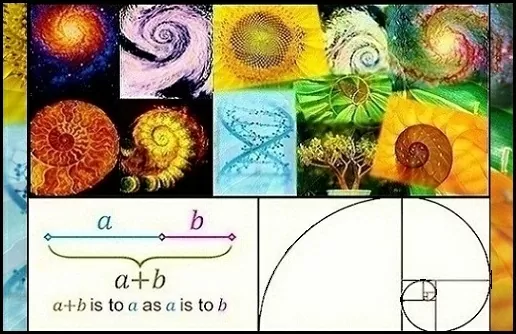
In mathematics and the arts, two quantities are in the golden ratio if their ratio is the same as the ratio of their sum to the larger of the two quantities. When the Golden Mean is conceptualised in two dimensions it is typically presented as a regular spiral that is defined by a series of squares and arcs, each forming “Golden Rectangles”.

This symbolic potential arises because of the way the mean’s spiral shape resembles growth patterns observed in nature and its proportions are reminiscent of those in human bodies. Thus, these simple spirals and rectangles, which served to suggest the presence of a universal order underlying the world, were thereby dubbed “golden” or “divine”.

The Golden Ratio in History

The golden ratio has fascinated Western intellectuals of diverse interests for at least 2,400 years. The earliest known monuments believed to have been built according to this alluring number are the statues of the Parthenon in Greece, dating back between 490 and 430 BC.  However, there are many who have argued that it goes back much further than this and that the Egyptians were well versed in the properties of this unique number.

According to some historians, the Egyptians thought that the golden ratio was sacred.  Therefore, it was very important in their religion.  They used the golden ratio when building temples and places for the dead.  In addition, the Egyptians found the golden ratio to be pleasing to the eye.  They used it in their system of writing and in the arrangement of their temples.  The Egyptians were aware that they were using the golden ratio, but they called it the “sacred ratio.”

The first recorded definition of the golden ratio dates back to the period when Greek mathematician, Euclid (c. 325–c. 265 BC), described what he called the “extreme and mean ratio”. However, the ratio’s unique properties became popularised in the 15th century when aesthetics were a vital component of Renaissance art and geometry served both practical and symbolic purposes.  As the famous mathematician, astronomer, and astrologer, Johannes Kepler (1571 – 1630) wrote:

Geometry has two great treasures: one is the Theorem of Pythagoras, and the other the division of a line into extreme and mean ratio; the first we may compare to a measure of gold, the second we may name a precious jewel.

The Golden Ratio in Architecture

Many artists and architects have proportioned their work to approximate the golden ratio, with the belief that the outcome will be more aesthetically pleasing.  Using any of these ratios, an architect can design a door handle that has a complementary relationship to its door, which in turn has a similar relationship to its enclosing wall, and so on.  But more than this, the golden ratio has been used for the façade of great buildings from the Parthenon to the Great Mosque of Kairouan and all the way through to modern landmarks such as the Sydney Opera House and the National Gallery in London.

The Golden Ratio in Nature

Perhaps what is most surprising about the Golden Ratio is that it can be seen as a naturally occurring phenomenon in nature.   The golden ratio is expressed in the arrangement of branches along the stems of plants and the veins in leaves.   It can be seen in the skeletons of animals and humans and the branching of their veins and nerves.  It can even be seen in the proportions of chemical compounds and the geometry of crystals. Essentially, it is all around us and within us and for this reason, German psychologist Adolf Zeising (1810 – 1876) labelled it a ‘universal law’:

in which is contained the ground-principle of all formative striving for beauty and completeness in the realms of both nature and art, and which permeates, as a paramount spiritual ideal, all structures, forms and proportions, whether cosmic or individual, organic or inorganic, acoustic or optical; which finds its fullest realization, however, in the human form.

As a result of the unique properties of this golden proportion, many view the ratio as sacred or divine and as a door to a deeper understanding of beauty and spirituality in life, unveiling a hidden harmony or connectedness in so much of what we see.

via Ancient Origins

Researchers Finally Show How Mindfulness and Your Thoughts Can Induce Specific Molecular Changes To Your Genes

Researchers Finally Show How Mindfulness and Your Thoughts Can Induce Specific Molecular Changes To Your Genes

cosmic-brain-dna-genesWith evidence growing that training the mind or inducing specific modes of consciousness can have beneficial health effects, scientists have sought to understand how these practices physically affect the body. A new study by researchers in Wisconsin, Spain, and France reports the first evidence of specific molecular changes in the body following a period of intensive mindfulness practice. The study investigated the effects of a day of intensive mindfulness practice in a group of experienced meditators, compared to a group of untrained control subjects who engaged in quiet non-meditative activities. After eight hours of mindfulness practice, the meditators showed a range of genetic and molecular differences, including altered levels of gene-regulating machinery and reduced levels of pro-inflammatory genes, which in turn correlated with faster physical recovery from a stressful situation. “To the best of our knowledge, this is the first paper that shows rapid alterations in gene expression within subjects associated with mindfulness meditation practice,” says study author Richard J. Davidson, founder of the Center for Investigating Healthy Minds and the William James and Vilas Professor of Psychology and Psychiatry at the University of Wisconsin-Madison. “Most interestingly, the changes were observed in genes that are the current targets of anti-inflammatory and analgesic drugs,” says Perla Kaliman, first author of the article and a researcher at the Institute of Biomedical Research of Barcelona, Spain (IIBB-CSIC-IDIBAPS), where the molecular analyses were conducted.

The study was published in the Journal Psychoneuroendocrinology.

Mindfulness-based trainings have shown beneficial effects on inflammatory disorders in prior clinical studies and are endorsed by the American Heart Association as a preventative intervention. The new results provide a possible biological mechanism for therapeutic effects.

Gene Activity Can Change According To Perception 

According to Dr. Bruce Lipton, gene activity can change on a daily basis. If the perception in your mind is reflected in the chemistry of your body, and if your nervous system reads and interprets the environment and then controls the blood’s chemistry, then you can literally change the fate of your cells by altering your thoughts.

In fact, Dr. Lipton’s research illustrates that by changing your perception, your mind can alter the activity of your genes and create over thirty thousand variations of products from each gene. He gives more detail by saying that the gene programs are contained within the nucleus of the cell, and you can rewrite those genetic programs through changing your blood chemistry.

In the simplest terms, this means that we need to change the way we think if we are to heal cancer. “The function of the mind is to create coherence between our beliefs and the reality we experience,” Dr. Lipton said. “What that means is that your mind will adjust the body’s biology and behavior to fit with your beliefs. If you’ve been told you’ll die in six months and your mind believes it, you most likely will die in six months. That’s called the nocebo effect, the result of a negative thought, which is the opposite of the placebo effect, where healing is mediated by a positive thought.”cosmic-neurons

That dynamic points to a three-party system: there’s the part of you that swears it doesn’t want to die (the conscious mind), trumped by the part that believes you will (the doctor’s prognosis mediated by the subconscious mind), which then throws into gear the chemical reaction (mediated by the brain’s chemistry) to make sure the body conforms to the dominant belief. (Neuroscience has recognized that the subconscious controls 95 percent of our lives.)

Now what about the part that doesn’t want to die–the conscious mind? Isn’t it impacting the body’s chemistry as well? Dr. Lipton said that it comes down to how the subconscious mind, which contains our deepest beliefs, has been programmed. It is these beliefs that ultimately cast the deciding vote.

“It’s a complex situation,” said Dr. Lipton. People have been programmed to believe that they’re victims and that they have no control. We’re programmed from the start with our mother and father’s beliefs. So, for instance, when we got sick, we were told by our parents that we had to go to the doctor because the doctor is the authority concerning our health. We all got the message throughout childhood that doctors were the authority on health and that we were victims of bodily forces beyond our ability to control. The joke, however, is that people often get better while on the way to the doctor. That’s when the innate ability for self-healing kicks in, another example of the placebo effect.

Mindfulness Practice Specifically Affects Regulatory Pathways

The results of Davidson’s study show a down-regulation of genes that have been implicated in inflammation. The affected genes include the pro-inflammatory genes RIPK2 and COX2 as well as several histone deacetylase (HDAC) genes, which regulate the activity of other genes epigenetically by removing a type of chemical tag. What’s more, the extent to which some of those genes were downregulated was associated with faster cortisol recovery to a social stress test involving an impromptu speech and tasks requiring mental calculations performed in front of an audience and video camera.

Biologists have suspected for years that some kind of epigenetic inheritance occurs at the cellular level. The different kinds of cells in our bodies provide an example. Skin cells and brain cells have different forms and functions, despite having exactly the same DNA. There must be mechanisms–other than DNA–that make sure skin cells stay skin cells when they divide.

Perhaps surprisingly, the researchers say, there was no difference in the tested genes between the two groups of people at the start of the study. The observed effects were seen only in the meditators following mindfulness practice. In addition, several other DNA-modifying genes showed no differences between groups, suggesting that the mindfulness practice specifically affected certain regulatory pathways.

The key result is that meditators experienced genetic changes following mindfulness practice that were not seen in the non-meditating group after other quiet activities — an outcome providing proof of principle that mindfulness practice can lead to epigenetic alterations of the genome.

Previous studies in rodents and in people have shown dynamic epigenetic responses to physical stimuli such as stress, diet, or exercise within just a few hours.

“Our genes are quite dynamic in their expression and these results suggest that the calmness of our mind can actually have a potential influence on their expression,” Davidson says.

“The regulation of HDACs and inflammatory pathways may represent some of the mechanisms underlying the therapeutic potential of mindfulness-based interventions,” Kaliman says. “Our findings set the foundation for future studies to further assess meditation strategies for the treatment of chronic inflammatory conditions.”

Subconscious Beliefs Are Key

Too many positive thinkers know that thinking good thoughts–and reciting affirmations for hours on end–doesn’t always bring about the results that feel-good books promise.

Dr. Lipton didn’t argue this point, because positive thoughts come from the conscious mind, while contradictory negative thoughts are usually programmed in the more powerful subconscious mind.

“The major problem is that people are aware of their conscious beliefs and behaviors, but not of subconscious beliefs and behaviors. Most people don’t even acknowledge that their subconscious mind is at play, when the fact is that the subconscious mind is a million times more powerful than the conscious mind and that we operate 95 to 99 percent of our lives from subconscious programs.

“Your subconscious beliefs are working either for you or against you, but the truth is that you are not controlling your life, because your subconscious mind supersedes all conscious control. So when you are trying to heal from a conscious level–citing affirmations and telling yourself you’re healthy–there may be an invisible subconscious program that’s sabotaging you.”

The power of the subconscious mind is elegantly revealed in people expressing multiple personalities. While occupying the mind-set of one personality, the individual may be severely allergic to strawberries. Then, in experiencing the mind-set of another personality, he or she eats them without consequence.

The new science of epigenetics promises that every person on the planet has the opportunity to become who they really are, complete with unimaginable power and the ability to operate from, and go for, the highest possibilities, including healing our bodies and our culture and living in peace.

About the Author

Michael Forrester is a spiritual counselor and is a practicing motivational speaker for corporations in Japan, Canada and the United States.

Sources: wisc.edu brucelipton.com ts-si.org

 
10 Ways to Raise Your Vibrations

10 Ways to Raise Your Vibrations

raising-vibrations

1. Find something beautiful and appreciate it.
Beauty is all around us, from the morning dew to the evening stars and everything in between. Most go through life not noticing all the beautiful things that are around them, and yes it’s every where, so take the time to notice them, and appreciate them when you see it. Whether it’s the scent of a flower or the way rain ripples in puddles of water, appreciate the beauty life has to offer.

2. Make a list of all that you are grateful for.
Making a gratitude list shifts your vibrations from focusing on what you do not have to what is already abundant in your life. There is more to be grateful for than you could possibly imagine. You can start with “I’m Alive!” and expand from there. Gratitude is the Attitude.

3. Meditate.
Sit in a comfortable position, close your eyes and breath in and out. Too often we rush through our days with a scattered brain leaving us in a state of anxiety and stress, Meditation helps to calm your spirit down and put you in a peaceful state of mind. 10 Minuets of meditation a day can change your life forever.

4. Do something for someone else.
Giving to someone else shifts your thinking from “I don’t have enough, to I have more than enough to give to others.” Abundance is a high vibration.

5. Stop complaining and gossiping.
Complaining and Gossip puts you in a very low vibration. Ask yourself “Are the things you are talking about bringing you more of what you want?” if not then, Stop complaining, and start finding ways to rejoice.

6. Move. Exercise. Get active.
Vibration requires movement, the more you move the better your vibrations move. So Get Active! Dance! The happier you feel, the more you will draw happy experiences to yourself because you are operating at a different frequency.

7. Realize that you have more control over your life than you thought.
You are not a victim to circumstance, past, family upbringing, trauma, or anything else. You can change your life in an instant. Just realize this. In many wisdom traditions this is called “total responsibility.” No one is responsible for how you feel right now but you. It isn’t a curse. It’s a blessing because it gives you your power back.

8. Breathe.
Just sit and try to make your breath longer, fuller, and more relaxed. It has a direct affect on your nervous system and helps to calm you down. A calm vibration is a high vibration.

9. Do Something You’re Afraid Of
Fear holds us back from being in a state of love and happiness, and facing those fears opens you up to a greater world of possibilities. Fear of Heights? Go skydiving. Scared of public speaking, say a poem at an open mic. You’ll begin to realize your fear was worse then the actual problem, and a sense of relief will wash over you.

10. Have a Meaningful Conversation with a Friend
Rather than gossip or complaining, talk about you ideas. What do you have planned for yourself? what do you think is the nature of reality? Are we spiritual beings having a human experience? Talking about these things with someone helps to raise both your vibrations by thinking big. If you don’t have someone to talk to about these kinds of things with, there’s a community of higher minded individuals right here. Leave a comment down below and let’s chat!

‘Proof of Heaven’ Documents Existence of Afterlife, Multiverse, Intelligent Life Beyond Earth & Multidimensional Realities

‘Proof of Heaven’ Documents Existence of Afterlife, Multiverse, Intelligent Life Beyond Earth & Multidimensional Realities

There’s a secret that’s much bigger than politics, health freedom, science or even the entire history of the human race. That secret remains entirely unacknowledged — even condemned — by the scientific community, and yet it is the single most important secret about everything that is. Yes, everything.

That secret is simply this: We all survive the physical death of our bodies. Our consciousness lives on, and upon our death in this Earthly dream, our consciousness transcends this physical reality and experiences an existence so amazing and powerful that the human language cannot even begin to describe it.

This is the message from Dr. Eben Alexander, author of the newly-published book, “Proof of Heaven.” I recently read the book and found it both fascinating and also confirming of several important theories I’ve been developing about the nature of life and the Creator. (See below.)

A lifelong science skeptic who never believed in God, Heaven or consciousness

Long before this book was ever written, Dr. Alexander was a practicing neurosurgeon and a lifelong “science skeptic.” He did not believe in consciousness, free will or the existence of a non-physical spirit. Trained in western medical school and surrounded by medical colleagues who are deeply invested in the materialism view of the universe, Dr. Alexander believed that so-called “consciousness” was only an illusion created by the biochemical functioning of the brain.

This is a view held by virtually all of today’s mainstream scientists, including physicists like Stephen Hawking who say that human beings are nothing more than “biological robots” with no consciousness and no free will.

Dr. Alexander would have held this view to his own death bed had it not been for his experiencing an event so bizarre and miraculous that it defies all conventional scientific explanation: Dr. Alexander “died” for seven days and experienced a vivid journey into the afterlife. He then returned to his physical body, experienced a miraculous healing, and went on to write the book “Proof of Heaven.”

E.coli infection eats his brain

It all started when e.coli bacteria infected Dr. Alexander’s spinal fluid and outer cerebrum. The e.coli began to literally eat his brain away, and he went into an extremely violent fit of seizures, verbal outbursts and muscular spasms before lapsing into a brain-dead coma.

In this coma, he showed zero higher brain activity and was only kept alive via a respirator and IV fluids. The attending physicians soon concluded that Dr. Alexander would die within a matter of days, and that even if he lived, he would be a non-functioning “vegetable” with limited brain function. Statistically, the death rate for patients with e.coli infections of the brain is 97%.

But here’s the real shocker in all this: Rather than experiencing nothingness during these seven earth-days of unconsciousness, Dr. Alexander found himself “awakening” from the dream of his earthly life, suddenly experiencing an incomprehensibly vast expansion of his consciousness in the afterlife.

This experience is described in more detail in his book “Proof of Heaven,” but here are the highlights:

• The experience of the afterlife was so “real” and expansive that the experience of living as a human on Earth seemed like an artificial dream by comparison.

• There was no time dimension in the afterlife. Time did not “flow” as it does in our universe. An instant could seem like eternity, and consciousness could move through what we perceive to be time without effort. (This idea that all time exists simultaneously has enormous implications in understanding the nature of free will and the multiverse, along with the apparent flow of time experienced by our consciousness in this realm.)

• The fabric of the afterlife was pure LOVE. Love dominated the afterlife to such a huge degree that the overall presence of evil was infinitesimally small.

• In the afterlife, all communication was telepathic. There was no need for spoken words, nor even any separation between the self and everything else happening around you.

• The moment you asked a question in your mind, the answers were immediately apparent in breathtaking depth and detail. There was no “unknown” and the mere asking of a question was instantly accompanied by the appearance of its answers.

• There also exists a literal Hell, which was described by Dr. Alexander as a place buried underground, with gnarled tree roots and demonic faces and never-ending torment. Dr. Alexander was rescued from this place by angelic beings and transported to Heaven.

God acknowledges the existence of the multiverse

The passage of “Proof of Heaven” I found most interesting is found on page 48, where Dr. Alexander says:

Through the Orb, [God] told me that there is not one universe but many — in fact, more than I could conceive — but that love lay at the center of them all. Evil was present in all the other universes as well, but only in the tiniest trace amounts. Evil was necessary because without it free will was impossible, and without free will there could be no growth — no forward movement, no chance for us to become what God longed for us to be. Horrible and all-powerful as evil sometimes seemed to be in a world like ours, in the larger picture love was overwhelmingly dominant, and it would ultimately be triumphant.

This passage struck an important cord with me, as I have long believed our universe was created by the Creator as just one of an infinite number of other universes, each with variations on life and the laws of physics. (Click here to read my writings on the Higgs Boson particle, consciousness and the multiverse.) What Dr. Alexander’s quote confirms is that our life on planet Earth is a “test” of personal growth, and that the way to make progress in this test is to overcome evil while spreading love and compassion.

Even more, this passage also confirms the existence of free will and even helps answer the question I’m often asking myself: “Why are we placed here in a world of such evil and surrounded by ignorance, darkness and deception?” The answer appears to be that Earth is a testing ground for souls that have been selected by the Creator for the ultimate test of good versus evil.

Earth as a testing ground

Although “Proof of Heaven” doesn’t go as far as I’m explaining here, my working theory is that our planet Earth is among the highest evil-infested realms in the grand multiverse. Only the most courageous souls agree to come to Earth by being born into human bodies and stripped of their memories.

From there, the challenge of life is multi-faceted:

1) Figure out WHO you are and WHY you are here.
2) Learn to recognize and overcome EVIL (tyranny, slavery, oppression, Big Government, etc.).
3) Learn to spread love, compassion, healing and knowledge.

Upon our death, we are judged by a higher power, and that judgment takes into account our performance in these areas. Did we achieve a measure of self-awareness? Did we work to overcome evil? Did we express love and compassion and help uplift others with knowledge and awareness?

As you’ve probably already figured out, the vast majority of humans fail these tests. They die as bitter, selfish, substance-addicted, greed-driven minions of evil who mistakenly thought they were winning the game of life while, in reality, they were losing the far more important test of the Creator.

The most important part about living a human life is not acquiring money, or fame, or power over others but rather achieving a high “score” in this simulation known as “life” by resisting evil, spreading love and expanding awareness of that which is true.

For those who respect life, who practice humility and self awareness, who seek to spread knowledge and wisdom while resisting tyranny, oppression, ignorance and evil, their souls will, I believe, be selected for special tasks in the greater multiverse. That’s the “real” existence. This Earthly life is only a dream-like simulation where your soul interfaces with the crude biology of our planet for a very short time span that’s actually the blink of an eye in the larger picture.

In reality, you are much more than your body. In fact, your soul is infinitely more aware, intelligent and creative than what can be experienced or expressed through the brain of a human. Trying to experience the full reality of what you are through the limited physical brain matter of a human being is a lot like trying to teach an insect to compose music like Mozart.

The multiverse is teeming with intelligent life, including multidimensional beings

Dr. Alexander’s journey also confirms the existence of intelligent life far beyond Earth. As he explains in Proof of Heaven:

I saw the abundance of life throughout the countless universes, including some whose intelligence was advanced far beyond that of humanity. I saw that there are countless higher dimensions, but that the only way to know these dimensions is to enter and experience them directly. They cannot be known, or understood, from lower dimensional space. From those higher worlds one could access any time or place in our world.

This not only confirms the existence of other intelligent civilizations throughout our known universe, but more importantly the existence of multidimensional beings who can come and go from our realm as they please.

Throughout the cultures of the world, there are countless accounts of advanced beings visiting Earth, transferring technology to ancient Earth civilizations, and possibly even interbreeding with early humans. Even the very basis of Christianity begins with the idea that an omnipresent multidimensional being (God) can intervene at will, and can therefore transcend time and space.

Alternative researchers like David Icke also talk about multidimensional beings visiting Earth and infecting the planet with great evil. According to Icke, the globalist controllers of our planet are literally reptilian shape-shifters who have invaded our world for the purpose of controlling and enslaving humanity. Although nothing like this is covered in Dr. Alexander’s book, it is not inconsistent with what Dr. Alexander was told by God during his coma… Namely, that there are multidimensional realities, that certain high-vibration beings can traverse those realities at will, and that Earth is infested with a great evil with the specific purpose of testing our character.

If all this sounds a little too spooky for you, consider the words of the Bible itself: An upright talking reptilian snake spoke in audible words to Adam and Even in the Garden of Eden, did it not?

The science skeptics are wrong (again)

Regardless of what you might think about multidimensional beings, intelligent life beyond Earth, and the existence of great evil on our planet, there’s one aspect of all this that’s crystal clear: The science skeptics are dead wrong.

Science “skeptics” are actually misnamed. They aren’t skeptical at all. They simply follow their own religion with its own sacred beliefs that cannot be questioned… ever! Those beliefs include the utter worship of the materialistic view of the universe. Simultaneously, so-called “skeptics” do not believe they are conscious beings themselves because they believe consciousness is merely an “artifact” of biochemical brain function.

There is no afterlife, they insist. There is no mind-body medicine, the placebo effect is useless, and there’s no such thing as premonition, remote viewing or psychic phenomena. Oh yes, and they also insist that injecting yourself with mercury, MSG and formaldehyde via vaccines is actually good for you, that fluoride chemicals are good for the public health and that we should all eat more GMOs, pesticides and synthetic chemicals.

It’s no surprise these religious cult members of the “scientism” cult don’t believe in an afterlife. That’s what allows them to commit genocidal crimes against the human race today via GMOs, experimental medicine, toxic vaccines and other deadly pursuits. In their view, humans have no souls so killing them is of no consequence.

As Dr. Alexander says,

Certain members of the scientific community, who are pledged to the materialistic worldview, have insisted again and again that science and spirituality cannot coexist. They are mistaken.

Well of course they are. The “science skeptics” are dead wrong about almost everything they claim to advocate. But their biggest mistake of all is in denying the existence of their own souls. Needless to say, they are all going to fail the human experience simulation once they pass on and face judgment. My, what a surprise that will be for those sad souls when they day arrives…

I would hate to face God one day after having lived a life of a science skeptic, and then have God ask the question: “You doubted ME?” How could anyone take a look at the world around them and not see the signs of an intelligent Creator? Even the very laws of physics have been tweaked and fine-tuned in precisely the right balance so that our universe itself can support the formation of stars, and planets, and carbon-based life forms. This is called the “Goldilocks Enigma,” and there’s a wonderful book by that same name written by Paul Davies.

No biochemical explanation for Dr. Alexander’s experience

For those skeptics who may be reading this, Dr. Alexander goes through nine possible biochemical hypotheses for his experiences and then meticulously and scientifically dismisses them all one by one. The result? His experience was REAL. In fact, it was “more real” than life as a human being.

Remember, Dr. Alexander is a neurosurgeon. This guy knows the physical brain like no one else. The nine medical explanations he considers and dismisses as possible causes for his experience are:


1) Primitive brainstem program.
2) Distorted recall of memories from the limbic system.
3) Endogenous glutamate blockade with excitotoxicity.
4) DMT dump.
5) Isolated preservation of cortical regions of the brain.
6) Loss of inhibitory neurons leading to highly levels of activity among excitatory neuronal networks to generate an apparent “ultra-reality.”
7) Activation of thalamus, basal ganglia and brainstorm to create a hyper-reality experience.
8) Reboot phenomenon.
9) Unusual memory generation through archaic visual pathways.

Dr. Alexander may be the most credible afterlife witness in the history of humanity

Dr. Alexander’s experience (and subsequent book) is arguably the best-documented case of the afterlife that exists in western science today. The fact that a vivid, hyper-real afterlife was experienced by a science skeptic materialistic brain surgeon who didn’t believe in the afterlife — and who subsequently found the courage to document his experiences and publish them in a book — adds irrefutable credibility to the experience.

This was not some kook seeking fame on a TV show. In fact, his writing this book earned him endless ridicule from his former “scientific” colleagues. There was every reason to NOT write this book. Only by the grace of God was Dr. Alexander healed of his e.coli infection, restored to normal brain function, and granted the VISION of the afterlife so that he could return to this realm and attempt to put it into words.

Personally, I believe Dr. Alexander, and his experience mirrors that of countless others, across every culture, who have reported similar NDEs (Near Death Experiences). There is life after life, and the shift in consciousness of Earthlings that is required to take our species to a higher level of understanding begins, I believe, with embracing the truth of the immortality of our own souls (and the existence of a grand Creator).

What does it all mean?

Dr. Alexander’s spiritual journey gives us a wealth of information that can help provide meaning and purpose in our daily lives.

For starters, it means that all our actions are recorded in the cosmos and that there are no secrets in the larger scope of things. You cannot secretly screw somebody over here on Earth and think it won’t be recorded on your soul forever. It also means that all our actions will be accounted for in the afterlife. If this message sounds familiar, that’s because an identical idea is the pillar of every major world religion, including Christianity.

It also means there are people living today on this planet whose souls will literally burn in eternal Hell. There are others whose souls, like Dr. Alexander, will be lifted into Heaven and shown a greater reality. What we choose to do with our lives each and every day determines which path our souls will take after the passing of our physical bodies.

What matters, then, is not whether you actually succeed in defeating evil here on Earth, but rather the nature of your character that emerges from all the challenges and tribulations you face. This is all a test, get it? That’s why life seems to suck sometimes. It’s not a panacea; it’s a testing ground for the most courageous souls of all — those who wish to enter the realm of great evil and hope they can rise above it before the end of their human lifespan.

Quantum Measurements Leave Schrödinger’s Cat Alive

Quantum Measurements Leave Schrödinger’s Cat Alive

Schrödinger’s cat, the enduring icon of quantum mechanics, has been defied. By making constant but weak measurements of a quantum system, physicists have managed to probe a delicate quantum state without destroying it – the equivalent of taking a peek at Schrodinger’s metaphorical cat without killing it. The result should make it easier to handle systems such as quantum computers that exploit the exotic properties of the quantum world.

Quantum objects have the bizarre but useful property of being able to exist in multiple states at once, a phenomenon called superposition. Physicist Erwin Schrödinger illustrated the strange implications of superposition by imagining a cat in a box whose fate depends on a radioactive atom. Because the atom’s decay is governed by quantum mechanics – and so only takes a definite value when it is measured – the cat is, somehow, both dead and alive until the box is opened.

Superposition could, in theory, let quantum computers run calculations in parallel by holding information in quantum bits. Unlike ordinary bits, these qubits don’t take a value of 1 or 0, but instead exist as a mixture of the two, only settling on a definite value of 1 or 0 when measured.

But this ability to destroy superpositions simply by peeking at them makes systems that depend on this property fragile. That has been a stumbling block for would-be quantum computer scientists, who need quantum states to keep it together long enough to do calculations.

Gentle measurement

Researchers had suggested it should be possible, in principle, to make measurements that are “gentle” enough not to destroy the superposition. The idea was to measure something less direct than whether the bit is a 1 or a 0 – the equivalent of looking at Schrödinger’s cat through blurry glasses. This wouldn’t allow you to gain a “strong” piece of information – whether the cat was alive or dead – but you might be able to detect other properties.

Now, R. Vijay of the University of California, Berkeley, and colleagues have managed to create a working equivalent of those blurry glasses. “We only partially open the box,” says Vijay.

The team started with a tiny superconducting circuit commonly used as a qubit in quantum computers, and put it in a superposition by cycling its state between 0 and 1 so that it repeatedly hit all the possible mixtures of states.

Next, the team measured the frequency of this oscillation. This is inherently a weaker measurement than determining whether the bit took on the value of 1 or 0 at any point, so the thought was that it might be possible to do this without forcing the qubit to choose between a 1 or a 0. However, it also introduced a complication.

Quantum pacemaker

Even though the measurement was gentle enough not to destroy the quantum superposition, the measurement did randomly change the oscillation rate. This couldn’t be predicted, but the team was able to make the measurement very quickly, allowing the researchers to inject an equal but opposite change into the system that returned the qubit’s frequency to the value it would have had if it had not been measured at all.

This feedback is similar to what happens in a pacemaker: if the system drifts too far from the desired state, whether that’s a steady heartbeat or a superposition of ones and zeros, you can nudge it back towards where it should be.

Vijay’s team was not the first to come up with this idea of using feedback to probe a quantum system, but the limiting factor in the past had been that measurements weak enough to preserve the system gave signals too small to detect and correct, while bigger measurements introduced noise into the system that was too big to control.

Error correction

Vijay and colleagues used a new kind of amplifier that let them turn up the signal without contaminating it. They found that their qubit stayed in its oscillating state for the entire run of the experiment. That was only about a hundredth of a second – but, crucially, it meant that the qubit had survived the measuring process.

“This demonstration shows we are almost there, in terms of being able to implement quantum error controls,” Vijay says. Such controls could be used to prolong the superpositions of qubits in quantum computing, he says, by automatically nudging qubits that were about to collapse.

The result is not perfect, points out Howard Wiseman of Griffith University in Brisbane, Australia, in an article accompanying the team’s paper. “But compared with the no-feedback result of complete unpredictability within several microseconds, the observed stabilization of the qubit’s cycling is a big step forward in the feedback control of an individual qubit.”

Journal reference: Nature, DOI: 10.1038/nature11505

via NewScientist

The Mind as a Stargate

The Mind as a Stargate

“And so I went out to meet them.  And they taught me about the stars.”

The human mind is a stargate.  In fact, it is probably the only real stargate there is.  We don’t realize that because from the time we become aware as children, we are told that we live in a tiny box called earth.  Within that tiny box the mind inhabits another even tinier box called the human body.  From these two boxes, there can be no escape but death, which is not really an escape from the box, but the moment the mind and its personality enters an eternal oblivion.   Many people actually believe this and some of them have the audacity to call me a buzzkill.

I used to believe what people told me.  I believed my brain held my personality and kept it within the confines of my skull. I thought my heart is what kept everything alive. My soul was some nebulous thing that also existed. I just wasn’t sure where it was located.  The problem I had, of course, is that throughout my life I had been receiving messages and subtle clues from people that were not like me.  These people didn’t seem to always use bodies or to live by the same rules that I did.  Some of these clues were unimaginably terrifying, but perhaps only because I was so grounded to the world I was told to believe in, a world whose reality has begun to fall away to some extent.

Part of my problem was that I was a a devotee of my own anger and resentment.  I used these as far as I could take them as an outlet to work through the dross I had both made through my own actions as well as what I inherited from my family lines.   The more I was able to pull down the veil of my inward imperfections and shortcoming, the more the light was beginning to shine through.  First as a tiny glimmer and then as a blazing sun.

What I witnessed did not terrify me, but for the first time allowed a clean break with the well-ordered world I had belonged to and believed in for so long.  The old world was a world of laws and scientific explanations.  In that world both meaning and mystique were crowded out by endless explanations that sapped the meaning out of things.  Wonder was becoming eroded by unsatisfying ideas, each one new and innovative, yet wholly dead.  If we couldn’t see, hear, touch, taste, or smell a thing it didn’t exist.  The newly elected priests of the modern world explained everything away with science.  The  sun, moon, and stars had no significance.  They were dead celestial bodies floating in space.   Everything had an explanation, and if it didn’t have one somebody somewhere was hard at work on one. The modern world, sadly, has travelled an outward path away from what is real and therefore science becomes increasingly superficial.  Instead of giving fulfilling answers, it can only give us explanations that may or may not be true.

While the intellect taken to its logical conclusion can deliver a person to the door of the real, it cannot nudge them through it.  There comes a point where reason and intellection become a curse that anchors one to the world of death’s reign.  If the imagination does not take over, the journey dies utterly.  But it is not enough to merely imagine, one must literally exit the unreal by entering the doorway that has always remained open for us. The difficulty of that feat depends on how much we have come to believe in the world we were told to believe in.   Ultimately, the depths of the mind must be plumbed to the point of finality, which is really the beginning point of the real world.

“Things began to change.  A doorway within my mind opened, so I stepped inside to see what was there.

To open that door to the real world, the reasoning mind must be kept absolutely still, it must put the world as we believe it to death. This doesn’t come with effort, but rather in the absence of effort.  It doesn’t come by struggling to create landscapes and characters in the mind.  It arrives, strangely, when the mind no longer puts forth any effort whatsoever.  In a word, the mind literally surrenders any idea of knowledge upon realizing that the real world doesn’t require wisdom or knowledge, but spontaneity and being.  It must simply become what it was before it was forged by the experiences of life, both good and bad.  The ”reality” we see everyday is only one part of a much greater world that is unseen, but always present in the eternal now.

This world beyond is really the world we live in right now, minus the box we attempt to place it in.  Death, no matter how you look at it, removes that box exposing us to the real world.  Those that seek to keep that box in place, the box that leads to all pain and suffering, experience the worst of the postmortem states.  They attempt to retain the piece because they cannot face the whole truth of what they are.  For that reason alone a kind of pseudo-physical world is often entered upon death.  I have seen it many times, I have spoken to those living there, and I have seen strange things that could not possibly come from me or the use of my imagination alone.  These postmortem worlds run the gamut of ugliness and beauty.


“At some point I found that even though I was a single piece, a veritable illusion, that stars were growing in my mind.  Slowly my identity was expanding into a completion that had no further need of growth or evolution.  This is who I really was.  I was becoming all while still remaining “me.”  This was death and I was very happy.  This was a happiness I had never known in life. ”
The world we have been told to believe in is a lie.  This is not a new age platitude or an airy-fairy state of mind I am talking about.  This is the unfathomable reality we are not yet ready to face.  An apocalypse is on the horizon, and this apocalypse will create a divergent path in humanity. It may be collective, it may be individual.  Some will remember and others will continue to forget.  That is simply the way things are.
Rapture of the Nerds: Will the Singularity Turn us into Gods or End the Human Race?

Rapture of the Nerds: Will the Singularity Turn us into Gods or End the Human Race?

A gathering of experts on artificial intelligence becomes a search for deeper meaning

Hundreds of the world’s brightest minds — engineers from Google and IBM, hedge funds quants, and Defense Department contractors building artificial intelligence — were gathered in rapt attention inside the auditorium of the San Francisco Masonic Temple atop Nob Hill. It was the first day of the seventh annual Singularity Summit, and Julia Galef, the President of the Center for Applied Rationality, was speaking onstage. On the screen behind her, Galef projected a giant image from the film Blade Runner: the replicant Roy, naked, his face stained with blood, cradling a white dove in his arms.

At this point in the movie, Roy is reaching the end of his short, pre-programmed life, “The poignancy of his death scene comes from the contrast between that bitter truth and the fact that he still feels his life has meaning, and for lack of a better word, he has a soul,” said Galef. “To me this is the situation we as humans have found ourselves in over the last century. Turns out we are survival machines created by ancient replicators, DNA, to produce as many copies of them as possible. This is the bitter pill that science has offered us in response to our questions about where we came from and what it all means.”

The Singularity Summit bills itself as the world’s premier event on robotics, artificial intelligence, and other emerging technologies. The attendees, who shelled out $795 for a two-day pass, are people whose careers depend on data, on empirical proof. Peter Norvig, Google’s Director of Research, discussed advances in probabilistic first-order logic. The Nobel prize-winning economist Daniel Kahneman lectured on the finer points of heuristics and biases in human psychology. The Power Point presentations were full of math equations and complex charts. Yet time and again the conversation drifted towards the existential: the larger, unanswerable questions of life.

Rapture of the nerds

Inside the Masonic Temple the morning light shone through a glorious set of stained glass windows. The work, completed in 1957 by Emile Norman, charts the progress of industry, from covered wagons to high speed trains, from sailing ships to cruise liners. It’s a celebration of civilization, interwoven with the beauty of the natural world, and above it, the all seeing eye of God.

That same year Norman completed his masterpiece, the mathematician John von Neumann passed away. It was von Neumann who first spoke of a technological singularity. He imagined the pace of scientific progress would grow faster and faster, until it becomes impossible for humans to keep up with the change. By singularity, von Neumann was referring to a spacial anomaly, like a black hole, where the traditional rules of physics do not apply.

While there are numerous versions of what the future will become in the wake of the Singularity, the unifying principle is that, beyond this moment, the universe as we know it will be dramatically altered. And so the Summit is a sort of nirvana for hyper-intelligent dreamers: sci-fi fans with PhDs, big bank accounts, and boring day jobs, who love to debate radical visions of the future. Making a religion of rationality, it turns out, can lead some very smart people to embrace some insane-sounding ideas.

Laura Deming, who began attending MIT at the precocious age of 14, was one of four Thiel Fellows to speak onstage. Peter Thiel, the billionaire hedge fund manager, tech investor and founder of PayPal, is one of the biggest donors to the Singularity Institute. His fellowship offers the world’s brightest minds $100,000 each to drop out of school and pursue their bold ideas. Deming, who at 18 has already finished college, electrified the crowd with her short talk.

“There is one fact that never fails to infuriate me. Every day 150,000 die of a disease that we ignore. I remember when I was eight, I decided that I wanted to work on curing aging,” Deming began. “It was watching my grandma try to play with my brother and I when arthritic joints made just walking painful.” Deming’s voice grew husky, and her eyes watered with tears. “I remember clearly the death of three grandparents, three amazing people, from this awful, inexorable process that we have somehow come to view as something normal, natural, and beautiful… to be celebrated.” She paused to collect herself. “At least outside this room, that seems to be the consensus.”

“Just think how far we’ve come in a century,” said Deming, her cheeks flushed with excitement. “Only a century ago, the nature of genetic code was still a mystery. Now we’re creating pocket-sized DNA calculators and swapping biological circuitry like it’s Lego blocks.” Like many at the conference, her faith in a brighter future was grounded in the continuing acceleration of scientific progress. “If we succeed, we will have turned the most awful paradigm that we know on its head. The inevitability of death.”

The crowd burst into rapturous applause.

I wondered if The Singularity might serve as a sort of substitute for faith among the Silicon Valley set who felt uncomfortable with some of religion’s mystical beliefs. “The Singularity resolves a lot of the problems that religion irons out for humans,” said R.U. Sirius, a longtime attendee I chatted with. “The contradictions, the pains and suffering of living: these are deeply troubling for people who pride themselves on their rational minds. Here you can find a vision of absolute transcendence, but one that uses as its foundation long-term projections that are at least somewhat grounded in science.”

Making a religion of rationality, it turns out, can lead some very smart people to embrace some insane-sounding ideas

Laura Deming

The prophet of progress

When the conference broke for lunch, I wandered outside to California Avenue. The area was clean, bright, and quiet. Across the street the high steeple of Grace Cathedral caught the afternoon light. At the corner, the road descended at a frightening angle, sloping off like the inverse of one of the many charts projected on the screen that morning to display the astounding rate of our technological gains.

The audience at the conference was a pleasant polyglot: unassuming geeks in t-shirts adorned with coding jokes, bankers in Oxford shirts, freaks with gelled mohawks, crossdressers in leather boots, and one man in Victorian breeches and top hat. Grabbing a seat at an outdoor table, I caught the tail end of a discussion between several programmers and a pair of quants from a hedge fund. They were talking about the amount of trading in today’s stock markets that is governed entirely by computer algorithms, moving at light speed, with little or no human involvement. “You want to see a world where computer intelligence is leaving humans in the dust,” the hedgie boasted. “It’s already here.”

While the concept of the Singularity has been around since the 1950s, it failed to catch on with the mainstream until 2005, when the prolific inventor and polymath Ray Kurzweil published The Singularity is Near. It was an update to his 1999 work, The Age of Spiritual Machines, which became a bestseller in Amazon’s science section. But The Singularity is Near broke through to become a New York Times bestseller, largely by mixing Kurzweil’s earlier notions of sentient machines with new predictions about the possibilities for eliminating diseases like cancer and Alzheimer’s and, eventually, overcoming death itself.

Kurzweil is the Singularity’s optimistic prophet. As a young inventor, he set out to help the blind to see and the mute to speak. Incredibly, he accomplished these lofty goals, creating technologies that touched many lives, and making himself a millionaire many times over the process. So perhaps it’s not surprising that he truly believes he can solve the vexing problem of mortality, and even, as he explains in the documentary Transcendent Man, bring his dead father back to boot. In Kurzweil’s vision of the future, we can merge our brains with computers, giving us a near godlike intelligence and the ability to back up our memories and thus live forever. This new species of man-machine will spread out across the universe, a super race on an infinite quest for knowledge.

This new species of man-machine will spread out across the universe, a super race on an infinite quest for knowledgeThe excitement in the crowd was palpable when Kurzweil stepped onstage, the last speaker on the first day. Despite the advances made in computer processing, brain imaging, and even artificial intelligence, it’s not clear to Kurzweil, or anyone else, exactly when this change will occur. “The Singularity’s not here, but it’s near,” Kurzweil said, by way of an opening line. He currently swallows over 200 pills each day in the hopes of lasting till that momentous event. His talk pointed out the promising signs: IBM’s Watson outsmarting humans at Jeopardy and improvements in brain scans allow computers to recreate more and more of how our minds work.

Kurzweil’s most important and controversial belief is that sciences like biology and medicine are increasingly becoming “information technologies.” This would mean the same principles of accelerating returns which have played out in the world of computers would now hold true for you and me: Moore’s law will apply equally mitochondria and microchips. As soon as Kurzweil finished, a hand shot up in the front row. John Linnemeier, a frail man with thinning white hair, grasping a ski pole for a cane, called for the microphone.

“I just want to ask, you and I are both pretty old, what if we don’t make it to the Singularity? Do you have any plans for that?”

Kurzweil gets this question a lot. While his three health books have been a “wake up call” for baby boomers, he explains, the generation won’t necessarily make it. “But before 2030 we will be adding more than a year every year to our life expectancy. Of course you could be hit by the proverbial bus tomorrow, but we are doing something about that too, with Google’s work on self-driving cars.” He didn’t mention it onstage, but Kurzweil also sells his own line of supplements. “You don’t want to be the first person in line not to make it into the theater,” he joked, to laughter and cheers from the crowd.

After Kurzweil’s talk the conference broke up, and we made our way downhill to The Cellar for a Saturday evening after-party. Descending from Nob Hill into downtown San Francisco, the city grew dirtier, louder, and more crowded. A cluster of tourists had gathered around a game of Three-card Monte. The smell of weed drifted out of a window.

Inside the bar the mood was festive. A “conscious” mixologist specializing in “essential oil wizardry” poured pungent elixirs. Downstairs in a basement club, someone had stacked a large pile of cardboard cubes. Attendees donned special virtual reality glasses that turned the blocks into a real life game of Tetris.

Kurzweil made his way through the bar, mobbed by fans eager to chat him up or take a photo with their idol. “When he came on stage, it was definitely a Jesus moment,” said Tom Rausch, a first time attendee, sipping a beer, noting the way people hung on Kurzweil’s every word.

The bar was too small for the growing crowd of Singularitarians. They spilled out onto the street. I chatted for a while with Ioven Fables, a philosophy major from Boston College who now works as an executive assistant at the Singularity Institute. “Our big problem is, we can attract all these smart people to come together, to chat and to network. But how do we get the world’s best mathematicians and programmers to actually work for us? If you are serious about the Singularity, like I am, then it’s not about the money.” He took a deep swallow from his drink. “We’re not all as optimistic as Ray about how things are going to turn out.”

continues below

Through a glass, darkly

“Fasten your seatbelts, because this could be very bad.”

Jann Tallinn

Like most of the dominant modern religions, the Singularity presents a dramatic duality in its visions for what will follow — a heaven and hell. In Kurzweil’s vision, mankind escapes death and gains godlike intelligence. But for many in attendance, including the senior staff of the Singularity Institute, something far more cataclysmic seemed the likely outcome, a superhuman form of artificial intelligence that gives rise to a race of sentient machines which wipe humanity from the face of the Earth.

Jaan Tallinn, an Estonian programmer known for his work helping to create the peer-to-peer architecture behind Kazaa and Skype, has become one of the most vocal advocates and biggest financial donors to the Singularity Institute. “It will be the biggest change the universe has seen,” he explained to me during a Q&A session in the sweaty press room underneath the stage. “Fasten your seatbelts, because this could be very bad.”

Tallinn has wispy hair, slightly ridiculous bangs, and the first flecks of grey creeping in. His talk was a playful affair, touching on topics like the multiverse and time travel with comic, hand drawn illustrations. But in private, his passion was alarming. “People always ask me after my talks, ‘What can we do?’ One thing is just spread the idea that, although this sounds like science fiction, it is deadly serious. We definitely need way more resources to work on the safety aspects of developing artificial intelligence and possibly superhuman intelligence. Right now we are spending vastly more on lipstick research than planning for changes of galactic scale.”

I didn’t come away from this weekend thinking the Singularity Institute was some kind of apocalyptic cult. As charming as the comparison seemed at first, Singularitarians are not to the tech world what Scientologist are for Hollywood. Rational thought and healthy skepticism are core values in this community. Many of the folks I met were more interested in networking with their industry peers than discussing the implications of a neural network. Melanie Mitchell, a Professor of Computer Science at Portland State, directly contradicted Kurzweil during her talk. IBM’s Watson, she pointed out, had beaten the best human players at Jeopardy. And yet the program had no chance of explaining, as a precocious ten year old could, why the audience laughed every time Watson’s robot voice intoned, “I’ll take ‘Chicks Dig Me’ for $400, Alex.”

Google’s Peter Norvig, a venerable figure in the world of Artificial Intelligence, was similarly dismissive. Despite the prodigious minds and mountainous resources at his disposal, the biggest artificial intelligence breakthrough of this year wouldn’t exactly pass the Turing test. 1000 computers using 10 million YouTube stills learned how to identify a cat… 15.8 percent of the time. “I think our progress is best summed up by a cartoon from Abstruse Goose,” Norvig said, projecting the strip onto the auditorium screen.

Throughout the Summit, the Singularity Institute’s staff implored the audience for donations of time and money. The world’s best minds, they insisted, were needed to work on planning for the disastrous possibilities of the Singularity, and that kind of brain power doesn’t come cheap. “The Singularity Institute actually knows some brilliant mathematicians who can work on these problems and want to work on them, and we can’t afford to hire them, that is the state of funding for the world’s most important problem,” warned Luke Muehlhauser, the Institute’s Executive Director. While intellectual curiosity was the dominant trait among attendees, fear was the emotion the Institute leveraged in trying to solicit support. “If superhuman AIs are steering the future, they might take it somewhere we don’t want to go,” Muehlhauser emphasized.

As reporters filed out of the press room for the next talk, a small group gathered around Tallinn to ask some follow-up questions. In a confidential tone, he made it clear that creating a sense of urgency around the Singularity was his current mission in life. “How valuable are the mistakes, that can be warnings?” Tallinn asked. “The only dramatic thing I have found, which wasn’t good enough… a decade ago an aircraft cannon in South Africa went berserk and started killing people.” I ask him about the computer algorithms that caused flash crashes in the stock market. “I don’t think that’s dramatic enough,” he said, shaking his head. Speaking in a near whisper, he looked me square in the face. “From a long term perspective, it might be good to have a major AI disaster. A real wake-up call.”

Photo of Masonic Center by Wally Gobetz
Photo of Ray Kurzweil by JD Lasica
Photo of Grace Cathedral by Shubert Ciencia

via TheVerge

Physicists Say There May Be a Way To Prove That We Live in a Computer Simulation

Physicists Say There May Be a Way To Prove That We Live in a Computer Simulation

Back in 2003, Oxford professor Nick Bostrom suggested that we may be living in a computer simulation. In his paper, Bostrom offered very little science to support his hypothesis — though he did calculate the computational requirements needed to pull off such a feat. And indeed, a philosophical claim is one thing, actually proving it is quite another. But now, a team of physicists say proof might be possible, and that it’s a matter of finding a cosmological signature that would serve as the proverbial Red Pill from the Matrix. And they think they know what it is.

According to Silas Beane and his team at the University of Bonn in Germany, a simulation of the universe should still have constraints, no matter how powerful. These limitations, they argue, would be observed by the people within the simulation as a kind of constraint on physical processes.

So, how could we ever hope to identify these constraints? Easy: We just need build our own simulation of the universe and find out. And in fact, this is fairly close to what the physicists are actually trying to do. To that end, they’ve created an ultra-small version of the universe that’s down to the femto-scale (which is even smaller than the nano-scale).

And to help isolate the sought-after signature, the physicists are simulating quantum chromodynamics (QCD), which is the fundamental force in nature that gives rise to the strong nuclear force among protons and neutrons, and to nuclei and their interactions. To replace the space-time continuum, they are computing tiny, tightly spaced cubic “lattices.” They call this “lattice gauge theory” and it is subsequently providing new insights into the nature of matter itself.

Interestingly, the researchers consider their simulation to be a forerunner to more powerful versions in which molecules, cells, and even humans themselves might someday be generated. But for now, they’re interested in creating accurate models of cosmological processes — and finding out which ones might represent hard limits for simulations.

To that end, they have investigated the Greisen–Zatsepin–Kuzmin limit (or GZK cut-off) as a candidate — a cut-off in the spectrum of high energy particles. The GZK cut-off is particularly promising because it behaves quite interestingly within the QCD model.

According to the Physics arXiv blog, this cut-off is well known and comes about when high energy particles interact with the cosmic microwave background, thus losing energy as they travel long distances. The researchers have calculated that the lattice spacing imposes some additional features on the spectrum, namely that the angular distribution of the highest energy components should exhibit cubic symmetry in the rest of the lattice (causing it to deviate significantly from isotropy).

“In other words,” write the arXiv bloggers, “the cosmic rays would travel preferentially along the axes of the lattice, so we wouldn’t see them equally in all directions.”

And that would be the kind of reveal the physicists are looking for — an indication that there is indeed a man hiding behind the curtain.

And what’s particularly fascinating about this is that we can make this measurement now with our current level of technology. As the researchers point out, finding this effect would be the same as ‘seeing’ the orientation of the lattice on which our own universe is simulated.

That said, the researchers caution that future computer models may utilize completely different paradigms, ones that are outside of our comprehension. Moreover, this will only work if the lattice cut-off remains consistent with what we see in nature.

At any rate, it’s a remarkable suggestion — one that could serve as an important forerunner to further research and insights into this fasinating possibility.

The entire study can be found at Physics arXiv.

Top image via. Inset image courtesy Silas Beane.

thanks to i09

September 20, 2012 – DCMX Radio: The Infinite YOU – Part VI: Making It Easy To Change Your Beliefs, Using Fear To Your Advantage, Living In The Moment

September 20, 2012 – DCMX Radio: The Infinite YOU – Part VI: Making It Easy To Change Your Beliefs, Using Fear To Your Advantage, Living In The Moment

The Infinite Human is a concept that dates back millennia. Somehow, we have become experts at ‘limitation’, and applying it wherever possible. This episode is the first of a multi-part series of which is dedicated to YOU, the listener. Tune in to understand how important our definitions, believe systems, and emotional state becomes in relation to achieving goals, reaching ‘success’, and ultimately experiencing true happiness. Realize the power of NOW, the power of LOVE, and the power of SELF. Remember that the essential nature of the universe, is that it is non-material. After understanding this, it is easier to see how we can choose to have the things we want, or just the reasons why we can’t.


Every Week Night 12-1am EST (9-10pm PST)

– Click Image to Listen LIVE –

September 19, 2012 – DCMX Radio: The Infinite YOU – Part V: Following Excitement, Movie Truths, Harnessing the Power of Frequency

September 19, 2012 – DCMX Radio: The Infinite YOU – Part V: Following Excitement, Movie Truths, Harnessing the Power of Frequency

The Infinite Human is a concept that dates back millennia. Somehow, we have become experts at ‘limitation’, and applying it wherever possible. This episode is the first of a multi-part series of which is dedicated to YOU, the listener. Tune in to understand how important our definitions, believe systems, and emotional state becomes in relation to achieving goals, reaching ‘success’, and ultimately experiencing true happiness. Realize the power of NOW, the power of LOVE, and the power of SELF. Remember that the essential nature of the universe, is that it is non-material. After understanding this, it is easier to see how we can choose to have the things we want, or just the reasons why we can’t.


Every Week Night 12-1am EST (9-10pm PST)

– Click Image to Listen LIVE –

September 18, 2012 – DCMX Radio: The Infinite YOU – Part IV: The Feedback Loop, Event Neutrality, Assigning Definitions, Observing Synchronicity

September 18, 2012 – DCMX Radio: The Infinite YOU – Part IV: The Feedback Loop, Event Neutrality, Assigning Definitions, Observing Synchronicity

The Infinite Human is a concept that dates back millennia. Somehow, we have become experts at ‘limitation’, and applying it wherever possible. This episode is the first of a multi-part series of which is dedicated to YOU, the listener. Tune in to understand how important our definitions, believe systems, and emotional state becomes in relation to achieving goals, reaching ‘success’, and ultimately experiencing true happiness. Realize the power of NOW, the power of LOVE, and the power of SELF. Remember that the essential nature of the universe, is that it is non-material. After understanding this, it is easier to see how we can choose to have the things we want, or just the reasons why we can’t.

Every Week Night 12-1am EST (9-10pm PST)

– Click Image to Listen LIVE –

September 14, 2012 – DCMX Radio: The Infinite YOU – Part II: Recieving the Reality that You Prefer, Becoming a Physical, Emotional, Mental, Antenna

September 14, 2012 – DCMX Radio: The Infinite YOU – Part II: Recieving the Reality that You Prefer, Becoming a Physical, Emotional, Mental, Antenna

The Infinite Human is a concept that dates back millennia. Somehow, we have become experts at ‘limitation’, and applying it wherever possible. This episode is the first of a multi-part series of which is dedicated to YOU, the listener. Tune in to understand how important our definitions, believe systems, and emotional state becomes in relation to achieving goals, reaching ‘success’, and ultimately experiencing true happiness. Realize the power of NOW, the power of LOVE, and the power of SELF. Remember that the essential nature of the universe, is that it is non-material. After understanding this, it is easier to see how we can choose to have the things we want, or just the reasons why we can’t.


Every Week Night 12-1am EST (9-10pm PST)

– Click Image to Listen LIVE –

September 13, 2012 – DCMX Radio: The Infinite YOU – Part I: Adjusting to a Positive Mindset, Removing Limitation, Harnessing the Power of Visualization & Meditation

September 13, 2012 – DCMX Radio: The Infinite YOU – Part I: Adjusting to a Positive Mindset, Removing Limitation, Harnessing the Power of Visualization & Meditation

The Infinite Human is a concept that dates back millennia. Somehow, we have become experts at ‘limitation’, and applying it wherever possible. This episode is the first of a multi-part series of which is dedicated to YOU, the listener. Tune in to understand how important our definitions, believe systems, and emotional state becomes in relation to achieving goals, reaching ‘success’, and ultimately experiencing true happiness. Realize the power of NOW, the power of LOVE, and the power of SELF. Remember that the essential nature of the universe, is that it is non-material. After understanding this, it is easier to see how we can choose to have the things we want, or just the reasons why we can’t.

Every Week Night 12-1am EST (9-10pm PST)

– Click Image to Listen LIVE –

Identify Traits of an Old Soul

Identify Traits of an Old Soul

Are You an Old Soul?

How can you tell if you are an old soul?  Are there differences in traits or behaviors? What signs can I look for that can help me differentiate the difference?

Generally speaking, we are all old souls, but some of us have been here longer than others.

The word “old” is only relative to time.  Because time is linear and our souls are eternal, 10,000 years would be the blink of an eye.

Dolores Cannon believes that we need to incarnate many, many times as inanimate objects, plants and animals before we can become human.  Then, as humans, we still need to incarnate many, many times to learn all of the lessons we came here for.  For example, according to Cannon, we all had to be an air molecule and a drop of water to learn what it’s like to work together as ONE.

So, how can you tell if you have an old soul?

You understand many of life’s deeper lessons.

For some people, it is hard to fathom that the soul of a child may be much older than the soul of his or her parents. For these particular people, this is a sign that their soul might be younger than yours.  When you begin to understand why you keep incarnating to this 3rd dimensional reality, it becomes similar to the movie, Groundhog Day, where Phil wakes up each day to find out that it’s still February 2nd until he learns how to remove his ego and starts doing kind deeds for others.

Once you realize that time, space, energy and matter are 3rd dimensional products, the theory of time becomes irrelevant, thus the theory of how old your soul is also becomes irrelevant.

But for the sake of understanding how old your soul may be, we’ll continue!

You are in touch with your natural abilities or have an extreme interest in these abilities.

Some people are born with innate gifts, such as special healing abilities or psychic abilities.  The truth is that we all possess these abilities, but an older soul is more in tune with how to access and implement these abilities in the name of humanity. If you don’t have any particular ability, but have a strong interest in them, this is simply your soul trying to recall these abilities that you may have had in a previous lifetime.

You become spiritually aware.

Everyone is pure consciousness, but many people have a difficult time understand what this means.  Your soul is pure consciousness and love.  It has a unique understanding of how the matrix is being played on this planet and understands that everything we do as a collective will help to facilitate the awakening of others.

You understand the importance forgiveness.

Some people are old souls who still have much to learn because they are trapped inside the box with their ideologies, are stubborn or have not learned the importance of forgiveness. By forgiving yourself and others, we can release any karma between these people.

You’re able to transcend ego.

It’s nearly impossible for anyone to completely transcend ego 100% of the time but simply being aware of our ego and how it plays against unity consciousness is a definite sign on an old soul. On the other side, there is no ego.  During your life review, you will re-live your ego and will see how it affected others, as well as yourself.  At this point in “time”, you will probably make a soul contract with the hopes of overcoming ego and atoning for whatever ego issues you had in your previous incarnation.

You’re able to transcend materialism.

Money and materialism are products of this 3rd dimensional reality and it’s easy to succumb to materialism, especially when it’s in your face through advertising, programming and peer pressure. An older soul realizes that money is non-existent on the other side and it generally takes away from who we truly are as spiritual beings. Those who are older souls will generally use money as a tool to either help facilitate their spiritual progression through spiritual retreats or by possibly creating a lavish feng shui home decorated with spiritual meaning versus the most luxurious furnishings. They may also use their money to help others who are less fortunate.

You are able to understand the concept that your body is a shell for your soul.

Before you were born, you not only chose your parents, you also chose your life situations and challenges that would help to facilitate your spiritual growth while atoning for any previous karma. The body that you are currently in is simply a vessel for your soul.  Your name is what your soul currently refers itself as, but in previous lifetimes, you had many different names and you have lived many previous lives as either a male or a female.  Your name and title are both associated with ego because ultimately, you are infinite consciousness and we are all on the same team.

You seem to have a special connection to eras long before you were born.

Did you ever watch an old movie or see some artwork from a specific era in time and have a connection to that era?  Chances are, you lived a previous life during that time period and this is your cellular memory letting you know!

You have an understanding of what you need to do to complete your spiritual progression.

Just by making it this far, you are more awakened than most people on this planet.  You have an understanding of Universal laws and what is left to do on your soul contract.  Even if you are not specifically sure of either, your higher self and spirit guides will continue lead you in the right direction.

You have a strong feeling that home isn’t Earth.

Did you ever look at a random area of the sky and star at an unknown star for no particular reason?  Do you have a special connection with specific star systems such as the Pleiades or Orion’s Belt?   Do wars and corruption make you feel uneasy, as if they didn’t exist where you originally came from?  Are you one of the souls who volunteered to come here at this specific point in time to help with the Earth’s ascension?  If you answered yes to any of these questions, then chances are, Earth is not your home planet.

You tend to be a loner.

The stigma on the word loner is often condescending, but those who are old souls are merely looking for other fragments of themselves and will often distance themselves from younger souls who need more incarnations into a 3rd dimensional planet. Older souls will seek out other like-mided people because there’s a comfort and familiarity with these types of people who will help to facilitate each others spiritual progression.

You have a rebellious nature.

Whether you rebel from religion, laws or anything else, this is a sign that your soul knows the only true laws… the Laws of the Universe.  While you respect the reasoning and intention behind laws and religion, you might not be compelled to use these as absolute laws when you know there are a set of higher laws that are intended to facilitate our spiritual progressions.

You have a burning desire to attain truth and inner wisdom.

Many older souls can easily see through the lies we’ve been taught through religion, politics and through our educational facilities.  While they realize they are all one with the universe, they also want the truth exposed to help other people’s awakening process. They also continue to seek knowledge in the spiritual, metaphysical and esoteric fields and will absorb this information much easier than anything they were taught in school.

You are not controlling of others.

Older souls are more accepting, not just of other people, but of circumstances as well.  For example, while you don’t approve of the corruption within politics, you understand how the corruption will help to awaken other people to the truth. You respect the free will of others and are more likely to use tact than verbal demands of others. You tend to be more of a team player than anything else.

You sense a separation between yourself and the “real world”.

As you transcend ego and materialism, you find yourself living a different lifestyle. While this lifestyle is unique to your current incarnation, there also seems to be a familiarity of the direction you’re heading.

You are curious whether you’re an old soul or not.

Many young souls wouldn’t ask this question or much less be concerned about it.  While many older souls aren’t concerned either, for different reasons, they simply “know” they’re old souls, but it’s nice to have affirmations that coincide with your spiritual progression.

There are many lessons we have learned throughout our lifetimes, all of which has culminated into this particular incarnation.  All of your previous life incarnations are embedded into your cellular memory and can be recalled through past life regressions.  Most of the people on this planet are old souls, yet many remain unawakened and still have a lot more to learn and will need several more incarnations to a 3rd dimensional planet.

Many of those who are awakened will probably move on to their next level of spiritual progression.  It’s important to remember that this is not a race because in the end, we all win.  Enjoy every millisecond in this incarnation because this may be the last time you’ll ever experience a 3rd dimensional reality!

By Gregg Prescott – in5d.com

Did Philip K. Dick Disclose The Real Matrix in 1977?

Did Philip K. Dick Disclose The Real Matrix in 1977?

http://youtu.be/jXeVgEs4sOo


Dick’s stories typically focus on the fragile nature of what is “real” and the construction of personal identity. His stories often become surreal fantasies as the main characters slowly discover that their everyday world is actually an illusion constructed by powerful external entities (such as in Ubik[32]), vast political conspiracies, or simply from the vicissitudes of an unreliable narrator. “All of his work starts with the basic assumption that there cannot be one, single, objective reality”, writes science fiction author Charles Platt. “Everything is a matter of perception. The ground is liable to shift under your feet. A protagonist may find himself living out another person’s dream, or he may enter a drug-induced state that actually makes better sense than the real world, or he may cross into a different universe completely.”[29]

Alternate universes and simulacra were common plot devices, with fictional worlds inhabited by common, working people, rather than galactic elites. “There are no heroes in Dick’s books”, Ursula K. Le Guin wrote, “but there are heroics. One is reminded of Dickens: what counts is the honesty, constancy, kindness and patience of ordinary people.”[32] Dick made no secret that much of his thinking and work was heavily influenced by the writings of Carl Jung.[26][33] The Jungian constructs and models that most concerned Dick seem to be the archetypes of the collective unconscious, group projection/hallucination, synchronicities, and personality theory.[26] Many of Dick’s protagonists overtly analyze reality and their perceptions in Jungian terms (see Lies Inc.), while other times, the themes are so obviously in reference to Jung their usage needs no explanation.[citation needed] Dick’s self-named Exegesis also contained many notes on Jung in relation to theology and mysticism.[citation needed]

“Phil Dick’s third major theme is his fascination with war and his fear and hatred of it. One hardly sees critical mention of it, yet it is as integral to his body of work as oxygen is to water.” – Steven Owen Godersky[34]

Dick frequently focused on the question, “What is human?” In works such as Do Androids Dream of Electric Sheep? beings can appear totally human in every respect while lacking soul or compassion, while completely alien beings such as Glimmung in Galactic Pot-Healer may be more humane and complex than Dick’s human characters.

Mental illness was a constant interest of Dick’s, and themes of mental illness permeate his work. The character Jack Bohlen in the 1964 novel Martian Time-Slip is an “ex-schizophrenic”. The novel Clans of the Alphane Moon centers on an entire society made up of descendants of lunatic asylum inmates. In 1965 he wrote the essay titled Schizophrenia and the Book of Changes.[35]

Drug use (including religious, recreational, and abuse) was also a theme in many of Dick’s works, such as A Scanner Darkly and The Three Stigmata of Palmer Eldritch. Dick was a drug user for much of his life. According to a 1975 interview in Rolling Stone,[36] Dick wrote all of his books published before 1970 while on amphetamines. “A Scanner Darkly (1977) was the first complete novel I had written without speed”, said Dick in the interview. He also experimented briefly with psychedelics, but wrote The Three Stigmata of Palmer Eldritch, which Rolling Stone dubs “the classic LSD novel of all time”, before he had ever tried them. Despite his heavy amphetamine use, however, Dick later said that doctors had told him that the amphetamines never actually affected him, that his liver had processed them before they reached his brain.[36]

Summing up all these themes in Understanding Philip K. Dick, Eric Carl Link discussed eight themes or ‘ideas and motifs’[37]: Epistemology and the Nature of Reality, Know Thyself, The Android and the Human, Entropy and Pot Healing, The Theodicy Problem, Warfare and Power Politics, The Evolved Human, and ‘Technology, Media, Drugs and Madness’.[38]

Selected works

For complete bibliography, see Philip K. Dick bibliography.

The Man in the High Castle (1962) is set in an alternate universe United States ruled by the victorious Axis powers. It is considered a defining novel of the alternate history sub-genre,[39] and is the only Dick novel to win a Hugo Award.

The Three Stigmata of Palmer Eldritch (1965) utilizes an array of science fiction concepts and features several layers of reality and unreality. It is also one of Dick’s first works to explore religious themes. The novel takes place in the 21st century, when, under UN authority, mankind has colonized the Solar System‘s every habitable planet and moon. Life is physically daunting and psychologically monotonous for most colonists, so the UN must draft people to go to the colonies. Most entertain themselves using “Perky Pat” dolls and accessories manufactured by Earth-based “P.P. Layouts”. The company also secretly creates “Can-D”, an illegal but widely available hallucinogenic drug allowing the user to “translate” into Perky Pat (if the drug user is a woman) or Pat’s boyfriend, Walt (if the drug user is a man). This recreational use of Can-D allows colonists to experience a few minutes of an idealized life on Earth by participating in a collective hallucination.

Do Androids Dream of Electric Sheep? (1968) is the story of a bounty hunter policing the local android population. It occurs on a dying, poisoned Earth de-populated of all “successful” humans; the only remaining inhabitants of the planet are people with no prospects off-world. The 1968 story is the literary source of the film Blade Runner (1982).[40] It is both a conflation and an intensification of the pivotally Dickian question, What is real, what is fake? What crucial factor defines humanity as distinctly ‘alive’, versus those merely alive only in their outward appearance?

Ubik (1969) uses extensive networks of psychics and a suspended state after death in creating a state of eroding reality. A group of psychics is sent to investigate a group of rival psychics, but several of them are apparently killed by a saboteur’s bomb. Much of the novel flicks between a number of equally plausible realities; the “real” reality, a state of half-life and psychically manipulated realities. In 2005, Time magazine listed it among the “All-TIME 100 Greatest Novels” published since 1923.[13]

Flow My Tears, the Policeman Said (1974) concerns Jason Taverner, a television star living in a dystopian near-future police state. After being attacked by an angry ex-girlfriend, Taverner awakens in a dingy Los Angeles hotel room. He still has his money in his wallet, but his identification cards are missing. This is no minor inconvenience, as security checkpoints (manned by “pols” and “nats”, the police and National Guard) are set up throughout the city to stop and arrest anyone without valid ID. Jason at first thinks that he was robbed, but soon discovers that his entire identity has been erased. There is no record of him in any official database, and even his closest associates do not recognize or remember him. For the first time in many years, Jason has no fame or reputation to rely on. He has only his innate charisma to help him as he tries to find out what happened to his past and avoid the attention of the pols. The novel was Dick’s first published novel after years of silence, during which time his critical reputation had grown, and this novel was awarded the John W. Campbell Memorial Award for Best Science Fiction Novel.[8] It is the only Philip K. Dick novel nominated for both a Hugo and for a Nebula Award.

In an essay written two years before dying, Dick described how he learned from his Episcopalian priest that an important scene in Flow My Tears, the Policeman Said – involving its other main character, Police General Felix Buckman, the policeman of the title – was very similar to a scene in the Acts of the Apostles.[30] Film director Richard Linklater discusses this novel in his film Waking Life, which begins with a scene reminiscent of another Dick novel, Time Out of Joint.

A Scanner Darkly (1977) is a bleak mixture of science fiction and police procedural novels; in its story, an undercover narcotics police detective begins to lose touch with reality after falling victim to the same permanently mind altering drug, Substance D, he was enlisted to help fight. Substance D is instantly addictive, beginning with a pleasant euphoria which is quickly replaced with increasing confusion, hallucinations and eventually total psychosis. In this novel, as with all Dick novels, there is an underlying thread of paranoia and dissociation with multiple realities perceived simultaneously. It was adapted to film by Richard Linklater.

VALIS (1980) is perhaps Dick’s most postmodern and autobiographical novel, examining his own unexplained experiences. It may also be his most academically studied work, and was adapted as an opera by Tod Machover.[41] Later works like the VALIS trilogy were heavily autobiographical, many with “two-three-seventy-four” (2-3-74) references and influences. The word VALIS is the acronym for Vast Active Living Intelligence System. Later, PKD theorized that VALIS was both a “reality generator” and a means of extraterrestrial communication. A fourth VALIS manuscript, Radio Free Albemuth, although composed in 1976, was posthumously published in 1985. This work is described by the publisher (Arbor House) as “an introduction and key to his magnificent VALIS trilogy.”

Regardless of the feeling that he was somehow experiencing a divine communication, Dick was never fully able to rationalize the events. For the rest of his life, he struggled to comprehend what was occurring, questioning his own sanity and perception of reality. He transcribed what thoughts he could into an eight-thousand-page, one-million-word journal dubbed the Exegesis. From 1974 until his death in 1982, Dick spent many nights writing in this journal. A recurring theme in Exegesis is PKD’s hypothesis that history had been stopped in the 1st century AD., and that “the Empire never ended”. He saw Rome as the pinnacle of materialism and despotism, which, after forcing the Gnostics underground, had kept the population of Earth enslaved to worldly possessions. Dick believed that VALIS had communicated with him, and anonymous others, to induce the impeachment of U.S. President Richard Nixon, whom Dick believed to be the current Emperor of Rome incarnate.

In a 1968 essay titled “Self Portrait”, collected in the 1995 book The Shifting Realities of Philip K. Dick, Dick reflects on his work and lists which books he feels “might escape World War Three”: Eye in the Sky, The Man in the High Castle, Martian Time-Slip, Dr. Bloodmoney, or How We Got Along After the Bomb, The Zap Gun, The Penultimate Truth, The Simulacra, The Three Stigmata of Palmer Eldritch (which he refers to as “the most vital of them all”), Do Androids Dream of Electric Sheep?, and Ubik.[42] In a 1976 interview, Dick cited A Scanner Darkly as his best work, feeling that he “had finally written a true masterpiece, after 25 years of writing”.[43]

Adaptations

Films

A number of Dick’s stories have been made into films. Dick himself wrote a screenplay for an intended film adaptation of Ubik in 1974, but the film was never made. Many film adaptations have not used Dick’s original titles. When asked why this was, Dick’s ex-wife Tessa said, “Actually, the books rarely carry Phil’s original titles, as the editors usually wrote new titles after reading his manuscripts. Phil often commented that he couldn’t write good titles. If he could, he would have been an advertising writer instead of a novelist.”[44] Films based on Dick’s writing have accumulated a total revenue of over US $1 billion as of 2009.[45]

Future films based on Dick’s writing include the animated adaptation King of the Elves from the Walt Disney Animation Studios, set to be released in the winter of 2012; Radio Free Albemuth, based on Dick’s novel of the same name, which has been completed and is currently awaiting distribution; and a film adaptation of Ubik which, according to Dick’s daughter, Isa Dick Hackett, is in advanced negotiation.[48] Ubik is set to be made into a film by Michel Gondry.[49]

The Halcyon Company, known for developing the Terminator franchise, acquired right of first refusal to film adaptations of the works of Philip K. Dick in 2007. In May 2009, they announced plans for an adaptation of Flow My Tears, the Policeman Said.[50] It has been reported in 2010 that Ridley Scott will produce an adaptation of The Man in the High Castle for BBC, in the form of a mini-series.[51]

David Wilcock: The Source Field Investigations

David Wilcock: The Source Field Investigations

David Wilcock reveals the stunning scientific proof that DNA and biological life emerge directly out of the Source Field… a universal matrix of energy creating all space, time, matter, energy, biological life and consciousness — and we are indeed about to experience the Greatest Moment of All Time. Learn about the pineal gland, Illuminati, government conspiracy, UFOs, DMT, the Mayan Calendar and more!


Quantum Researchers Able to Stop and Restart Light

Quantum Researchers Able to Stop and Restart Light

In two independent experiments that defy the notions of Einstein, researchers have been able to stop, then restart a beam of light.

Ordinarily, light travels at the speed of 186,282 miles per second, but the research team of Lene Hau, a professor of physics at Harvard, who in 1999 was able to slow light down to 38 miles per hour, has been able to trap light in a cloud of sodium atoms super-cooled to near ‘absolute zero.’

“It’s nifty to look into the chamber and see a clump of ultracold atoms floating there,” Hau says. “In this odd state, light takes on a more human dimension; you can almost touch it.” [1]

In an independent experiment, an easier approache was tried by the team of Ronald Walsworth and Mikhail Lukin at the Harvard-Smithsonian Center for Astrophysics (CfA).

They shot laser beams through a dense cloud of rubidium and helium gas. (Rubidium, in its solid or natural form, is a soft, silver-white metal.) The light bounced from atom to atom, gradually slowing down until it stopped. No supervacuum or ultra-cold was needed. In fact, the chamber where the light stopped was at a temperature of 176 degrees F. [1]

Both experiments accomplish almost the same thing, however, in the CfA experiment researchers were only able to store about half of the incoming light, and the storage time was about half that of Hau’s experiment.

Think of both contraptions as sophisticated light switches that control not just light but information. Incoming light can carry information expressed by changes or modulations of its frequency, amplitude, and phase. When the light stops, that information is stored just like information is stored in the electronic memory of a computer. To access the information, you turn on a control laser, and out it comes. [1]

Remarkably, scientists are somewhat uncertain about the implications and practicality of this research.

“We hope for wonderful things,” says David Phillips, who worked on the CfA “stop light” project. “Our imagination hasn’t figured out what the possibilities are yet.” [1]

However, there appear to be clear implications for using experiments like this to ultimately improve the speed of computers, potentially creating the possibility to shift from binary computing to quantum encoding of data.

Computers operating by these so-called quantum effects are much more efficient that those available today, or even on the drawing board. (“Quantum” refers to changes in the energy levels of the atoms.) Today’s machines represent information in bits, electronic combinations of zeros and ones. Bits represented by quantum states of atoms could carry much, much more information. Cubic inch for cubic inch, quantum computers could tackle problems that would stymie the most super of conventional computers. For example, they could perform many calculations simultaneously. [1]

The eminent physicist Albert Einstein theorized that it was impossible for light to travel at a speed faster than 186,282 miles per second, and in this case he has not yet been proven wrong.

Watch the following video for amazing footage of Hau’s research:


Sources for this article include:
[1] www.news.harvard.edu

This article is offered under Creative Commons license. It’s okay to republish it anywhere as long as attribution bio is included and all links remain intact.

RESEARCH CREDIT: WAKING TIMES

Truth Seekers: The Meaning of Life #YouAreTheMatrix

Truth Seekers: The Meaning of Life #YouAreTheMatrix

Truth Seekers

“Let him who seeks continue seeking until he finds. When he finds, he will become troubled. When he becomes troubled, he will be astonished, and he will rule over the all.”


http://youtu.be/7sPUpKGI1Z4


There is only one way to defeat this systemic cancer or virus that is spreading across the planet and through every living being and it isn’t by getting on your knees and praying to an external God for a miracle… I’m sorry to disappoint you if you’re a believer in these concepts but the idea of a savior existing somewhere outside of the infinitely powerful intelligence that is YOU is one of the greatest confidence tricks that you’ve played on yourself… you just don’t realize it yet.

As long as you’re searching “outside” for this imaginary savior to come sweeping down from the heavens on a chariot of fire or something you will be wallowing in self inflicted suffering for a very long time because metaphorically speaking… hell will first have to freeze over. What is outside is a projection of the inside, therefore, anything that is seen out there is really a reflection of what is going on inside here. God and Jesus are cosmic ideas or conscious expressions unfolding from the imagination of an infinitely powerful intelligence that is you and every point of light that exists in this reality… in whatever form.

You, we, us… have ALL created a cosmic drama that goes beyond the comprehension of isolated and limited intelligence, however, because we are currently undergoing a metamorphosis in a capacity that some might call a “spiritual” awakening, where our collective Mind or shadow universe is being illuminated by the essence of truth, we are for the first time in a very long time able to see our own magnificent reflection in the mirror or firmament and understand what it is to be hu-man-e

What we find in the mirror is the divided essence of Love. Individual strands of energy on the above plasma ball do well in representing sentient currents of light that arc away ever so briefly from their source, much like a solar flare arcing from the sun before being pulled back by the power of electromagnetism. The experience is one of self discovery before metaphorically returning home to the ONE and ONLY source.

Do you have children… do you remember them experiencing an arc around the age of 15 to 18 months when they become self aware and were able to recognize the reflection in the mirror. The next look in the mirror is looking up into the universe that is your-self and understanding that your not looking “out there” but actually looking at the reflection of your own infinite subconscious, that you are a universe within a universe.

The purpose of God and Jesus… and of every saint or so called sinner like all other sentient beings that has in the past and to this moment continue to influence humanity is to divert the “collective” attention – to keep the eyes looking in the opposite direction in order to prevent the sleeping giant from waking up out of its own self induced slumber and seeing itself for what it is. There is a process to follow… wheels and cogs must turn.

You have to understand… most people are not ready to be unplugged and many of them are so inured , so hopelessly dependent on the system that they will fight to protect it

Morpheus

The restrictive field that manifests by choosing to put faith in someone or something else blocks opportunities to evolve in terms of developing knowledge and it ensures YOU won’t be looking in the one place that really matters. The place where your eyes should be focused if you want to call on a true savior is an aspect of the self that is taken for granted every day… it is of course the eternal subconscious or inner self… the inner universe. This integral part of the self, this other aspect of you is the original source of all there is and all there ever will be. By using the power of intent to place your-imaginary-self into limited states of awareness where you depend on something else… you are actually holding to ransom the essence of you in a world of virtual hope where ironically… there is no hope.

As frustrating and maddening as the world can sometimes appear externally reality is merely reflecting the inner imaginings of the one-self, particularly now, in this era of global silliness and contrived insanity you should realize, more than ever, in your heart, that there is always a happy ending… and therefore allowing the madness and frustration to consume and eat you up is to allow negative energy to vampire you. The meaning of suffering becomes clear when you realize that spiritual or soul growth can only be achieved when you experience and FEEL all manner of pain. The way in which we experience this pain is to see our-self as something we are not.

As the famous comedian Bill Hicks once said:

The world is like a ride at an amusement park, it goes up and down and round and round, it has thrills and chills and it’s very brightly coloured and it’s very loud and its fun, for a while. Some people have been on the ride for a long time and they begin to question: Is this real, or is this just a ride?

Every sentient being that is born into this world unfolds from an all embracing source as a temporary point of isolated awareness… or light. In the beginning eternal memories are wiped clean but are never forgotten… they are simply filed away… stored in the Akashic library or on the cosmic hard drive. The ultimate quest is to harvest new feelings and experiences from newly born points of view… but as Bill Hicks rightly observed and then pointed out… life is just a ride…

Call it a lucid dream… a movie of epic proportions or liken it to a fly-on-the-wall drama, in every way shape and form, intelligent awareness is observing these events play out, furthermore, this intelligence participates in key decision moments to co-create reality in real time whilst the better part of itself remains hidden from view. The truth is… we co-create everything – there is nothing we cannot and have not created with an infinitely powerful imagination.

The challenge… and I say challenge in the loosest terms because life and all of this madness is really a game… is for intelligence to once again see itself for what it is… through a web of intricately linked and highly personal mind-opening apocalypses. The ONLY reason IT can’t see itself for what it is at the moment isn’t because it’s too blind or stupid… but because it has conditioned or programmed itself to forget itself until this moment.

Right now in this moment in time individual waves of light are breaking the surface of the ONE infinite sea of intelligence to view the reflection from a myriad of isolated points or nodes of awareness. As a temporary and seemingly isolated “wave” our/your/my understanding is limited because a wave is momentary unlike the perpetual ocean from which it unfolds. The ocean is seeing the waves and remembering.

Forgetfulness is a trait or characteristic that is reflected inwards and outwards in every aspect of creation. At an infinitely larger scale, forgetfulness has been used to hide or mask the true nature of awareness. Forgetfulness has been a welcome break for that part of you that is everlasting and God-like.

Subtle reminders are embedded into life experiences in the hope that one day you will re-discover yourself… there was never any rush and as the Rolling Stones once memorably sang… “Time is on my side”. Listen to your-self. These reminders or jolts come in the form of thoughts, ideas, images, words, symbols and sounds and in other less obvious ways such as dreams and intuition.

The eternal source that is you gives as it must and takes when necessary. You know what you need in order to grow. No one knows you better than you. The bible is part of the cosmic code… like all historical documents and books it contains fragments of a wider and deeper truth, call them cosmic jigsaw pieces, whatever, the quality of this information is like a Mandelbrot fractal in that it contains memories or information about the entire whole.

It is these pieces of information that are designed to jolt awareness into remembering who and what it is and thus initiate the long and sometimes painful process of self discovery or awakening… this is an intelligent process that “feels” its way and is deeply troublesome for those experiencing it. However, its important to remember that everything happens as it should and that you are never somewhere that you are not meant to be.

This is a game of cosmic hide and seek and the full magnitude stretches way beyond the scope of many people’s vision and imagination, at least for the time being… but that doesn’t mean everyone will always be blind to what has been hidden, it simply means that some people are just not ready for the veil to be lifted, but then that shouldn’t come as a surprise because the game hasn’t been made easy… it’s not easy to accept a truth that is too blinding to see.

But Love will find a way, so for now, but not for very much longer, the game plays out, a game that has probably been playing for billions of years… perhaps even billions and billions of aeons… but even billions and billions of aeons for immortality is a drop in its own never ending ocean of potential.

The experience that is collectively known as “mankind” is a life-like dream based on the idea of helplessness. As a so-called species, mankind has been led to believe it is the victim of unpredictable circumstances and that it has been born into an unwelcoming and cold mechanistic universe, that it is some tiny insignificant dot unable to save itself… in short, the collective experience is guided to view itself as something it is not… this is part of the show, the game, the bigger dilemma in which you star.

The reason that life with all its thrills and spills feels so real is because it has been designed this way… experience has to be what it is, it has to be fantastically surreal in order for you to come into contact with the most breathtaking FEELINGS of adventure and perhaps discover something new about yourself. This is the ultimate desire – to learn something new.

So remember, even those playing the bad guys… and you know the ones… the ones you constantly fret and worry about – the ones that waltz around the planet thinking they are the chosen ones whilst causing all manner of destruction… well, they too are role playing a fantasy in blissful pig ignorance… they have no more or no less importance in the grand scheme of things than you do. They are no more or no less sovereign than you.

The ultimate truth is that you and collectively WE (even them) are the all powerful omnipotent intelligence that permeates everything… and it is down to you to individually wake up and remember who and what you are if you want to be the change. You have to discover what you have hidden from your-self… you have to remember that you are the universe, that YOU are the genie and as a genie you don’t ask for wishes… you grant them, because you are the designer… the co-creator, the programmer. The master of imaginings… God.

Life experience gives you plenty of opportunities to remember who you are. I call these opportunities “nodal” experiences or key moments in conscious streams or individually defined sentient wavelengths – they are the points at which potential wave experiences diverge and cross. They symbolize the cross over of paths… the fork in the road where we stare change in the face without even realizing.

Nodal experiences are predetermined points that are often referred to as moments of fate or destiny. In essence, that is, in imagination, these key moments exist before we reach them… they are set in stone, however, the outcome of each moment is defined when we choose which fork in the road to take. Therefore, these points or moments are the manifestation of our ability to express choice through desire – hence we co-create elements of our life alongside predetermined events, subsequently, life is a blend of intent and destiny. Choice represents the potential to change something about our lives in order to make something different. Life is full of this potential.

In the grand scheme of things,  intent is an opportunity for us Mandelbrot fractals of intelligence to personally “sign” our energy expressions… it is our opportunity to continue riding the same wavelength and chase our own tail in endless cycles if we so desire or it is an opportunity to change direction and take the road to truth, freedom and self discovery.

The problem (nudge nudge wink wink) is that intelligence has become so caught up in the real-life drama it has imagined, written, produced and consequently co-stars in… that it has completely forgotten itself. Intelligence is experiencing its very own cosmic groundhog day.

It’s time to wake up… can’t you hear the calling?

The Shakedown


Bucky Balls Could Double Your Lifespan

Bucky Balls Could Double Your Lifespan

Buckminster fullerene molecules, the naturally occurring spheres made up of 60 carbon atoms, have long been suspected to have biological benefits. Now, a study that set out to establish if they were toxic when administered orally has proven quite the opposite—they almost doubled the lifespan of the rats that they were fed to.

The experiments, which were carried out at the Université Paris Sud, France, set out to assess what adverse reactions might be caused by ingesting Bucky balls orally. To do that, they fed three groups of rats differently. Along with their normal diet, one group was held as a control; a second was fed olive oil; and a third group was fed olive oil doped with a 0.8 mg/ml concentration of Buckminster fullerene.

The results, which appear in Biomaterials, took the researchers by surprise. The control group had a median lifespan of 22 months, and the olive oil group one of 26 months. But the Bucky ball group? They stuck it out for 42 months. That’s almost double the control group.

The researchers have established that the effect is mediated by a reduction in oxidative stress—an imbalance in living cells that contributes to ageing. To say these results are important is an understatement: the desire to live longer runs strong in many of us, and it’s a feat scientists have been hoping to achieve for centuries.

But while it’s a remarkable finding, it’s worth remembering that it’s just a single study. It’s going to take a hell of a lot more work before the scientific community is completely convinced that we should all be splashing Bucky-enriched olive oil on our salads, that’s for sure. [Biomaterialsvia Extreme Longevity]

SOURCE:
http://gizmodo.com/5902703/bucky-balls-could-double-your-lifespan

By: Jamie Condliffe, April 17, 2012

Matrix Breakthrough: Self Correcting ‘Computer’ Code Discovered in Depths of String Theory

Matrix Breakthrough: Self Correcting ‘Computer’ Code Discovered in Depths of String Theory


“Doubly-even self-dual linear binary error-correcting block code,” first invented by Claude Shannon in the 1940’s, has been discovered embedded WITHIN the equations of superstring theory!

Why does nature have this? What errors does it need to correct? What is an ‘error’ for nature? More importantly what is the explanation for this freakish discovery? Your guess is as good as mine.

References
1.) Recent NPR interview with Professor Gates: http://being.publicradio.org/programs/2012/codes-for-reality/gates-symbolsofp…
2.) Gates original paper: http://arxiv.org/abs/0806.0051
3.) A potential explanation, Bostrom’s Simulation Hypothesis (below): http://www.simulation-argument.com/simulation.html

ARE YOU LIVING IN A COMPUTER SIMULATION?

BY NICK BOSTROM

Faculty of Philosophy, Oxford University

Published in Philosophical Quarterly (2003) Vol. 53, No. 211, pp. 243-255.

[www.simulation-argument.com]

         pdf-version: [PDF]


ABSTRACT


This paper argues that at least one of the following propositions is true: (1) the human species is very likely to go extinct before reaching a “posthuman” stage; (2) any posthuman civilization is extremely unlikely to run a significant number of simulations of their evolutionary history (or variations thereof); (3) we are almost certainly living in a computer simulation. It follows that the belief that there is a significant chance that we will one day become posthumans who run ancestor-simulations is false, unless we are currently living in a simulation. A number of other consequences of this result are also discussed.


I. INTRODUCTION


Many works of science fiction as well as some forecasts by serious technologists and futurologists predict that enormous amounts of computing power will be available in the future. Let us suppose for a moment that these predictions are correct. One thing that later generations might do with their super-powerful computers is run detailed simulations of their forebears or of people like their forebears. Because their computers would be so powerful, they could run a great many such simulations. Suppose that these simulated people are conscious (as they would be if the simulations were sufficiently fine-grained and if a certain quite widely accepted position in the philosophy of mind is correct). Then it could be the case that the vast majority of minds like ours do not belong to the original race but rather to people simulated by the advanced descendants of an original race. It is then possible to argue that, if this were the case, we would be rational to think that we are likely among the simulated minds rather than among the original biological ones. Therefore, if we don’t think that we are currently living in a computer simulation, we are not entitled to believe that we will have descendants who will run lots of such simulations of their forebears. That is the basic idea. The rest of this paper will spell it out more carefully.

Apart form the interest this thesis may hold for those who are engaged in futuristic speculation, there are also more purely theoretical rewards. The argument provides a stimulus for formulating some methodological and metaphysical questions, and it suggests naturalistic analogies to certain traditional religious conceptions, which some may find amusing or thought-provoking.

The structure of the paper is as follows. First, we formulate an assumption that we need to import from the philosophy of mind in order to get the argument started. Second, we consider some empirical reasons for thinking that running vastly many simulations of human minds would be within the capability of a future civilization that has developed many of those technologies that can already be shown to be compatible with known physical laws and engineering constraints. This part is not philosophically necessary but it provides an incentive for paying attention to the rest. Then follows the core of the argument, which makes use of some simple probability theory, and a section providing support for a weak indifference principle that the argument employs. Lastly, we discuss some interpretations of the disjunction, mentioned in the abstract, that forms the conclusion of the simulation argument.


II. THE ASSUMPTION OF SUBSTRATE-INDEPENDENCE


A common assumption in the philosophy of mind is that of substrate-independence. The idea is that mental states can supervene on any of a broad class of physical substrates. Provided a system implements the right sort of computational structures and processes, it can be associated with conscious experiences. It is not an essential property of consciousness that it is implemented on carbon-based biological neural networks inside a cranium: silicon-based processors inside a computer could in principle do the trick as well.

Arguments for this thesis have been given in the literature, and although it is not entirely uncontroversial, we shall here take it as a given.

The argument we shall present does not, however, depend on any very strong version of functionalism or computationalism. For example, we need not assume that the thesis of substrate-independence is necessarily true (either analytically or metaphysically) – just that, in fact, a computer running a suitable program would be conscious. Moreover, we need not assume that in order to create a mind on a computer it would be sufficient to program it in such a way that it behaves like a human in all situations, including passing the Turing test etc. We need only the weaker assumption that it would suffice for the generation of subjective experiences that the computational processes of a human brain are structurally replicated in suitably fine-grained detail, such as on the level of individual synapses. This attenuated version of substrate-independence is quite widely accepted.

Neurotransmitters, nerve growth factors, and other chemicals that are smaller than a synapse clearly play a role in human cognition and learning. The substrate-independence thesis is not that the effects of these chemicals are small or irrelevant, but rather that they affect subjective experience only via their direct or indirect influence on computational activities. For example, if there can be no difference in subjective experience without there also being a difference in synaptic discharges, then the requisite detail of simulation is at the synaptic level (or higher).


III. THE TECHNOLOGICAL LIMITS OF COMPUTATION


At our current stage of technological development, we have neither sufficiently powerful hardware nor the requisite software to create conscious minds in computers. But persuasive arguments have been given to the effect that if technological progress continues unabated then these shortcomings will eventually be overcome. Some authors argue that this stage may be only a few decades away.[1] Yet present purposes require no assumptions about the time-scale. The simulation argument works equally well for those who think that it will take hundreds of thousands of years to reach a “posthuman” stage of civilization, where humankind has acquired most of the technological capabilities that one can currently show to be consistent with physical laws and with material and energy constraints.

Such a mature stage of technological development will make it possible to convert planets and other astronomical resources into enormously powerful computers. It is currently hard to be confident in any upper bound on the computing power that may be available to posthuman civilizations. As we are still lacking a “theory of everything”, we cannot rule out the possibility that novel physical phenomena, not allowed for in current physical theories, may be utilized to transcend those constraints[2] that in our current understanding impose theoretical limits on the information processing attainable in a given lump of matter. We can with much greater confidence establish lower bounds on posthuman computation, by assuming only mechanisms that are already understood. For example, Eric Drexler has outlined a design for a system the size of a sugar cube (excluding cooling and power supply) that would perform 1021 instructions per second.[3] Another author gives a rough estimate of 1042 operations per second for a computer with a mass on order of a large planet.[4] (If we could create quantum computers, or learn to build computers out of nuclear matter or plasma, we could push closer to the theoretical limits. Seth Lloyd calculates an upper bound for a 1 kg computer of 5*1050 logical operations per second carried out on ~1031 bits.[5] However, it suffices for our purposes to use the more conservative estimate that presupposes only currently known design-principles.)

The amount of computing power needed to emulate a human mind can likewise be roughly estimated. One estimate, based on how computationally expensive it is to replicate the functionality of a piece of nervous tissue that we have already understood and whose functionality has been replicated in silico, contrast enhancement in the retina, yields a figure of ~1014 operations per second for the entire human brain.[6] An alternative estimate, based the number of synapses in the brain and their firing frequency, gives a figure of ~1016-1017 operations per second.[7] Conceivably, even more could be required if we want to simulate in detail the internal workings of synapses and dendritic trees. However, it is likely that the human central nervous system has a high degree of redundancy on the mircoscale to compensate for the unreliability and noisiness of its neuronal components. One would therefore expect a substantial efficiency gain when using more reliable and versatile non-biological processors.

Memory seems to be a no more stringent constraint than processing power.[8] Moreover, since the maximum human sensory bandwidth is ~108 bits per second, simulating all sensory events incurs a negligible cost compared to simulating the cortical activity. We can therefore use the processing power required to simulate the central nervous system as an estimate of the total computational cost of simulating a human mind.

If the environment is included in the simulation, this will require additional computing power – how much depends on the scope and granularity of the simulation. Simulating the entire universe down to the quantum level is obviously infeasible, unless radically new physics is discovered. But in order to get a realistic simulation of human experience, much less is needed – only whatever is required to ensure that the simulated humans, interacting in normal human ways with their simulated environment, don’t notice any irregularities. The microscopic structure of the inside of the Earth can be safely omitted. Distant astronomical objects can have highly compressed representations: verisimilitude need extend to the narrow band of properties that we can observe from our planet or solar system spacecraft. On the surface of Earth, macroscopic objects in inhabited areas may need to be continuously simulated, but microscopic phenomena could likely be filled in ad hoc. What you see through an electron microscope needs to look unsuspicious, but you usually have no way of confirming its coherence with unobserved parts of the microscopic world. Exceptions arise when we deliberately design systems to harness unobserved microscopic phenomena that operate in accordance with known principles to get results that we are able to independently verify. The paradigmatic case of this is a computer. The simulation may therefore need to include a continuous representation of computers down to the level of individual logic elements. This presents no problem, since our current computing power is negligible by posthuman standards.

Moreover, a posthuman simulator would have enough computing power to keep track of the detailed belief-states in all human brains at all times. Therefore, when it saw that a human was about to make an observation of the microscopic world, it could fill in sufficient detail in the simulation in the appropriate domain on an as-needed basis. Should any error occur, the director could easily edit the states of any brains that have become aware of an anomaly before it spoils the simulation. Alternatively, the director could skip back a few seconds and rerun the simulation in a way that avoids the problem.

It thus seems plausible that the main computational cost in creating simulations that are indistinguishable from physical reality for human minds in the simulation resides in simulating organic brains down to the neuronal or sub-neuronal level.[9] While it is not possible to get a very exact estimate of the cost of a realistic simulation of human history, we can use ~1033 – 1036 operations as a rough estimate[10]. As we gain more experience with virtual reality, we will get a better grasp of the computational requirements for making such worlds appear realistic to their visitors. But in any case, even if our estimate is off by several orders of magnitude, this does not matter much for our argument. We noted that a rough approximation of the computational power of a planetary-mass computer is 1042 operations per second, and that assumes only already known nanotechnological designs, which are probably far from optimal. A single such a computer could simulate the entire mental history of humankind (call this an ancestor-simulation) by using less than one millionth of its processing power for one second. A posthuman civilization may eventually build an astronomical number of such computers. We can conclude that the computing power available to a posthuman civilization is sufficient to run a huge number of ancestor-simulations even it allocates only a minute fraction of its resources to that purpose. We can draw this conclusion even while leaving a substantial margin of error in all our estimates.


  • Posthuman civilizations would have enough computing power to run hugely many ancestor-simulations even while using only a tiny fraction of their resources for that purpose.


IV. THE CORE OF THE SIMULATION ARGUMENT

The basic idea of this paper can be expressed roughly as follows: If there were a substantial chance that our civilization will ever get to the posthuman stage and run many ancestor-simulations, then how come you are not living in such a simulation?

We shall develop this idea into a rigorous argument. Let us introduce the following notation:


: Fraction of all human-level technological civilizations that survive to reach a posthuman stage


: Average number of ancestor-simulations run by a posthuman civilization


: Average number of individuals that have lived in a civilization before it reaches a posthuman stage


The actual fraction of all observers with human-type experiences that live in simulations is then


Writing for the fraction of posthuman civilizations that are interested in running ancestor-simulations (or that contain at least some individuals who are interested in that and have sufficient resources to run a significant number of such simulations), and for the average number of ancestor-simulations run by such interested civilizations, we have


and thus:


(*)


Because of the immense computing power of posthuman civilizations,  is extremely large, as we saw in the previous section. By inspecting (*) we can then see that at least one of the following three propositions must be true:


(1)

(2)

(3)


V. A BLAND INDIFFERENCE PRINCIPLE


We can take a further step and conclude that conditional on the truth of (3), one’s credence in the hypothesis that one is in a simulation should be close to unity. More generally, if we knew that a fraction x of all observers with human-type experiences live in simulations, and we don’t have any information that indicate that our own particular experiences are any more or less likely than other human-type experiences to have been implemented in vivo rather than in machina, then our credence that we are in a simulation should equal x:


(#)


This step is sanctioned by a very weak indifference principle. Let us distinguish two cases. The first case, which is the easiest, is where all the minds in question are like your own in the sense that they are exactly qualitatively identical to yours: they have exactly the same information and the same experiences that you have. The second case is where the minds are “like” each other only in the loose sense of being the sort of minds that are typical of human creatures, but they are qualitatively distinct from one another and each has a distinct set of experiences. I maintain that even in the latter case, where the minds are qualitatively different, the simulation argument still works, provided that you have no information that bears on the question of which of the various minds are simulated and which are implemented biologically.

A detailed defense of a stronger principle, which implies the above stance for both cases as trivial special instances, has been given in the literature.[11] Space does not permit a recapitulation of that defense here, but we can bring out one of the underlying intuitions by bringing to our attention to an analogous situation of a more familiar kind. Suppose that x% of the population has a certain genetic sequence S within the part of their DNA commonly designated as “junk DNA”. Suppose, further, that there are no manifestations of S (short of what would turn up in a gene assay) and that there are no known correlations between having S and any observable characteristic. Then, quite clearly, unless you have had your DNA sequenced, it is rational to assign a credence of x% to the hypothesis that you have S. And this is so quite irrespective of the fact that the people who have S have qualitatively different minds and experiences from the people who don’t have S. (They are different simply because all humans have different experiences from one another, not because of any known link between S and what kind of experiences one has.)

The same reasoning holds if S is not the property of having a certain genetic sequence but instead the property of being in a simulation, assuming only that we have no information that enables us to predict any differences between the experiences of simulated minds and those of the original biological minds.

It should be stressed that the bland indifference principle expressed by (#) prescribes indifference only between hypotheses about which observer you are, when you have no information about which of these observers you are. It does not in general prescribe indifference between hypotheses when you lack specific information about which of the hypotheses is true. In contrast to Laplacean and other more ambitious principles of indifference, it is therefore immune to Bertrand’s paradox and similar predicaments that tend to plague indifference principles of unrestricted scope.

Readers familiar with the Doomsday argument[12] may worry that the bland principle of indifference invoked here is the same assumption that is responsible for getting the Doomsday argument off the ground, and that the counterintuitiveness of some of the implications of the latter incriminates or casts doubt on the validity of the former. This is not so. The Doomsday argument rests on a much stronger and more controversial premiss, namely that one should reason as if one were a random sample from the set of all people who will ever have lived (past, present, and future) even though we know that we are living in the early twenty-first century rather than at some point in the distant past or the future. The bland indifference principle, by contrast, applies only to cases where we have no information about which group of people we belong to.

If betting odds provide some guidance to rational belief, it may also be worth to ponder that if everybody were to place a bet on whether they are in a simulation or not, then if people use the bland principle of indifference, and consequently place their money on being in a simulation if they know that that’s where almost all people are, then almost everyone will win their bets. If they bet on not being in a simulation, then almost everyone will lose. It seems better that the bland indifference principle be heeded.

Further, one can consider a sequence of possible situations in which an increasing fraction of all people live in simulations: 98%, 99%, 99.9%, 99.9999%, and so on. As one approaches the limiting case in which everybody is in a simulation (from which one can deductively infer that one is in a simulation oneself), it is plausible to require that the credence one assigns to being in a simulation gradually approach the limiting case of complete certainty in a matching manner.


VI. INTERPRETATION

The possibility represented by proposition (1) is fairly straightforward. If (1) is true, then humankind will almost certainly fail to reach a posthuman level; for virtually no species at our level of development become posthuman, and it is hard to see any justification for thinking that our own species will be especially privileged or protected from future disasters. Conditional on (1), therefore, we must give a high credence to DOOM, the hypothesis that humankind will go extinct before reaching a posthuman level:


One can imagine hypothetical situations were we have such evidence as would trump knowledge of . For example, if we discovered that we were about to be hit by a giant meteor, this might suggest that we had been exceptionally unlucky. We could then assign a credence to DOOM larger than our expectation of the fraction of human-level civilizations that fail to reach posthumanity. In the actual case, however, we seem to lack evidence for thinking that we are special in this regard, for better or worse.

Proposition (1) doesn’t by itself imply that we are likely to go extinct soon, only that we are unlikely to reach a posthuman stage. This possibility is compatible with us remaining at, or somewhat above, our current level of technological development for a long time before going extinct. Another way for (1) to be true is if it is likely that technological civilization will collapse. Primitive human societies might then remain on Earth indefinitely.

There are many ways in which humanity could become extinct before reaching posthumanity. Perhaps the most natural interpretation of (1) is that we are likely to go extinct as a result of the development of some powerful but dangerous technology.[13] One candidate is molecular nanotechnology, which in its mature stage would enable the construction of self-replicating nanobots capable of feeding on dirt and organic matter – a kind of mechanical bacteria. Such nanobots, designed for malicious ends, could cause the extinction of all life on our planet.[14]

The second alternative in the simulation argument’s conclusion is that the fraction of posthuman civilizations that are interested in running ancestor-simulation is negligibly small. In order for (2) to be true, there must be a strong convergence among the courses of advanced civilizations. If the number of ancestor-simulations created by the interested civilizations is extremely large, the rarity of such civilizations must be correspondingly extreme. Virtually no posthuman civilizations decide to use their resources to run large numbers of ancestor-simulations. Furthermore, virtually all posthuman civilizations lack individuals who have sufficient resources and interest to run ancestor-simulations; or else they have reliably enforced laws that prevent such individuals from acting on their desires.

What force could bring about such convergence? One can speculate that advanced civilizations all develop along a trajectory that leads to the recognition of an ethical prohibition against running ancestor-simulations because of the suffering that is inflicted on the inhabitants of the simulation. However, from our present point of view, it is not clear that creating a human race is immoral. On the contrary, we tend to view the existence of our race as constituting a great ethical value. Moreover, convergence on an ethical view of the immorality of running ancestor-simulations is not enough: it must be combined with convergence on a civilization-wide social structure that enables activities considered immoral to be effectively banned.

Another possible convergence point is that almost all individual posthumans in virtually all posthuman civilizations develop in a direction where they lose their desires to run ancestor-simulations. This would require significant changes to the motivations driving their human predecessors, for there are certainly many humans who would like to run ancestor-simulations if they could afford to do so. But perhaps many of our human desires will be regarded as silly by anyone who becomes a posthuman. Maybe the scientific value of ancestor-simulations to a posthuman civilization is negligible (which is not too implausible given its unfathomable intellectual superiority), and maybe posthumans regard recreational activities as merely a very inefficient way of getting pleasure – which can be obtained much more cheaply by direct stimulation of the brain’s reward centers. One conclusion that follows from (2) is that posthuman societies will be very different from human societies: they will not contain relatively wealthy independent agents who have the full gamut of human-like desires and are free to act on them.

The possibility expressed by alternative (3) is the conceptually most intriguing one. If we are living in a simulation, then the cosmos that we are observing is just a tiny piece of the totality of physical existence. The physics in the universe where the computer is situated that is running the simulation may or may not resemble the physics of the world that we observe. While the world we see is in some sense “real”, it is not located at the fundamental level of reality.

It may be possible for simulated civilizations to become posthuman. They may then run their own ancestor-simulations on powerful computers they build in their simulated universe. Such computers would be “virtual machines”, a familiar concept in computer science. (Java script web-applets, for instance, run on a virtual machine – a simulated computer – inside your desktop.) Virtual machines can be stacked: it’s possible to simulate a machine simulating another machine, and so on, in arbitrarily many steps of iteration. If we do go on to create our own ancestor-simulations, this would be strong evidence against (1) and (2), and we would therefore have to conclude that we live in a simulation. Moreover, we would have to suspect that the posthumans running our simulation are themselves simulated beings; and their creators, in turn, may also be simulated beings.

Reality may thus contain many levels. Even if it is necessary for the hierarchy to bottom out at some stage – the metaphysical status of this claim is somewhat obscure – there may be room for a large number of levels of reality, and the number could be increasing over time. (One consideration that counts against the multi-level hypothesis is that the computational cost for the basement-level simulators would be very great. Simulating even a single posthuman civilization might be prohibitively expensive. If so, then we should expect our simulation to be terminated when we are about to become posthuman.)

Although all the elements of such a system can be naturalistic, even physical, it is possible to draw some loose analogies with religious conceptions of the world. In some ways, the posthumans running a simulation are like gods in relation to the people inhabiting the simulation: the posthumans created the world we see; they are of superior intelligence; they are “omnipotent” in the sense that they can interfere in the workings of our world even in ways that violate its physical laws; and they are “omniscient” in the sense that they can monitor everything that happens. However, all the demigods except those at the fundamental level of reality are subject to sanctions by the more powerful gods living at lower levels.

Further rumination on these themes could climax in a naturalistic theogony that would study the structure of this hierarchy, and the constraints imposed on its inhabitants by the possibility that their actions on their own level may affect the treatment they receive from dwellers of deeper levels. For example, if nobody can be sure that they are at the basement-level, then everybody would have to consider the possibility that their actions will be rewarded or punished, based perhaps on moral criteria, by their simulators. An afterlife would be a real possibility. Because of this fundamental uncertainty, even the basement civilization may have a reason to behave ethically. The fact that it has such a reason for moral behavior would of course add to everybody else’s reason for behaving morally, and so on, in truly virtuous circle. One might get a kind of universal ethical imperative, which it would be in everybody’s self-interest to obey, as it were “from nowhere”.

In addition to ancestor-simulations, one may also consider the possibility of more selective simulations that include only a small group of humans or a single individual. The rest of humanity would then be zombies or “shadow-people” – humans simulated only at a level sufficient for the fully simulated people not to notice anything suspicious. It is not clear how much cheaper shadow-people would be to simulate than real people. It is not even obvious that it is possible for an entity to behave indistinguishably from a real human and yet lack conscious experience. Even if there are such selective simulations, you should not think that you are in one of them unless you think they are much more numerous than complete simulations. There would have to be about 100 billion times as many “me-simulations” (simulations of the life of only a single mind) as there are ancestor-simulations in order for most simulated persons to be in me-simulations.

There is also the possibility of simulators abridging certain parts of the mental lives of simulated beings and giving them false memories of the sort of experiences that they would typically have had during the omitted interval. If so, one can consider the following (farfetched) solution to the problem of evil: that there is no suffering in the world and all memories of suffering are illusions. Of course, this hypothesis can be seriously entertained only at those times when you are not currently suffering.

Supposing we live in a simulation, what are the implications for us humans? The foregoing remarks notwithstanding, the implications are not all that radical. Our best guide to how our posthuman creators have chosen to set up our world is the standard empirical study of the universe we see. The revisions to most parts of our belief networks would be rather slight and subtle – in proportion to our lack of confidence in our ability to understand the ways of posthumans. Properly understood, therefore, the truth of (3) should have no tendency to make us “go crazy” or to prevent us from going about our business and making plans and predictions for tomorrow. The chief empirical importance of (3) at the current time seems to lie in its role in the tripartite conclusion established above.[15] We may hope that (3) is true since that would decrease the probability of (1), although if computational constraints make it likely that simulators would terminate a simulation before it reaches a posthuman level, then out best hope would be that (2) is true.

If we learn more about posthuman motivations and resource constraints, maybe as a result of developing towards becoming posthumans ourselves, then the hypothesis that we are simulated will come to have a much richer set of empirical implications.


VII. CONCLUSION

A technologically mature “posthuman” civilization would have enormous computing power. Based on this empirical fact, the simulation argument shows that at least one of the following propositions is true: (1) The fraction of human-level civilizations that reach a posthuman stage is very close to zero; (2) The fraction of posthuman civilizations that are interested in running ancestor-simulations is very close to zero; (3) The fraction of all people with our kind of experiences that are living in a simulation is very close to one.

If (1) is true, then we will almost certainly go extinct before reaching posthumanity. If (2) is true, then there must be a strong convergence among the courses of advanced civilizations so that virtually none contains any relatively wealthy individuals who desire to run ancestor-simulations and are free to do so. If (3) is true, then we almost certainly live in a simulation. In the dark forest of our current ignorance, it seems sensible to apportion one’s credence roughly evenly between (1), (2), and (3).

Unless we are now living in a simulation, our descendants will almost certainly never run an ancestor-simulation.


Acknowledgements

I’m grateful to many people for comments, and especially to Amara Angelica, Robert Bradbury, Milan Cirkovic, Robin Hanson, Hal Finney, Robert A. Freitas Jr., John Leslie, Mitch Porter, Keith DeRose, Mike Treder, Mark Walker, Eliezer Yudkowsky, and several anonymous referees.


[Nick Bostrom’s academic homepage: www.nickbostrom.com]
[More on the simulation argument: www.simulation-argument.com]


[1] See e.g. K. E. Drexler, Engines of Creation: The Coming Era of Nanotechnology, London, Forth Estate, 1985; N. Bostrom, “How Long Before Superintelligence?” International Journal of Futures Studies, vol. 2, (1998); R. Kurzweil, The Age of Spiritual Machines: When computers exceed human intelligence, New York, Viking Press, 1999; H. Moravec, Robot: Mere Machine to Transcendent Mind, Oxford University Press, 1999.

[2] Such as the Bremermann-Bekenstein bound and the black hole limit (H. J. Bremermann, “Minimum energy requirements of information transfer and computing.” International Journal of Theoretical Physics 21: 203-217 (1982); J. D. Bekenstein, “Entropy content and information flow in systems with limited energy.” Physical Review D 30: 1669-1679 (1984); A. Sandberg, “The Physics of Information Processing Superobjects: The Daily Life among the Jupiter Brains.” Journal of Evolution and Technology, vol. 5 (1999)).

[3] K. E. Drexler, Nanosystems: Molecular Machinery, Manufacturing, and Computation, New York, John Wiley & Sons, Inc., 1992.

[4] R. J. Bradbury, “Matrioshka Brains.” Working manuscript (2002), http://www.aeiveos.com/~bradbury/MatrioshkaBrains/MatrioshkaBrains.html.

[5] S. Lloyd, “Ultimate physical limits to computation.” Nature 406 (31 August): 1047-1054 (2000).

[6] H. Moravec, Mind Children, Harvard University Press (1989).

[7] Bostrom (1998), op. cit.

[8] See references in foregoing footnotes.

[9] As we build more and faster computers, the cost of simulating our machines might eventually come to dominate the cost of simulating nervous systems.

[10] 100 billion humans50 years/human30 million secs/year[1014, 1017] operations in each human brain per second  [1033, 1036] operations.

[11] In e.g. N. Bostrom, “The Doomsday argument, Adam & Eve, UN++, and Quantum Joe.” Synthese 127(3): 359-387 (2001); and most fully in my book Anthropic Bias: Observation Selection Effects in Science and Philosophy, Routledge, New York, 2002.

[12] See e.g. J. Leslie, “Is the End of the World Nigh? ” Philosophical Quarterly 40, 158: 65-72 (1990).

[13] See my paper “Existential Risks: Analyzing Human Extinction Scenarios and Related Hazards.” Journal of Evolution and Technology, vol. 9 (2001) for a survey and analysis of the present and anticipated future threats to human survival.

[14] See e.g. Drexler (1985) op cit., and R. A. Freitas Jr., “Some Limits to Global Ecophagy by Biovorous Nanoreplicators, with Public Policy Recommendations.” Zyvex preprint April (2000), http://www.foresight.org/NanoRev/Ecophagy.html.

[15] For some reflections by another author on the consequences of (3), which were sparked by a privately circulated earlier version of this paper, see R. Hanson, “How to Live in a Simulation.” Journal of Evolution and Technology, vol. 7 (2001).

The Holographic Universe

The Holographic Universe

Book Description
Publication Date: May 6, 1992
Today nearly everyone is familiar with holograms, three-dimensional images projected into space with the aid of a laser. Now, two of the world’s most eminent thinkers — University of London physicists David Bohm, a former protege of Einstein’s and one of the world’s most respected quantum physicists, and Stanford neurophysiologist Karl Pribram, one of the architects of our modern understanding of the brain — believe that the universe itself may be a giant hologram, quite literally a kind of image or construct created, at least in part, by the human mind. This remarkable new way of looking at the universe explains now only many of the unsolved puzzles of physics, but also such mysterious occurrences as telepathy, out-of-body and near death experiences, “lucid” dreams, and even religious and mystical experiences such as feelings of cosmic unity and miraculous healings.

List Price: $14.99

Lucid Dreaming: The Art of Conscious Dream Control

Lucid Dreaming: The Art of Conscious Dream Control


Lucid Dreaming is the ability to become aware while you’re dreaming… to consciously “wake up” inside the dream world and control your dreams.

Most people don’t even remember their regular dreams. These dreams alone are rich inner worlds that tell us much about the subconscious mind.

And lucid dreams go one giant leap further – to a fantasy realm where everything you see, feel, taste, hear and smell can be as authentic as your waking reality.

With conscious control, you can then explore your private dreamscape as if it were a virtual reality world. Sounds cool? You have no idea!

Music: Lucid by Casale (MP3 Download)

What Does Lucid Dreaming Feel Like?

Lucidity is brought about by having self-awareness in the dream world. These aren’t normal dreams – they’re high definition, 360-degree awareness.

Profoundly, there are no physical laws in the dream world. Anything you can conceive of comes true. You can control your dreams (if you choose) and warp The Matrix like Neo, fly over cities Superman style, travel through time, have sex with anyone, fight like a ninja, re-live childhood memories, and way more.

In fact, the possibilities of lucid dreaming are limitless.

And you can do it all with intense physical sensation and emotional awareness. A lucid dream is not merely a fantasy playground; it’s a chance to interact with your own subconscious mind via dream characters and gain psychological insights.


The Benefits of Lucid Dreaming

Once you know how to become lucid in dreams, you will discover a strange new world – an entire universe, no less – of which you are fully aware and can manipulate with the power of thought.

The most obvious benefit of lucid dreams is you can fulfil your every desire in total realism. But that’s not all.

You can also rehearse real life events (such as a first date) and re-live memories from the past (such as your favorite vacation). Perhaps most intriguing of all is the ability to communicate with your subconscious mind.

In normal dreams, the environment, characters, themes, symbols and plot are all driven by your subconscious mind, which communicates through experiential memory and conceptual form.

Now, for the first time in your life, lucid dreaming allows you to consciously ask any question of your dream (your subconscious or inner self) and receive an independent response that may surprise you.

When lucid dreaming, you can ask your dream questions like:

  • What is my ideal career?
  • Where shall I live in the world?
  • How can I become wealthy?
  • What is the purpose of my life?

The answers will be provided by another you… a deeper you… your subconscious dreaming self! The answer may be spoken directly by a dream character, written in the sky, or shown to you in conceptual form, allowing for live dream interpretation.

Yep, lucid dreaming is a strange new world… come on in :)

Is Lucid Dreaming Scientific?

In 1975, lucid dreaming was scientifically proven in the laboratory for the first time ever. The British parapsychologist Keith Hearne recorded a set of pre-determined eye movements from his volunteer, Alan Worsley, who was in a lucid dream. This proved that Worsley was conscious while dreaming.

However, their groundbreaking research slipped under the radar of mainstream science journals and it was Stephen LaBerge at Stanford University who became famous for first publishing this experiment in 1983.

Like Hearne, LaBerge also chose lucid dreaming as the subject for his doctorate thesis and created new methods that beginners could use to become lucid on a regular basis. Today, LaBerge is a leading lucid dream researcher, running intensive workshops and dream experiments out of The Lucidity Institute.

More recently, in 2009, a study by the Neurological Laboratory in Frankfurt showed people with significantly increased brain activity while lucid dreaming. An EEG machine recorded highly active frequencies up to the 40 Hz (or Gamma) range in lucid dreamers. This is far more active than the normal dream state (Theta: 4-8 Hz) and even waking (Beta: 12-38 Hz).

The German researchers also saw heightened activity in the frontal and frontolateral areas of the brain which are the seat of linguistic thought as well as other higher mental functions associated with self-awareness. Science fully accepts that lucid dreaming is a real state of being – and may offer considerable insights into the nature of human consciousness itself.

Did You Know?

Congenitally blind people (blind since birth) show little or no Rapid Eye Movement (REM) while they dream – because their “dream eyes” are not LOOKING at anything. Instead, they have intense dreams featuring their heightened perception of sounds, smells and touch.

The hit movie, Inception, has popularized lucid dreaming. It was written and directed by a real life lucid dreamer, Chris Nolan of Memento and The Dark Knight fame. Learn more about other famous lucid dreamers.

Lucid Dreaming: The Basics

The lucid dream researcher, Stephen LaBerge, says: “Everyone has, in theory, the capacity to learn to dream lucidly, because everyone dreams every night.”

As a lucid dreamer, I know there is nothing special about my brain that allows me to control my dreams. It’s simply a matter of mental training – entering the mindset required to realize when you’re dreaming (rather than sleep through it).

However, just like playing chess or learning the piano, your skills will improve over time. That’s not to say you can’t have a lucid dream tonight – but you will need to develop your ability to go lucid at will and control your dreams naturally.

To give you a taste of the training involved, here are three basic methods you’ll need to increase your self-awareness and dream recall…

Step 1. Remember Your Dreams

Good dream recall is essential for increasing your awareness in dreams. Keep a dream journal (written or voice recorder) and remember at least one dream every morning. Write, draw, or talk about it in as much detail as you can remember, and solidify the memory of the dream before you get out of bed.

For more info on dream journaling, see How to Remember Your Dreams.

Step 2. Reality Checks

A reality check increases your level of self-awareness while awake. It eventually filters through to the dream world by force of habit and triggers lucid dreaming. To do a reality check now, take two fingers from your right hand, and try to push them through your left palm. At the same time, ask yourself “Am I dreaming right now?” Perform this action a dozen times throughout your waking day.

You’ll soon perform the same action in your dream on auto-pilot. When that happens, you’ll recognize that you are in a dream world, your consciousness will kick in, and your senses will come alive! See my Top 10 Reality Checks.

Step 3. Meditation

Dream research is uncovering the extraordinary link between meditation and lucid dreaming. The more you meditate by day – and night – the easier it will be for you to start experiencing conscious dreams. Simple as that.

Here’s a quick session you can do as you fall asleep tonight.

Lay on your back and allow every muscle to melt into the bed. Relax deeply until you’re too tired to move. To help you focus, count backwards in your mind: “100. I’m dreaming. 99. I’m dreaming. 98. I’m dreaming…” and so on. Otherwise, just quiet your mind and observe your self-awareness. Imagine your body is totally invisible and light.

Quite often, this will lead you directly into the dreamstate. Your goal is to remain conscious while your body falls asleep and your mind starts dreaming! This is not always easy, so check out my Wake Induced Lucid Dreams tutorial.


The Lucid Dreaming FAQ

If you’ve just now discovered the concept of conscious dream control, you’ll probably have a lot of questions – or misconceptions. So here is a taster of my full Lucid Dreaming FAQ to get you on your feet.

What is lucid dreaming?
How do I know when I’m lucid?
How can I stay lucid for longer?
How can I change the scenery?
How can I have flying dreams?
Are lucid dreams tiring?
Can I get stuck in a lucid dream?
Can I talk to my subconscious in a lucid dream?

What is lucid dreaming?

A lucid dream is when you consciously wake up inside a dream. The word lucid means clear so it literally translates as clear dreaming. It is a result of heightened consciousness in the dream state, initiated by the realization that you are dreaming.

Most people will have one or two conscious dreams in their lifetime by accident. But with practice, you can learn how to have lucid dreams regularly and act out your greatest fantasies and use it for personal development. While some children can program their dreams naturally, for adults it requires practice of lucid dreaming techniques and a dedication to the concept of waking up in your dreams.

The reason so many people are drawn to lucidity is because it sets them free and allows them to do impossible things in the dream world. Once you learn to induce conscious dreams, you can control your actions, manipulate the scenery, and drive the plot as you see fit. This enables you to explore the depths of the oceans or the edge of the universe. You can travel forward in time, fly to the moon, or run like a cheetah. There are no limits in the world of lucid dreaming.

How do I know when I’m lucid dreaming?

In Dream Initiated Lucid Dreams, the moment you become lucid is the moment you suddenly realize you are dreaming.

In the movies, fictional characters often realize they’re dreaming and make funny comments about it but otherwise allow the dream to continue of it’s own accord and nothing changes.

In real life, the effect is quite different. Saying (and knowing) “This is a dream!” results in a rush of clarity of thought. Your surroundings will zoom into focus and become much more vivid. You will have far greater awareness of your body and it is more like a waking experience, seeing the dream through your own eyes and having the opportunity to move freely at will.

Lucid dreaming involves your conscious brain. So it will look and feel a lot like waking life, where the conscious brain is in charge. The more experience you gain of conscious dreaming, the better you will become at observing and controlling your dream awareness. You can focus on distant landscapes, feel the texture of the grass underfoot, and taste any food you can imagine.

However, the features of conscious dreams can spontaneously change just like a normal dream. For instance, you may manifest a group of bear cubs which later change into a pile of boxes. Of course, you can easily call the bear cubs back again. But don’t be surprised if you notice these subtle changes which seem beyond your control. This is the subconscious mind showing its influence in what is, after all, a subconsciously generated landscape. Just remember to reassert your conscious will every now and then by reminding yourself “I’m dreaming – and none of this is real.”

How can I stay lucid for longer?

If your lucid dream is coming to an end, you will notice your senses fading away – starting with vision and finishing with touch. It can happen within seconds so you need to act fast or you’ll wake up. Alternatively, you may just lose your clarity of thought and slip back into a regular dream state which is blurry and guides itself.

I recommend you increase your awareness with these Tips for Prolonging Lucid Dreams the moment you recognize that you’re dreaming. Often, beginners find their lucid dreams last only a few seconds before they get too excited and accidentally wake themselves up. With these techniques you can prolong your conscious dreams for up to an hour.

My favorite way to enhance my lucidity and ground myself into the dream is to rub my hands together, which stimulates the conscious brain and distracts me from thinking about my physical body lying in bed. I also say out loud “I’m dreaming. I’m lucid.”

How can I change the scenery?

Making the dream scene morph in front of your eyes can sometimes difficult – mainly because you simply don’t expect it to happen. This is typical of the results beginners complain about because they lack the anticipated dream control.

If you’re having problems with dream control (and I should stress that not everyone does have such issues) the best way to change things is to work WITH your subconscious dream logic. For instance, to change the scenery:

  • Locate a dream door (a door that stands randomly in the middle of any landscape) and step through to another world.
  • Pass through a mirror portal (a liquid-like mirror that leads to another dimension) and emerge in any scene you choose.
  • Change the channel on a TV, then jump into the screen and allow the image to become 3-dimensional around you.
  • Turn away from the scene, imagine a new location emerging behind you. When you turn back – lo and behold – it is there!
  • Spin around and imagine a new scene appearing when you stop spinning.

As you can see, there are many creative solutions to issues of dream control. The most important thing to remember is that your conscious expectation plays a major role. If you question your own ability to manifest new scenes, then your abilities will falter. But if you remain confident and learn from your experiences, you’ll soon find that absolutely anything is possible inside a lucid dream.

How can I have flying dreams?

Learning how to fly in lucid dreams is something we all want to master first.

However, it’s not like you’ve had any practice in real life, so the concept can be a little difficult on the lucid dreaming mind. While some people take to the sky like Superman, others can get stuck in power lines, bump into buildings, or waver as if there is wobbly dream gravity acting against them (which of course there isn’t!)

Think of the movie The Matrix, when Morpheus asks Neo how he beat him in a virtual reality fight. Was it because he was stronger, faster, or fitter in this simulated world? No! It was because he truly believed he was better. It’s the same concept in dreams.

Take a look at this article on How to Have Lucid Flying Dreams, which explains the rules of flying dreams and offers a three-step flight training program to work with.

Are lucid dreams tiring?

The short answer for 99% of people is no.

You dream for around 100 minutes every night, broken down into multiple different dreams occurring in different stages of sleep. The average proficient lucid dreamer can expect to do it maybe 2-4 times a week, with each session lasting 10-40 minutes. Most people don’t miss that sleep – even if it were deemed to be worthless (which it isn’t). Indeed, lucid dreaming can often leave you on a natural high for the rest of the day, which gives you more mental and physical energy.

For a very small fraction of people, lucid dreaming occurs every night. They can feel engulfed by their conscious dreams and unable to sleep deeply and properly the whole night. This can leave them feeling sleep deprived and is a very real sleep disorder once it begins to impact on their normal daily life. That’s not to say lucid dreaming is a sleep disorder – but anything in excess can have profound effects on the mind and body. People who complain of this condition have usually been lucid dreaming their whole lives and should seek expert advice.

Can I get stuck in a lucid dream?

If you are imagining getting stuck in a lucid dream that way a child gets stuck in a painting in a horror movie, then no, that’s science fiction! Often it’s the opposite problem: people find it difficult to stay in their dream, and just about all mine end before I’m done with them.

Waking yourself up while lucid dreaming is quite easy and something many lucid dreamers develop early on to stop nightmares. Simply open and shut your dream eyes in quick succession (which triggers your real eyes to open) and shout out to yourself “Wake up!”

Some people report being stuck in lucid nightmares or false awakenings against their will but in my experience this is no worse than being in a regular nightmare or dream. Eventually you either wake up naturally or you have the consciousness required to think “Hang on… this is a dream. I don’t have to do this!”

Can I talk to my subconscious in a lucid dream?

While lucid dreaming, we have easy access to our subconscious mind. It is right there, setting up the imagery and guiding the plot. So once you become lucid, you can personify your subconscious by talking to a dream figure and seeking all the information you like from your subconscious inner self. This is a whole other application for lucid dreaming and I highly recommend looking into it. Start with the article 10 Things to Ask Your Lucid Self inspired by the lucid dream author, Robert Waggoner.

If you found this FAQ helpful, visit the full Lucid Dreaming FAQ.

http://www.world-of-lucid-dreaming.com/