Shortly after the Snowden leaks began exposing the NSA’s massive collection efforts, the New York Times uncovered the DEA’s direct access to AT&T telecom switches (via non-government employee “analysts” working for AT&T), from which it and other law enforcement agencies were able to gather phone call and location data.
Unlike the NSA’s bulk records programs (which are limited to holding five years worth of data), the Hemisphere database stretches back to 1987 and advertises instant access to “10 years of records.” And unlike the NSA’s program, there’s not even the slightest bit of oversight. All law enforcement needs to run a search of the Hemisphere database is an administrative subpoena — a piece of paper roughly equivalent to calling up Hemisphere analysts and asking them to run a few numbers. Administrative subpoenas are only subject to the oversight of the agency issuing them.
Unlike the documents obtained by the New York Times (possibly inadvertently), these do contain a few redactions, including some apparent success stories compiled at the end of the presentation. But like the earlier documents, the documents show that the DEA and law enforcement have unchecked access to a database that agents and officers are never allowed to talk about — not even inside a courtroom.
It is expected that all Hemisphere requests will be paralleled with a subpoena for CDRs from the official carrier for evidentiary purposes.
It’s spelled out more explicitly on a later slide, listed under “Official Reporting.”
DO NOT mention Hemisphere in any official reports or court documents.
Judging from the request date, it would appear that this version of the Hemisphere presentation possibly precedes the New York Times’ version. However, this one does not name the cooperating telco, although that appears to be a deliberate choice of the person writing the presentation, rather than due to redaction. At one point the document declares Hemisphere can access records “regardless of carrier,” but later clarifies that it will only gather info that crosses certain telecom switches — most likely AT&T’s. Additional subpoenas will be needed to gather info from other carriers, as well as to obtain subscriber information linked to searched numbers. This small limitation plays right into the DEA’s insistence that Hemisphere be “walled off” from defendants, court systems and the public.
If exigent circumstances make parallel construction difficult, Hemisphere analysts (non-government liaisons within the telco) will “continue to work with the investigator throughout the entire prosecution process in order to ensure the integrity of
Hemisphere and the case at hand.” Analysts are allowed to advise investigators on report writing, presentations to prosecutors and issues occurring during the trial phase. The word “integrity” seems out of place when it describes non-government employees assisting government agencies in hiding the origin of evidence from other government agencies.
Cross-referencing what’s been redacted in this one with the unredacted document published earlier, it appears as though the DEA is trying to (belatedly) hide the fact that its Hemisphere can also search IMSI and IMEI data (for wireless connections). Although this document states (after a long redaction) that Hemisphere does not collect subscriber information, that’s only partially true. As of July 2012, subscriber information for AT&T customers can be obtained from the database. This information may have been redacted or it may be that this presentation pre-dates this added ability.
What this shows is that the DEA has access to loads of information and a policy of “parallel construction in all things.” Tons of other government agencies, including the NSA, FBI and CIA are funneling information to the DEA and instructing it to hide the origin. The DEA then demands law enforcement agencies around the nation to do the same thing. This stacks the deck against defendants, who are “walled off” from the chain of evidence, preventing them from challenging sources, methods or the integrity of the evidence itself.
The Blaze A high-ranking Mexican drug cartel operative currently in U.S. custody is making startling allegations that the failed federal gun-walking operation known as “Fast and Furious” isn’t what you think it is.
It wasn’t about tracking guns, it was about supplying them — all part of an elaborate agreement between the U.S. government and Mexico’s powerful Sinaloa Cartel to take down rival cartels.
The explosive allegations are being made by Jesus Vicente Zambada-Niebla, known as the Sinaloa Cartel’s “logistics coordinator.” He was extradited to the Chicago last year to face federal drug charges.
Zambada-Niebla claims that under a “divide and conquer” strategy, the U.S. helped finance and arm the Sinaloa Cartel through Operation Fast and Furious in exchange for information that allowed the DEA, U.S. Immigration and Customs Enforcement (ICE) and other federal agencies to take down rival drug cartels. The Sinaloa Cartel was allegedly permitted to traffic massive amounts of drugs across the U.S. border from 2004 to 2009 — during both Fast and Furious and Bush-era gunrunning operations — as long as the intel kept coming.
This pending court case against Zambada-Niebla is being closely monitored by some members of Congress, who expect potential legal ramifications if any of his claims are substantiated. The trial was delayed but is now scheduled to begin on Oct. 9.
Zambada-Niebla is reportedly a close associate of Sinaloa Cartel kingpin Joaquin “El Chapo” Guzman and the son of Ismael “Mayo” Zambada-Garcia, both of which remain fugitives, likely because of the deal made with the DEA, federal court documents allege.
Based on the alleged agreement ”the Sinaloa Cartel under the leadership of defendant’s father, Ismael Zambada-Niebla and ‘Chapo’ Guzman, were given carte blanche to continue to smuggle tons of illicit drugs into Chicago and the rest of the United States and were also protected by the United States government from arrest and prosecution in return for providing information against rival cartels which helped Mexican and United States authorities capture or kill thousands of rival cartel members,” states a motion for discovery filed in U.S. District Court by Zambada-Niebla’s attorney in July 2011.
A source in Congress, who spoke to TheBlaze on the condition of anonymity, said that some top congressional investigators have been keeping “one eye on the case.” Another two members of Congress, both lead Fast and Furious Congressional investigators, told TheBlaze they had never even heard of the case.
One of the Congressmen, who also spoke to TheBlaze on the condition of anonymity because criminal proceedings are still ongoing, called the allegations “disturbing.” He said Congress will likely get involved once Zambada-Niebla’s trial has concluded if any compelling information surfaces.
“Congress won’t get involved in really any criminal case until the trial is over and the smoke has cleared,” he added. “If the allegations prove to hold any truth, there will be some serious legal ramifications.”
Earlier this month, two men in Texas were sentenced to 70 and 80 months in prison after pleading guilty to attempting to export 147 assault rifles and thousands of rounds of ammunition to Mexico’s Los Zetas cartel. Compare that to the roughly 2,000 firearms reportedly “walked” in Fast and Furious, which were used in the murders of hundreds of Mexican citizens and U.S. Border Agent Brian Terry, and some U.S. officials could potentially face jail time if they knowingly armed the Sinaloa Cartel and allowed guns to cross into Mexico.
If proven in court, such an agreement between U.S. law enforcement agencies and a Mexican cartel could potentially mar both the Bush and Obama administrations. The federal government is denying all of Zambada-Niebla’s allegations and contend that no official immunity deal was agreed upon.
To be sure, Zambada-Niebla is a member of one of the most ruthless drug gangs in all of Mexico, so there is a chance that he is saying whatever it takes to reduce his sentence, which will likely be hefty. However, Congress and the media have a duty to prove without a reasonable doubt that there is no truth in his allegations. So far, that has not been achieved.
Zambada-Niebla was reportedly responsible for coordinating all of the Sinaloa Cartel’s multi-ton drug shipments from Central and South American countries, through Mexico, and into the United States. To accomplish this, he used every tool at his disposal: Boeing 747 cargo planes, narco-submarines, container ships, speed boats, fishing vessels, buses, rail cars, tractor trailers and automobiles. But Guzman and Zambada-Niebla’s overwhelming success within the Sinaloa Cartel was largely due to the arrests and dismantling of many of their competitors and their booming businesses in the U.S. from 2004 to 2009 — around the same time ATF’s gun-walking operations were in full swing. Fast and Furious reportedly began in 2009 and continued into early 2011.
According Zambada-Niebla, that was a product of the collusion between the U.S. government and the Sinaloa Cartel.
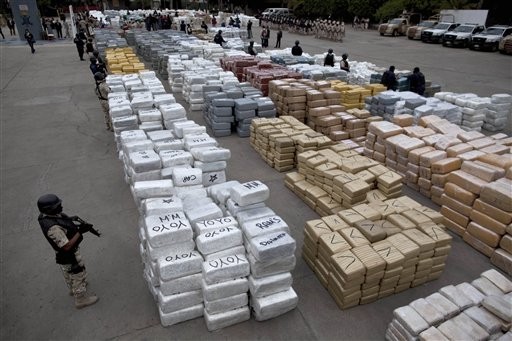
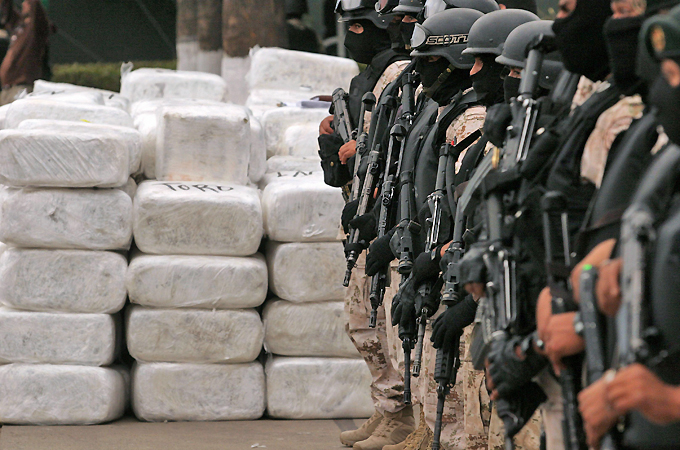
Soldiers and police officers guard packages of seized marijuana during a presentation for the media in Tijuana, Mexico. (AP Photo/Guillermo Arias)
The claims seem to fall in line with statements made last month by Guillermo Terrazas Villanueva, a spokesman for the Chihuahua state government in northern Mexico who said U.S. agencies ”don’t fight drug traffickers,“ instead ”they try to manage the drug trade.”
Also, U.S. officials have previously acknowledged working with the Sinaloa Cartel through another informant, Humberto Loya-Castro. He is also allegedly a high-ranking member of the Sinaloa Cartel as well as a close confidant and lawyer of “El Chapo” Guzman.
Loya-Castro was indicted along with Chapo and Mayo in 1995 in the Southern District of California in a massive narcotics trafficking conspiracy (Case no. 95CR0973). The case was dismissed in 2008 at the request of prosecutors after Loya became an informant for the United States government and subsequently provided information for years.
In 2005, “the CS (informant Loya-Castro) signed a cooperation agreement with the United States Attorney’s Office for the Southern District of California,” states an affidavit filed in the Zambada-Niebla case by Loya-Castro’s handler, DEA agent Manuel Castanon.
“Thereafter, I began to work with the CS. Over the years, the CS’ cooperation resulted in the seizure of several significant loads of narcotics and precursor chemicals. The CS’ cooperation also resulted in other real-time intelligence that was very useful to the United States government.”
Under the alleged agreement with U.S. agencies, “the Sinaloa Cartel, through Loya-Castro, was to provide information accumulated by Mayo, Chapo, and others, against rival Mexican Drug Trafficking Organizations to the United States government,” a motion for discovery states.
In return, the United States government allegedly agreed to dismiss the charges in the pending case against Loya-Castro (which they did), not to interfere with his drug trafficking activities and those of the Sinaloa Cartel and not actively prosecute him or the Sinaloa Cartel leadership.
“This strategy, which he calls ‘Divide & Conquer,’ using one drug organization to help against others, is exactly what the Justice Department and its various agencies have implemented in Mexico. In this case, they entered into an agreement with the leadership of the Sinaloa Cartel through, among others, Humberto Loya-Castro, to receive their help in the United States government’s efforts to destroy other cartels.”
“Indeed, United States government agents aided the leaders of the Sinaloa Cartel.”
The government has denied this and says the deal did not go past Loya-Castro.
Zambada-Niebla was arrested by Mexican soldiers in late March of 2009 after he met with DEA agents at a Mexico City hotel in a meeting arranged by Loya-Castro, though the U.S. government was not involved in his arrest. He was extradited to Chicago to face federal drug charges on Feb. 18, 2010. He is now being held in a Michigan prison after requesting to be moved from Chicago.
“Classified Materials”
During his initial court proceedings, Zambada-Niebla continually stated that he was granted full immunity by the DEA in exchange for his cooperation. The agency, however, argues that an “official” immunity deal was never established though they admit he may have acted as an informant.
Zambada-Niebla and his legal council also requested records about Operation Fast and Furious, which permitted weapons purchased in the United States to be illegally smuggled into Mexico, sometimes by paid U.S. informants and cartel leaders. Their request was denied. From the defense motion:
“It is estimated that approximately 3,000 people were killed in Mexico as a result of ‘Operation Fast and Furious,’ including law enforcement officers in the state of Sinaloa, Mexico, the headquarters of the Sinaloa cartel. The Department of Justice’s leadership apparently saw this as an ingenious way of combating drug cartel activities.”
“It has recently been disclosed that in addition to the above-referenced problems with ‘Operation Fast & Furious,’ the DOJ, DEA, and the FBI knew that some of the people who were receiving the weapons that were being allowed to be transported to Mexico, were in fact informants working for those organizations and included some of the leaders of the cartels.”
Zambada’s attorney has filed several motions for discovery to that effect in Illinois Federal District Court, which were summarily denied by the presiding judge who claimed the defendant failed to make the case that he was actually a DEA informant.
In April, 2012, a federal judge refused to dismiss charges against him.
From a Chicago Sun Times report: “According to the government, [Zambada-Niebla] conveyed his interest and willingness to cooperate with the U.S. government, but the DEA agents told him they ‘were not authorized to meet with him, much less have substantive discussions with him,’” the judge wrote.
In this courtroom artist’s drawing Jesus Vincente Zambada-Niebla appears before U.S. District Judge Ruben Castillo Tuesday, Feb. 23, 2010, in Chicago. (AP Photo/Verna Sadock)
In their official response to Zambada-Niebla’s motion for discovery, the federal government confirmed the existence of “classified materials” regarding the case but argued they “do not support the defendant’s claim that he was promised immunity or public authority for his actions.”
Experts have expressed doubts that Zambada-Niebla had an official agreement with the U.S. government, however, agree Loya Castro probably did. Either way, the defense still wants to obtain DEA reports that detail the agency’s relationship with the Sinaloa Cartel and put the agents on the stand, under oath to testify.
The documents that detail the relationship between the federal government and the Sinaloa Cartel have still not been released or subjected to review — citing matters of national security.
Stoners aren’t known for their memory prowess but a new review suggests that drugs similar to marijuana’s active ingredients may hold promise for preventing— or even reversing— brain aging and possibly Alzheimer‘s and other degenerative brain diseases.
Since the mid 2000′s researchers have been building an appreciation for the power of marijuana-like substances that make up the brain’s cannabinoid systems. In animal experiments, for example, synthetic compounds similar to THC—marijuana’s main psychoactive component—have shown promise in preserving brain functions. A 2008 study even demonstrated that a THC-like substance reduced brain inflammation and improved memory in older rats.
The latest review, published in Philosophical Transactions of the Royal Society B, suggests that activating the brain’s cannabinoid system may trigger a sort of anti-oxidant cleanse, removing damaged cells and improving the efficiency of the mitochrondria, the energy source that powers cells, ultimately leading to a more robustly functioning brain.
Previous studies have linked cannabinoids to increased amounts of brain-derived neurotrophic factor (BDNF), a substance that protects brain cells and promotes the growth of new ones. Since new cell growth slows or stops during aging, increasing BDNF could potentially slow the decline in cognitive functions.
Activation of cannabinoid receptors can also reduce brain inflammation in several different ways, which may in turn suppress some of the disease processes responsible for degenerative brain diseases such as Alzheimer’s.
Andras Bilkei-Gorzo of the Institute of Molecular Psychiatry at the University of Bonn in Germany and an author of the study, is encouraged by the expanding knowledge of the brain’s cannabinoid system and its potential for leading to new understanding of aging in the brain. “[C]annabinoid system activity is neuroprotective,” he wrote, and increasing it “could be a promising strategy for slowing down the progression of brain aging and for alleviating the symptoms of neurodegenerative disorders.”
Still, Gary Wenk, professor of neuroscience, immunology and medical genetics at Ohio State University, who conducted some of the research Bilkei-Gorzo included in the review, is aware of the delicate nature of cannabinoid research, given the controversial nature of medical marijuana issues. “The literature is a mess and he’s done a nice job organizing it,” he says. “He was positive about developing cannabinoid drugs without going overboard.”
Other studies covered in the review showed that mice bred to lack the cannabinoid receptors have better memories early in life but have more rapid cognitive decline as they age, including inflammation in the hippocampus, a key region for memory. “This finding suggests that, at some point during aging, cannabinoid activity helps maintain normal cognitive functions in mice,” says Daniele Piomelli, professor of neurobiology, anatomy and biological chemistry at the University of California – Irvine, who was not associated with the study.
Piomelli cautions that the review doesn’t support the idea of using marijuana to improve brain aging among the elderly, not least because of its psychoactive effects. “This is definitely an important area of investigation but we are still far from a consensus,” he says.
Moreover, some of the research covered in the review had conflicting results. Although three clinical trials studied cannabinoids for the treatment of Parkinson’s Disease, these studies “did not provide a clear answer whether cannabinoids modify the progression or the outcome of the disease,” wrote Bilkei-Gorzo. He found similar results for Huntington’s Disease, which, like Parkinson’s, is a progressive, degenerative brain disorder. And for the most common form of dementia, “Despite the promising preclinical results, the detailed clinical evaluation of cannabinoids in [Alzheimer’s] patients is missing,” he said in the paper.
The social and political challenges to conducting such research, however, mean that it may be a while before we see such scientific gaps filled. Scientists have yet to conduct, for example, a solid study in which they follow marijuana smokers to see if they are more or less likely to develop Alzheimer’s— or to compare the cognitive decline of marijuana smokers to those who do not smoke. Doing so is too controversial to attract funding.
“In my experience, working in this area is like touching the third rail,” says Wenk, “I get hate and love mails that are bizarre and phone messages from people too high to talk. Some of my colleagues have left the area after seeing their names in the National Enquirer… I do not blame a war on marijuana but rather the public’s prejudice and extreme bias. I’ve now discontinued my research on this system.”
He and others in the field are not completely pessimistic, however. He says, “I’ve been trying to find a drug that will reduce brain inflammation and restore cognitive function in rats for over 25 years; cannabinoids are the first and only class of drugs that have ever been effective. I think that the perception about this drug is changing and in the future people will be less fearful.”
Given that Alzheimer’s already affects one in eight people over 65— and nearly half of those over 85—and there have been few successes at treating or preventing it so far, that would certainly be a welcome change.
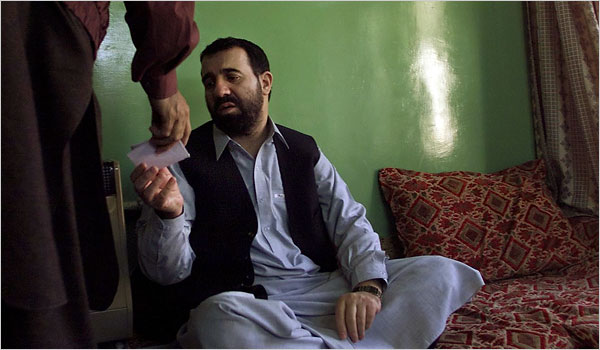
Newly released internal emails from the U.S. private security firm Stratfor state that in 2007 the Bush Administration and CIA ordered the Drug Enforcement Agency to back off a major drug trafficking investigation of Afghan President Hamid Karzai’s half brother.
Ahmed Wali Karzai was an influential power broker in Afghanistan before he was assassinated in July 2011.
The brother of President Karzai of Afghanistan is under investigation by DEA as a major narcotics trafficker. For political reasons, DEA has beentold to backoff [sic] by the White House and CIA.DEA is seeing a direct nexus between terrorism and narcotics in Afghanistan with narcotics sales being used to fund jihadist operations.
After a Stratfor analyst asks “how close is karzai to this brother?” Burton replies:
Was described to me as close. Karzai will end up being another Noreiga.
Off the record — DEA will proceed and take ’em (both?) down anyway, once this White House disappears.
As I’ve said before, every country we have touched, turns to shit.
WikiLeaks has published 2,694 out of what it says is a cache of 5 million internal Stratfor emails (dated between July 2004 and December 2011) obtained by the hacker collective Anonymous around Christmas.
UPDATE: As redditor WhoShotJR notes, current and former American officials told the New York Times in 2009 that Ahmed Karzai received regular payments from the CIA since 2001.
Suspicious Words and Phrases Alert! Drug War Facts, DEA Corruption, CIA Conspiracy, Who’s Who in the Drug Running Business, Untraceable Cash and the Reason the War on Drugs is just another War-by-Design.
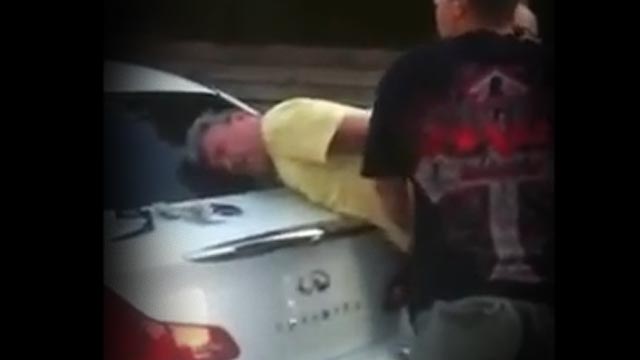
James Stewart, the 65-year-old raw “milk man” and founder of Rawesome Foods, was assaulted near his home today by three armed men driving unmarked luxury vehicles with no license plates. Carrying firearms on their hips and dressed in gangster-style street clothes, Satanic T-shirt imagery and tattoos, they claimed to be making an “arrest” and verbally assaulted James, sprayed pepper spray in his face, then forced his head against a car and screamed, according to witnesses, “You better listen to me or you’re gonna have a bad f*ckin’ day!”
James Stewart’s cell phone was on the entire time, and a phone witness told NaturalNews the arrest was conducted “Nazi style.” Meanwhile, James was screaming to anyone who would listen, “HELP ME! HELP ME! WHY ARE YOU DOING THIS TO ME?”
A partial video of the incident was captured by a witness. The redness in the face of James Stewart is due to the pepper spray assault. That video link is here: http://www.youtube.com/watch?v=UYTP9C7jtrI
James was wanted on $130,000 in bail by Ventura County, which had originally put him on $1 million bail — an amount usually reserved for murderers, rapists or serial killers. James, accused of selling “unpasteurized milk” through Rawesome Foods, was made the target of an FDA-funded and politically motivated attempt to destroy the raw milk industry in California. He has been charged with financial crimes by Ventura County even though there is literally no legitimate evidence whatsoever linking James to any such crimes, and the entire case is already in the process of being unraveled.
In the Ventura case, there is no crime, no evidence, and not even any justifiable reason to arrest James and put him on bail in the first place! The entire thing was utterly fabricated as a publicity stunt to attempt to intimidate would-be raw milk producers.
Bounty hunters drive cars with no plates, carry weapons, intimidate witnesses
In the arrest video, James clearly says, “Sir I was trying to give you the information that I thought Mr. McAfee was giving to me.” James is referring to Mark McAfee of Organic Pastures, California’s largest organic milk producer. NaturalNews has confirmed that Mark McAfee, among several other people, had helped fund James Stewart’s bail bond. According to James Stewart, who phoned from Ventura county jail, Mark McAfee was present at the “arrest” and watched the bounty hunters take James away.
UPDATE: Readers of this story were asking for more details and comments on Mark McAfee. As this story is moving quickly, some of the relevant details haven’t yet been reported. Mark had really gone out on a limb to help bail out James Stewart, even putting up his own house as collateral. When James failed to make a recent court appearance in Ventura — because he had decided to fight the malicious charges against him from outside the system — this put McAfee and other people at financial risk. McAfee, in particular, had mortgaged his house to raise some of this bail money, which I believe came to $100,000 on McAfee’s part. This money would have been forfeited had James not been taken into custody by the bounty hunters.
It’s not yet clear whether McAfee had anything to do with leading the bounty hunters to James. Many people suspect so, and opinion is currently divided over whether this was a reluctant but important act of financial preservation or a betrayal of a key figure in the raw food community. I intend to reach out to McAfee to ask for his accounting of events, if he is willing to go on the record with comments. My history with McAfee has so far been a positive one, and I have known him to be a strong advocate of raw food freedom and someone who clearly went out of his way to help James Stewart make his bail.
Bounty hunters verbally intimidate witnesses
During the so-called “arrest,” one of the bounty hunters attempts to verbally intimidate the person filming the video, threatening them by saying, “You’re interfering with an arrest, you’re blocking traffic.” In reality, the bounty hunter never identified himself, never read James any rights and was not involved in any legal arrest whatsoever. The whole thing was a charade carried out by what might appear to a rational person to be armed thugs driving stolen vehicles while impersonating undercover police officers.
In the video, what appears to be a firearm can be seen on the hip of one of the men wearing a pink shirt. At no point during the assault did these men show any badges or identification of any kind. According to California law, “All bounty hunters must carry with them a certification of completion of required courses and training programs.”
According to witnesses, these armed men did not produce any certificates at all. Instead, they verbally intimidated the people filming the incident. One of the bounty hunters called the camera person a “retard” for daring to film him.
We can hear on the video another bounty hunter saying, “You’re in a lot of trouble, you better get an attorney!” During all this, they are rifling through James’ pockets and apparently stealing all his personal belongings. “You are in a lot more trouble than anybody up here,” one of them says to James. “You are in a lot of trouble.”
Over raw milk? Really? Is this what California has come to now? If you sell unpasteurized milk, you get accosted by three armed men driving unlicensed (stolen?) vehicles, working for the state?
“We are not the police…”
When the witnesses filming the incident asked for the badge numbers of the individuals who claimed to be making an “arrest,” they were told, “We’re not the police so we’re not gonna give you badge numbers.”
Later in the video, a close-up image appears for one of the license plates of the luxury vehicles used by the armed assailants. It is clearly an Infinity car dealership plate number KMA-367. The vehicle is a white Infinity luxury sedan.
The other vehicle, which also has no California license plate, is a black sports car. While James is being stuffed into one of the vehicles, one of the bounty hunters calls him a “scumbag.”
James has privately told me, the editor of NaturalNews, that he fears if he is taken back to jail, he will be tortured, subjected to starvation or even murdered by the authorities there. This may be more likely than you think, because the outright criminality of California officials who persecuted James Stewart is now being exposed.
For example, NaturalNews has already exposed Michelle LeCavalier and L.A. district attorney prosecutors for illegally signing search warrants and conducting armed raids on Rawesome Foods even though they had never taken an oath of office as required by California law (http://www.naturalnews.com/036523_Rawesome_District_Attorney_imperson…).
This means the armed raid against Rawesome Foods, the arrest of James Stewart and all the actions taken against him were illegal. Furthermore, James now has a potential multi-million-dollar civil case against Los Angeles County — and possibly individuals in Ventura County — for false arrest, kidnapping and violating his civil rights while they were “impersonating” officials.
Given these circumstances, James has legitimate reason to fear that county authorities there — who almost certainly staged the armed bounty hunter interception of James last night — may quite literally be trying to kill him.
James told me on the phone many times, “I love live, I will not give up. If they say I committed suicide, it means they killed me, Mike. They’re gonna try to kill me.”
That James was stuffed into unmarked, unlicensed cars driven by intimidating-looking men carrying weapons and verbally threatening witnesses at the scene only further supports the legitimacy of James’ fear.
Let Ventura County know we are watching and that we demand the charges against James be dropped
Here, I ask for your support to let the Ventura County DA’s office know we are watching them, and we hold them responsible for the treatment of James.
Call the main DA’s office at 805-654-2500 and let them know that you are joining tens of thousands of other people who are watching this and carefully scrutinizing their behavior. The Ventura County case against James Stewart is, I can assure you, utterly fabricated and completely without merit. It should be immediately dropped and James set free.
Ventura County has been waging a “war of personal vengeance” against Stewart (http://www.naturalnews.com/035197_James_Stewart_Sharon_Palmer_Ventura…). Both Ventura and L.A. counties have spent millions of dollars in taxpayer money in an attempt to incarcerate a raw milk man! A senior citizen! The man is 65 years old, utterly non-violent in every way, and yet has been targeted in the most vicious manner by district attorneys who apparently don’t have any real criminals to go after.
Questions remain about the “arrest” of James Stewart
Some serious questions emerge tonight from the “hunting down” of James Stewart by Ventura county:
• What crime has James allegedly committed that is so serious it justifies $130,000 in bail bonds?
• Where is the evidence of such crimes? (It doesn’t exist!)
• Why are armed individuals who claim to be working for the county running around Ventura with unlicensed vehicles that appear to be stolen off the new car lot of an Infinity dealership?
• Why were these “bounty hunters” dressed in Satanic imagery and sporting gang-style facial hair and tattoos while driving high-dollar luxury cars?
• Why were they so verbally abusive to James Stewart, calling him a “scumbag” if they were just bounty hunters looking to earn a paycheck?
• How were these bounty hunters able to locate James Stewart in the first place? Were they tipped off by someone?
• What will happen to James Stewart in Ventura county jail? Will they torture him? Will they silence him? Will they drop the charges and apologize?
This story is developing here on NaturalNews.com. We will continue to bring you details as we speak with witnesses and investigate more deeply. Share this story. Spread the word: No one who sells real food in California is safe from the “authorities” there. You can and will be targeted, kidnapped, robbed at gunpoint by the police, then tortured in the jail system.
Juarez, Mexico– The US Central Intelligence Agency and other international security forces “don’t fight drug traffickers”, a spokesman for the Chihuahua state government in northern Mexico has told Al Jazeera, instead “they try to manage the drug trade”.Allegations about official complicity in the drug business are nothing new when they come from activists, professors, campaigners or even former officials. However, an official spokesman for the authorities in one of Mexico’s most violent states – one which directly borders Texas – going on the record with such accusations is unique.
“It’s like pest control companies, they only control,” Guillermo Terrazas Villanueva, the Chihuahua spokesman, told Al Jazeera last month at his office in Juarez. “If you finish off the pests, you are out of a job. If they finish the drug business, they finish their jobs.”
A spokesman for the CIA in Washington wouldn’t comment on the accusations directly, instead he referred Al Jazeera to an official website.
Accusations are ‘baloney’
Villanueva is not a high ranking official and his views do not represent Mexico’s foreign policy establishment. Other more senior officials in Chihuahua State, including the mayor of Juarez, dismissed the claims as “baloney”.
“I think the CIA and DEA [US Drug Enforcement Agency] are on the same side as us in fighting drug gangs,” Hector Murguia, the mayor of Juarez, told Al Jazeera during an interview inside his SUV. “We have excellent collaboration with the US.”
Under the Merida Initiative, the US Congress has approved more than $1.4bn in drug war aid for Mexico, providing attack helicopters, weapons and training for police and judges.
More than 55,000 people have died in drug related violence in Mexico since December 2006. Privately, residents and officials across Mexico’s political spectrum often blame the lethal cocktail of US drug consumption and the flow of high-powered weapons smuggled south of the border for causing much of the carnage.
Drug war ‘illusions’
“The war on drugs is an illusion,” Hugo Almada Mireles, professor at the Autonomous University of Juarez and author of several books, told Al Jazeera. “It’s a reason to intervene in Latin America.”
“The CIA wants to control the population; they don’t want to stop arms trafficking to Mexico, look at [Operation] Fast and Furious,” he said, referencing a botched US exercise where automatic weapons were sold to criminals in the hope that security forces could trace where the guns ended up.
The Bureau of Alcohol Tobacco and Firearms lost track of 1,700 guns as part of the operation, including an AK-47 used in 2010 the murder of Brian Terry, a Customs and Border Protection Agent.
Blaming the gringos for Mexico’s problems has been a popular sport south of the Rio Grande ever since the Mexican-American war of the 1840s, when the US conquered most of present day California, Utah, Nevada, Arizona and New Mexico from its southern neighbour. But operations such as Fast and Furious show that reality can be stranger than fiction when it comes to the drug war and relations between the US and Mexico. If the case hadn’t been proven, the idea that US agents were actively putting weapons into the hands of Mexican gangsters would sound absurd to many.
‘Conspiracy theories’
“I think it’s easy to become cynical about American and other countries’ involvement in Latin America around drugs,” Kevin Sabet, a former senior adviser to the White House on drug control policy, told Al Jazeera. “Statements [accusing the CIA of managing the drug trade] should be backed up with evidence… I don’t put much stake in it.”
Villanueva’s accusations “might be a way to get some attention to his region, which is understandable but not productive or grounded in reality”, Sabet said. “We have sort of ‘been there done that’ with CIA conspiracy theories.”
In 1996, the San Jose Mercury News published Dark Alliance, a series of investigative reports linking CIA missions in Nicaragua with the explosion of crack cocaine consumption in America’s ghettos.
In order to fund Contra rebels fighting Nicaragua’s socialist government, the CIA partnered with Colombian cartels to move drugs into Los Angeles, sending profits back to Central America, the series alleged.
“There is no question in my mind that people affiliated with, or on the payroll of, the CIA were involved in drug trafficking,” US Senator John Kerry said at the time, in response to the series.
Other newspapers, including the Washington Post and the Los Angeles Times, slammed Dark Alliance, and the editor of the Mercury News eventually wrote that the paper had over-stated some elements in the story and made mistakes in the journalistic process, but that he stood by many of the key conclusions.
Widespread rumours
US government has neglected border corruption
“It’s true, they want to control it,” a mid-level official with the Secretariat Gobernacion in Juarez, Mexico’s equivalent to the US Department of Homeland Security, told Al Jazeera of the CIA and DEA’s policing of the drug trade. The officer, speaking on the condition of anonymity, said he knew the allegations to be correct, based on discussions he had with US officials working in Juarez.
Acceptance of these claims within some elements of Mexico’s government and security services shows the difficulty in pursuing effective international action against the drug trade.
Jesús Zambada Niebla, a leading trafficker from the Sinaloa cartel currently awaiting trial in Chicago, has said he was working for the US Drug Enforcement Agency during his days as a trafficker, and was promised immunity from prosecution.
“Under that agreement, the Sinaloa Cartel under the leadership of [Jesus Zambada’s] father, Ismael Zambada and ‘Chapo’ Guzmán were given carte blanche to continue to smuggle tonnes of illicit drugs… into… the United States, and were protected by the United States government from arrest and prosecution in return for providing information against rival cartels,” Zambada’s lawyers wrote as part of his defence. “Indeed, the Unites States government agents aided the leaders of the Sinaloa Cartel.”
The Sinaloa cartel is Mexico’s oldest and most powerful trafficking organisation, and some analysts believe security forces in the US and Mexico favour the group over its rivals.
Joaquin “El Chapo”, the cartel’s billionaire leader and one of the world’s most wanted men, escaped from a Mexican prison in 2001 by sneaking into a laundry truck – likely with collaboration from guards – further stoking rumours that leading traffickers have complicit friends in high places.
“It would be easy for the Mexican army to capture El Chapo,” Mireles said. “But this is not the objective.” He thinks the authorities on both sides of the border are happy to have El Chapo on the loose, as his cartel is easier to manage and his drug money is recycled back into the broader economy. Other analysts consider this viewpoint a conspiracy theory and blame ineptitude and low level corruption for El Chapo’s escape, rather than a broader plan from government agencies.
After an election hit by reported irregularities, Enrique Pena Nieto from the Institutional Revolutionary Party (PRI) is set to be sworn in as Mexico’s president on December 1.
He wants to open a high-level dialogue with the US about the drug war, but has said legalisation of some drugs is not an option. Some hardliners in the US worry that Nieto will make a deal with some cartels, in order to reduce violence.
“I am hopeful that he will not return to the PRI party of the past which was corrupt and had a history of turning a blind eye to the drug cartels,” said Michael McCaul, a Republican Congressman from Texas.
Regardless of what position a new administration takes in order to calm the violence and restore order, it is likely many Mexicans – including government officials such as Chihuahua spokesman Guillermo Villanueva – will believe outside forces want the drug trade to continue.
The widespread view linking the CIA to the drug trade – whether or not the allegations are true – speaks volumes about officials’ mutual mistrust amid ongoing killings and the destruction of civic life in Mexico.
“We have good soldiers and policemen,” Villanueva said. “But you won’t resolve this problem with bullets. We need education and jobs.”
The Central Intelligence Agency was intimately involved with the federal government’s infamous “Operation Fast and Furious” scheme to send American weapons to Mexican drug cartels while simultaneously working with other agencies allowing narcotics to be shipped over the border, according to a series of explosive reports.
Citing an unnamed CIA source, a Washington Times article theorizes that U.S. officials were actively aiding organizations such as the Sinaloa cartel with guns and immunity in an effort to stymie Los Zetas. That’s because, according to the piece, the powerful and brutal criminal Zetas syndicate has the potential to overthrow the government of Mexico — and might be planning to do so.
Apparently the secretive U.S. intelligence agency also played a key role in creating and using the American government’s gun-running program to arm certain criminal organizations. The scheme, which has already been implicated in countless deaths including the murders of several U.S. and Mexican law enforcement officers, saw thousands of high-powered American guns delivered to multiple cartels.
“The CIA’s motive is clear enough: The U.S. government is afraid the Los Zetas drug cartel will mount a successful coup d’etat against the government of [Mexican President] Felipe Calderón,” wrote Robert Farago and Ralph Dixon in the Times’ report, entitled “Was CIA behind Operation Fast and Furious?”
According to the article, which also cites former CIA officials and even ex-Drug Enforcement Administration boss Phil Jordan, Los Zetas has already prepared to disrupt and possibly even subvert Mexico’s 2012 national election. Ironically, many leaders of the criminal empire supposedly threatening the existence of the Mexican government were actually trained in the U.S. at the infamous military training center known as School of the Americas.
“Founded by ex-Mexican special forces, the Zetas already control huge swaths of Mexican territory,” Farago and Dixon noted. “They have the organization, arms and money needed to take over the entire country … There’s a very real chance the Zetas cartel could subvert the political process completely, as it has throughout the regions it controls.”
As The New Americanreported last week, federal court filings by a top Sinaloa Cartel operative shed even more insight on what may have been going on. And the documents would appear to lend some credence to the Times’ article.
The accused “logistical coordinator” for the Sinaloa organization, Jesus Vicente “El Vicentillo” Zambada-Niebla, claimed that he had an agreement with top American officials. In exchange for information on rival cartels, the deal supposedly gave him and his associates immunity to import multi-ton quantities of drugs across the border.
“Indeed, United States government agents aided the leaders of the Sinaloa Cartel,” the court filing states. Countless guns — via Operation Fast and Furious — also flowed to the cartel under the arrangement, according to Zambada-Niebla and U.S. officials.
But there might be even more to the story than this. Other former U.S. agents have claimed that Los Zetas is controlled and abetted by the American government, too. “There’s warehouses down here [in Texas] where they’re training more Zetas individuals that work for the cartels,” former DEA operative and whistleblower Celerino Castillo said during a radio interview with Alex Jones.
And a separate report late last month based on allegations by CIA and DEA insider Phil Jordan is even more explosive. He is claiming that the Obama administration was selling Los Zetas military-grade weaponry through a front company set up in Mexico.
“They’ve found anti-aircraft weapons and hand grenades from the Vietnam War era,” former CIA pilot Robert “Tosh” Plumlee, who supported Jordan’s claims, told the El Paso Times.
Even members of the Zetas have confirmed the allegations, as The New Americanreported last month. One of the cartel’s founders, Jesús “El Mamito” Aguilar, told Mexican police in a taped interrogation released to the public that his organization was getting weapons directly from the U.S. government.
New revelations also indicate that American taxpayers were even financing the cartels’ arms acquisitions through multiple federal agencies. And available evidence shows that approval for the programs reached into the highest levels of the Justice Department and other parts of the Obama administration.
The Bureau of Alcohol, Tobacco, Firearms and Explosives (still known as ATF) officially claimed that “Fast and Furious” was an effort to track guns and arrest higher-ups involved in Mexico’s criminal underworld. But after the scheme was publicly exposed, countless analysts and whistleblowers questioned that excuse.
Many speculated that it may have been a plot to demonize the Second Amendment and impose further restrictions on the rights of law-abiding Americans. Indeed, the process is already well underway — and gun violence in Mexico has been used for years as a primary justification.
But this new twist in the story adds another, even more troubling dimension to the whole plot. The Washington Times claimed that, in an effort to stop a Zetas takeover of Mexico, “Uncle Sam has gotten into bed with the rival Sinaloa cartel, which has close ties to the Mexican military.” According to the article, the Obama administration was essentially taking sides to help keep the Calderón regime in power at any cost.
But if the U.S. government is also coddling and helping the Zetas, that theory cannot be entirely accurate. As more information continues to surface, the questions are growing in number and importance.
In the past, the CIA has been implicated in numerous scandals involving drug and weapons trafficking. From Vietnam and Iran to Latin America, the agency has repeatedly been caught importing narcotics and exporting arms for shadowy and subversive purposes.
Whether segments of the CIA were definitively involved in Mexico’s mayhem remains to be seen. A former DEA agent cited by Narco Newsraised that possibility last month, but said if the agency was indeed behind the plot, evidence would almost certainly be sealed under the guise of “national security.”
For now, the New York Timesreported on August 6 that the Obama administration was sending more CIA operatives to the troubled nation of Mexico. Congress is also currently investigating some elements of the administration’s ever-expanding gun-running scandal.
But as the Washington Times’ piece and various analysts have suggested, it might be time to appoint a special prosecutor and hold officials linked to the chaos and criminality responsible in a court of law. Otherwise, the whole truth may never be known.
Joaquin “El Chapo” Guzman Loera reported head of the Sinaloa cartel in Mexico, ranked 701st on Forbes’ yearly report of the wealthiest men alive, and worth an estimated $1 billion, today officially thanked United States politicians for making sure that drugs remain illegal. According to one of his closest confidants, he said, “I couldn’t have gotten so stinking rich without George Bush, George Bush Jr., Ronald Reagan, even El Presidente Obama, none of them have the cajones to stand up to all the big money that wants to keep this stuff illegal. From the bottom of my heart, I want to say, Gracias amigos, I owe my whole empire to you.”

 Shortly after the Snowden leaks began exposing the NSA’s massive collection efforts, the New York Times uncovered the DEA’s direct access to AT&T telecom switches (via non-government employee “analysts” working for AT&T), from which it and other law enforcement agencies were able to gather phone call and location data.
 re be “walled off” from defendants, court systems and the public.