
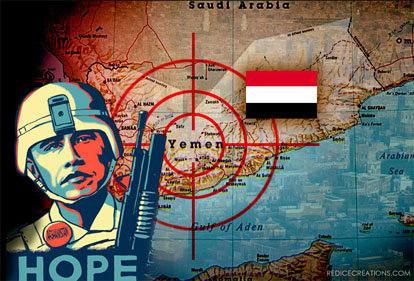
U.S. Forces, Intelligence Agents and American Security Agents (MERCs) clandestine war in Yemen
 Saudi militants were behind the massive car bombing and assault on Yemen’s military headquarters that killed more than 50 people, including foreigners, investigators said in a preliminary report released Friday.
Al-Qaeda claimed responsibility for the attack, saying it was retaliation for US drone strikes that have killed dozens of the terror network’s leaders.
The attack – the deadliest in Sanaa since May 2012 – marked an escalation in the terror network’s battle to undermine the US-allied government and destabilise the impoverished Arab nation despite the drone strikes and a series of US-backed military offensive against it.
US forces also have been training and arming Yemeni special forces, and exchanging intelligence with the central government.
Military investigators described a two-stage operation, saying heavily armed militants wearing army uniforms first blew up a car packed with 500 kilograms of explosives near an entrance gate, then split into groups that swept through a military hospital and a laboratory, shooting at soldiers, doctors, nurses, doctors and patients.
Officials earlier said 11 militants were killed, including the suicide bomber who drove the car. It was not clear if the 12th attacker was captured or escaped.
The investigative committee led by Yemen’s Chief of Staff Gen. Ahmed al-Ashwal, said militants shot the guards outside the gates of the military hospital, allowing the suicide bomber to drive the car inside, but a gunfight forced him to detonate his explosives before reaching his target.
It said the 12 militants killed, included Saudis.
Two military officials told The Associated Press that wounded soldiers had told them the assailants who stormed the hospital separated out the foreigners and shot everybody in the head.
Other military officials said American security agents were helping with the investigations, but that could not be confirmed. All officials spoke on condition of anonymity because they were not allowed to brief reporters.
Yemeni commandos and other security forces besieged the militants before they could reach the ministry’s main building, preventing them from going further than the ministry’s entrance gate. All the attackers were killed by 4:30 pm Thursday, according to the committee.
Yemeni security forces launched a manhunt in the capital to find the perpetrators, sparking gun battles that killed five suspected militants and a Yemeni commando, officials said.
The committee, which sent its report to Yemeni President Abed Rabbo Mansour Hadi, did not explain how it came to its conclusions.
The report, read on state TV, raised the death toll to 56 and said more than 200 people were wounded.
The foreigners killed included two aid workers from Germany, two doctors from Vietnam, two nurses from the Philippines and a nurse from India, according to Yemen’s Supreme Security Commission.
But a spokesman for the Philippines’ Department of Foreign Affairs, Raul Hernandez, said on Friday that seven Filipinos were killed in the attack, including a doctor and nurses, while 11 others were wounded.
The victims were among 40 Filipino workers in the hospital. Hernandez said that the Philippines’ honorary consul reported that the others survived by pretending to be dead.
It was not immediately possible to reconcile the conflicting accounts. But officials from the military hospital said Friday that at least 10 foreigners had been killed.
The United States considers the Yemeni al-Qaeda branch to be the most active in the world and it has escalated drone attacks against the militants in Yemen.
via SkyNews



 Thoe with the darkest fears became the most powerful